
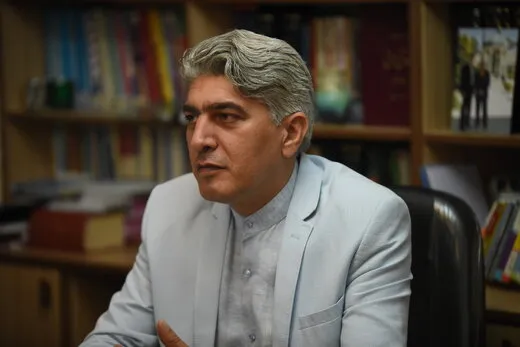
Iran, in the midst of complex crises, faces once again a decisive question: change or continuity? The statement by Mir Hossein Mousavi and the referendum proposal by intellectuals have revived a serious debate about the country's political future; can the Constituent Assembly open a path to freedom or will it become a new ground for despotism?
The right to self-determination; from the Constitution to Iran's historical experiences
Abdi Media: Today, Iran, in the midst of intertwined crises, faces a fundamental question once again: change or continuity? The statement of Mir Hossein Mousavi and many intellectuals and the referendum proposal have revived a debate that can transform the destiny of a nation. Will the Constituent Assembly open a path to freedom or will it be a new gate to a new despotism? I believe that if we talk about the Constituent Assembly, the legal discourse must be prioritized, and we cannot reach anywhere without it. Borrowing from the current Constitution, is it even possible to hold a referendum to change or reform the country’s political structure?
Jafarpour: Undoubtedly, in the legal realm, whatever is raised requires some historical review or analysis of its foundations. Regarding this issue, we can examine it historically and also consider the position of this question under the Sharia governing the Islamic Republic system, as all rules in Iran’s governance are to be derived from Sharia and aligned with its rules and decrees, as well as based on constitutional principles. Thus, we can answer this question from three perspectives.
Unquestionably, the Constitution, as the highest law governing the relationship between the state and the nation and the governance method, first originates from Sharia and the opinions and votes of the people in the 1979 referendum. The preamble of the Constitution, under the title "Method of Government in Islam," explicitly states people's participation in all decision-making stages in the Islamic government and the Islamic Republic. Even before the Constitution's principles were drafted, the founders emphasized the system is based on people's votes and participation. Furthermore, Article 1 explicitly states that the Iranian nation participated in the referenda on March 30 and 31, 1979, to choose their political regime. Article 2 defines the system’s goal as negation of domination and achieving people's independence and freedom, naturally implying the people's involvement in determining their fate, which is to be analyzed as the right to self-determination. Article 3 refers to people's general participation in political, economic, social, and cultural determination of their destiny, explicitly granting this right to the people. Article 9 stipulates a significant note that even preserving the country's territorial integrity and similar issues cannot justify restricting the rights defined as fundamental by the Constitution.
Both the preamble and primary principles defining governance base this right as an inherent and fundamental right of the Iranian nation to define their political fate. When examining Sharia and its decrees, we refer to Verse 38 of Surah Ash-Shura, which states, "God does not change the condition of a people until they change what is in themselves," and the letter of Imam Ali (AS) to Malik al-Ashtar concerning entrusting governance to the people of that land.
Historically, governance in Iran supports this; since 1979, although there were precedents for the Constituent Assembly and referenda before the revolution, after 1979, at least three referenda were held regarding the political regime’s definition. Article 59 of the Constitution mentioned referenda; matters on presidential powers and abolition of the prime minister were addressed by referenda too. Over these 40 years, based on the Constitution, the people's votes have been solicited to involve them in their political fate. The same people who, in the decade following the revolution and at the war's end, managed to evaluate and vote in referenda. Therefore, after four decades, considering political and social literacy and challenges faced, they arguably have better political insight than before, particularly based on experiences, allowing them to decide on their political fate and Iran's future as the owners and sovereigns of this country and system.
Special condition of Iran and Mousavi's statement
Abdi Media: What were the key legal points of Mir Hossein Mousavi's statement?
Jafarpour: Political analysts believe Mousavi’s main point was the obvious principle accepted in all democratic systems—the people's sovereignty over their fate, the right to self-determination, meaning the freedom and discretion people have to define and ensure the nature of governance. The right to self-determination, in various forms, has been debated by philosophers, political scientists, and notable political figures, whether it is a political and public right or a natural right. My interpretation is that while it is defined under constitutional and political rights, due to humans’ social nature, this right is as natural and innate as the right to life. A political system does not grant this right; it belongs to me to choose my political fate with freedom and discretion, to choose a political system to manage the country’s affairs. From this viewpoint, the phrase "right to self-determination" in Mousavi’s proposal is very important. It seems that this phrase is missing today among Iran's political society, whether those who hold power in governance or those outside it, including opposition groups worldwide proposing solutions for Iran or domestic critics of governance. If this phrase is a guiding principle for groups and factions, then half the way is traveled, at least preventing dissemination of slogans favoring foreign control or imposition.
The phrase used by the opposition in this regard often ignores this right. Many analysts see Mousavi’s statement as akin to Tunisia’s situation during Ben Ali and South Africa during apartheid, suggesting we might model referenda from those countries with adjustments, acknowledging differences but recognizing similarities.
Abdi Media: Iran's social and political situation at the time of this statement was very particular, and the people experienced an attack many did not foresee, though some anticipated it. Please speak about Iran's political-social situation.
Jafarpour: Despite my specialty, I have studied political history extensively. A shared notion about Iranians is their unpredictability, which complicates matters. The recent war's outcomes stem from this unpredictability. Many analysts expecting protests and uprisings within days of the war's start were proven wrong; instead, the opposite happened. Restricted social media during the 12-day war arguably increased people's involvement more than state media. National unity emerged through online sharing of content—videos, photos, poems, literary discourse—for keeping Iran united. Given Mousavi’s deep understanding of Iranians and experience in the worst governmental conditions, he stood alongside the people and recognized the situation accurately. He issued this statement based on his precise assessment, possibly intended for these very days, which might have lacked effect if issued weeks before or months after the war. Unlike previous statements of his, which faced harsh criticism and attack, this one faced less backlash.
Referendum; National Necessity or Political Initiative?
Abdi Media: Factions that copied this opinion and started the statement are visible in cyberspace with their views and responses beginning. In your opinion, is the referendum proposal a national necessity or a political initiative? Do you think this issue is a necessity at this point in time?
Jafarpour: The discussion of referendum and plebiscite and, as a prelude, constitutional reform has long been raised in Iran. If we go back a bit, during Rouhani's government, which is the closest time to the current period, murmurs about constitutional reform were raised. Analyses and discussions about how Iran is governed have surfaced in various domains, ultimately pointing to the constitution and some of its principles. The referendum and constitutional reform have been proposed.
In my opinion, it is a mixture of both national necessity and political reaction. Politically, the Islamic Republic system has reached a point requiring a shake-up through a referendum. On the people's side, today's generation within society demands rights and considers themselves advocates, even in the smallest aspects of governance. Whether those known as Generation Z, Generation Alpha, or youth from the 70s and 80s, they refer to the founders' words of this system. They say, "There is no reason to accept what our parents chose, be it the Shah or the Islamic Republic," implying it is not necessary to accept their parents' choices.
From a political perspective, challenges and restrictions exist, such as limitations on presidential powers in the constitution or parallel councils and institutions established alongside the three branches of government, sometimes obstructing certain governance powers defined mainly for the three branches. Politically, I believe the referendum and plebiscite are justified.
Historical Lessons from Constituent Assemblies in Iran
Abdi Media: We discussed government affiliates who express their opinions as responses to Mr. Mousavi's views. The Reformist Front's reactions show their own interpretation of Mousavi's statement within specific frameworks, yet still open to definition and interpretation. What lessons and teachings does Iran's history with Constituent Assemblies offer?
Jafarpour: Looking at Iran's political history, key moments when the government referred back to the people include the Constitutional Revolution of 1906 (1285 in the Iranian calendar), a fundamental and lasting political transformation in Iran; then in 1949 (1328) when the Shah's powers were reconsidered after an assassination attempt, and the establishment of a Constituent Assembly was proposed to define some authorities by law; and later in 1979 and 1989 with referendums roughly every 20 years. The outcome of these referendums shows people generally achieved what they sought, though history will judge the correctness of their desires. For instance, during the Constitutional Revolution, people fought for constitutionalism, which was realized.
In the 1970s, revolutionary groups and leftists fought the Shah aiming to change the government structure; this succeeded, and a referendum on the political system was held, where people made a choice. Given the context then, it was a victory for that generation. Thus, when senior figures talk about 1979 events, they sometimes say it wasn’t exactly what was wanted or expected, given the personalities leading the revolution and their promises.
Comparing to today’s advocates for regime change, it seems learning from those involved in the 1979 revolution and critically assessing their criticisms of the Shah’s regime can provide a valuable guideline for the public. But it is not absolute that a referendum with free and safe elections would result in a choice perfectly aligned with public will.
A key question today is: If leadership agrees to a referendum, what happens afterward? Many people remain uncertain about the political regime and governance structure that would follow. Hence, many analysts discuss a transitional phase, believing Iran’s political atmosphere is not yet ready for a fundamental change. Thus, Iran needs to experience a transitional period to avoid mistakes witnessed in the 1979 revolution—to prevent impulsive revolutionary passions, slogans leading people into unified yet volatile fronts who later regret their choices. A stable transitional period with a properly defined political structure followed by a referendum based on events during transition is desirable.
Comparative Experiences; Tunisia, South Africa, and France
Abdi Media: It is better to examine countries like France, India, South Africa, and Tunisia. We should have a comparative look at the history of Constituent Assemblies, especially from a legal perspective.
Jafarpour: The referendum in Tunisia occurred with extensive social participation and support. At that time, the demand of the Tunisian people was exactly to change the governance structure, meaning people criticized the whole system, and the Constituent Assembly set out to change the whole framework, putting it to a public vote. This happened with the highest participation rate. Tunisia does not face the obstacles present in the Islamic Republic. The social environment in Tunisia was prepared to accept this referendum, but currently, within Iranian society, parts of the population do not even contemplate a referendum. From one perspective, those with strong dependence on the current regime believe this system works properly and that progress is near, viewing the regime as structured. The other part fears a repeat of the 1979 revolution incidents and compares it with neighbors like Syria, Iraq, and Afghanistan, fearing that disorder in the relatively stable system would worsen their plight. There is this social gap when compared to the situation in Tunisia.
In South Africa, national unity was clear and focused on fighting one clear issue: racial discrimination and apartheid. The leader was one of their own, meaning the core of the revolution and movement was transparent and obvious. They said that being called "colored" was injustice and demanded equal rights with white citizens. The South African people's and leaders' demands were tangible and widely supported.
In France, various factions debated the Constituent Assembly and referendum. Social issues were analyzed by three factions forming a triangle, pulling society toward one vertex: a referendum to eliminate absolute monarchy. People with different views criticized absolute monarchy, whether or not they agreed on other points, sharing the opinion that absolute monarchy hindered the fulfillment of fundamental rights of the French people and must be removed temporarily. After eliminating the monarchy, the three factions would decide on France's future. This shared criticism led to drafting the first French constitution, which later became a comprehensive model for many countries.
The Necessity of National Consensus Before a Referendum
Abdi Media: Drawing from the French constitution as a model, writing a constitution is one issue and its implementation another. Many critics or supporters of Pahlavi express views that cannot be easily overlooked. They argue that in some countries like those in Scandinavia, a monarchy exists alongside democracy, or in republics where constitutional rights like freedom of expression and protest are nominally recognized but not genuinely respected. As a result, a large part of society contemplates a transitional revolution or referendum because if the system worked correctly, these issues would not arise or be contentious. What should the referendum focus on? Should it be about change or reform? Should the governance system itself be put to referendum from the start? In 1979, when the referendum was held, the Islamic Republic option was presented without dispute. Is the fundamental governance system itself to be reconsidered in the current discourse for referendum?
Jafarpour: I believe before addressing the topic of a referendum, groundwork and preparation must be made by all factions, civil and political activists, media professionals, legal experts, politicians, and others. Preparations for the referendum must be formed on the belief that the people, in the truest sense—not one word less or more—are the owners of this country. These people have the right to decide the future of the country, and the laws and governance system to be established must arise from the people's will.
The first step in this perception and definition of a referendum is legitimizing the referendum. The initial step is reaching consensus among society through discussions with family and peers about the necessity of a referendum. Different factions and characters with various religious beliefs must intellectually agree that holding a referendum is now necessary—a national consensus to create this necessity in people's minds that the time for change has come. After this national consensus is reached, the second step naturally follows: participation by all groups, minorities, and factions, as the consensus has deep roots. We say, regardless of thought or faction, we are committed to this national consensus and agreed that changes will occur.
Forming these two fundamental steps requires freedom of operation. Media and political-social activists must be free to raise awareness, define characteristics of various governance systems for the people, explain its consequences, perhaps differences between a constitutional monarchy and democratic or liberal republic, conveying necessary political system features.
Then, the issues, challenges, and current structure's problems must be transparently communicated—not populistically justified, but logically explained—informing people that if changes arise from the referendum, it is due to financial corruption, inefficiency of systems and officials, or corruption of some officials. We must clearly inform people that the current political structure, under this constitution, has not been able to establish a respectable structure or achieve constitutional goals in articles 2 or 3 after 40-plus years. This transparency allows people to realize that to attain relative political and social stability, public consultation on governance and political regime change is necessary.
Ultimately, a final text acceptable to the majority would be reached for the referendum subject.
Legal and Political Obstacles in the Constitution
Abdi Media: Are there constitutional procedures currently in place for conducting a referendum?
Jafarpour: Article 177 mentions constitutional revision: the Supreme Leader, after consulting the Assembly of Experts, issues an order to the president to refer revision or amendment proposals to a council called the Constitutional Review Council, whose operation is defined by law, comprising university professors and various representatives.
Article 59 provides regulations on referenda, allowing two-thirds of parliament members to approve holding a referendum.
Analysts point to the Supreme Leader's approval as key, and a conflicting constitutional principle. Sometimes the ruling body or institutions capable of proposing a referendum might decide a referendum is needed but may face opposition from the Supreme Leader, making the referendum difficult. The first obstacle to holding a referendum is the Supreme Leader’s assent, which the current political environment intensifies.
His close associates might argue that the country is not in a suitable state, stability is lacking, war is possible, and questioning a referendum in this situation is misguided.
Supporters of referendum and reform cite systemic inefficiency to advocate referendum, while opponents claim the current unstable, war-affected society facing sanctions and crises like water and electricity shortages is not ready.
Some activists carry the referendum banner, proclaiming the country’s need for it.
Conflict of Interests and Supreme Leader’s Powers
Abdi Media: Some seek fundamental changes such as limiting the Supreme Leader’s powers, merging the leadership with the presidency, or reforming clauses like Article 110 and 57. These provoke resistance. Why should the political system in control accept putting its legitimacy on a referendum, potentially risking the existence of current powerful institutions?
Jafarpour: I believe the governance structure and political system resemble a family. If the head of the household understands the family's best interest and concludes changes are necessary, he does not cling to power merely because he holds it. Political and legal analyses of Iran’s constitution and the founding principles of the Islamic Republic differ from an absolute power model. Therefore, acceptance of a referendum and systemic change should face no political governance obstacle—except the belief that people lack understanding, thus it’s not the right time for a referendum.
Ayatollah Khomeini wrote to then-President Khamenei about constitutional amendments, saying after ten years Iran faced constitutional and national problems requiring reform. Considering this, after forty years, can the constitution really be beyond reform? By analogy, present conditions are not better than those in 1989 (1368). Juristically and by analogy, referendum and plebiscite are legitimate and necessary.
Abdi Media: If religious leaders argue that the analogy is invalid, note that some clergy themselves advocate for structural change, despite not representing official clerical institutions. With optimism, if such a referendum occurs, what follows?
Jafarpour: There may be some mental preparation in cyberspace, but historically change occurred after about a decade of revolutionary effort culminating in 1979. Then, few countries had clear experiences of regime change or rulers replaced within a unified revolutionary model. Today, numerous global examples of political restructuring exist, needing localization to Iran’s political geography.
Just as in 1977 (1356), Khomeini and others translated and adapted constitutions of France and Switzerland to draft Iran’s constitution, today there are more examples for learning and shaping what structure suits post-referendum Iran.
Iran has experienced golden eras from Nader Shah to Karim Khan Zand, parts of the Pahlavi and Qajar eras, and the modernization under Mozaffar ad-Din Shah. Diverse historical and international models can inspire a blend and local adaptation after referendum, though expertise is essential.
Ability to Completely Change the Constitution?
Abdi Media: Do you foresee total constitutional overhaul or mere amendment?
Jafarpour: Possibly. When Rouhani discussed constitutional reform, only a few articles were seen for revision. Now, it seems the entire constitution might be replaced with a new one.
Legal Obstacles
Abdi Media: What legal obstacles exist? Are there political hurdles? Can the regime itself be questioned in a referendum?
Jafarpour: Constitutionally, no obstacle exists if conditions in constitutional articles are met, chiefly a proposal by the Leader or two-thirds of parliament approving. Politically, power centers oppose it.
Abdi Media: Article 59 imposes no limit for referendum, needing two-thirds parliamentary approval for major political, social, cultural, or economic issues.
Jafarpour: Legally no barrier; politically, parallel institutions stronger than constitutionally defined powers resist.
Abdi Media: The constitution suffers from severe conflicts of interest. Article 57 states powers are legislative, executive, judicial under absolute guardianship, with these powers independent; yet they are subject to leadership, representing a conflict where "nation" turns into "ummah", and absolute guardianship prevails, effectively absolute power. The Leader can unilaterally halt legal processes, override laws, establish councils without parliamentary approval, and stop judicial oversight—the essence of governance by decree. How do you interpret this?
Jafarpour: Article 110 addresses this. Clause three defines the Leader’s referendum command; clause two oversees policy approval and supervision. Legally, these create a hard road to referenda; politically, nearly impossible unless two-thirds of parliament push it—representing the majority’s voice. The governance structure faces broad criticism—people highlight systemic corruption leading to referendum discussions. If all were well, these would not be raised; such conflicts and interests justify constitutional reform.
Referendum as Restoring People's Rights
Abdi Media: So a referendum will take place?
Jafarpour: If I believe the nation’s welfare rests in their destiny's hands, following Imam Ali’s words and Quranic guidance entrusting people's fate to themselves, and I recognize governance power as a trust, today hearing people’s criticism means referendum.
Warning About Withered Embers
Abdi Media: Final words?
Jafarpour: Once a guest of three respected political analysts, discussing issues like inflation and public quietness despite hardships, they warned about "embers under ashes." The system must be cautious—not to ignite these embers into uncontrolled fire. The death of Mahsa Amini was the spark igniting these embers. Ignoring sincere criticism fosters tragedies affecting the public. People own this country and have the right to decide; no one should decide instead of them.
Full file of Abdi Media's conversation with Mohammad Hadi Jafarpour, lawyer

Take less than a minute, register and share your opinion under this post.
Insulting or inciting messages will be deleted.
Sign Up