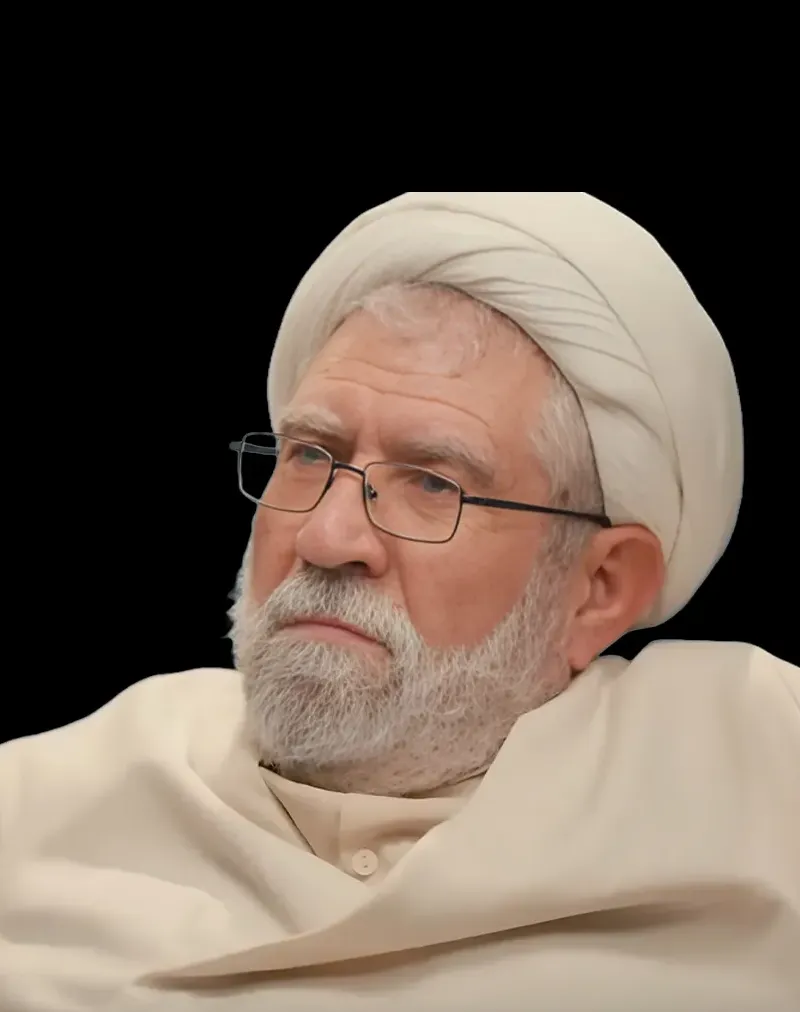
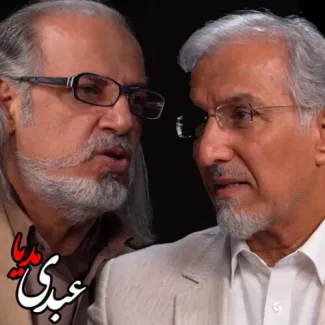
In a frank and candid conversation with Haj Sheikh Abdolrahim Soleimani Ardestani, we have explored the fundamental challenges of Islam in Iran's contemporary political landscape. From the relationship between ethics and religion in power to the question of the future of faith in an era distancing itself from traditional institutions; this dialogue is an attempt to understand the catastrophe targeting social ethics and a re-examination of the path the Islamic Republic has traversed over these 47 years.
This dialogue is an effort to understand the catastrophe targeting social ethics and a re-examination of the path the Islamic Republic has traversed over these 47 years.
The Confrontation of Religion and Power; A Philosophical Question in the Back Alleys of Iran
Abdi Media: Tonight, I want to touch the heart of one of Iran’s core issues—an issue that has upended not just a political system, but the spiritual life and the future of a nation's religious identity. Iran stands on the threshold of a philosophical question; a question that first shook the minds of thinkers during the Enlightenment and is now perhaps coming back to life in the back alleys of Iran. This question is: when religion becomes entwined with power, what happens to the truth?
In a world where the younger generation is distancing itself from the institution of religion at an unprecedented pace, while simultaneously the thirst for spirituality and freedom flares up beneath the ashes of politicization, the big question is: is it still possible to be a believer? When power structures have transformed the face of religion, is there a future for Islam in the Islamic Republic? Or is what we are seeing today the end of a 1,400-year era?
These questions we approach tonight may be shocking, but escaping them is impossible. I have the honor of hosting a well-known guest tonight; his name has certainly come to your eyes and ears more frequently in recent weeks and months, placed at the center of Iran’s intellectual and religious disputes: Haj Sheikh Abdolrahim Soleimani Ardestani. In my own style of writing at Abdi Media, I call you "Haj Sheikh" because I am at a loss as to who is a Hojatoleslam and who is an Ayatollah.
Haj Sheikh Abdolrahim Soleimani Ardestani is an Islamic scholar, a theological researcher, and one of the few clerics who dared to pull the spirit of religion out from the shadow of power and speak about the future of Islam in a frank, candid, and rational language. In Iran’s intellectual sphere, some consider him a quiet reformer and others a defiant theologian—though criticisms have become much more intense in recent days. I believe that just as Spinoza challenged the foundations of authoritarian theology in the 17th century and returned religion to the realm of ethics and freedom, today Soleimani and those like him are prominent figures critiquing the obsession with power within religion in Iran.
The Iranian Spinoza; Boldness in Critiquing Authoritarian Theology
The subject of discussion is the future of Islam in the Islamic Republic. I had a mental perception that you have emerged as a Spinoza in Iran, with bold questioning and, given your mastery of religious foundations, we see a reflection of him in you today. If you have a perspective on this yourself, please share it with us first.
Haj Sheikh Abdolrahim Soleimani Ardestani: I do not know to what extent the terms you used apply to me. I am a small student (Talabeh) who expresses what I honestly understand; that description is correct. The reality is I have nothing hidden; I express what I understand and I have no fear of stating the truth. The comparison to Spinoza might make me proud, as these are great scientific figures.
Analyzing the 47-Year Record; The Promise of Spirituality and Current Reality
Abdi Media: The Islamic Republic has been in power for over forty years. Many were waiting for a religious government and said that with this religious government—"not a word less, not a word more"—spirituality would come to Iran, and people would reach a high human status. Forty-seven years have passed since the formation of the Islamic Republic; in your opinion, how much was Islam able to develop and consolidate in Iran? How do you see the state of Islam after forty-seven years?
Haj Sheikh Abdolrahim Soleimani Ardestani: Thank you very much. Because I have also worked in the history of religions, I have seen this as a general principle: whenever religion has entered society and taken charge of the government, religion has been harmed. This wasn't something [unexpected]; if I had my current insight into religions and their history back in 1979, I would have concluded then that when religion comes to take stewardship and assume responsibility for government and law in society, it gets damaged—and this damage is severe.
The reality is that what I have seen in these 46 years aligns with what I have seen and studied in the history of religions. Specifically regarding Islam, if its main goal—as our Prophet says—was solely and exclusively to be appointed for "ethics" (akhlaq), the reality is quite evident in the events of the last few days: neither ethics is visible, nor is there any ethical concern.
Even the scholars who have raised their voices in protest—none of them protested how much this process has harmed social ethics; in fact, they may have even harmed it further. I did not see a single turban-wearing cleric protest and say, "observe ethics." All their protests were about whether their beliefs and what they have come to believe throughout history were harmed or not. Meanwhile, what suffered the most and was a catastrophe was the wave of immorality.
In my view, this has existed throughout the history of the Islamic Republic. From my perspective, the goal of religion is ethics and human rights, whereas the Islamic Republic and the system were not successful or honorable in this regard. I give it a failing grade. This was clearly visible in recent days as well, where not even one of these clerics protested the immoralities taking place. Unfortunately, this same issue exists throughout the Islamic Republic. Even the Reformist clerics—again, in this saga, no one protested what was contrary to human rights, freedom of speech, freedom of belief, and the like. Most of their protest was that perhaps it is "not advisable" to say such things, and no one saw that aspect. While in my view, what happened in these few days was a catastrophe in terms of ethics and human rights, no one addressed these issues and they seemingly held no importance to them. I see the entire 47-year history of the Islamic Republic this way: if we consider the spirit and message of religion to be ethics and human rights, it has been completely unsuccessful.
Soleimani's Bitter Hypothesis: The Destruction of Ethics in the Current Interpretation of Shiasm
Abdi Media: What has upset you the most during these past few days?
Haj Sheikh Abdolrahim Soleimani Ardestani: It is very strange; I had a hypothesis—and although I was certain of it, I wanted to be wrong. I wished for my hypothesis to be incorrect. Sometimes humans are like this. I wanted to say: "This interpretation of religion that you are presenting is destroying the ethics of society." This was my hypothesis, and I was so certain of it for myself, yet at the same time, I wished it were a mistake.
It's like someone who knows their father has cancer, but until the very last moment, they hope their knowledge turns out to be wrong. I, too, hoped until the last moment that I was wrong, but unfortunately, my hypothesis was clearly proven: this interpretation of Shiasm currently being presented is destroying ethics.
It is the strangest thing to happen—for someone to have a hypothesis and then be saddened that it was proven true. That was my greatest source of sorrow. I did not want scholars to demonstrate this much immorality within the Seminary, but unfortunately, they did.
An Elegy for Religion: Beyond Personal Insults and Accusations
Abdi Media: Two things were very evident: one was the insults—someone who insulted and cursed you in a mourning ceremony for the Ahl al-Bayt was given an iPhone 17 today as a reward for those insults (or perhaps for something else). The other part was the accusations; slanderous things were said about you. Which was more painful: the accusations or the insults?
Haj Sheikh Abdolrahim Soleimani Ardestani: Neither. I was not upset by the insults or the accusations. It doesn't matter; I was prepared. These were not unexpected for me. I moved with my eyes open; it was natural, and having knowledge of the history of religions, I know what happens.
Even regarding the eulogist (maddah) or storyteller who insulted or slandered me, I was not upset at all. Nor was I upset by the young people who insulted me over the phone or in person; I was never upset, even in those moments.
However, when it came to the scholars who used profanity—I was not upset for my own sake, but because of the damage done to the faith and to Shiasm. This movement by the clergy—not because of me, but because they harmed the core of the religion—truly saddened me. Perhaps these actions both proved my hypothesis and did not diminish my character; it wasn't as if they harmed me personally, I have no problem with that. It was predictable. Yet, at the same time, I was saddened by the things the scholars said and by the fact that they did not fulfill their duty regarding the immoralities taking place.
I engaged in a debate; I raised a scientific and academic point. I said nothing that could be characterized as immoral or harsh. At most, I expressed a "wrong" academic opinion. It was never appropriate to see this level of immorality coming from scholars and professors who are supposed to be the teachers of ethics in society. This part upset me deeply—not for myself, but because the conduct of scholars causes immorality to spread in society and stains the face of religion. That is why I was saddened.
The Primacy of Appearance over Substance: The Catastrophe of Institutionalized Moral Decay
Abdi Media: Have you received any summons, phone calls, or "recommendations" from government agencies or the judiciary?
Haj Sheikh Abdolrahim Soleimani Ardestani: No, I haven't had any contact for several months. If anything was said, it was indirect; nothing direct has occurred.
Abdi Media: You had a grievance regarding the clerics, or perhaps the Marjas (Grand Ayatollahs) and scholars. Many criticize this silence. People often protest: why do you speak out on a subject like the Hijab—which is mentioned in all state-controlled prayer resources—but remain silent on issues like poverty, bribery, or the death of a young girl?
There is a common point here where this clerical circle sometimes bites even the scholars themselves. Some believe that with the structures the Islamic Republic has created within the clergy over these years—such as security offices and the Special Clerical Court—figures like Taleghani, Beheshti, or Motahhari will no longer emerge. What has the Islamic Republic done to Islam in these 47 years? Did it help it develop? What actually happened? To what extent has the structure created by the Islamic Republic in the realm of religion aided the development of Islam?
Haj Sheikh Abdolrahim Soleimani Ardestani: I interpret it this way: the goal of religion is to reform the ethics of society. I consider culture to be the foundation, and the core of culture is ethics. If this is damaged, everything is damaged. I believe a society with corrupted ethics cannot grow or develop economically or in other fields. When this aspect is harmed, we are harmed in every direction.
Economically, when ethics vanish, commitment disappears—both professional and economic commitment. When ethics are gone, those placed at the top are no longer experts or committed individuals. Therefore, corruption spreads everywhere. At that point, corruption becomes institutionalized. In my opinion, this catastrophe has occurred: moral corruption has become institutionalized in our society.
You mentioned why scholars didn't protest certain issues. I think even regarding beliefs—specifically where something was said about the Imams—scholars did not act honestly. For example, someone on television described Imam Ali and the Prophet as "harsh" and "foul-tempered," but not a sound was heard from the Seminary. Another person said the corruption in our society also existed during Imam Ali’s rule, yet no one spoke up.
It seems they are only sensitive to very specific issues. Even regarding their own beliefs—take the two examples I gave about the character of the Imams, or when someone on TV said that the goal of religion is not ethics—the scholars’ voices did not come out. Yet they erupt over a minor issue tied to eulogies (rowzeh) and the like. I wish the scholars had raised their voices when fundamental beliefs were questioned. They didn't speak up then, even though those comments directly targeted the ethics of society.
My point is that a society without ethics has nothing. It has no economy, no culture, no politics; nothing is in its right place. It has no family, no peace, no security. A society without morality has nothing. I believe this catastrophe has happened. Ethics were ignored, and instead of relying on morality, the focus shifted to the outward appearances of religion. As you mentioned—matters like hair, or devotional acts like I'tikaf (a voluntary spiritual retreat). If as much emphasis had been placed on honesty and truthfulness—which are the foundations of religion—as was placed on I'tikaf, we would have a better society. But unfortunately, we destroyed ethics, and by destroying ethics, we have lost everything.
Abdi Media: One point of criticism raised even by those well-meaning toward you was an expression you supposedly used during a debate, where you referred to the mourners as "donkeys" (fools). Such an expression offended some people.
Haj Sheikh Abdolrahim Soleimani Ardestani: First of all, it wasn't during the debate; it was in a different speech. They clipped and edited that speech. I didn't use that term in the way it's being portrayed. I was quoting a story from the late [Martyr] Motahhari.
The late Motahhari tells a story about a preacher who was asked, "Why do you say such nonsensical things from the pulpit?" The preacher replied, "Because the level of my audience is low." He said, "Today I will prove it."
So, first of all, this is a quote from the late Motahhari. He says that the preacher went up on the pulpit to expose the ignorance of his audience. He began a mourning narration (rowzeh), saying: "On the day after Ashura, when the captives and children were tied onto the camels, the heat and the sun were scorching, and the children were panting from thirst and sweating profusely. On the other hand, the ground was frozen solid, and the camels were slipping on the ice, causing the captives to fall from the camels to the ground." At this point, the people began to weep intensely due to the magnitude of the tragedy.
I quoted this from the late Motahhari, and at that point, I stopped and said—and I’ll correct it now—that a Shiite should not be so "uncomprehending" (nafahm) as to not listen to what is actually being said. If the weather is scorching hot, how can the ground be frozen and the camels slipping on ice? I was merely relaying Motahhari's point. Instead of the word "uncomprehending," I used another word—referring to the four-legged animal you mentioned. The truth is, because I am a village boy, I know that even that animal is not that uncomprehending.
Hear it without filters on Castbox.
From the Unity of the First Decade to Eulogist-Centricity and Recent Political Divides
Abdi Media: Regarding these structures that the Islamic Republic has built to "protect and safeguard" the institution of religion—such as the Special Clerical Court and the security offices (Harasat) of the seminaries—how successful do you think they have been? Why is it that under this structure, prominent figures like those who emerged before or during the Revolution are no longer produced? Where is the flaw in the system?
Haj Sheikh Abdolrahim Soleimani Ardestani: If I were to name one "achievement" of these security offices, the Special Clerical Court, and similar tribunals, it is the cultivation of hypocrisy (monafeq-parvari). In reality, these structures have turned people into hypocrites who perhaps speak according to the government's desires, while their true beliefs are something else entirely.
I believe the most significant achievement of these crackdowns, in general, has been the promotion of hypocrisy and the spread of lying in society. It has reached a point where today, lying is one of the "necessities" of life in Iran. No one can lead a normal life without lying. That is to say, if someone refuses to lie, they couldn't even be hired as a municipal parking attendant; they would have to tell 40 or 50 lies just to pass the hiring process. The primary achievement has been the cultivation of hypocrites and liars.
Abdi Media: Let's take a step back and look from a broader perspective at the Islamic Republic's interpretation of Islam. Perhaps after 47 years, we can offer a better analysis. From your standpoint as a religious scholar and a cleric, what kind of Islam is the Islamic Republic’s interpretation? Since the emergence of Islam, there have been various interpretations—Alawite, Umayyad, and so on. Do you consider the Islamic Republic an independent interpretation of Islam? Do you see it as a version of "Alawite Islam"? What interpretation does the Islamic Republic actually hold?
Haj Sheikh Abdolrahim Soleimani Ardestani: In my opinion, the Islamic Republic is an unprecedented interpretation. It has no historical precedent. One cannot use the word "Republic" and claim to implement a republican government—the same modern republic found elsewhere, like France, where the people are sovereign—and then reconcile it with the doctrine of Velayat-e Faqih (Guardianship of the Jurist) that emerged during the constitutional process after the 1979 referendum.
This interpretation is in no way compatible with republicanism. A "republic" is formed where the people are supposedly in charge, yet they end up having no real power. A republic where one individual has "guardianship" and absolute authority over the people is a contradiction in terms. It is laughable. "Republic" means the people are everything; when you say you want to bring in Velayat-e Faqih, it means the Jurist is everything. It is meaningless.
Perhaps back in 1979, when I voted for the Islamic Republic, I didn't see these two terms as incompatible. But there is no inherent harmony between republicanism and [this interpretation of] Islamism. Therefore, it is a unique reading. We have no history of someone shouting the slogan of a modern government—claiming the people are sovereign—while simultaneously stating, "God has chosen me to rule." These two are incompatible. I believe that even for Imam Ali and Prophet Muhammad (PBUH), their right to govern was given by the people, not by God; I have a fundamental disagreement on this point.
If I were to summarize the theoretical core: in reality, the "Republic" part says the people are everything, while the "Islamic" part (as interpreted by these gentlemen) says the people are nothing. This is absurd. It is a very strange situation. According to the Quran, society should be managed through reason (aql) and science; the people must manage society using intellect and knowledge.
Abdi Media: My inference is that the Islamic Republic's interpretation is distanced from "Alawite Islam" (the model of Imam Ali).
Haj Sheikh Abdolrahim Soleimani Ardestani: No, it is certainly distanced from Alawite Islam; that much is clear. In fact, these two words [Republic and Islamic] together are fundamentally flawed. Either Ayatollah Khomeini should have said "Islamic Government"—as the late Ayatollah Misbah Yazdi used to say, where the people have no role and the vote is merely ceremonial; that would have at least been consistent.
The inconsistency arises when we say, "The criterion is the vote of the nation," but then we reach a point where the Assembly of Experts is formed and there is only one candidate. Even if every single person wrote "Death to [Candidate X]" on their ballot, that person would still become the representative of the Assembly of Experts. We cannot even give this a name.
What we see in practice bears no resemblance to the Alawite government. I have said before: some argue that since there was corruption in Imam Ali's government, it's natural for there to be corruption in this one too. I counter this by saying there was corruption in both Ali's and Yazid's governments—because no human government is without flaw—but that comparison is a fallacious argument.
I state this as a general rule: throughout the history of religions, whenever religious authorities have intervened in social governance, the outward form, body, and shell of religion become very rigid, while the spirit, core, and essence of religion are ignored. Because the shell has become so emphasized—and this has happened throughout history—the same has occurred in this Islamic Republic. They have clung to the shell; in fact, right now, it is 100% shell. While 10% should have been focused on the shell and 90% on the core, spirit, essence, and content, this has been inverted. This is the catastrophe that has taken place.
The Legacy of Misbah Yazdi: Confronting Human Rights and Strengthening One-Man Rule
Abdi Media: We could spend dozens of sessions discussing Ayatollah Khomeini’s thoughts on founding a religious government, dating back to his 1960s lectures on Velayat-e Faqih. One issue is that the Constitution explicitly contains repeated contradictions. Article 57 includes the phrase "Imamate of the Ummah" (Leadership of the Nation); we have defined a "Republic" but included the concept of "Ummah." Many believe this requires revision as applying "Ummah" to a "Republic" of citizens creates a clear conflict of interest.
Since you mentioned the views of Mr. Misbah Yazdi, we have seen Ayatollah Khamenei honor his thoughts and statements. This suggests an alignment of vision—at least, that is my inference. It feels as though the Islamic Republic is moving toward becoming an "Islamic Government." How do you view the transformation of the religious institution during Ayatollah Khamenei's leadership? Was there a reform, or was it a process of institutionalizing security and surveillance within religion?
Haj Sheikh Abdolrahim Soleimani Ardestani: You mentioned the Leader's treatment of the late Ayatollah Misbah Yazdi. I consider the late [Martyr] Motahhari’s interpretation of Islam to be the least flawed. I have also studied Ayatollah Misbah. The Leader once addressed Misbah, calling him "the Motahhari of our time." Having studied both, if I were to say what their similarity is, I would say: both of their turbans are white. Beyond the fact that they both wore white turbans, I see no resemblance between these two personalities. To call Ayatollah Misbah the "Motahhari of this time" is something in which I see no likeness.
The Shift from Unity to Factionalism
If I were to compare the first decade [under Khomeini] with the period that followed, significant changes occurred:
The Death of "Unity": Whether we like it or not, the most important slogan Ayatollah Khomeini used was "Unity—All Together." He emphasized this constantly, seeking cohesion. This slogan generally ceased to be repeated. I don't want to pass judgment, but the feeling is that focus shifted toward one specific faction, even if it was a minority.
The Rise of the "Maddah" (Eulogist) Culture: During Ayatollah Khomeini’s time, the culture of praising the leader—or even the specific style of mourning for the Imams we see today—did not flourish. If someone tried to praise him, he would become intensely agitated; no one dared to eulogize him to his face or behind his back.
Note: Even when the late Kowsari performed a rowzeh (mourning narration) for him, Khomeini would cover his face with a handkerchief and weep privately. I am a critic of Ayatollah Khomeini, not a supporter, but we must acknowledge what changed.
The Loss of the "Common Father" Figure: During Khomeini's era, both political factions in the country claimed, "Khomeini is with us." Both felt represented. After him, one faction claimed the Leadership belongs to them, and the opposing faction agreed: "Yes, the Leadership is with you [the other side]." The rival wing no longer claimed him as their own. This is a monumental shift that we cannot deny.
Abdi Media: You mentioned taking notes on Ayatollah Khamenei's meeting with the family of Misbah Yazdi. He used rare and profound terms to describe him, which I think clarifies the direction for anyone analyzing the structure of power. He stated that he sees a unique combination of qualities in Misbah Yazdi—abundant knowledge, clear expression, inexhaustible motivation, outstanding character, and spiritual conduct—that he cannot find in anyone else. He emphasized that Misbah’s path must not be abandoned or closed.
This strategic orientation defines Ayatollah Khamenei’s worldview within the framework of Misbah's school of thought. We see this reflected in the various conferences held by the Misbah Institute. My question is: Do you believe Ayatollah Khamenei’s leadership has strengthened "Political Islam," and what are your thoughts on this model of leadership?
Haj Sheikh Abdolrahim Soleimani Ardestani: To address the glorification of Ayatollah Misbah, I can point to my book, The Encounter of Contemporary Iranian Muslim Thinkers with the Modern Human Rights System. In it, I discuss both Misbah and Motahhari in detail. Among traditional scholars, the late Motahhari had the best encounter with modern human rights before the Revolution. He called the Universal Declaration of Human Rights the "greatest achievement of mankind" and described the sentences in its preamble as "golden."
Conversely, Ayatollah Misbah had the worst encounter with the modern human rights system, even though he spoke thirty years after Motahhari. I have demonstrated the serious flaws in his views in my book. Ayatollah Misbah was a staunch advocate of one-man rule; he essentially defined "Islamic Government" as individual autocracy.
Abdi Media: Borrowing from that, it seems that under Ayatollah Khamenei’s leadership, the country is navigating away from a "Republic" toward an "Islamic Government." We see this in governance, where the Presidency is often sidelined. For instance, there are councils under the Leader’s authority whose decisions are untouchable. In an unprecedented move, Ayatollah Khamenei issued a written order stating that the judiciary cannot even challenge the resolutions of the Supreme Council of the Cultural Revolution. If a citizen wants to seek justice against a decision made there, where can they go? Nowhere. This contraction of structures suggests a shift toward a total "Islamic Government." Do you see this, and can such a model succeed in the modern era?
Haj Sheikh Abdolrahim Soleimani Ardestani: As for whether this shift has occurred—it certainly has. Between the powers granted to the Leader in the Constitution and what we see in practice (such as the Assembly of Experts being elected with minimal competition and the Guardian Council's vetting process), it has effectively transformed.
However, I fundamentally believe we do not have such a thing as "Islamic Government" in the way they describe it. I consider the governments of the Prophet and Imam Ali to have been democratic and popular. We find this in Imam Ali’s own words: the only legitimate government is the one the people want, and the people are the masters of the government. I do not accept the concept of "Islamic Government" as it is currently presented; it simply does not exist in true religious tradition.
Abdi Media: The "Islamic Emirate"?
Haj Sheikh Abdolrahim Soleimani Ardestani: I would say even "Islamic Emirate" is an incorrect term; we don't have such a thing [in true tradition], but it is a claim being made and historically enacted. If your question is whether this has turned into a one-man rule, I believe it has. The reality is that it has. If your question is whether this is desirable, clearly it is not. As for how successful such a government is—one only needs to look at the economy, the culture, the environment, land subsidence, groundwater depletion, and air pollution. To see the "success" of this system, it is enough to place a camera next to a trash bin in Tehran for 24 hours; the result becomes perfectly clear.
A Critique of Absolute Guardianship: From Sheikh Ansari to Contemporary Interpretations
Abdi Media: I want to move to the topic of Velayat-e Mutlaqe-ye Faqih (Absolute Guardianship of the Jurist). I am focusing on the second era of leadership. In your view, has the concept of Absolute Guardianship transformed? Has it expanded? Where do you see its current standing?
Haj Sheikh Abdolrahim Soleimani Ardestani: As the vast majority of Shia jurists have maintained throughout history, there is no such thing as Velayat-e Faqih in the sense of a "government by a jurist." I am fond of the expression by Sheikh Ansari, who said: "Proving [the political] Velayat-e Faqih is harder than stroking your hand upward against a tree branch covered in terrifying thorns." I hold the same view; I consider the foundation of Velayat-e Faqih to be baseless.
During Ayatollah Khomeini's time, a debate arose: are the powers of the Guardian limited to the "Primary Ordinances" of Islam, or can he invoke "Secondary Ordinances"? For example, if a house stands in the way of a necessary new road, does the Guardian have the right to forcibly purchase and demolish it for urban development?
What Ayatollah Khomeini argued then was actually rational: he said you cannot govern solely within "Primary Ordinances." Even the Chinese government has to quarantine a city during a pandemic—that is a secondary necessity. A Prophet might even have to demolish a mosque for a greater public good. Any ruler, even a Shah, must have the right to purchase property for public roads (provided fair compensation is paid).
However, after Ayatollah Khomeini, the term "Absolute" (Mutlaq) began to be interpreted by people like Ayatollah Misbah as "The Guardian is above the law." This is a catastrophe. If the Guardian is above the law, it means whatever he does is inherently "correct," and no one can ask "why." While Khomeini used "Absolute" to mean "not restricted solely to primary religious rulings," the current interpretation means "not restricted by any law." This interpretation is disastrous.
Abdi Media: And the interpretation of the Constitution lies with the Guardian Council, which itself is under the Leader's oversight. All roads lead to one point. Now, the resolutions of the Supreme Council of the Cultural Revolution and the Supreme Council of Cyberspace are "above the law." The Parliament, which was once "at the head of all affairs," is no longer there because other bodies can bypass or restrict it.
Haj Sheikh Abdolrahim Soleimani Ardestani: Unfortunately, there are about a hundred "Supreme Councils," and each has its own resolutions...
Abdi Media: The Supreme Councils under Ayatollah Khamenei aren't quite a hundred, but their resolutions vary. I’d like to jump ahead: we’ve talked about Islam, but how do you see the current state of the clergy? Where does Islam stand in Iran today?
Haj Sheikh Abdolrahim Soleimani Ardestani: If we look at its place in the minds of today's youth, the reality is that for the majority, it has no place—they simply don't like it. But what about the future?
I don't believe in historical or personal determinism (jabr). I believe individuals make decisions; I believe in the primacy of the individual. Throughout history, individual choices have steered the course of events. For instance, the Mongol invasion of Iran resulted from a single individual's mistake. In our era, the 8-year war—with its incalculable losses of life, health, and economy—began and continued due to individual decisions. The "Poisoned Chalice" [ceasefire] of 1988 could have been drunk much earlier. The late Salehi Najafabadi argued in Jihad in Islam that the war could have ended two months in, according to the Quran. I agree. We are still paying the price for individual errors, like the takeover of the US Embassy, which Ayatollah Khomeini could have prevented from becoming a "second revolution."
However, because I believe in individual agency, I don't believe history is predictable. A single personality can turn the tide. Look at the Catholic Church: youth were fleeing the faith, but a spiritual figure—a sincere, honest person—can make them say, "One can be a Catholic and still be a decent human being." I was deeply saddened by the death of such spiritual figures [likely referring to Pope Benedict or similar figures] because the world loses a real spiritual anchor.
A minor event, or a tragedy like the killing of Mahsa Amini, creates an earthquake that changes society forever; things cannot go back to the way they were. But because I believe in the individual, I cannot predict the next few years. One person can change the mindset of the youth.
Abdi Media: Based on historical lessons, I want to talk about something yet to come. Some criticize this question, asking: "How do you even know the Islamic Republic will last long enough for a Third Leader?" Without prophesying, what is your analysis? Will it reach a third leadership?
Haj Sheikh Abdolrahim Soleimani Ardestani: I cannot predict history because, for me, Iran and its integrity come first. I am a Muslim, but the nation of Iran is my priority, whether the system is "Islamic" or not.
Because it depends on individual will, I cannot say. I have many criticisms of Ayatollah Khamenei, but tomorrow is a personal decision. If he were to change his approach, I would become his supporter. My criticism is of performance. Many critics would agree: if we want change, we should seek it through a 10-to-20-year process because revolutions are destructive. Since it depends on the decision of a person, I can never say for certain what will happen.
Abdi Media: What if the situation continues exactly as it is?
Haj Sheikh Abdolrahim Soleimani Ardestani: If this same "driving style" continues, I am not optimistic.
Abdi Media: You are not optimistic about the transition from the second to the third leadership?
Haj Sheikh Abdolrahim Soleimani Ardestani: Because we don't know the timing—whether the moment for the third [leader] arrives tonight or tomorrow—we can't definitively say. It might reach that point; perhaps tomorrow. But what will happen then?
This is the most complex situation. As someone within the clerical circle, I say that anyone making a prediction is just guessing wildly. Why? Because you cannot predict a society characterized by hypocrisy (nafaq).
The Corruption of "Taqiyya" into Hypocrisy
In Shiasm, we have a doctrine called Taqiyya (expedient dissimulation). Originally, it is a Quranic and rational principle: if telling the truth serves no purpose and brings unbearable harm, you don't have to express it. That’s a rational concept.
However, these gentlemen have interpreted it to mean: "Wherever telling the truth has a cost, don't say it." Well, telling the truth always has a cost—you might lose your job or go to prison. Truth-telling is inherently costly. This is where the doctrine of Taqiyya has transformed into systemic hypocrisy.
I don't have a "hypocrisy-meter" to measure exactly what percentage of the Assembly of Experts is being hypocritical, but I have no doubt most are over 50%, and some are 100%. The words they speak now—we don't know what is actually in the back of their minds. Within 24 hours of the Leader's passing, the veil will fall. No one knows what will happen in those 24 hours. People who acted out of fear or the desire for power, under the guise of Taqiyya, will suddenly shift their positions.
The "Pashuli" (Gnat) Effect in Power Transitions
You can try to guess what the Assembly of Experts thinks, but you can't see behind their minds to know if their words match their convictions. 24 hours later, it becomes clear.
Imam Ali has a saying in the Nahj al-Balagha where he divides people into three groups:
The Divine Scholars: Those who know the truth and pay the price for it.
The Seekers of Salvation: Those following the path of truth.
The Gnats (Pashuli): In my local dialect, we call them Pashuli—tiny insects that are moved by the mere wind of a waving hand.
Imam Ali views the third group as being blown here and there by the slightest breeze. In those critical 24 hours, I don't know which way the winds will blow or where those "gnats" will be carried. It is absolutely unpredictable what will emerge from the current Assembly of Experts after the current Leader. Predictions based on their current positions are useless because in a hypocritical society, words do not align with hearts and minds. That is the very definition of hypocrisy.
Abdi Media: So, if it happens today, it will reach a third leader; but if time goes on, it’s unclear whether it will reach that stage or not?
Haj Sheikh Abdolrahim Soleimani Ardestani: If we continue with this same "driving style," it is impossible to predict. If we were to retreat slightly from certain positions—not even a full retreat—and make four correct decisions to give value to the people, things might change.
Abdi Media: The people now have the experience of religious rule. You pointed out some of the outcomes of this government. Based on your historical studies, your religious scholarship, and the experience you've gained—as they say, "fate didn't give these white hairs for free, you bought this experience with your youth"—do you think these people will still seek a religious government under a third leadership? Will the people, who are the true owners of this land, still choose to wear the cloak of a religious government?
Haj Sheikh Abdolrahim Soleimani Ardestani: Because I consider the Iranian people to be wise and rational. I was among the people during the events of 2009, and I am among them now. The people truly weigh the interests of the country and make rational decisions. They might not accept a certain individual or even a whole system, yet they may conclude that the rational choice is for transitions to happen peacefully and for a revolution not to occur.
I am optimistic about the Iranian nation because I believe they are wise. Even though they are angry—and they have every right to be—I believe the nation has reached a state of maturity. When one suffers a defeat, that defeat becomes a lesson. In economics, if you invest and fail, yes, you've lost, but the lesson moves you forward. Perhaps we have "failed" in the sense that our world and hereafter were supposed to become a paradise and they didn't, but this failure has taught us vital lessons.
One of those lessons is that revolution is unpredictable; we don't know what it leads to. Instead of revolution, no matter how much time and patience it requires, we should seek fundamental and basic reform with patience. I believe the nation might reach this conclusion. Despite all the anger—and I reiterate, the people are rightfully angry—they are also rational. I have faith in the wisdom of this nation.
If this nation wasn't wise, then regardless of those who say "the Hidden Imam is protecting the country" or "the Leadership/Clergy/Religion is keeping it together," I say: No. It is the wisdom of this people that has preserved the integrity of this country despite all the pressure they have endured. History shows this nation has a high level of understanding and consciousness; they weigh the situation, and if they must be patient, they practice patience so that the country itself is not harmed.
Abdi Media: My point is about religious leadership—the government or the Islamic Republic. My question is: do these people, whom you say you know, believe that religious leadership meets their needs? Will they accept a religious leader for the third leadership? Some say even if the clerics bring a jar of honey, we don't want it.
Haj Sheikh Abdolrahim Soleimani Ardestani: I do not see anyone in the clergy who is qualified to manage a country, and I fundamentally believe this seminary cannot train such a person. My vote is the vote of the nation. I say that clerics—since they currently lack competence—after they study Islamic studies, which they haven't and don't know (and these days proved they don't), if they had this competence, they could preach to me in the mosque. Right now, they don't even have the competence for the mosque. My personal opinion is: whenever they find competence, they should go there. The seminary simply cannot train someone who is able to lead. Only a madman would give such authority to a lifelong individual rule. Unless I am mad, I will not give absolute, lifelong authority to anyone—whether a cleric or a Shah, whether wearing a crown or a turban. Whoever I give authority to must have limited, temporary power and be completely under supervision.
Abdi Media: You want democracy.
Haj Sheikh Abdolrahim Soleimani Ardestani: My whole point is, what process must be traversed to reach that? Do people experience a revolution to reach that goal?
Abdi Media: That is another chapter. At a moment when we have always said life is in God's hands and none of us can say how long we will live—what we have learned from our experiences is that death is a certainty; it is nothing but the truth, and no one in history has had eternal life. In this context and with this 47-year historical experience, if we reach a day that marks the endpoint of Ayatollah Khamenei’s leadership and move toward a third leadership, it seems to be a vital turning point. Do you think the people you are in contact with will accept this in a third leadership? Given the output of the Assembly of Experts and the existing ideologies. The output of the Assembly of Experts will be one of the existing Sheikhs or Sayyids, and from those available, they must choose the "best of what exists," presenting Mr. Haj Sheikh or so-and-so to the people as the Leader of the Islamic Republic. What reaction do you think the people will show then? Will they accept it? How do you see the status of Islam in Iran?
Haj Sheikh Abdolrahim Soleimani Ardestani: Anyone who might be proposed now does not possess the authority that the current leader has at all. Even for the current leader, if he were to seek a vote from the nation, I believe such a vote might not emerge from the ballot box; I don't know what would come out of the box. I don't want to predict, but I am not optimistic; I believe a positive vote would not emerge. From the turnout of this Assembly of Experts election—when the Speaker of the Parliament receives 3% of the votes of eligible voters in Tehran—it is not a very difficult analysis to see what position the people hold.
Suppose the Experts introduce an individual who has been alongside the people, even temporarily, so that the people can express their opinion in peace about what kind of government they want. I would say, if there were an individual—even for a temporary period of three years, for instance, under this same Constitution—who provides the groundwork for the people to transition peacefully to a truly democratic government. I don't know if this will happen or not. My point is a temporary three or four years, led by a personality who is acceptable to the people for that interim period—which is very rare and one must search for such a person with a magnifying glass. It is not simple; it is very difficult. But if it happened and was possible, perhaps the people would submit to it instead of saying "let's pay the heavy price for a revolution." To traverse this path under this same Constitution, where the people are asked in peace what system they accept. You cannot talk to this nation about religious government anymore; many generations must pass for them to forget. On the other hand, I want to emphasize the rationality of the nation; I truly consider them wise, and for that reason, I don't want to judge. I say perhaps a proposal is given for a temporary period, led by a personality who is generally accepted. For example, a personality like Khatami as a temporary leader—I am giving an example—a temporary leader, not to have a religious government, but to provide the groundwork to seek the nation's vote.
Abdi Media: Someone who wants to carry out a transition would not choose such a person.
Haj Sheikh Abdolrahim Soleimani Ardestani: You mean the Assembly of Experts? Perhaps rationality and piety will emerge. Miracles are not impossible; I believe in miracles.
Abdi Media: It seems very dreamy and idealistic to imagine someone like him coming to power, given institutions like the IRGC and others that condemn Mr. Khatami. Of course, in some places, some of the people have moved past the likes of Khatami and the Reformists; they even say if someone is a cleric, we have a problem with them.
Haj Sheikh Abdolrahim Soleimani Ardestani: I just said they should go to the mosque—I meant all clerics, including Khatami. But sometimes one says, "Very well, but since I cannot start a revolution, I choose the lesser of two evils." I said it from that perspective, not from the perspective of being a supporter. I am saying the cost of revolution is high; we say let’s take this calm path because he was a soft-natured personality, not because I am a supporter—no, I do not believe in the government of any cleric. But I said for two or three years, in order to get the people's vote in peace and let the people say what system they want.
Abdi Media: That depends on the person who holds the power—the individuals whose job it is during the transition from the second to the third leadership, those who safeguard the nature of the Islamic Republic. The IRGC's duty is to guard the Islamic Revolution and its achievements; a military institution that has weapons, prisons, and intelligence agencies, and is equipped with everything necessary. Will they allow even the thought of someone like Mr. Khatami, whom you mentioned, to happen? I don't know...
Haj Sheikh Abdolrahim Soleimani Ardestani: It is very unlikely.
Abdi Media: It is not just unlikely, but impossible.
Haj Sheikh Abdolrahim Soleimani Ardestani: It is very, very unlikely, but I gave an example—even using his person specifically because I cannot find another example to give—I do not know what the nation's reaction will be. When the tide turns, these very people who are here may see that there is no other choice. Do not judge the next 24 hours based on right now. Do not judge these gentlemen based on their current state, and do not judge the IRGC either. Allow for the possibility that anything could happen in those following 24 hours. Consider that some might recognize the interest of the nation and the country as something else entirely during that period. I want to say that right now, there is a wall in front of us called Taqiyya and hypocrisy, and we cannot read what is behind people's minds. I do not want to say what will happen at all; I say myself that there is no cleric right now whom I would say I’d vote for to be the next ruler—I do not believe in the rule of clerics at all. You asked if it's possible for a third person to come to power? I say that in the world of hypothesis, it is possible that in those 24 hours, developments occur that pull individuals into another realm, so that when the white smoke emerges, it is completely contrary to our expectations, and the nation might submit to it. The nation will not trust again; it must be limited and for a specific duration. You know, in history sometimes people say something and the person is considered a prophet; what was just said can transform into a hypothesis and find supporters. This could be raised as a hypothesis. Among the personalities I know, if we want a personality who can temporarily see what the people want in peace so that a revolution does not occur, such a person is in my mind.
Abdi Media: The people play a vital role. Closing remarks.
Haj Sheikh Abdolrahim Soleimani Ardestani: This system has not reached its goals and has dealt severe blows to both the religion and the worldly lives of the people. We have arrived at a one-man rule, and this individual rule has caused great damage. I do not believe in religious government; I believe in a democratic government in the true sense. I hope I am not misunderstood; I am optimistic. First, I believe in fundamental reforms—and I don't mean that specific political faction; I am not part of a faction. I have a different meaning of reform in mind. I believe fundamental reforms must be created in both the religion and the system, but they must be rational, calm, and without agitation. We must endure the pains. As I say these things, I don't think anyone in Iran is currently under as much pressure as I am, but at the same time, I advocate for reform and moving toward a democratic society with composure. Let me add this point—I have no recommendation, but I am stating my own view: the reality is that what you have seen and heard is not necessarily all of Islam. We can present a much better interpretation of Islam, which I have personally arrived at; an interpretation whose core concern is ethics and human rights. I believe the religion of Islam came for this very purpose, and I can extract this from the Holy Quran. We can have an interpretation of Islam that is completely ethical, human rights-oriented, and compassionate (Rahmani). When God introduces Himself, He is the Compassionate and the Merciful; He has made mercy mandatory upon Himself. The interpretation of religion you have seen and heard is not a compassionate one. The interpretation I speak of is a rational and compassionate interpretation—it is both wise and merciful. Merciful in the sense that ethics and human rights are its primary concern.
The complete file of Abdi Media's interview with Haj Sheikh Abdolrahim Soleimani Ardestani; researcher of religions, retired professor at Mofid University, and former member of the Assembly of Lecturers and Researchers of the Qom Seminary.

Take less than a minute, register and share your opinion under this post.
Insulting or inciting messages will be deleted.
Sign Up