
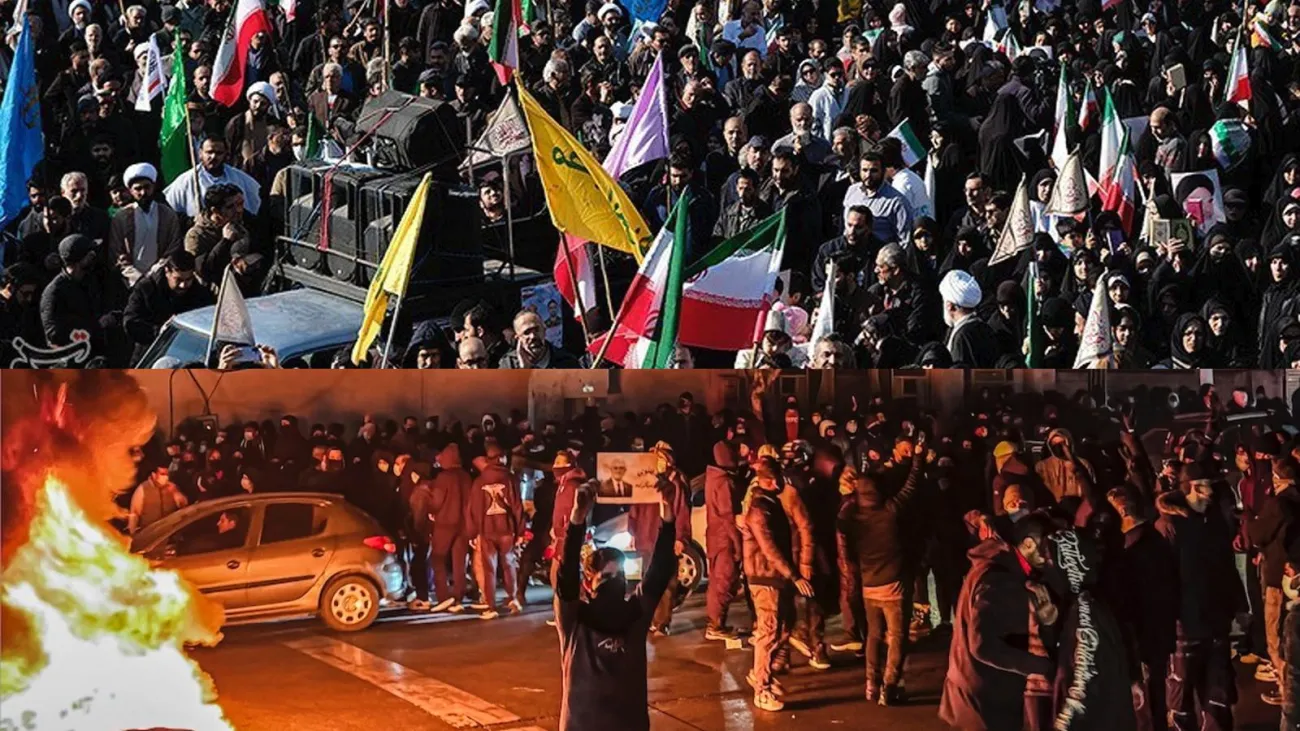
The Islamic Republic appears to have entered a new phase of its "street reclaiming policy"; one that relies on a calculated combination of organized supporter presence, highlighting...
It appears the Islamic Republic has entered a new phase of the "policy of reclaiming the streets"—a phase relying on a calculated mix of organized supporter presence, highlighting funeral processions, simultaneous negotiations at various levels, and the persistent internet shutdown. This set of actions is not a temporary reaction, but a strategic move to control, erode, and ultimately extinguish the protests.
In this framework, the street has transformed into a field of symbolic competition and a security zone. The presence of government supporters and the holding of official and semi-official ceremonies are conscious efforts to shift the image of the street from a space of protest to a stage for displaying power and reproducing legitimacy—an act aimed at breaking the protesters' psychological monopoly over public spaces.
Simultaneously, both overt and covert negotiations are underway, both regionally and through non-public international channels. This synchronization is not accidental. The Islamic Republic, following historical experience, views the street and the negotiating table as two parallel paths: one to contain domestic pressure, and the other to manage external costs and prevent the crisis from entering an uncontrollable phase.
The continued internet shutdown and communication blockage form the backbone of this strategy. Cutting off the free flow of information both weakens the protesters' organizational capacity and strips society of the possibility for independent narrative-making.
Meanwhile, a key international point must be noted: despite Donald Trump’s aggressive tweets and stances, there is no sign of a quick or hasty entry into direct military conflict. This behavior is neither accidental nor a result of momentary hesitation. It was clear from the start that Trump, even with aggressive rhetoric, would not enter a costly war without a precise cost-benefit analysis, guaranteed tangible achievements, and certainty regarding the management of consequences. His previous experiences show that he prefers the "policy of threat for a deal" over an actual war.
If, in the coming days, no specific event—such as a more massive and coordinated public presence than in previous days, or an uncoordinated security/military action outside of calculations—occurs, it can be expected that the Islamic Republic will achieve operational control based on pressure (or, in its own narrative, "authority").
Following that, the protests will likely enter a quieter but more accumulated phase: a decrease in large gatherings, an increase in scattered actions, hidden discontent, and stored anger. The streets may temporarily appear calmer, but the issue of protest will not be resolved; rather, it will move beneath the surface of society.
In such a scenario, a major difference from the "Woman, Life, Freedom" protests emerges: Given the massive volume of arrests, case-building, and televised confessions, there will be no sign of a general amnesty. On the contrary, we should expect a move into a new stage: a mass of trials, the issuance of heavy sentences, and likely a new wave of executions as tools for deterrence and social intimidation.
What is happening now is, in fact, a piece of that "security mega-puzzle of the system" mentioned in numerous notes over the past two years—a puzzle that today seems to be redefined and completed within the context of these events.
Therefore, one must be somewhat patient and carefully monitor the next 72 hours: If a serious event occurs, the main question will be its level, scope, and consequences; If it does not, it can be said that the first phase of this scenario has, from the establishment's perspective, ended successfully—in which case, al-Fatiha ma'al-Salawat (it is over).
What is underway today is neither a total victory for the street nor a stable consolidation of power; rather, it is an unstable and high-risk balance that could lead to a greater catastrophe with the slightest miscalculation from either side. The street may be temporarily reclaimed, but the blood shed, the unanswered questions, and the unforgettable responsibilities will remain.
Take less than a minute, register and share your opinion under this post.
Insulting or inciting messages will be deleted.
Sign Up