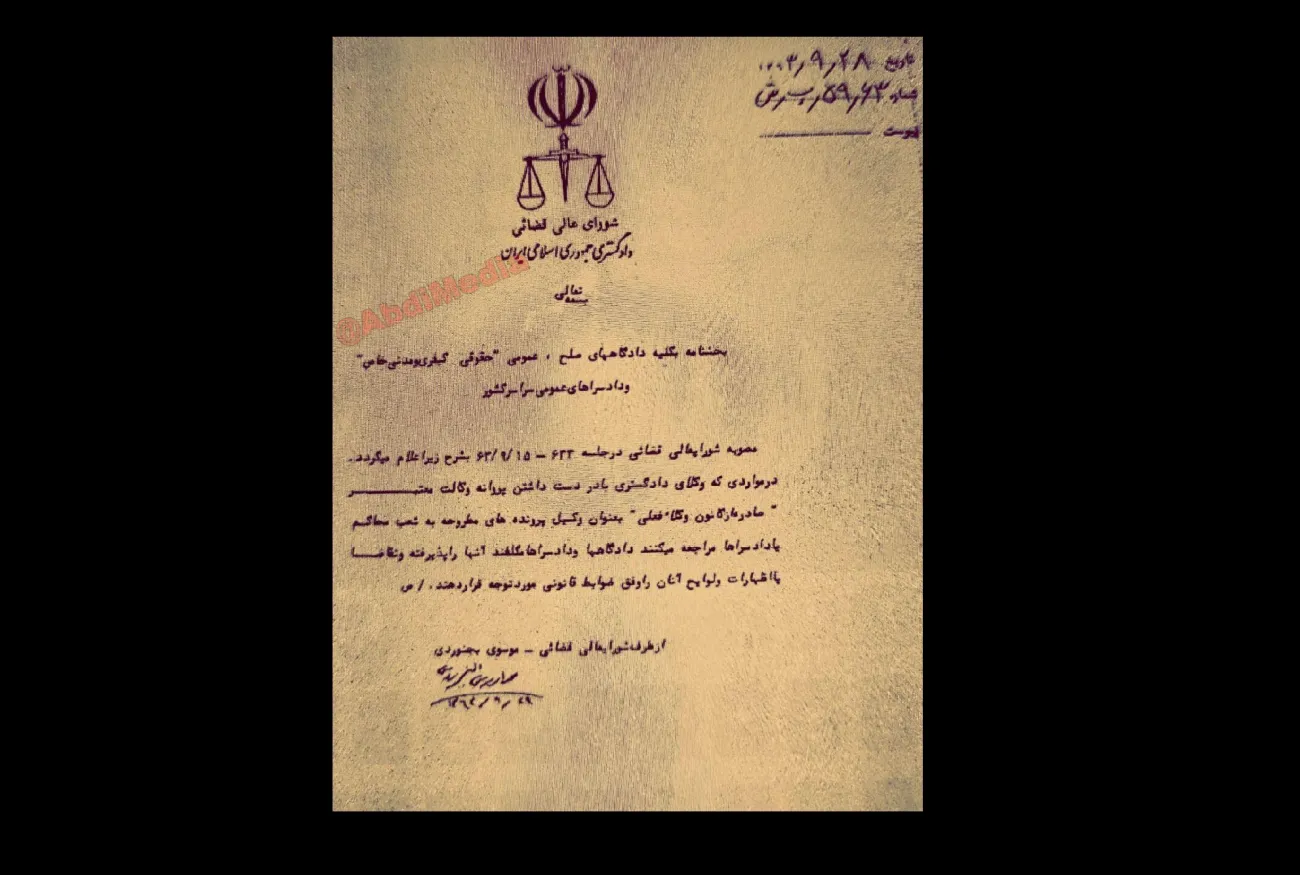
Home/Special noteRepublication - The text of the Supreme Judicial Council's directive dated December 19, 1984, to all courts and prosecutor's offices in Iran regarding the acceptance of attorneys.Read1 minute -Friday 2026/02/27 - 00:03News Code:24543Share One of the wonders of the history of advocacy in Iran following the victory of the Revolution is that up until 1984, there were numerous obstacles to practicing law in the justice system.Abdollah Abdi - Abdi MediaOne of the wonders of the history of advocacy in post-revolutionary Iran is that until 1984, numerous obstacles were created for practicing law in the judiciary, particularly in the Revolutionary Courts, and many defendants lacked legal representation. Even in cases involving capital punishment (death sentences), the situation remained the same.On December 6, 1984, the Supreme Judicial Council passed a resolution allowing lawyers to access branches of the courts and prosecutor's offices for pending cases; these bodies were also mandated to consider the statements and briefs of lawyers in accordance with legal regulations.At that time, Ayatollah Mousavi Bojnourdi notified all former Courts of Peace, General Courts (including Civil, Criminal, and Special Civil), and General Prosecutor's offices across the country of this directive on December 19, 1984.However, it should be noted that the names of the Islamic Revolutionary Courts, Military Courts, and their respective prosecutor's offices are absent from this resolution. This situation continued for years until the Expediency Discernment Council later issued a resolution emphasizing and approving the presence of lawyers. Nevertheless, regarding the Special Clerical Court, it stipulated that the parties to the lawsuit must select their lawyer from among the "qualified clerics" introduced by that specific court. Take less than a minute, register and share your opinion under this post.Insulting or inciting messages will be deleted.Sign UpComming Up Next This “costly calm” was the best possible condition for completing the internal security ring.خواندن 1 minute When and under what conditions does the internet connect? The answer is on the street, at sea, and in the sky.خواندن 4 minutes The policy of reclaiming the street: from control to the beginning of a tough crackdownخواندن 3 minutes Trump, Iran Street, and the Politics of Deal-Making; How Important is Democracy?خواندن 5 minutes Yalda, this beautiful and graceful long-haired Iran, is the legacy of our ancestors.خواندن 2 minutesMost ReadMemories of Akbar Hashemi - February 20, 2000 - Meeting with Abdullah Jasbi and Concerns About Election ResultsMovie / Where is Commander Morteza Talaie?Akbar Hashemi's memoirs - 1999 September 10 - The two-person political negotiations with Vaez Tabasi continued until he was escorted to Tehran, where Hashemi apparently decided to seriously participate in the sixth parliamentary elections.The records of the recent periods of the Islamic Council showed that the parliament is not in charge of affairs and cannot interfere or pass resolutions on the authority of the Commander-in-Chief of the Armed Forces at any level, let alone supervise.What will be the future of Iran with the announced candidates for the presidential election? / Conversation with Dr. Taghi Azad AramakiCan I feel tired with you?A Basiji veterinarian was appointed head of the health network instead of an otolaryngologist.Akbar Hashemi's memoirs - 1999 September 5 - The meeting of the senior managers of the judiciary with Hashemi Rafsanjani and their complaint about the neglect of Hashemi Shahroudi, the new head of the judiciary, continues.Memories of Akbar Hashemi - 1999 September 7 - In continuation of the efforts of the late Vaez Tabasi, who used to encourage Hashemi to participate in the elections in frequent meetings, this time he also met with Hashemi.Akbar Hashemi's memories - 1999 September 9 - Continued visits to the belongings, buildings and works of Astan Quds