
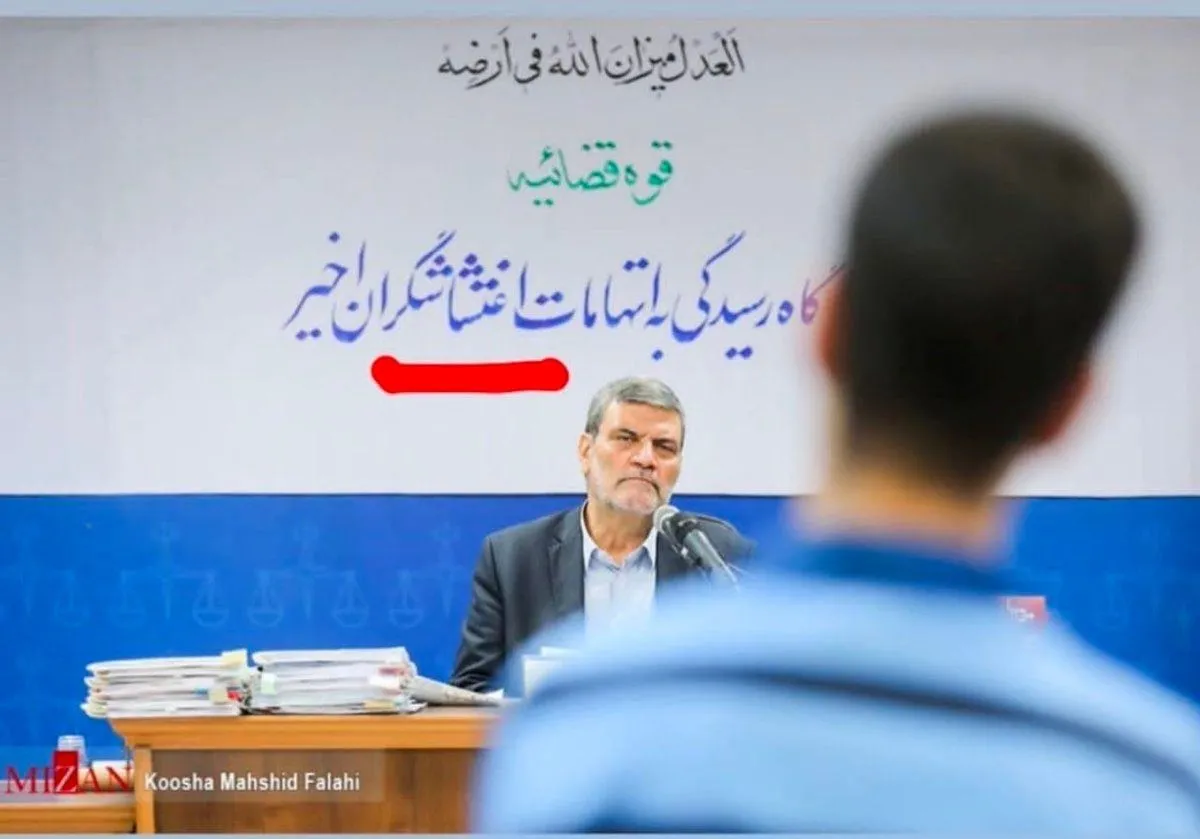
Abdollah Abdi - Abdi Media
Maybe some people didn't pay much attention to the text behind Judge Salavati's head, and maybe it's normal with the excitement and news these days; But for the country's legal community and independent judges and related people, it has a thousand words said and unsaid!
It should be noted that there is a court and not a prosecutor's office!
According to the law, the court must judge impartially between the prosecutor and the accused.
In the photos that have been published in the media, except for Mr. Salavati's trial in Tehran's Revolutionary Court, which is sometimes convened to deal with charges of death and permanent imprisonment with the presence of counsel and has the powers of Criminal Court 1, in its other branches In these days, I did not see this expression behind the head.
Of course, after the amendment of the law on the establishment of public courts and the revolution; The Revolutionary Court is correct and the word (Islamic) has been removed, and the court is also a public and revolutionary court, but it is still written as the Islamic Revolutionary Court.
In addition, this banner and text:
1- It clearly and openly shows the departure from the neutrality of the trial court and independent judgment.
2- It calls for the preparation of all the necessary platforms to prove the presumption of the charge behind (the troublemaker).
3- More important than the previous two cases, it evokes the collapse of the legal and judicial systems; In particular, the defendants do not have the right to choose a designated lawyer and must choose their lawyers from among the approved lawyers referred to in Article 48 of the Criminal Procedure Law, only if a more reliable lawyer is not selected by the court.
Of course, this issue also has a historical background, and Shaykh Mohammad Mohammadi Gilani, the Ruler of Sharia at the time of the Revolutionary Courts, in the court hearing the accusations of Abbas Amirantzam, started the court session by interpreting the verses of the Holy Quran about spies and their punishment, which showed the presumption of the spy judge's mind. Being accused.
Will the leaders of the judiciary pay attention to the public consequences of this matter and will they observe the corruption resulting from it and at least the appearance of judgment and the principles of proceedings?


Take less than a minute, register and share your opinion under this post.
Insulting or inciting messages will be deleted.
Sign Up