
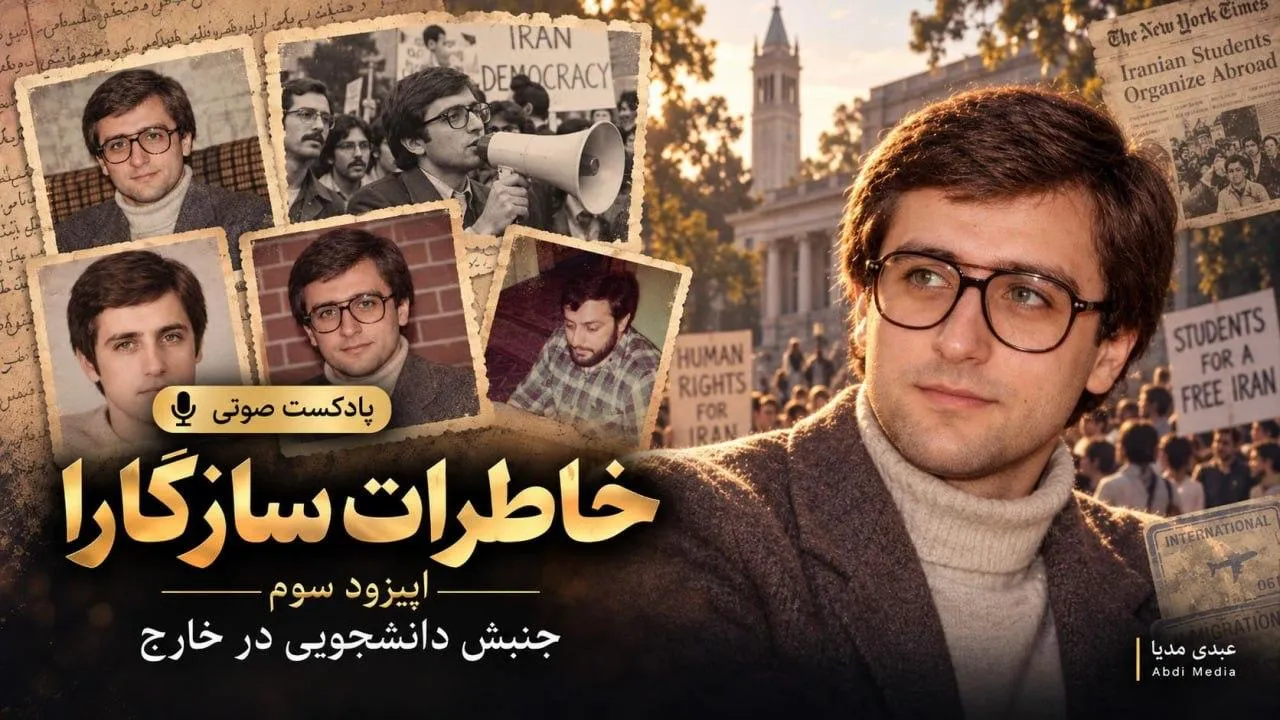
Episode 3: From Sharif University to America
It was the first time in my life that I had ever boarded a plane, and I arrived in New York. The flight was delayed, and I had missed the next flight I had booked from Iran, which was supposed to take me from New York to Washington. However, the airline itself got a hotel for me and said to go right in front of the terminal door, and the hotel shuttle, so to speak, would come pick you up. I stepped out of the airport door, and the first thing that caught my attention was the taxi drivers standing there, and I saw that their behavior was just like the taxi drivers in Iran. This thought crossed my mind that professions create certain behaviors that are common, regardless of whether it is in America, or in Iran, or anywhere else in the world. Later, I saw this in many other professions; for example, the behaviors of doctors have commonalities, or the behavior of pilots, or drivers, etc., etc. And I remember I was wearing a T-shirt that had BGSU written on it with jeans, I had long hair, and summer shoes as well.
It was an early morning flight, and I couldn't sleep until morning in the New York hotel room. I was stressed about waking up early, so I stood on the balcony of that hotel room. The salty smell of the sea was in the air, and the sound of New York City sirens continued until morning, meaning it is a night that never sleeps. I was dying to get up and go into the city to see what was happening, but I didn't have the courage or the time, though it was clear a large city was in a feverish state until morning. As Frank says, I want to wake up in a city that never sleeps. Anyway, in the morning I took a flight to Washington. I had to study for a month at a language school called American Language Academy, a language class, ALA. That was my first experience with 4 or 5 teachers; one taught grammar, one taught spelling, one taught composition and writing, and one was for conversation.
I remember the first time, because I didn't eat meat due to Islamic slaughter and such, one of the teachers was a vegetarian girl who said, I don't eat meat, it is like eating my brother or sister if I eat an animal. As a result, we were friends when it was lunchtime. I remember she said something good in class that is still in my mind; she said to the students, we were from all nationalities, she said, don't be ashamed to speak, no matter how many mistakes you make, we will understand. And remember, here in America, we are all foreigners, it is just that some came earlier, so don't think being a foreigner here makes a difference. During that month I was there, in the dormitory where the language class was held, the room next to mine had two Egyptian students. They were from the Egyptian army, they had received scholarships to come to America to study, and had come to language class. They spoke English with an Arabic accent, saying "ze" for "the", "ze go ze come". I became friends with them; it was my first experience. They talked about Egypt, they were big fans of Sadat, he had won the 1973 war, well, Sadat was their hero. Since we were Muslims, we had common ground.
It was my first experience with other Muslim and non-Muslim American countries, and it was good. Unfortunately, the experience I had later when I went to study and work was not as available to us because I was so immersed in the Iranian environment. Now, I think about it, and later when my own son wanted to go abroad to study, I gave him this advice: do not make our mistake. Go and mingle in societies, go test their culture, live in all different places with various nationalities. We were an Iranian revolutionary subculture; there were 50 to 100 of us in our own city, members of the Islamic Association of Students, and even when we went to university, we spoke to others only as much as necessary, rushing to get back to Iranian Islamic student activities, for example.
That one month ended, as I mentioned before, and it caused me to arrive late. I arrived late at the University of Texas where I had admission, so I traveled around America and ended up in Chicago, and then I went to IIT university.
In Chicago, the World Confederation of Students, whose founders actually started it in the 1960s, originated from the fact that the Iranian Students' Association, which the Shah's regime had created to help students, was assisted by embassies. They would rent places called Iran House to help new students when they arrived. Once a year in America, they would hold a Nowruz celebration in a hotel. When the Second National Front was formed in Iran and there was apparently some freedom, Ardeshir Zahedi, who was the ambassador to America at the time—since he served several terms as Iran's ambassador to America—came to give a speech. That year, Iranian students had been invited. In his speech, he also spoke ill of Dr. Mossadegh. Dr. Mossadegh was still alive, exiled in Ahmadabad. It was around 1960; the Second National Front had been formed in Iran, there was freedom, and Kennedy had come to power in America. A number of nationalist students had prepared beforehand to cause a commotion and disrupt things if Zahedi said anything. Ghotbzadeh and Dr. Shahin Fatemi, the nephew of Dr. Hossein Fatemi, were two of the students who were prepared. In short, when Zahedi spoke ill in his speech, they rushed him. Ghotbzadeh slapped Zahedi, a fight broke out, and things were smashed. The Nowruz ceremony was ruined. They told him, let this be the last time you speak ill of Mossadegh. From that point, because dishes and furniture were broken in the hotel, the embassy refused to pay, saying it was the fault of the opposition students who broke them, and the students said it was the embassy's responsibility because they arranged the venue. Right there, the nationalist students separated their path from the government, and the Iran Houses that existed became the headquarters for anti-government activities. That is, the student organization for Iranian students that the government had created fell into the hands of the government's opponents. Perhaps a similar case after the Islamic Revolution was the university student associations and the Office for Strengthening Unity. The student office was pro-regime in the 1980s, but after the end of the war, the opposition kids took over the Islamic associations and the Office for Strengthening Unity, and it became a student organization opposing the Islamic Republic government until the government, for example, shut it down.
That became the nucleus of the Student Confederation. Well, we had Marxist leftists, Muslims, and nationalists all in one place. In Iran, the Freedom Movement of Iran, which Engineer Bazargan, Ayatollah Taleghani, and Dr. Sahabi announced, created a party, but it was a member of the Second National Front. Abroad, Muslim students were also in one place with the nationalists and Mossadegh's followers. It was the same in Europe and the same in America.
In America, Dr. Yazdi, who had come to America two or three years earlier, had studied at Baylor University and was teaching there. Sadegh Ghotbzadeh was apparently in Vancouver, Canada, for a period but had come to America; he was in Washington, if I am not mistaken. I think Dr. Fatemi was in Michigan, but I am not sure. Dr. Chamran was also in America. Dr. Mostafa Chamran had been the top student at the Faculty of Engineering at the University of Tehran and had received a scholarship, as scholarships were given to the top students of the universities. He got his PhD from Berkeley and was teaching there. In Europe, for example, there was Dr. Habibi. In Germany, there were active Muslim kids like Mehdi Navvab, Karim Khodapanahi, and later England. Iranian students mostly went to Germany first, earlier they went to France, then Germany became very popular, then England became popular, and then Iranian students became numerous in America as well in the decade of the 1970s when I came to America. In England, the well-known figures of the Islamic Association were perhaps Dr. Soroush, for example. Kamal Kharrazi had also studied in America and got his PhD in England. There were Ahmad Attari and Enayat Ettehad; these are the ones I remember from the activists of the Islamic Association of Students in England, which grew large as the number of Iranian students increased.In different cities, opposition youth went and took over Iran Houses and turned the Iranian Students Association into a federation, and later a confederation was created between Europe and America. Then, because University of Tehran also, Engineer Tavassoli, who is now the Secretary General of the Freedom Movement, came as a representative to the annual congress, I think the 3rd congress of the Confederation, as he also came representing the University of Tehran, he was a student of the Faculty of Engineering at the University of Tehran, and practically it became the World Confederation of Students. The Confederation in fact became the student organization opposing the Shah's regime, whose internal structure included Nationalists, Religious figures, and Communists working together. But what happened was that each of these, their more active members, besides student activities, also had political parties, many of which were secret. The Tudeh Party of Iran, which was mostly in Germany and its leaders were in East Germany, Leipzig, and some were in Italy and West Germany, but a split occurred and after the separation of China and these things, a group had separated and created the Revolutionary Organization of the Tudeh Party of Iran, they were Maoists, that was another communist organization. Then, for example, the Union of Communists was created, in short, several communist organizations were created. The Muslims also, well in Iran the Second National Front ended in 15 Khordad and was suppressed, Bazargan and others went to prison, and these Muslims also secretly created the Freedom Movement of Iran abroad, whose founders were Dr. Yazdi, Qotbzadeh, Chamran, and others. The overseas branch of the Freedom Movement was a secret organization. Also, because the Second National Front became illegal in Iran and then the Shah shut it down after 15 Khordad 42, 1963, the Third National Front was created by Bani Sadr, and he also published an organ for it called Khabarnameh. The Freedom Movement's overseas organ was Payam-e-Mojahed. During the 60s, the 40s in the Iranian calendar, from the years 44 and 45 onwards, meaning the years 65 66, in Iran, well, young fighters of the Freedom Movement like Hanifnejad and Badizadegan and ?? the first three, Saied Mohsen and Badizadegan and Hanifnejad, and later 50 60 other youths, they gradually reach the conclusion that one must engage in armed struggle. The Communists separately move towards the idea that one must engage in armed struggle, and well, the model was Cuba and the dream was that you go to the mountains for a short time and return victorious, as a result, those abroad also became supporters of these, meaning the common currency of the day was guerrilla and armed warfare. The stirring and heroic literature of guerrilla and armed struggles is called terrorism today, but in those days it was heroism. But this quality where activists of various political organizations were abroad and simultaneously in the Confederation, as a result, they would recruit from students who came from Iran and entered the Confederation, everyone wanted to pull them towards themselves. The Muslims and Nationalists reached the conclusion that the Communists had taken over sensitive positions in the Confederation like the publication and such, and whatever these people did, they would take it and turn it Communist and take it into their own organizations, as a result, the big split, in a way it can be said the Nationalists separated from the Communists, and the Religious ones, they were together, gradually the Religious ones were also more active. The Nationalists also, Bani Sadr published its organ, but several National Fronts were gradually created. The Freedom Movement was a more organized place, the Religious ones in fact reached the conclusion to do this in 1968, the first time they were active in the Confederation, as for example Dr. Chamran had been elected as part of the permanent board of secretaries of the Confederation in America so that his activities would not be diverted at some point. It was known as the Berkeley Coup, one night the Communists conspired and kicked Chamran out of the Confederation, even though they were among the organizers and among those who founded it and worked hard to create this global organization, it was a good, brilliant organization because I always say the Shah was perhaps not the worst military dictator in the world, there were plenty of bloodthirsty, mustachioed dictators in those days, America was carrying out coups left and right in Latin American countries, the military would come to power, violent military men who committed murders, in Iran too, after all, America had carried out a military coup and brought back the Shah.
The Shah was such a military dictator, he was perhaps not the worst of the military dictators, but he had become the most famous military dictator in the world, mainly due to the activities of the Confederation and the Iranian students who were everywhere.As usual, just like now, the Iranian regime says dissidents are, I don't know, mercenary agents of the CIA or mercenary agents of Mossad. If you look at the Shah's regime's propaganda back then, they said the Confederation kids were agents of communism, the Soviet Union gives them money, and they are foreign servants, and stuff like that. Whereas, regarding both the communist kids and the Muslim and nationalist kids of the Confederation, I am one of the witnesses; I arrived abroad in the 70s, but the kids truly washed dishes in restaurants, did student work, and barely made ends meet to study and pay their living expenses. However, they were committed; we would set aside a few dollars a week and give it to the Confederation to cover its expenses if it had any. The Muslims were a bit luckier when they separated the Islamic Association and created their own organization because they also received help from religious taxes and the bazaar traders helped. Dr. Yazdi was the public face of the Islamic Students Association and the Freedom Movement abroad; Dr. Yazdi was Mr. Khomeini's representative in America. He collected religious taxes from doctors and Iranian Muslims. Students did not have religious taxes to give, but if there was a Muslim doctor, engineer, or businessman, Khomeini had authorized Dr. Yazdi to spend 40% of whatever religious taxes he collected at his own discretion.
Consequently, the Islamic Associations were in a better position. Nevertheless, for our current expenses, like the weekly meetings we had at the mosque, the kids had a membership fee from their student budgets, I think it was 5 dollars a month, but beyond that, the kids would help. If something happened and we wanted to do something, 50 dollars or 60 dollars would be collected, and they provided the costs from those tight student pockets. My point is that the Shah's accusations, like the accusations this regime makes, are the kind of talk that dictatorial governments always use to try to tarnish their opponents.
The Confederation and the activities of Iranian students abroad became one of those brilliant chapters that not only made the Shah the most famous dictator in the world but even many student organizations in the West, for example, the German kids, said they first established good relations with the leftist or other student organizations of the Western countries themselves, and then said the Iranian student model is a very good model. It had even become a pattern for student activists from other countries because this pain of fighting dictators, for instance, students from Latin American countries or other third-world countries, had the same issues. But the parties behind these organizations caused, gradually, first the big split of the Muslims and nationalists from the communists, then the student activities of the Muslims and nationalists became somewhat separated. The nationalists were under the name of the Confederation but had their own Confederation, and the communists were also branched out; there were several world confederations, and they all said we are the World Confederation of Students.
Consequently, when I arrived in America in 1975 after this introduction, Chicago was one of the places; it was a working-class city and a large city. Iranian students would come; many came to Chicago in the summers to work during the three-month summer break, or if they came to Chicago, they went to university because there was also a lot of work, they worked. As a result, it was one of the centers of student activity for students in America; it was a political city. But within the Confederation, there were three major lines among the communists, and if you went deeper into it, I had counted the various splits that existed in Europe and America; we had 17 Confederation lines; it had been torn to pieces. Of course, SAVAK was certainly very happy and was over the moon with such divisions.
The Muslims could also be said to have become three large pieces: one was the Islamic Students Associations, and another line was the Muslim Students Organization, whose leaders happened to be in Chicago. His name was Ali Jamali, and his brother Mohammad Jamali had played the role of Kaveh in a theater; they called him Mohammad Kaveh.They had branches and representation in two or three other cities, including ?? Dr. Mousavi Ardebili's son-in-law was their activist there. We called them Ali Jamali Nia, they were actually staunch supporters of the People's Mujahedin Organization and the armed struggle, and for this reason, they were closer to that left wing of the Confederation of communists who supported the People's Fedai Guerrillas; sometimes there were joint meetings. Their perspective on Islam was also similar to the Mujahedin-e Khalq, they used their works a lot. Of course, one of the interesting points about them was that apparently in the beginning, when Shariati's works were being reproduced in Iran and reaching America, I personally didn't hear it from Mr. Ali Jamali, but it seems he had access to them; in the meetings they held, he wouldn't say these were Shariati's works, he would lecture on Shariati's concepts, and it was very attractive, like Fatima is Fatima, or Ali is Alone. Later, when the Muslim Students Association established a book publishing office alongside it and reproduced and sold them in large quantities, everyone became familiar that these were Shariati's works through the book tables we set up at universities or alongside seminars and conferences.
The third line of Muslims were Bani-Sadr and his friends, who politically published the Third National Front, but in fact, it cannot be said—since Bani-Sadr was also Mr. Khomeini's representative in France—it cannot be said that they had fundamental ideological differences, for example, with the Muslim Students Association, but mostly in America, Alireza Nobari, who later became the Governor of the Central Bank, was a supporter of Bani-Sadr, and in Northern California, the branches of the Muslim Association in Northern California where Tajzadeh and others were, universities like Berkeley and cities in Northern California, there were some activities of Mr. Bani-Sadr's supporters in the Muslim Association in these branches, but they had disagreements, mainly influenced by the personal dispute Bani-Sadr had with Yazdi and Ghotbzadeh. Ghotbzadeh was also in France at that time, but I think the rift went back to a personal dispute; it was famous that Bani-Sadr said, I wrote the book Cult of Personality based on Yazdi and Ghotbzadeh, and Yazdi and Ghotbzadeh would say Bani-Sadr put a mirror in front of himself and wrote it based on himself. Incidentally, this book Cult of Personality is not a bad piece of writing. This was also a kind of third line. Especially in France, as the guys in Europe used to say, Paris is the seat of the grandees, all the famous people are there, Ghotbzadeh and Habibi would come there, and Bani-Sadr and others each had a clique around them and weren't very active in the student sphere of the Muslim Association. In Germany, by contrast, or England or Sweden where Iranian students had gone, it was more active; instead, in America, branches of the Muslim Association had been established in various cities, and by the years 1977 and 1978, the Muslim Students Association single-handedly—well, there was the wave of the revolution in Iran too, of course—but if we organized a protest, the guys would come from all over America, they would rent cars and come, we ourselves would rent a bus from Chicago and load it up and come to, say, a protest in Washington or go to an Association seminar in Texas. Truly, if the Association organization organized something, it was single-handedly more than all the Confederation groups combined; 5,000 people would show up, and the Muslim Students Association had grown.
Let me also mention this now that we are talking about the Muslim Students Association, before I get to my own position in the Association and my membership activities in the Freedom Movement of Iran abroad, honestly, Dr. Yazdi's role—he wrote about his actions in his memoirs too, of course—is peerless. That is, Ebrahim Yazdi was a man who worked tirelessly in America; he was among the founders of the Muslim Students Association. The Muslim Students Association had a good constitution. Wherever a few Muslim kids gathered, we called it an affiliated branch, so to speak, and since they had established a book publishing office separate from the organization, like a branch of the Sherkat-e Sahami-ye Enteshar in Iran, we had a printing press, an organization, and books. We had Shariati's works; when I reached America, the wave of Shariati's works had reached America, and in fact, I witnessed the impact of Shariati twice in my life in student environments: once inside Iran when I went to university and the wave was taking over the universities and as I said, we were printing them secretly. When I reached America, the reproduction of Shariati's works had begun, and I saw they were selling like hotcakes and the kids were reading them.We ourselves had developed a study method in Chicago, a new student coming from Iran had not seen it, it was secret. If we recruited them into the association, first we gave them "Father, Mother, We are Accused", they would become questioning. We knew that reading this, then you would give them "Martyrdom", then "After Martyrdom", the person would become thoroughly revolutionary, heated up, and get moving. Then the "Islamology" lessons, and you would move on to "Ummah and Imamate", I don't know, really by reading a course of 5, 6, to 7 books by Shریعتی, the person would become a full-fledged revolutionary. And then we would duplicate and distribute Shریعتی's tapes as well, it was a tool in our hands that the communists, who were our rivals, did not have. Furthermore, what we did to ensure the kids' time wasn't wasted, because the communists would come to recruit, especially when a new student arrived, we had done two or three things. One was that we had summarized the works of the communists; I taught the book "Elementary Principles of Philosophy" myself. We would say this is what they say, don't waste too much time. we had extracted a digest of the works of Lenin and Mao, we had read their collected works. Look, they say this here. Then, regarding the Confederation lines, we had created a small pamphlet, I had named it "Lineology" (Line-recognition), so the kids wouldn't get wandered, like, look, if this person comes to you, have this pamphlet, this guide. This CISNU issue, behind it is such and such Maoist organization, such and such Federation is behind that one, that one is that, the Tudeh Party is there, the Revolutionary Organization is here, and I equipped them.
But really, the theoretical weapon we had through Shریعتی developed the Muslim youth, it was one of the factors in the growth of the Islamic Association. I remember once, one of the activists of the middle line, who was actually from one of the major Maoist lines of the Confederation in Chicago, there was a ceremony, I don't remember on what occasion, in one of the universities. He was standing next to me, we were rivals, we even greeted each other. He told me, I want to tell you the outside judgment; they called us petty bourgeoisie, I don't know, said you aren't fighters, they would attack and disrupt our meetings saying you aren't fighters. But privately as we stood there, he said to me, "If we had a Shریعتی, we would have taken Iran with him." To be honest, I looked for him after the revolution but didn't find him. If I find him, I want to tell him that with that same Shریعتی, we took Iran and brought down the regime.
In any case, besides duplicating Shریعتی's works, Dr. Yazdi published the journal of the Islamic Association of Students, "Islam: A Militant and Productive School," which was published jointly between Europe and America, it had been coming out for years. And the duplication of tapes and various materials, well, Bazargan's works were also duplicated, but they were not comparable to Shریعتی at all. Dr. Yazdi himself was a man who, well, at that time was 40-some years old, experienced, and a political person. He traveled tirelessly around America, held seminars, visited every branch of the association, invited people, and in forming the Islamic Association of Students, its growth, and training the youth, certain points were also common in the association. For example, write reports, a series of basic management training, being on time, taking minutes, producing reports. It had found a good structure, it was organized and orderly. As Yazdi himself once told me after the revolution, "In the Islamic Association of Students, we actually trained a group of young people who were both committed, had received Islamic training, and the ideology with which the Islamic Revolution happened." In our association branches, our constant work was that the cultural secretary of the association would create pamphlets that everyone used. These were Quranic exegesis, history, history of Islam, Islamic political topics, and interpretation of current events and news, etc. These caused a group of young people to be trained who were both committed and equipped with the ideology of the Islamic Revolution, and were specialists, because in the association, unlike the Confederation where a person would get immersed in activities and forget about studying, and might not study at all, stay for several years and not even get a bachelor's degree, we were strictly careful in the association that the kids must study, that they wouldn't fall behind in their studies due to activities. As a result, many became educated, got good degrees, went to good universities, and those trained by the Islamic Association of Students in America and Canada, and later Europe, were more useful than anyone else to this Islamic Republic after the victory of the Islamic Revolution, because they returned to Iran and were also organizational people, had worked, and were employed in many suitable positions and jobs.
Thank you for listening to this part of the memoirs, I hope you listen to other parts as well. Until next time, goodbye.
Take less than a minute, register and share your opinion under this post.
Insulting or inciting messages will be deleted.
Sign Up