
In those days, there was a metal box they called the City of Culture. We would peer into the box through a circular opening. Pictures that came one after another.
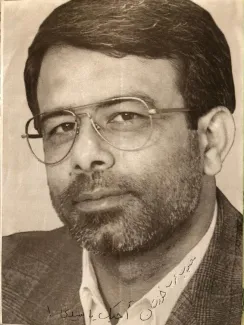
Memoirs and Experience-Narrative of Mohammad Kianoush-Rad, Representative of the Sixth Term of the Islamic Consultative Assembly
Rah va Rahavard
An Experience-Narrative of a Life
Mohammad Kianoush-Rad
Part Two
In those days, there was a metal box called "Shahr-e Farang." We would peer through a round opening into the box. Pictures came one after another. The Shahr-e Farang owner would explain the image. The first images we saw of the new world and the land of the Franks were exciting. Buildings, streets, gardens and parks—something I later saw excitedly on the cinema screen and enjoyed. The Shahr-e Farang owner, to attract customers, would say loudly: "The city is Shahr-e Farang, of all colors, come see Shahr-e Farang." We would line up. By paying money—which I now do not know how much it was—we would see the pictures in turn.
I spent my childhood in play and heedlessness. The game of Haft-Sang, the game of Choop Gatteh, the game of hide-and-seek, the honey lottery with a ten-shahi or one-rial prize, buying Qara from Mash Yadollah, buying the spiral Bamieh by chance, watching the champions' shows, chain-breaking, the merry-go-round and snake dancing, and so on—were a collection of our childhood amusements. A little later, going to the cinema and buying chocolate, soda, and sandwiches was another world. Pleasure, carefreeness, and heedlessness of the world. Being in the kingdom of God is peculiar to childhood.
When we were children, we liked to grow up. Now that we have grown older, how we long for our childhoods. When we were children, we saw the world as big. Now that we have grown older, how small the world has become.
In childhood, the nights of the month of Ramadan and its pre-dawn times were memorable. Eating warm walnut-stuffed dates and keeping "sparrow fasts"—fasts that were special to children and were broken by noon of that same day. After iftar on one of the nights of Ramadan, for the first time I became acquainted with something called a book. My father was a reader. He would narrate to us the story of Bijan and Manijeh, which is part of Ferdowsi's Shahnameh and was illustrated and colored and printed on high-quality glossy paper. He would turn the pages of the book and explain from the pictures.
My mother had an unbelievable belief in religion, God, and the Day of Judgment. Her love was prayer, supplication, and pilgrimage. Whatever we have of religion is a drop from the immense beliefs of my mother. She was simple, unadorned, and a people-person. The door of our house was always open to people. Managing life and the accounts and reckoning of the house was more in her hands than my father's. My mother, for religious reasons, did not allow the purchase of a television. Only after the revolution was a portable Toshiba television bought. Sometimes, to watch some series like "Khaneh be Doush" or "Morad Barghi" with Parviz Kardan, or "Sarkar Ostovar" with Parviz Sayyad, I would go to my uncle's house. Watching the Muhammad Ali Clay and Joe Frazier match, or the trial of Khosrow Golsorkhi in 1974, of course made my gaze in politics sharper and more acute.
The residents of Ferdowsi Street were mainly bazaar families and from the urban middle class and the economically upper class. Families like Ghabiti, Qadaksaz, Ahangaran, Asadinia, Mapar, Dobahri, and so on lived on this street. Abdolhossein Shamsi, Namaki, Marashi, Haj Nowruz, Eftekhari, Ghamishi, Bijan-Zadeh, Haddadian, Sane, Mahdavi, and so on were considered among the reputable bazaar families in Ahvaz.
Ahvaz in its historical past has had many ups and downs. In the book "Hudud al-Alam," its unknown author in 372 AH, describing the verdure of the city in those days, writes: "Ahvaz is a very verdant city, and in Khuzestan there is no city more verdant than this, with many blessings and a good nature and pale-faced people." But why did the author of Hudud al-Alam say further on: "They say whoever settles in Ahvaz, a deficiency falls upon his intellect." Perhaps his words indicate the hot and burning nature and the delicate imaginations of its people. God knows best.
"Ibn Hawqal" also in the book "Surat al-Ard" in the sixth century AH writes: "Ahvaz is a city known as Hormuz-Shahr and a large province and a vast region, such that other cities and the province itself are known by it. Now most of it has been ruined and its people have dispersed." Ahmad Kasravi in the Five-Hundred-Year History of Khuzestan writes: "The destruction of ancient Ahvaz is one of the mysteries of the history of Khuzestan."
From the era of Naser al-Din Shah, Ahvaz was placed on the path of development, and then with the transfer of the center from Shushtar to Ahvaz, in 1924 the modernization of Ahvaz gained double momentum. Ahvaz's connection with the center of the country was very difficult and agonizing. "Rawlinson" in his travelogue, "Passing from Zohab to Khuzestan," has well reported the difficulty of this journey.
The account of the journey of the representatives of the first term of Khuzestan in the Constitutional Assembly—namely Sheikh Abdolhossein Mo'ezzi Dezfuli, Seyyed Mohammad Ali Shushtari, and Sheikh Mohammad Ali Behjat—is worth reading. Nine people were chosen from Khuzestan, and three of them were selected and departed for Tehran. In the book "Izahat al-Shokuk wa al-Awham an al-Mashrutiyya Dawlat al-Islam" (Removing Doubts and Illusions from the Constitutional Government of Islam), Sheikh Abdolhossein Mo'ezzi, one hundred years ago, writes a treatise in defense of the constitution that, if we do not say it is equal to Naini's treatise "Tanbih al-Ummah wa Tanzih al-Millah," is undoubtedly one of the most credible books in defense of the constitution from a religious perspective—a book whose value and status, unfortunately, has not been recognized and has been less regarded.
A noteworthy point is that Mo'ezzi in the parliament, alongside the Moderate Faction and the Democrat Faction, establishes a new faction and party called the Liberal. From the time of the constitution until now, perhaps in Khuzestan, one cannot find a cleric equal to Mo'ezzi.
The problems of coming and going to Tehran in the past have played an important role in Khuzestan's falling away from the political developments of the capital. Even now, we Khuzestanis have not been able to seize the appropriate position of the province in the country's equations.
To be continued...
Take less than a minute, register and share your opinion under this post.
Insulting or inciting messages will be deleted.
Sign Up