
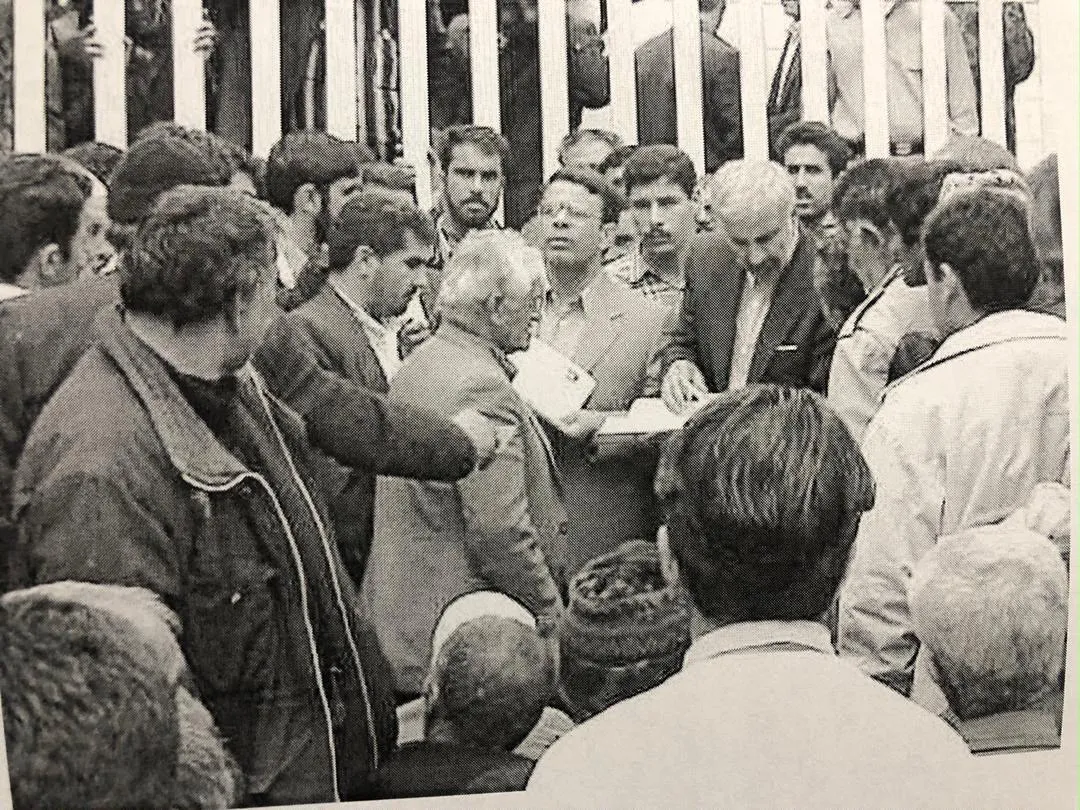
My father was not one to give advice. As Dinani says, "One who gives advice seems to be saying, I am better than you and I understand better than you."
Memoirs and Experience-Narrative of Mohammad Kianoush-Rad, Representative of the Sixth Term of the Islamic Consultative Assembly
Rah va Rahavard
(An Experience-Narrative of a Life)
Mohammad Kianoush-Rad
Part Seven
**The Magic Word**
My father was not one to give advice. As Dinani says, "One who gives advice seems to be saying, I am better than you and I understand better than you." My father had no such claim.
In his entire life, he advised me only twice.
One day my sister said something wise. This saying became an earring in my ear. Mehri said: "The outward appearance of all people you see is good. If you scratch a little and go inside them, you will probably see their bad sides, but when you go to the depth of people's existence, you see everyone as good."
Mehri's poems were read on Abadan Oil Radio before the revolution and published in Ferdowsi magazine. She was a friend of Tahereh Saffarzadeh. After the revolution, Mehri's poem was published in the middle school Persian textbook under the name "Mehri Karbalai." She is a Hafez scholar and Rumi scholar.
Our entertainment was swimming and football, and on summer nights in the first roundabout square, the kids wrestling with each other. There was no enmity; it was friendship. There were arguments, but we did not fight or clash. But between our neighborhood and the kids of the Officers' Quarter, meaning the other side of the ditch, war and clashes would sometimes occur. Like Red Indians, we would fall upon each other and throw stones at each other. The fights would start from high school and end at the border of the two neighborhoods, meaning the railway track. We had to have neighborhood zeal, otherwise we would be considered cowards.
The slingshot was our weapon. It was precise and effective. The stone-thrower was also a more advanced weapon. Once I joined the neighborhood kids. The result was that my forehead was split and my face was covered in blood.
Sometimes we would secretly escape from high school and go off to play. Our football field was in the desert and on today's Shahrivar Street.
Shushtaripour, the coach of the Water Organization team, had come to the field looking for players. He would watch the kids' games. He selected several people, including me, for the Water Organization's youth team.
In the "Iranian Youth Football Competitions, Pepsi Cola Cup," the Water Organization youth team participated. Our team was eliminated from the competition very quickly. The games were held on one of the side fields of Takhti Stadium.
In the summer of 1975, after finishing the first year of high school, I gave up playing football entirely.
Recounting the story of membership in the Water Organization team and playing or not playing is not very important, but its importance lies in why I abandoned this sport I loved. A reason that changed the course of my life.
In 1971, Dr. Ali Shariati's lecture at the Hosseiniyeh Ershad began with these words:
"Now the martyrs are dead and we the dead are alive. The martyrs said their words and we the deaf are their audience. They who had the audacity, when they could not stay alive, to choose death. They went and we remained shameless."
The power of Dr. Shariati's magic word at the Hosseiniyeh Ershad suddenly took me to another world. The world of politics and struggle.
After that, everything took on the color and scent of politics for me. Not only did religion become political, but any religion that was not political was condemned.
From adolescence I had a political understanding to my own extent. In the first year of middle school, it was the 2,500-year celebrations. They would gather the students and repeat the slogan "Long live the Shah." Behman Kardan—whose brother Nasser was political—I, and Kamal Kiarashi would say jokingly: "Long live the Shah" [with a pun meaning "Shut up, the Shah"].
Khosrow Golsorkhi's trial in 1973 caused an uproar.
Golsorkhi spoke of Islam and Imam Hussein to Abu Dhar and Salman and the liberation movements. We loved it. My cousin Amir said if I had a weapon, I would riddle the Shah with bullets.
I had heard the story of Mossadegh, the Shah, SAVAK, and the 1953 coup from my father. Golsorkhi's trial ignited the sparks in my mind. After that, Shariati kindled the fire of revolutionary anger in me.
In those days, I read every book that came into my hands. Religious and non-religious. Aziz Nesin's books, novels, the books of the Institute of the Right Path, the Maktab-e Islam magazine, and so on.
Shariati shook me, and I set aside many entertainments, including football.
My cinema-going decreased. On Fridays we would go to the cinema and then to Haj Habib's ice cream shop on Hafez Street. On the way back, I told my friend... let us go to Khayyam Restaurant and see what is happening. This too was a kind of adventure.
There it was buried in a haze of smoke. Tired, hopeless men, with sighs and pain, from the suffering of life, heads in their collars, fallen on the table, dazed and bewildered, outside the realm of life. The world of depression, the world of heedlessness. We had dinner and went home.
Our activity in the mosque expanded and became mixed with politics.
Mr.... was a member of the board of trustees of the Fatemiyeh Mosque. They said he was in contact with the police and SAVAK. He objected to our gatherings, which were held at night. Mehdi Rouhani and Ahmad Bidehandi were permanent fixtures at the gatherings.
It was an oppressive atmosphere. No one trusted anyone. There was an atmosphere of mistrust.
One day in the mosque courtyard, Mr.... turned to me and said: You are not allowed to hold political gatherings in the mosque. I was leaning against the wall.
I had my hands on my chest and my foot against the wall. I smiled and said, which political gathering? We do not discuss politics at all.
Angrily he said: Look, I am a cunning person. I will report that you are holding communist gatherings in the mosque. I will bring your father in.
I got a bit into a crouch. I took my foot off the wall. I looked at him directly. I said with surprise: Communist gatherings?
And then with a bitter smile, mixed with heedlessness and a bit of mischief, I said: Mr...., I had heard things about you. I did not believe it, but now that you say it yourself, I believe it. His face turned red. He wanted to say something but preferred to remain silent and angrily left the mosque. May God have mercy on him.
To be continued...
Take less than a minute, register and share your opinion under this post.
Insulting or inciting messages will be deleted.
Sign Up