Some artists had proposed designs for the official emblem of the country. The Prime Ministry organized a meeting to review them, in which Morteza Momayyez participated.
A group of artists had proposed several designs for the official emblem of the country. The Prime Ministry organized a meeting to review them, in which Morteza Momayyez participated. As one of our visionary and insightful designers and illustrators, he suggested that first, a few individuals knowledgeable in history and the past should offer their opinions, followed by an artistic review. Consequently, two more sessions were held, attended by several individuals invited by the Prime Ministry. Following the discussions, the participants' joint proposal was that Professor Mohit Tabatabaei should write a concise and organized summary of those deliberations to inform the government; the following is the text he authored, major parts of which were published in newspapers, including Bamdad.
September 23, 1979 Following prayers for well-being and success, pursuant to the invitation extended via memorandum No. 71145 dated September 29, 1979, to attend a meeting for selecting an emblem for the Islamic Republic of Iran, I attended the meeting on Monday, October 1, at 1:00 PM in Room 102 of the Prime Ministry’s administrative building. This session was attended by several professors of history, civilization, culture, and Islamic art, including Mr. Mostafavi (archaeologist), Dr. Shahidi (Islamic scholar), Mr. Iraj Afshar (palaeontologist/archivist), Mr. Yahya Zoka (art historian), Mr. Javadipour (design professor), Mr. Momayyez (design instructor), and Mr. Masoumi (painter).
Following the arrival of Messrs. Abolfazl Bazargan and Abdulali Bazargan representing the Prime Ministry, productive discussions began regarding the official emblem of Iran across different eras. The attendees debated the issue from various perspectives, and after an hour and a half of dialogue, reached the following conclusions for the consideration of the relevant authorities:
No banner, coin, seal, or emblem featuring the Lion and Sun motif remains from the Sassanid "Eranshahr" to have served as a precedent or model for Iranians of the Islamic period.
During the Islamic era, the distinguishing mark of Islamic governance was the color of the banner, garment, and turban, which appeared in white, green, and black. This third color (black) remained the symbol of the Abbasid Caliphate for over five hundred years without featuring any pictorial emblem.
During this long period, the Court of Baghdad served as the primary model for signs, artifacts, and customs which the emirs, sultans, and governors of various Iranian regions—who had risen to independence—were compelled to follow. The extent of their power and dominance did not influence this, as Sultan Mahmud of Ghazni, Adud al-Dawla of the Buyids, or Malik Shah the Seljuk considered themselves deputies of the Caliph of the time within their respective realms.
Among the dynasties subordinate to the Abbasid Caliphate, the Seljuks, following their nomadic traditions, featured a lion on their family banner. Traces of this were occasionally seen among the remnants of the Seljuk Atabegs inside and outside Iran until the 7th century. It is at this stage that the image of the sun was added to the lion's form, either due to the astrological relationship between the Sun and the sign of Leo (Asad) or for other reasons.
A sample of this composition in a motif inside Iran—predating the time of Ghiyath al-Din Kaykhusraw in Anatolia—proves that Bar Hebraeus's (Ibn al-Ibri) accounts regarding the Lion and Sun are as unreliable as his tales regarding the burning of the Library of Alexandria in the early Islamic era.
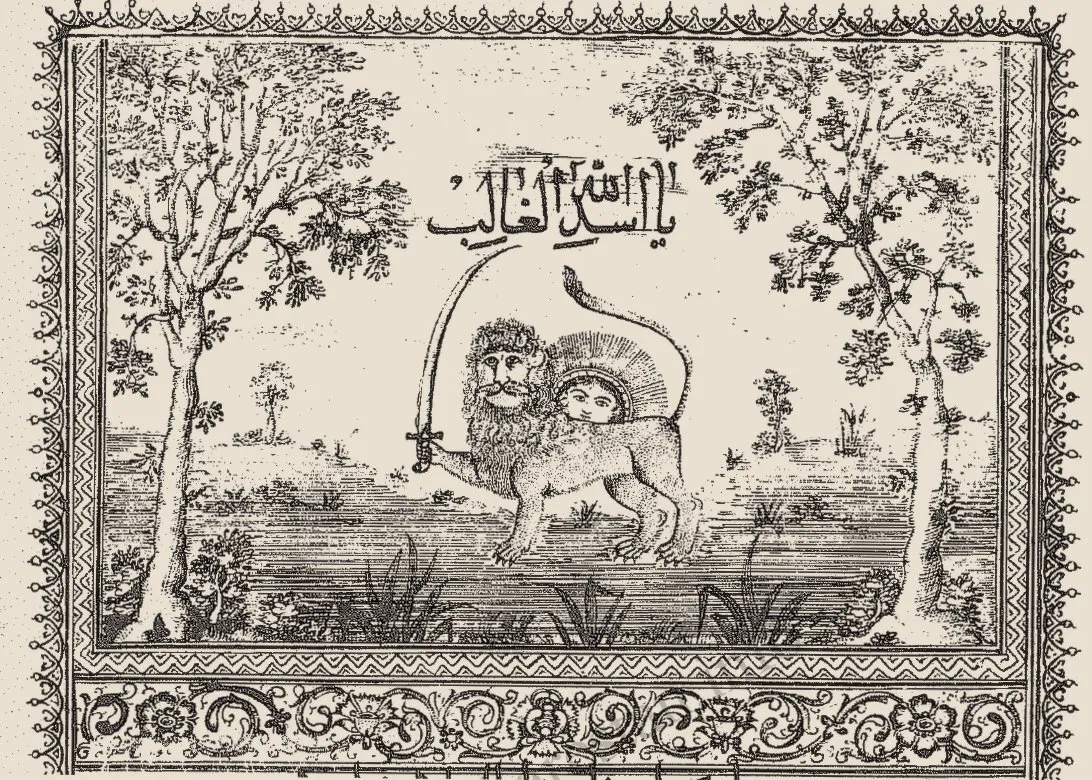
The presence of the lion on the Seljuk banner, which drew the admiration of Iranian poets, led the country's growing Shia population—who were awaiting an uprising—to view the lion as a calligraphic or symbolic representation of the beloved title of Imam Ali ibn Abi Talib, namely "Asadullah al-Ghalib" (The Victorious Lion of God). They found in this emblem a means to express their inner devotion. Consequently, during the Mongol period, they found two opportunities to feature the Lion and Sun motif alongside the names of the Twelve Imams: once on a coin minted by Muhammad Khodabandeh, and prior to that, on a coin from Abaqa Khan the Ilkhan.
Junayd, the grandfather of Shah Ismail and great-grandson of Sheikh Safi-ad-din, who spent a long time among the extremist Shias of Syria and Anatolia and oversaw the spiritual training of the Alawites of those lands, placed the Lion and Sun on his followers' banner when he sought to transform his ancestral dervish skin into an acquired throne. During the time of his son, Sultan Haydar, these followers were named Qizilbash and established the Safavid Shia state.
The Lion and Sun banner of the Safavid dynasty, who were promoters and protectors of the Shia faith, stood in contrast to the Crescent of the Ottoman flag (recognized as the symbol of Sunni Muslims) and was recognized as the emblem of the Shia state of Iran for three centuries...
From the Safavid era to the Qajar era, Iran's Lion and Sun stood on all fours on banners and lay recumbent on copper falus coins, carrying no sword. During the time of Agha Mohammad Khan, the sun was adorned with the name "Mohammad" (PBUH) and the lion with the name "Ali" (AS), suggesting to the faithful viewer that the sun symbolized Prophecy (Nubuwwah) and the lion symbolized Guardianship (Wilayah)—the Lion of God.
During Fath-Ali Shah's reign, the Lion and Sun banner was accompanied by the Zulfiqar banner. In the middle of the last century, these two banners and motifs were combined into a single flag featuring a Lion and Sun holding the Zulfiqar sword. Previously, the sun's disk was decorated with human features (eyes and eyebrows), but during the Constitutional Revolution, it was simplified and stripped of those features, as it appears today.
The Lion and Sun emblem, which for five hundred years has been recognized as the sole emblem of the only Shia country in the world—Iran—was approved by the representatives of the First Majlis during the ratification of the Supplementary Fundamental Laws in 1907. Among them were several Mujtahids and scholars of the Shia faith. Clearly, had they perceived any prohibition or issue in its retention, given the immense freedom the representatives of the first period enjoyed, they would certainly have voiced their opinions (which would have been printed in the parliamentary records) and, if necessary, refrained from its approval.
Five hundred years ago, after defeating the Eastern Roman Empire, the Ottoman Turks changed the name of Constantinople to Istanbul and converted the Church of Hagia Sophia into the Hagia Sophia Mosque; however, they preserved the Crescent, which was a symbol of Eastern Roman greatness, as their heritage. Fifty years ago, when they abolished the Ottoman monarchy and caliphate and founded the modern republic in place of the constitutional monarchy, they were willing to remove religious artifacts from the Hagia Sophia Mosque, but were unwilling to change the Crescent, which over five consecutive centuries had become the symbol of the Islamic religion to the Christians of the world.
Based on this brief history, the Lion and Sun has been continuously introduced to the world for five hundred years as the emblem of the Shia country of Iran. Iranian Shias, from the mystics to the common folk, have viewed it as a sacred relic, choosing it to adorn their religious, mystical, and ethical books. In the face of the Red Cross of Christian states and the Red Crescent of Muslim countries, they have identified their "Crimson Lion and Sun" to the world as the symbol of the only Shia Muslim nation. Therefore, it is appropriate now—as the Constitution of the Islamic Republic of Iran is under approval—that the authorities and members of the venerable Assembly of Experts, out of respect for the status this emblem has provided for the Shia religion and the Iranian Muslim nation over centuries, view the Lion and Sun with the same reverence and respect as did the great Ayatollahs and Hujjat al-Islams of the Constitutional era... and that they do not consent to any fundamental alteration of its internationally recognized form, approving it to be added to the approved colors of the national banner.
With highest regards, Mohammad Mohit Tabatabaei
Additionally, Dr. Seyed Jafar Shahidi noted the following points as a supplement in a letter:
Since the end of the Mongol era, throughout the Safavid era, and into the Qajar era, the Lion and Sun has been considered a symbol of the Shia faith. Mohammad Shah Qajar placed a crown above the Lion and Sun at the start of his reign, seemingly to indicate that he was the King of a Shia-religion country. Thus, the Lion and Sun was a symbol of the religion and the nation, not an emblem of the government.
The existence of flags, inscription covers, and carpets adorned with the lion or Lion and Sun from three hundred years ago—used in Tekyehs, mourning ceremonies (Rowzeh), and Ta'zieh—confirms that the Lion and Sun is a religious symbol, not a political one.
It appears that the presence of the sun or half-sun atop inscriptions and above the mihrabs (prayer niches) of some mosques is an allusion to the "Light of Alawite Guardianship" (Forough-e Wilayah).
When the late Momtaz al-Dowleh represented Iran at the Red Cross Union, he exerted great effort to have the Lion and Sun accepted by other members as an equivalent to the Ottoman Crescent. Given that the Cross is a religious symbol rather than a state one, it becomes clear that the Lion and Sun was proposed to the Red Cross organization because it is a symbol of the Shia faith, not because it was the political emblem of the King and the Iranian government.
With these explanations provided, there remains no doubt that for six centuries, the Shias of Iran have utilized the lion or the Lion and Sun, likely as an allusion to "Asadullah al-Ghalib" (Ali ibn Abi Talib) and the "Sun of Guardianship."
Seyed Jafar Shahidi ["The Motif of the Lion and Sun," Ayandeh Magazine, Vol. 5, pp. 703-708] Dr. Mahmoud Afshar Foundation; for the Promotion of Persian Language, Strengthening National Unity, and Territorial Integrity.

Take less than a minute, register and share your opinion under this post.
Insulting or inciting messages will be deleted.
Sign Up