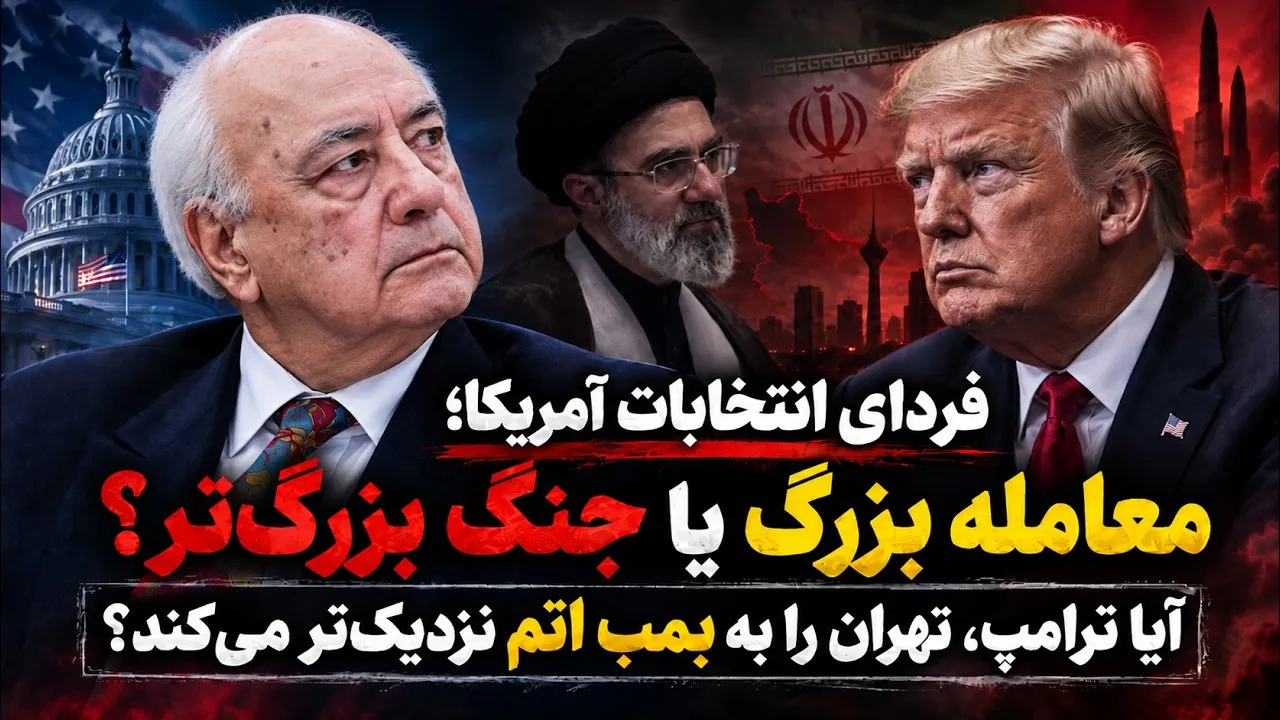
If Iran had a nuclear bomb, Trump would have had to speak more politely to Iran's leader. Now the question is: is Trump himself leading Tehran to the conclusion that security can only be achieved with a nuclear bomb? On the other hand, the U.S. election is approaching, the war continues, the Strait of Hormuz has become a stage for displays of power, and Mojtaba Khamenei and Donald Trump are moving one step closer to a more direct confrontation every day. What will happen after the election?
If Iran had an atomic bomb, Trump would have had to speak more politely to Iran's leader. Now the question is: is Trump himself leading Tehran to conclude that security can only be achieved with an atomic bomb? On the other hand, the U.S. elections are approaching, the war continues, the Strait of Hormuz has become a stage for displays of power, and Mojtaba Khamenei and Donald Trump are moving one step closer to more direct confrontation every day. What happens after the election? Will there be a grand bargain? Or a great war? As you saw in the title of this discussion, or will Iran enter a stage from which there is no return? That was the title of our program, and tonight I want to talk with you about it.
If frank, independent, and uncompromising discussions about what is happening to Iran and to our lives matter to you, please subscribe to Abdi Media's channel right now and like this program. Send it to your friends. Help spread awareness, because Abdi Media, together with you, who are countless, makes it possible for more people to hear these conversations.
Let's get to the heart of the matter. Sometimes in politics, one sentence matters more than a hundred missiles. A missile only demonstrates destructive power, but a sentence can reveal the logic of power. Donald Trump said something about Iran today that may be more significant than he himself realizes. He said that if Iran had nuclear weapons, he would have had to call Iran's leader and speak to him in a completely different tone. The question is this: when the President of the United States openly admits that having an atomic bomb can change the behavior of a greater power, what message is he sending to Tehran? Is Washington, in trying to prevent Iran from becoming nuclear, unintentionally leading Tehran to conclude that the only thing that can prevent the next war is the very bomb that America does not want Iran to obtain? But the equation is not only nuclear. In America, the midterm elections are ahead, energy prices and the continuation of the war have become domestic issues, and Trump has linked the possible end of the war to after the U.S. elections. At the same time, attacks around the Strait of Hormuz have intensified, ship traffic has declined, and oil prices have once again risen under the impact of the conflict. Just moments ago, we saw Brent crude reach $107.
In Tehran, too, the issue is not only war with America. A new leader is facing a heavy legacy. In the first months of his leadership, Mojtaba Khamenei has questioned the credibility of Trump's commitments and said that the signature of the American president is worthless. Now both sides are standing more firmly than ever not only over the nuclear program and the Strait of Hormuz, but also over their own credibility, authority, and political prestige. In the meantime, an old question has resurfaced: when Ayatollah Ali Khamenei spent years saying that America's issue was not only the nuclear program, and that if Iran retreated on one front, the next demand would begin, was he presenting an accurate picture of Washington's logic? Or was it the Islamic Republic that, through its own policies, turned his prediction into reality? From threats to return Iran to the Stone Age, to claims of controlling the Strait of Hormuz, and even the proposal to rename it the Trump Strait, from economic pressure to the possibility of another attack on nuclear facilities, today the line between diplomacy, threats, and war has become so thin that sometimes it is difficult to tell which is which.
My question tonight is not only whether the war will end or not. The more important question is: what awaits Iran after the U.S. elections? A great war? A grand bargain? Or something even more dangerous than these: a war that is no longer an incident but has become the normal condition of a country. My guest tonight needs no introduction. You know his face, you know his name. For years, he has viewed foreign policy through this very relationship between power, rationality, and interests. Mr. Fereydoun Majlesi, former diplomat at Iran's Ministry of Foreign Affairs, writer, translator, and international relations analyst, someone who in recent months has repeatedly spoken of the necessity of normalizing Iran's relations with the world. He has warned that independence is not only missiles and military capability, and has emphasized that a country that cannot trade, preserve the value of its currency, and create a predictable life for its people loses part of its real power. Just a few weeks ago, he wrote and expressed this very important phrase: that chronic war, even without bullets being fired, can gradually bring a country to its knees.
When the President of the United States says that if Iran had an atomic bomb, he would have had to speak to Iran's leader in a different tone, isn't he himself providing the strongest possible argument to supporters of nuclear weapons in Tehran? Why shouldn't a government under attack conclude from the words of the President of the United States that an atomic bomb is a guarantee of survival?
Fereydoun Majlesi: In response to your question, I should say that what Trump says, writes, or posts on Twitter cannot be interpreted in such a literal way. What he is actually saying is that we will absolutely not allow Iran to obtain nuclear weapons. In other words, he is saying that because we do not want Iran, and because we want Iran to enter negotiations in a state of surrender, if it had an atomic bomb, I would have had to deal with them differently, in a way that goes beyond the policies and reasons they have so far used to oppose Iran's nuclearization. His statement is actually an emphasis on the policy they have pursued until now and continue to pursue, and it is a continuation of threats whose roots lie in Israel. Therefore, I do not see it in the literal sense that some people might infer. Although I know that in Iran there are forces, individuals, and institutions that, even before Trump made this statement, had in the latest phase of announcing their policies publicly supported Iran's nuclearization and its possession of nuclear and atomic bombs. Personally, whether by nature or because of my diplomatic upbringing, I detest threats and violence, and I hope we never resort to such a course. Nor do I think that under the current circumstances the situation is such that we could. Of course, I know that there are large quantities of enriched uranium available. Without needing to be turned into a nuclear bomb, this has the capability of being converted into other deadly weapons, which are also subject to international prohibitions on use, and like chemical gas, the use of these weapons is both prohibited and unacceptable.
Regarding the continuation of previous threats, I say that I hope they will perhaps soften Iran's positions, and that with the continuation of the talks that were unfortunately interrupted, whether because of the attack on cargo ships, or because they used that as a pretext and violated the agreement, whatever the reason may have been, I hope the continuation of negotiations will return us to a peaceful solution. I know that both inside and outside Iran there are two completely and apparently opposing groups that want Iran's issues to be resolved through war. I do not want any more damage to come to Iran, to the lives of Iranians, to the hopes of Iranians, and to Iran's future. For this reason, I hope that those who support peace and Iran's continued integration into a normal international life will prove effective, and that in the end rationality will prevail in this country.
Abdi Media: You pointed out an interesting point. It reminded me of that sweet Persian proverb: in Tehran, and of course in Washington and some other countries, some people dance before the music even starts, let alone when Trump's statements or other remarks are added to it. It could be an indication that they insist on their own interests or wishes. But in your recent remarks—you are a diplomat—you know that the leader of a government, even if he makes contradictory statements, those very statements become the basis for deep analysis and examination. Trump says the war may end after the U.S. midterm elections. This statement may also have no basis, because he has repeatedly said the war will end soon, and at times he has not even used the word "war" and has called it a military operation. At the same time, Trump accuses the Islamic Republic of wanting to influence the outcome of the U.S. election. Doesn't this mean that the war between the United States and the Islamic Republic of Iran has effectively entered American domestic politics as well, and that the timing of war and peace has become part of Washington's electoral calculations? Can that interpretation be made?
Fereydoun Majlesi: Yes, that interpretation can be made. The reason is that Trump insists that Iran wants—or that his opposing party wants—to use these circumstances for its own electoral benefit. This is more of an excuse-making. They feel that he will lose this election. The reason is the problems he has created for the United States, for the American economy, and for America's international relations, and he has made the U.S. president a subject of public ridicule not only abroad but sometimes within his own country as well. His statements, his claims, his disputes over the Panama Canal, Greenland, and... everywhere, even regarding the Strait of Hormuz, which he had named the Trump Strait for himself, or the Gulf of Mexico—well, the world laughs at these things, and inside America they are a source of embarrassment. The votes of more enlightened, more rational circles, people with greater social ideals, those who are forward-looking and educated—after all, America is not only advanced economically; America is highly advanced in science, technology, legal matters, sociology, economics, and so on.
The masses who voted for Trump are actually the ones who suffer the greatest harm from these economic ups and downs in America, and for these reasons he knows—the polls have told him, his think tanks have told him—that the statistics show his chances of winning these midterm elections are slim. He wants to place the responsibility for this on the ill will of the rival party, the Iran war, and the unfriendly propaganda of countries from which he expected cooperation and friendship. This is more of an excuse. But as for whether the election result will have a major impact or not—when he says that if they win, the war may end, perhaps he says this knowing that they will win, and that the decision to end a war that amounts to an admission of a kind of defeat for America—without there being any reason to call it a victory for Iran, because Iran's victory would be that its country is not harmed, does not suffer damage, its people are not killed, and its welfare is not destroyed. Those are successes for Iran. But if, despite these losses, the enemy fails to achieve its objectives, that is a defeat for the enemy. Still, we cannot count such a situation as a victory. These are two separate points that must be distinguished.
Perhaps he is making hints that they have been forced to set aside the saber-rattling. But now the rival party has come along; they oppose this approach, and I will end this war. Yet whether this war ends or not will not resolve the fundamental problem. The fundamental problem is that Iran has been dealing with this situation in the region for more than 40 years, repeatedly advancing, retreating, advancing again, suffering damage, while others have progressed and Iran has at least not progressed as much as they have. Large amounts of national capital, oil revenues, and so on have been spent in various places. We hope that whenever this situation is stopped, that will reduce the damage. Wherever it is stopped, it is a benefit—for the nation and for the future.
I hope the main reasons are reconsidered, not that you want to see them. Supporting the rights of the oppressed has its place, but fighting for these values on behalf of others and at the expense of national interests is something I hope we have learned enough lessons about.
Abdi Media: You have a very attractive characteristic for me as a student of politics and history. I am extremely interested in these two fields, and I had followed you for more than conversations, and your experience, of course, all of this is completely evident from your expression, your speech, and your white hair. You were a diplomat before the 1979 Revolution, the Islamic Revolution in 1979, and in fact you were sent by the Ministry of Foreign Affairs to Washington. You worked there as consul general, and you also studied at Georgetown University in the field of American history. More importantly, after the Revolution, that is, after the victory of the Revolution, you returned to Iran and were one of the negotiators in the affair and incident of the U.S. Embassy hostage crisis. Have I stated the facts correctly so far?
Fereydoun Majlesi: Well, I was never consul general. I was too young to be consul general. As the official in charge of consular affairs, or consul, which is an internal matter within the embassy, I handled that work for a while in Washington. After returning to Iran, my assignment was with the European Union. I spent four years in the European Economic Community as second secretary, and by the end I was first secretary. Then, at the beginning of 1979, when the period of the Revolution's intensification and its eventual culmination began, I returned to Iran.
Abdi Media: I am very curious about your role in the hostage crisis negotiations. Did you play a role? Were you present?
Fereydoun Majlesi: As a political officer, by chance, when the U.S. Embassy incident occurred, the matter was brought to me as the duty diplomat. The next day, when Yazdi returned to Iran and the Swedish ambassador came to express regret and protest to him, according to diplomatic protocol there always had to be a diplomat present, and I was assigned to write the report of that meeting. At first, these matters were handled with the Swedish ambassador, who was later replaced by the Swiss ambassador, and Switzerland became the protecting power for U.S. interests in Iran. Until the end of 1979, while I was still at the Ministry of Foreign Affairs, I was present at all these negotiations as a witness and the person writing the reports. At that time, negotiations were not conducted the way they are now, where both sides had already prepared their positions in advance and knew who would participate and what role they would play. We knew that the ambassadors who came were coming to protest. Their request was mediation for the release of the hostages. They were colleagues of theirs, and they wanted the fundamental principle of international politics—which Iran itself had pioneered since the Sasanian era and even the Parthian era, when diplomatic exchanges took place between Iran and Rome. There were no other countries then, except for a few places in India and, far away, China, where occasional contacts existed. The continuity of this principle was astonishing for the diplomats who came. At that time, I did not know I was doing something historic and witnessing a historic process. But later it became clear that all such events, when you are present in them, become history; their narratives become history. It was educational for me. I also wished that the matter could have been resolved at that time, but it dragged on and was settled years later, after I had already left the Foreign Ministry, after 444 days. What was not acceptable to me was that we both released the hostages and allowed our thirteen billion dollars in foreign currency deposits in America to be used to pay compensation to American companies, instead of having the cases heard in Iranian courts, placing them under the jurisdiction of international arbitration in The Hague. And the diplomats were released without the Shah returning, without any reciprocal action taking place, merely with a standard condition of global diplomacy: non-interference in each other's internal affairs, which does not require a treaty, reciprocity, commitments, and so on.
Abdi Media: Perhaps what is more important for me at this historical juncture, when once again we are living through history, at a time when Iran has come under attack by foreign forces, is this question: To what extent do you think history is repeating itself? Is the Islamic Republic this year, right now, repeating the same behavior? Beyond the outcome that was, in a way, Jimmy Carter's political defeat in the next election, after the election, the day after the election, the hostages and those who had been taken hostage from the U.S. Embassy were released. Is the Islamic Republic also seeking to repeat history? Are the circumstances similar? Is it hoping Trump loses the election and considering that an achievement? At that time, Mr. Khomeini also regarded Carter's defeat as a strong point of the whole affair. There was also the Tabas incident and other events. Can we draw a historical parallel, or do you think the Islamic Republic's current behavior is a repetition of that historical event?
Fereydoun Majlesi: The conditions of one era are never the same as those of nearly half a century earlier. Therefore, the circumstances cannot be repeated exactly, although there may be similarities. Carter lost the election, but the release of the hostages coincided with the moment Reagan was taking the oath of office on January 20 of that year. He had also made a major threat. Simultaneously with his presidential oath and inauguration, the hostages were released in that manner.
At that time, the hostage-taking was a tool for consolidating power, one that managed to preserve the core of power in Iran. The Islamic Republic had indeed come to power through a nationwide revolution, but within it were ideas and ways of thinking shaped by 50 years of different experiences during the Pahlavi era. The influence of the left had become very strong. The Tudeh Party, although it had been defeated and was not in Iran, had quickly reestablished itself abroad and managed to regain a presence by recruiting new members. Communist guerrillas were active in Iran, and although they had been thoroughly crushed through heavy casualties, street clashes, executions, and so on, after being released from prison they were able, especially in universities and among young people, to gain significant influence, generate excitement, and attract supporters. At that time, it could be said that the leftist slogans voiced by internal supporters of the Islamic Republic could, in some cases, neutralize the actual leftists. This greatly contributed to stabilizing a system that relied on a very large majority, a very large majority that was committed to the slogan of Islamic identity, a majority whose identity, whether when they lived in villages or later became part of the urban population, was primarily rooted in religion. They followed the religious clergy, and the struggles that unfolded ultimately worked in favor of that majority, which had also demonstrated in the referendum just how overwhelming it was. The referendum passed with a 98 percent majority. Even if those who opposed it, abstained, and so on were counted, the result could at most have fallen to around 90 percent, and subsequent elections also reflected this.
But now, after 50 years, that initial duality that allowed the more left-leaning, more radical, and more hardline forces to prevail and secure a privileged position for themselves gradually changed from within. Once they took power, once they assumed the responsibilities of governing, and once the demands of governing forced them to engage with the world, they needed imports. Then, because the war began very soon afterward, they needed spare parts, military equipment, and purchases that would allow them to continue the war. We even see, in the McFarlane affair and other indirect episodes, how those purchases were directed toward Iran, and how other groups, paramilitary forces from third countries, became involved. All of this gradually led to the emergence of a pragmatic group, a genuinely political group that understood realities and wanted the country's political life to return to and move closer to the normal course of global politics.
This prompted reactions from the opposing group, the hardliners. Their punishments of those who disagreed with them or whom they perceived as threats—all of this led them to react, and a duality and rivalry took shape within the system. Even the Islamic Republican Party, which had been established as a broad single-party organization that critics had nicknamed the "Islamic Rastakhiz," gradually developed the idea that if there was to be a party, it should hold governing power, and the government should implement the party's decisions and directives. This way of thinking led the clergy, who had gained somewhat freer rein, become more hardline, and tasted power more deeply, to refuse even to tolerate the party they themselves had created. They eventually brought about its dissolution, and afterward the government once again began moving toward what could be called a more conventional political life, with developments unfolding contrary to the initial expectations.
Look, when governments come to power, even in democratic systems, every government comes to power through the people's votes, stands alongside the people, attracts the people, gets votes from the people, and becomes the government. One thing that is ordinary, but not well recognized in non-democratic countries, is that from the moment a government is formed, it stands opposite the people. A government that wants to continue working alongside the people can no longer reform affairs. From the moment it stands opposite the people, well, criticism, conflicts, and problems also begin. They consider these criticisms, problems, and even conflicts to be normal matters. At most, four years later another group comes to power, and this process is repeated with them, or if they can maintain the people's satisfaction, they are elected again.
Selective elections among those who wanted to be considered trustworthy by that principlist group and so on had gradually created the suspicion among the people, along with the propaganda of radio and television, that the entire nation wanted that way of thinking. But gradually, with the developments that took place within the government, a so-called developmentalist way of thinking, a focus on construction, emerged within principlism during Rafsanjani's presidency, which ultimately, in a later election, perhaps to the astonishment of the principlists, led to Khatami's major victory. These victories and defeats did not have an ideological reason from the voters' point of view, but they taught them this lesson: that in the face of that principlist group, who considered themselves the complete will of society, you are the majority. You are not the minority. You support the Dialogue Among Civilizations and endorse it. You want a return to ordinary life. You want the implementation of this very Constitution and whatever the existing situation may be. This issue became a turning point, and this duality that emerged in society never disappeared. It was always there and still is. At one point it appeared as the field standing against diplomacy. At another point it led all the way to the JCPOA, generating support. People anxiously awaited those days, fearing that it might not be signed, because it was hanging by a very thin thread and could have snapped at any moment, leaving people disappointed. But from that very moment, when the foreign minister who had negotiated and signed it returned to Iran, he was greeted at the airport with a thrown shoe.
Something that was apparently an Arab custom; perhaps they had learned the act of throwing a shoe as an insult from them. After that, the JCPOA began, the doors opened, companies came, initiatives started, and once again, from within that system that was worried that these desires for prosperity, these early slogans that stemmed from a dualistic outlook—prosperity versus faith—might prevail, a missile was launched with the very opening slogan of the Iran-America disputes written on it, namely that Israel must be wiped off the face of the earth, written on the missile in Hebrew, Persian, and English. Well, that slogan left no room for reconciliation. For this reason, we see how companies left, embassies closed, security operations abroad took place, they happened in Vienna. These were more than being directed at the objective of those who were harmed or eliminated by those actions; they were aimed at striking this way of thinking that apparently was moving Iran toward becoming normal.
English translation:
Look, when governments come to power—even in democratic systems—every government comes to power through the people's votes. It stands alongside the people, attracts them, wins their votes, and becomes the government. There is, however, one ordinary reality that is not well understood in many non-democratic countries: from the very moment a government is formed, it stands opposite the people. A government that tries to remain alongside the people throughout its tenure can no longer reform affairs. From the moment it stands opposite the people, criticism, conflicts, and problems naturally begin. In those countries, these criticisms, problems, and even conflicts are considered normal. At most, another group comes to power four years later and the same process repeats itself with them; or, if they manage to maintain public satisfaction, they are elected again.
Gradually, elections that were selective and limited to those deemed trustworthy by that principlist group created the impression among the public—reinforced by state radio and television propaganda—that the entire nation wanted that way of thinking. But gradually, as developments occurred within the government itself, a development-oriented, reconstruction-minded current emerged within principlism during Rafsanjani's presidency. Ultimately, in the next election, perhaps to the astonishment of the principlists, this led to Khatami's major victory. From the perspective of voters, these victories and defeats were not ideological. Rather, they taught people this lesson: that against the principlist group who considered themselves the complete embodiment of society's will, they were actually the majority. They were not the minority. They wanted the Dialogue of Civilizations and supported it. They wanted a return to ordinary life. They wanted the implementation of this very Constitution and whatever existing order there was.
This became a turning point. The duality that emerged within society never disappeared; it was always there and still is. At one point it appeared as the confrontation between the military sphere and diplomacy. At another point it led to the JCPOA. It generated public support. People anxiously waited, fearing that the agreement might not be signed, because everything hung by a very thin thread that could snap at any moment and leave people disappointed. Yet from the very moment the foreign minister who had negotiated and signed the agreement returned to Iran, he was greeted at the airport with a thrown shoe.
Apparently, this was an Arab custom—perhaps they had learned the act of throwing a shoe as a form of insult. Then the JCPOA began. Doors opened. Companies arrived. Initiatives started. Once again, however, from within that same system that feared prosperity and worried that the original revolutionary slogans—born of a dualistic outlook that placed prosperity against faith—might prevail, a missile was launched bearing the very slogan that had marked the beginning of Iran-U.S. disputes: "Israel must be erased from the face of time." It was written on the missile in Hebrew, Persian, and English. Such a slogan left no room for reconciliation. That is why we saw companies leave, embassies close, security incidents occur abroad, including in Vienna. These actions, more than targeting those who were harmed or killed, were aimed at striking the mindset that seemed to be moving Iran toward becoming a normal country.
Therefore, today we are in a situation where, more than ever, those who still remain within the hard core of power need to understand that not only have domestic conditions changed, but they must not imagine that the public support people sometimes show for purely national issues is permanent support or genuine endorsement of their confrontational policies. At the same time, they should understand that internationally we are not an all-powerful superpower. Contrary to those slogans I hear these days when returning from my office—"We are a superpower, we are a superpower, we are a superpower"—this should not become self-deception.
Why should we be a superpower? We are one percent of the world's population. We are one percent of the world's land. We account for less than half a percent of the global economy. Why not increase that half-percent to one percent? Why not raise one percent to two percent? Why not use our six to seven percent share of the world's strategic resources to raise our economy to four percent of the global economy and reach a much higher level? Why should we not be more advanced than France, whose population is now smaller than ours, whose territory is one-third of ours, and whose resources are fewer than ours? Why should we not become their equal? Why should we fall behind the world and cut ourselves off from global connections?
That does not allow us to reach our main objective. Defensive and military capability must rest firmly upon economic capability, not the other way around, where economic capability is sacrificed for military power. That military power will gradually diminish if it cannot be renewed and sustained.
We now live in a world very different from fifty years ago. Back then we were surrounded by poor countries. Turkey, Iraq, Saudi Arabia, the UAE, Oman—all were among the poorest countries in the world. Today they are among the richest. Even Iraq, with daily exports of five million barrels of oil and the facilities being developed, especially in southern Iraq, along with investments that will undoubtedly create employment, will certainly follow the path of the UAE, Kuwait, and Oman with even greater resources.
We should benefit here from an advanced Turkey. We should benefit from Iraq's wealth, Kuwait's wealth, Saudi Arabia's wealth. We should be exporters to them and importers of the goods they now produce in abundance. Today Saudi Arabia has something to say in industry, petrochemicals, agriculture, meat, cheese, and dairy production. It is an exporter. It can supply materials and import many things from Iran. These are ordinary, everyday matters.
I think this should make others think. Fortunately, there is one issue that for years was raised negatively as criticism—why should military groups engage in economic activities? I say: how good that they have a hand in the economy. At least we gain one advantage from it: they themselves can see from within how this self-created economic isolation harms us. They should try to teach their comrades that it is better to return to the global arena, better to think about their own future, the nation's future, and Iran's future. Above all, we should strive to prevent Iran from suffering further harm. What I call this "chronic war" should be brought to an end.
Abdi Media: In your opinion, is the Islamic Republic trying to repeat that earlier experience? At the time, people also said that the hostages were being kept to take revenge on Carter, and that the reason for prolonging it was precisely to influence political change—or perhaps a change—in the United States through the impact of the hostage crisis on American public opinion. Now, instead of hostage-taking, perhaps oil has become the miniature equivalent. It has had a major impact on American public opinion. Oil has now reached $107, inflation and prices in America are clearly affected, and the polling numbers regarding Trump are also clear. Do you think the Islamic Republic is trying to repeat that experience, or is that experience simply impossible to repeat?
Fereydoun Majlesi: I had the opportunity to be involved in the hostage issue during its initial diplomatic negotiations. I attended those meetings with Dr. Yazdi, Banisadr, and Qotbzadeh. I reflected the outcome in a book, part of which consists of my memoirs.
There I wrote that the hostage crisis raised a question for me. Carter's administration brought its warships to the waters off Abadan and kept them there at a time when the Iranian army had suffered a devastating blow, the Revolutionary Guards had not yet really taken shape or acquired power, and Iran was at its weakest militarily. Perhaps, through the hostage-taking and displays of strength, Iran wanted to show that it was a government capable of standing up to America. But why did America not carry out its threat? Had it acted, could it not have ended the matter quickly under those circumstances?
If Trump's methods had been used—declaring that the city of Abadan, with its two or three hundred thousand inhabitants, had a deadline to evacuate because the city would otherwise be leveled—would that threat not have forced a quicker solution? Were there not people who would have asked where the city's residents were supposed to go? The Abadan refinery was the only refinery that kept Iran's domestic transportation running.
Years ago, on a trip abroad, I happened to meet Salamatian in Paris. I asked him—you came into office after the hostage crisis and were Banisadr's colleague—did you not think about this issue? He said, "Yes, we did." He had apparently read my book, and he said, "I think we would have found a quick solution and would not have allowed this."
So why did they not do it? My own conclusion is that the Americans said, "These few people will eventually be released anyway, but thirteen billion dollars of Iranian assets are worth holding onto for a while." Those hostages each received about four million dollars. Perhaps they became grateful for those 444 days—they bought homes and built their lives.
At that time, the circumstances were different. Threats could have been effective. That money dealt a major blow to Iran at a time when everything was empty, reserves were depleted, and those thirteen billion dollars ended up in America's hands.
Today, however, we are in a different situation. This government is fully in control and powerful throughout different parts of the country. Even after the massive bombardments we witnessed—which would have shaken any other country even more—the circumstances are different from those days.
Today, look at oil. We do not hold oil hostage; we hold the Strait of Hormuz hostage. Oil is the consequence...
Abdi Media: I meant its price because of the Strait of Hormuz.
Fereydoun Majlesi: I'm somewhat skeptical about that price, because I don't think it changed from $80 to $90...
Abdi Media: Right now it's $107, fluctuating between $107 and $108.
Fereydoun Majlesi: Twenty years ago, the dollar was worth thirty percent less than it is today. During Ahmadinejad's time, how much did a barrel of oil cost? It was $130.
When I compare today's situation with that of twenty years ago, I reach a different conclusion. My feeling is that shale oil—the oil America promoted so heavily and that once drove prices down, with claims that shale production cost around $60 per barrel and that selling at $70 was profitable, keeping prices between $70 and $80 for years—has reached a dead end. Otherwise America would be exporting much more shale oil. There are problems. It is unclear how unlimited those resources really are. There are environmental issues and other matters that deserve investigation.
Perhaps that is why they do not allow oil prices to rise too much now: because once the Strait is fully open and oil becomes more abundant, they do not want prices to rise far above the shale-oil era. This recent increase—with all the publicity around it—has only pushed Brent crude above $100 for three or four days. For years, prices remained between $70 and $80 because of shale oil.
But the Strait is indeed a hostage. Before this bargaining chip loses its value—before it loses its usefulness as leverage for an honorable exit or a pretext for resolving the situation—Iran's military officials should use it to achieve the lifting of sanctions under a reasonable framework and bring this issue to an end.
Still, I am not very hopeful, because the issue is neither oil nor sanctions nor even closing the Strait. It goes back to that first-day slogan, to that one sentence that has held everything hostage for forty-seven years: the initial sanctions, the hostage-taking sanctions, the hostage crisis itself, later problems, developments in Europe, the negotiations between Iran and the EU-3 (Britain, France, and Germany), the agreement reached during Bush's presidency that was ultimately rejected, and everything that followed. All of it comes back to one sentence: "Israel must be erased from the face of time."
I do not say this because I support Israel. In this climate, one almost feels compelled to defend oneself against misinterpretation. That is not my point. Everything is interpreted politically.
This slogan fuels war and conflict. Even if someone believes it is justified, we have only the right to condemn; we do not have to put ourselves on the front line, sacrifice our lives, wealth, and country, and risk Iran for a slogan that belongs first and foremost to the Palestinian people, and secondly to the four-hundred-million-strong, wealthy, and geographically vast Arab world—larger than China. They should resolve their own issue.
Therefore, there must be some form of ending hostilities around this sentence. I am not even talking about peace. I mean a serious and credible cessation of hostility. We say we do not trust them, but they do not trust us either. Every day they see this slogan repeated from somewhere, accompanied by new blows and harsher threats. As long as the status of that sentence remains unresolved, this mutual distrust cannot be repaired.
Abdi Media: Is that actually possible, or is it merely wishful thinking? After all, the Islamic Republic under Ayatollah Ali Khamenei did not do this until the very last moment. It had an ideal, and in pursuing that ideal it itself became the target. But now his son, who holds power—even though we have neither seen nor heard him publicly—has an even deeper hostility toward America and Israel. Regardless of his position as leader and commander-in-chief, do you think it is conceivable that the Islamic Republic, as the Islamic Republic, could end hostilities with Israel, or at least abandon those slogans?
Fereydoun Majlesi: Yes. Years ago, it was apparently said that whatever solution the Palestinians themselves accepted would also be acceptable to us. That could be a starting point.
The other point is this: regarding Iran's late leader, it was reported—with great confidence by those who reported it—that all the preparations for Israel's swift and decisive defeat had been completed. I believe that October 7, three years ago, could have been the beginning of implementing that plan. But the plan did not proceed successfully.
The Syrian government was not in a position to honor its commitments, nor did it necessarily consider itself deeply committed to carrying out the Islamic Republic's wishes.
Those conditions have now changed. At that time, Israel was effectively surrounded: by Hezbollah, Hamas, Syria, the Houthis, and others. From the Gulf of Aqaba to its Mediterranean coast and its land borders, there was a kind of encirclement. The Quds Force had considerable authority. After ISIS, the Popular Mobilization Forces had become powerful. They exercised influence near Syria, inside Syria itself, and in Iraq. It amounted to a comprehensive encirclement.
Today, however, those conditions no longer exist. Those capabilities no longer exist. Much of that equipment has been damaged, and those tunnels have been destroyed.
Whether in Lebanon, in Gaza, in parts of Syria, and elsewhere, these conditions lead people not to seek a deterrent measure, but to seek an end to it, and focusing on the Strait of Hormuz and emerging victorious there can be used as a tool for lifting restrictions. At the same time, whether openly, through a treaty, or through a collective commitment, perhaps what we need is a collective commitment to guaranteeing the recognized borders of the countries of the region, from the Mediterranean to the Persian Gulf, from Turkey to Yemen, and elsewhere. This should be agreed upon as part of a package, similar to the conditions that led to the Helsinki Accords regarding Europe's borders. Here, they should put an end to such a situation. Continuing this situation has no result other than damage, loss, turmoil, and danger. A full-scale war may not occur. The name Trump has given it is perhaps, I would say, more dangerous than war itself: so-called quasi-war conflicts, meaning the same chronic war. One side strikes and leaves, we try to fire a few missiles somewhere, and that does not harm America; those who are harmed are the ones who have to repair the damage. The continuation of this situation has another cost for Iran. We who are now living in Iran are in the midst of a war without bullets. Right now, with these conditions, with unemployment, the shutdown of industries, the lack of production, the lack of resources, rising prices day by day, and continuing inflation, as long as jobs are not created, as long as there is no production, as long as there is no possibility of exports, we are a country that relies on the comparative advantage of oil and gas. Our petrochemical industry must expand. We must produce downstream products of the oil industry. We must quickly reach a point where our capacity of four or 5 million barrels of oil is not merely enough for our domestic consumption, and our pride should not be that we can export oil, earn a dollar, and spend that dollar on food and people's welfare. These human capabilities and resources exist in Iran. As long as these main infrastructures still exist, or what has been damaged can be repaired, restored, and rebuilt, I hope this fundamental decision will be made. May the day never come when others want to make decisions for us amid chaos..
Abdi Media: Bani-Sadr told me in a conversation that the takeover of the U.S. embassy was somehow designed by the Americans themselves. He essentially said that the investigations he had conducted showed that the hostage-taking and the embassy takeover had somehow been planned by, or were desired by, the American side. What is your opinion on this?
Fereydoun Majlesi: He certainly had no documents in hand. In those days, when I myself was a witness, I heard from him personally that he was strongly opposed to the hostage-taking. He expressed regret with the ambassadors.
Abdi Media: He disagreed with me in our conversation, but he said that the Americans had a role in this.
Fereydoun Majlesi: He has taken the results as evidence of decision-making; it's a kind of so-called conspiracy thinking, meaning it's a conspiracy theory. I'm surprised; he shouldn't have believed in conspiracy theories. He should have looked at the issues that, on the surface, showed they were Iranian leftist groups. Khoeiniha, whose so-called leftist background goes back to very early times, to a time that goes back to his childhood, there was the Azerbaijan issue and his father and them and other leftist groups that formed the left wing of the clergy, groups that said let's not tell Mr. Khomeini that we want to go there and take hostages. The people involved are still around.
Abdi Media: I'll definitely get your promise that we'll discuss that period separately in detail. Let me get back to our main topic and examine this scenario with you. If the Republicans get Trump's desired result in the midterm elections, do you think the U.S. president will move toward a major deal with a freer hand? Or will he feel that he has an opportunity to increase pressure and launch broader attacks? Some people predict that in the fall we'll experience very heavy, though short, attacks to increase pressure and gain more concessions from Tehran. If Trump loses, is his electoral defeat good news for Iran? Or could it make Trump more dangerous? How do you see these scenarios?
Fereydoun Majlesi: His electoral defeat is good news for the Islamic Republic because they feel that one horn that could have become more dangerous has been broken, and they also know that America's overall policy and main course have nothing to do with Trump, before Trump, or after him. It fluctuates, but it doesn't change the course. But if Trump wins, even though he will have the upper hand and greater power and capability, I still don't think he will involve himself in more attacks. He knows the country will be devastated. Then a devastated country, with people who most likely, many of whom are not necessarily obedient but are not supporters of the government either, will also join the ranks of the opposition. A ruined Iran could create 90 million potential terrorists in the world, along with a thousand other side issues. They should also think that you can't punish an entire nation because of disagreements between governments, and you can't displace people because of Trump's whim or someone else's.
They should think in sensible ways, open the door to negotiations, make it understood that with strategic strikes there is no need for devastating strikes, for returning Iran to the Stone Age, and for such threats that one would not have expected to hear from America's wise men. Since the time of Jefferson, this is the first time that a U.S. president who emerged from the lower but lucrative occupations of society has had the opportunity to repeat the words, expressions, metaphors, and idioms of those classes.
Listen without a filter on Castbox
Abdi Media: Seyed Mojtaba Khamenei said in the month of Tir that repeated violations of agreements have shown that Trump's signature has no worth or credibility. On the other hand, Trump constantly says he is moving between an offer of an agreement and a military threat. Is it fundamentally possible today for trust to form between these two? Or is the relationship between Trump and the third leader of the Islamic Republic turning into a battle of prestige between two leaders?
Fereydoun Majlesi: I think that at such levels, blood feuds, personal revenge, and things like that cannot be at issue. Such positions require broad-mindedness and magnanimity beyond this kind of vengeance, which is not even endorsed in their own rulings and beliefs. I think that the interests of the Iranian nation, the health of the Iranian people, and the welfare of the Iranian people will inevitably lead to concessions and bring about a result that has not been achieved so far. At a time when we had greater power, both regionally and in terms of access to countries, groups, and many supporters, we did not achieve it. In more difficult circumstances, with the loss of our military fleet, with the loss of a large part of our aviation capabilities, and so on, it is even more difficult. Our situation is not better. We may make claims, but reality does not judge it that way. I think more thought should be given to the public interest. The highest levels of the ruling establishment always feel the heavy burden of responsibility for the nation on their shoulders. That is why groups change their behavior when they come to power, even if they have plans and programs, and when those plans cannot be carried out, they are forced to adopt another approach.
In the world, we have seen people who sacrifice the world of their own nations for their own prestige, but I hope we neither know of nor will have such a thing in Iran. For example, Hitler sacrificed the Hitler Youth, and the city of Berlin was reduced to rubble, and he was forced to commit suicide. The rationality that exists is different from the materialistic thinking of Hitler, who in practice was not mentally healthy, although today Trump apparently is not in such a state of health either, but in American society there are many other brakes that do not allow a president, even one with mental and rational problems, to do whatever he wants. In Iran, in other words, first of all I say this with firm hope, that they will prevent personal revenge and such things from being reduced to this level.
Abdi Media: Of course, on the other hand, while the current leader has what I mentioned, the proposition of a blood feud, on the other hand he is also the aggrieved party. If he forgives, perhaps many hardliners will not go against his word. One of the problems is the hardline factions. Someone who, from the perspective of hardliners or ultra-Hezbollah supporters, is both the aggrieved party and the leader, the absolute Guardian Jurist, and the commander-in-chief of the armed forces—if he wants to waive his own right, then they will no longer have any standing, and their voices can more easily be silenced or controlled.
Fereydoun Majlesi: Being the aggrieved party is a personal and private matter.
Abdi Media: The issue can be viewed from both sides.
Fereydoun Majlesi: He may choose not to give up that claim and wait until the end of his life in the hope that one day, somewhere, that person will be brought to trial and face retribution, but I do not think it is possible for an entire nation to be sacrificed for that agenda.
Abdi Media: Ayatollah Ali Khamenei used to say for years that the issue with America was not just the nuclear program. Today, from the nuclear issue to missiles, the Strait of Hormuz, regional policy, and even Iran's economic structure have all become part of this conflict between the Islamic Republic and the United States. Regardless of one's judgment about the Islamic Republic's policies, do you think Trump has unintentionally confirmed part of Ayatollah Ali Khamenei's long-standing pessimism about negotiating with America?
Fereydoun Majlesi: I think Iran's late leader knew exactly what the reason was. The reason was that same slogan of destroying Israel, and he knew that this slogan of destroying Israel also depended on the means to achieve it. Therefore, they knew that the atomic bomb was certainly considered one of the tools for destroying or threatening Israel. Missiles were another tool for destroying Israel. Therefore, they were certain that if an agreement were reached here, tomorrow they would turn to missiles. Then to all the other issues. Therefore, either there had to be some kind of accommodation, some kind of concession, some kind of cessation of hostilities regarding that statement, or America was not trustworthy.
Abdi Media: You actually coined a phrase and mentioned something that became a new and fascinating term for me, and it made me go study it more. You said that chronic war, even without gunfire, is destructive. This is the first time I have heard the phrase chronic war from you, and you said that this chronic war must end. Has Iran now entered exactly that stage? It has neither peace so that its economy can breathe, nor a war with a clear end. If so, who in Tehran should decide to end this situation? Does the power structure fundamentally have the ability to make such a decision? How do you see it?
Fereydoun Majlesi: I have considered Iran to be caught in chronic war for a long time. Chronic war means that you are effectively in a constant state of war without an actual war taking place. A very prolonged state of readiness, with forces in barracks, in trenches, in cities, flag-waving, where now we say it has reached day 190, soon it will be the 200th day—how long will this continue? These are all forms of chronic war. The shutdown of industries—not only did the factories themselves shut down, but when one part of the petrochemical sector shuts down, it creates a chain reaction of factories becoming idle, thousands and hundreds of thousands of workers becoming unemployed and not receiving wages. Then how are they supposed to live? And the government is forced to pay all kinds of subsidies. These subsidies are chronic war. Are the countries of the world busy handing out subsidies? Do countries around the world provide gasoline to their people at such heavily subsidized prices when people still cannot afford even those subsidized prices? These are all wartime conditions. Pakistan pays a higher price for gasoline, which leads to the daily smuggling of thousands of liters by pickup trucks into Pakistan, yet it has neither this inflation nor these military problems, even though it has a kind of state of alert in the Kashmir region, where it also has a problem, but that problem is specific and, so to speak, confined to allocating part of its national budget there. It is not this widespread. Right now, everything for us is waiting for someone to clarify our fate. They keep saying there will be war in the fall. Well, what are we supposed to do from now until the fall? If an attack happens tomorrow, then they will say we were caught by surprise. How many times are we supposed to be caught by surprise? We have been preparing for war for 40 years. One time they said the embassy in Syria was attacked and we were caught by surprise. Then after October 7 they struck back and we were caught by surprise. To avoid being caught by surprise, we have to remain in a permanent state of mobilization, and this permanent mobilization is exactly that: wartime conditions without war, without bullets, but with all the losses and damage that a major war inflicts on a country.
Abdi Media: Just now, the Supreme National Security Council issued a statement saying that Major General Mohsen Rezaei said the resolution passed by the Board of Governors is an illegal measure, technically baseless and completely political, and that he sees clear traces of pressure from the United States and Israel in it. He said the political and destructive actions of the International Atomic Energy Agency will push countries toward withdrawing from the Nuclear Non-Proliferation Treaty, the NPT. This may be the most serious signal yet that, in effect, the Islamic Republic is implicitly saying that if the IAEA Board of Governors wants to refer Iran's nuclear case to the United Nations Security Council, or if there is even an attack on Iran's new facilities such as Kuh Kolang, withdrawal from the NPT will happen. Some said Iran might even want to conduct a nuclear test, but in reality politics is also the realm of possibilities, and if we throw the apple of politics into the sky, by the time it comes down it has spun thousands of times and has great complexity.
Another piece of news that is among the very important stories is that the Israeli army announced it used more than a thousand tons of explosives to destroy a tunnel in southern Lebanon, saying that it employed more than 1,100 tons of explosives to eliminate tunnel infrastructure beneath the Ali al-Taher hill area in southern Lebanon, and that a very heavy explosion took place a short while ago. The Israeli army announced that Hezbollah's underground infrastructure in those heights has been destroyed.
As I said, politics is an arena of many twists and turns. At any moment, with one event, one new decision, or the opinion of a third country, many developments can change. I hope that whatever happens will be in the best interest of Iran and the Iranian nation. Our people deserve peace and comfort.
We spoke with Fereydoun Majlesi, former diplomat and analyst of international relations, writer and researcher, about one of the most complex periods in Iranian politics, about the U.S. election and its impact on the Iran war, the impact of the war on domestic politics in Washington, the confrontation between Trump and Seyyed Mojtaba Khamenei, Ayatollah Seyyed Ali Khamenei's historical distrust of the United States, Trump's Stone Age threat, the economy and people's lives, and of course that decisive question: does Trump himself, through the language of threats, bring Iran closer than ever to the belief that the only real deterrent is the atomic bomb? And in the end, we returned to the same question I raised at the beginning of the program: after the U.S. election, what will happen? A deal, or war, or the continuation of a situation that is neither called peace nor has any end to its war in sight.
But beyond all these names, one thing must not be lost in the uproar of politics: Iran's interests. Presidents come and go, leaders change, alliances collapse, and hostilities may one day turn into negotiations. History has repeatedly shown that no power is eternal. But Iran must remain. Iran must remain not only on the map, but with a people who still have hope, an economy that can still build lives, a generation that is not forced to flee its homeland for its future, and a country that measures its strength not only by the range of its missiles, but by the credibility of its passport, the value of its currency, the security of its people, and the respect the world shows to Iranian citizens.
Perhaps the greatest test of a politician begins when they must choose between preserving their own pride and preserving the future of a nation, and sooner or later history will ask: in those difficult days, who chose Iran?
The complete transcript of Abdi Media's conversation with Fereydoun Majlesi, writer and former diplomat at the Ministry of Foreign Affairs.
Take less than a minute, register and share your opinion under this post.
Insulting or inciting messages will be deleted.
Sign Up