
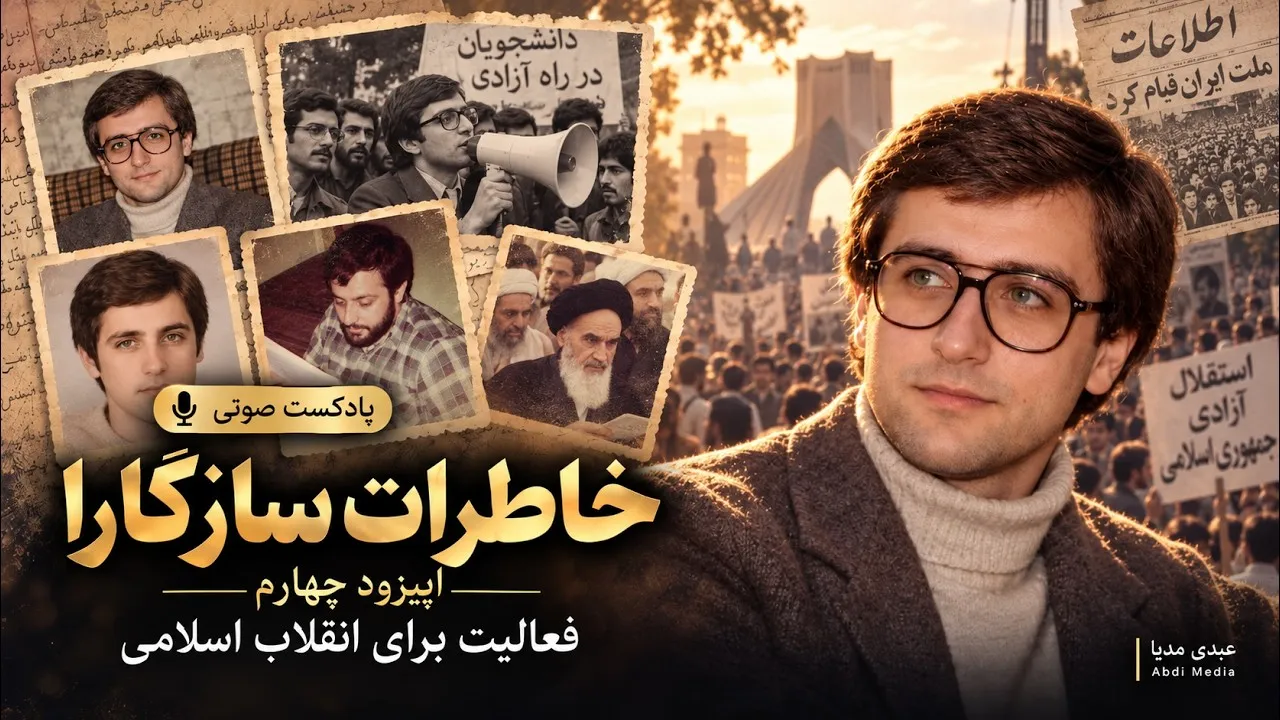
Episode 4: Activities for the Islamic Revolution
Welcome to another section of Mohsen Sazegara's memoirs. I hope to be a good companion for you on this journey into the past and through time.
At one point during Mr. Mousavi's government, I took a look and counted, and realized that we had nearly seven members of the Islamic Association of America in the government alone, people like Ali Najafi, Hadi Nejad, Hosseinian, Davoud Banki, and others. I myself was the head of the Industrial Development and Renovation Organization. We hired many of the young Americans I knew, who were engineers in factories and held PhDs in engineering. They became good managers, young and capable managers.
Yazdi was in America, Ghotbzadeh was in France. Once he came to America at the invitation of the Islamic Association. The reason Ghotbzadeh did not come to America was that, due to the activities he had carried out, first, he was among the first Iranians whose Iranian passport the Shah's regime had revoked and did not give him; second, due to his activities, they had apparently expelled him from America, and he had a Syrian passport and was close to Syria. That time we invited him, he himself said he came to America somewhat with ifs and buts. But he was active in Europe and the Middle East. I had seen him. Jokingly, the night he came and gave a speech, and afterwards four or five of the active kids sat down and talked with him at night, we jokingly said, "Brother Sadegh, he was an active person." Ghotbzadeh was completely a political practitioner. If you discussed politics with him, he would sometimes see points that a person had completely not paid attention to. For example, he would say, "If he has said this word, there his meaning is this side; let us be attentive to this story, the regime there might do this work." In the practice of politics, Ghotbzadeh was very good—a political pragmatist. And for a lifetime, from the age of sixteen when he had entered politics, he had fought, clashed, administered meetings, and there had been splits. Yazdi, one could say, was also a person of management and organization—meaning with the students, with whom he constantly lived, sat, got up, and slept in, for example, student houses. Also, the religious and Quranic teachings and such—ultimately they were all students of Engineer Bazargan. All of them, their outlook on Islam and such, wanted to extract scientific miracles from the Quran, but in any case he had worked on the Quran. Yazdi too was a political activist from his high school period and then his student period in Iran and then abroad. They both understood the practice of politics, but he was more theoretical than Ghotbzadeh.
I got to know Chamran later. Well, Chamran was also a political person, and he had an American wife and a child, but he left everything behind. Perhaps they had separated from him, and he got up and went to Lebanon. It was among the decisions that apparently the Freedom Movement had made abroad before I went to America, and Chamran went with Musa Sadr, because these had earlier been in contact with Abdel Nasser—Gamal Abdel Nasser, who was opposed to the Shah and was the hero of the Arab world and promoted Arab nationalism and the nonsense that Nasser injected, especially against Iran. They had seen the guerrilla period. I myself heard from Dr. Chamran; he said, "Our army was training in Egypt; I gave a technical [move] to this Sadegh; the two of them had apparently gone to see the course; with his tall stature and his waist, he fell to the ground and walked bent over for two months."
As I said, in that 1970s decade, especially, it had begun in Iran in 1971—armed struggle and so on. Everyone was after creating facilities for armed war and supporting armed struggle in Iran. Consequently, Chamran had gone to Lebanon. There, with Musa Sadr, whom they knew, they established a political party—the Shia of Lebanon, who were very poor and were the majority of Lebanon's population but were the most deprived part of it, and their share in Lebanon's constitution was the least compared to Christians and Sunnis—meaning the Speaker of Parliament was Shia, not the head of government or the president. They established this Movement of the Deprived (Harakat al-Mahrumin) to organize the Shia and, at the same time, for Chamran to establish a base there for guerrilla training and for activists of the struggle in Iran who either wanted to come from abroad or from inside to see a course and return. He had also set up a practice [force] alongside the Movement of the Deprived—Afwaj al-Muqawama al-Lubnaniyya, whose abbreviation was Amal. And of course, because the Palestinian camps were there, they were also close to the Palestinians, just as Arafat had given a speech that Fatah and Amal—meaning Fatah and Amal—and Chamran, because he was also a doctor of engineering, had established a technical and vocational school in Lebanon, an Institute of Technology and Vocational Training, to train Shia youth so they could find work, not be unemployed, and their livelihood would improve.
Later, Dr. Jalil Zarrabi, who was in Chicago—a pediatrician but a member of the Islamic Association of Students and a member of the Freedom Movement—went to Lebanon, and they established a clinic, and his wife, who was also a physician, [worked] for the Shia and so on. I want to say that one of the works of the Freedom Movement of Iran abroad was in fact work in Lebanon. We too, as members of the Movement—I myself, one of my tasks was to read the Middle East publications or other news about Lebanon, because we would categorize these and produce analyses, and so on. Once or twice a year, Yazdi and Ghotbzadeh would go to Lebanon, hold a meeting with Chamran, and from there, for example, they would usually go to Najaf and hold a meeting with Khomeini around him too, and we would give support of this kind. Or conversely, the Lebanese civil wars that had occurred—which were, of course, a very painful war—for example, Dr. Chamran's speech in which he had explained about these civil wars was on a tape; we reproduced it and distributed it in all the areas of the association so the kids would be informed and do work.
In Chicago, the first time, I knew Hamid Shahangian—whose brother Vahid I was a university classmate with—well, I knew Hamid. We became roommates. He had an apartment, and I went and joined. The two of us paid the rent jointly and worked. But after a while, because I had become a member of the Islamic Association of Students, I became acquainted with Reza Tabatabai and Asghar Sadeghian, and Dr. Jalil Zarrabi, and we concluded that we wanted the Islamic Association of Students in the city of Chicago to grow and gain members. We needed a hangout, a place where students would come at night—well, at least—to talk and hold meetings. So it was that I separated from Hamid, and with those two, we rented an apartment. It was an old apartment but large, and it was on the first floor too. We somehow made it the hangout of the Islamic Association. Besides a mosque where we held the weekly meetings on Sunday nights—the mosque belonged to African American Muslims, and they were also Sunni—especially in the summers, the kids who came from different cities to Chicago to work all had our house's address. They would come straight and sleep at our house at night. We had a large hall. Once I woke up in the morning—they themselves had come and opened the door—I saw ten or fifteen people sleeping on the floor of our hall. Kids had come from Kansas to work in the summer, and then when they found a place, they would leave. But this house of ours became the hangout of the Islamic Association of Students. And gradually, for this reason, when I went to the university, I knew that when I returned home in the evening, there was no studying, because it was discussion and talking and activity and preparing for the seminar and the weekend meeting—the things we had for the Chicago area. We would put library books in the locker we had, reach into our pockets, come home, and at night we were busy with discussion and work and so on. And our friend Asghar Sadeghian, who was a worker's kid and had endured a very hard life until he reached America, would work until two after midnight at the supermarket, and when he came back at two, even if we were asleep, he would wake us up saying, "Get up, I've come." We would cook food, eat, and talk.
The Chicago area of the Islamic Association of Students—perhaps it can be said—I and Reza Tabatabai and Asghar Sadeghian and Dr. Zarrabi—of course, well, he was not a student, but well, he helped—we raised its shutter and started the activity. It grew. Meaning, perhaps we started in 1976; by 1978, the meetings of the members of the Islamic Association of Students of the Chicago area had reached 50-60 people, and if we held meetings, sometimes up to two hundred people would come and sit. Also, the physicians in Chicago—Chicago is one of America's medical centers, and there were many Iranian physicians too; Dr. Yazdi himself had established an Islamic Association of Physicians in the style of Iran—but we too had connections with the Chicago physicians, we helped with their meetings, we gave speeches, sometimes we held Quran sessions for them, and they were also very good for us: they gave us medical help when we got sick, and they were a financial source too—comfortably, two hundred dollars, three hundred dollars each of them would donate to the association.
This period of activity of the Islamic Association of Students—I, as a member of the five-person board of secretaries of our own area—we had divided America into eight parts. North America, with its center in Chicago, which from that side went to the states of Wisconsin and Iowa, and from this side to Michigan, up to the border of New York State—seven or eight states of the North America region. I was elected to the board of secretaries of all the areas. I was elected to that board of secretaries; I was the cultural and organizational secretary for two different terms. One of the various tasks was that I and this same Reza Tabatabai had bought a car together for two hundred dollars—meaning he put in [money] and I paid a hundred dollars; we became partners. The two of us would take it, and with this car we would go and visit these areas: the Detroit area, the Carondale area—this same Zanjani who later became the head of the Plan and Budget Organization; they were graduates of Allameh Tabatabai University, and with his wife and so on, they had come looking for the association in the city. It was a university, in a small town; we went and first established their area as a dependent area, then as a connected area.
By the time we reached the revolution period, the Islamic Association in America—without exaggeration—perhaps had, for example, a hundred and some connected areas. A place where Iranians were numerous, like Houston itself, had a hundred members, or in Chicago perhaps, for example, forty-five official members. The association had at least, perhaps, for example, two hundred dependent and connected areas—dependent ones that were in the process of joining the association. It had become a large organization. An organization that, as I said, was more useful than anything to the Islamic Republic, because its activists were both specialized and committed and knew foreign languages. Many came and went to the Ministry of Foreign Affairs, went to various ministries, in industry, in governorates, in provincial governorates; they became middle managers, and many senior managers emerged from among them.
I used to read the publications "Islam-e Maktab-e Mobarez" and "Mowlad," which was the organ of the Islamic Associations of Students in America and Europe. A few years ago I was doing research about the Tobacco Movement and so on, [looking] at what was in our publications. One thing is clearly visible in the works of the Islamic Associations of Students abroad—and in my opinion, in Iran too—and that is that the idea of revolution, of making a revolution—now armed struggle, the fashion of the day—a kind of leftist ideology, a revolutionary leftist ideological reading of Islam, if we call it that—this certainly belonged to the university people. But it was the university people; just like our fathers in the Constitutional [Revolution] understood that their strength did not reach the Shah, they wanted to recruit two other classes. The first was the clergy. For this reason, the clergy—now let us return—if you look at the publications of the Islamic Association, this line is completely visible: not only in the form of a wish, but constantly serving them and, so to speak, bowing and praising and saying "please come" and so on—the revolutionary class and so on. The effort of the university people was to recruit the clerics as allies, like Malek Khan and others who went and recruited Mohammad Tabatabai as an ally. And they understood that their strength would not reach Naser al-Din Shah and the Qajars unless they brought the clergy into the field. Or Mossadegh too—in short, the Oil Movement: Kashani came and joined and it was victorious; Kashani split off and it was defeated. They needed the clergy—the intellectuals—to bring the masses. Therefore, completely consciously, in my opinion.
The bazaar was united with the clergy after the Constitutional era and was an important financial source. But the university people who were seeking to make a revolution had also established relations with the revolutionary bazaaris—if we go earlier, they become the Fadaiyan of Islam, then the Coalition of Islamic Societies, their bazaar and political part, and then let us come forward. In the 1960s and 1970s, the bazaaris only gave money to the clergy; religious dues—their main source came from the bazaar. For this reason, too, several mosques around the Tehran bazaar, their Friday prayer leaders were very important, because these were called the "Ashar-e Mubashira"—ten clerics, Friday prayer leaders of the bazaar, like this same Haj Agha Mojtaba Tehrani whose student we were. These were very important because if these bazaaris said, "So-and-so is the most learned, and we should give the religious dues to him," these bazaaris would give the religious dues to his representative. Because money is important, that person would become a source of emulation, money would be plentiful in his hands, and he would become a source of emulation. For this reason they called them "Ashar-e Mubashira"—meaning that if these gave the good tidings that this one is the most learned, they should gather followers for him and gather religious dues for him, and he would become a source of emulation, and his power would increase. If you want money, if you want to understand the relations of the clergy well, you must follow the weapon of money. Of course, before Mr. Khamenei, who has now upset this by in fact administering it with the money of the government and the establishment.
We, as university people and educated Muslims, our intellect reached—in my opinion, completely consciously—we wanted to create a unity between the university people, the clergy, and the bazaaris, and we succeeded. That is, one of the reasons for the victory of the Islamic Revolution is that at the juncture of the revolution, then after the revolution, there was disagreement, there was a split, and our intellect did not reach [the fact] that on the day we become victorious, the clerics and the bazaaris have the real base, they have the real power, we do not. There is no one to push us; they push us out. And that is what happened. That is, on the day after the victory of the revolution, their power was greater. The university people—their leaders like Bazargan and their pioneers, the Freedom Movement people and so on—were thrown out of the government. The rest of us, if we remained in the government, gradually we did not have a determining strategic role; it became advising and doing the work. As Behzad, who was not [there], said with surprise: "These people did not drink water without our permission; they asked us everything. Now no one needs us at all." And that is what happened. Meaning, the clergy—who did not take power by accident; they had the power, they had the social base—and these [university people], after a while, if they saw that these educated Muslims who made the revolution and so on have something to say and stand up to them, they went and created their own educated class. They established Imam Sadiq University; bearded bachelor's [holders]—they gave a group engineering and doctorates so they could say these are technocrats—and they handed the country's affairs to these people so they would be needless of those [others] whose tongues are long. And that is gradually what happened.
For this reason, incidentally, at the time of the Kian [magazine] period and the reform movement, which we will reach later, I once said in a gathering of Kian friends: "Look, we have created a religion that is different from the revolutionary ideological reading—a minimal religion, whose champion theoretician was Soroush, but Kian delivered it—and a secular religion, in fact a minimal individual sphere and liberal. I said this must have a social base; its foot must be on something of the nature of power for it to grow. And our closest ally for this is the industrialists, the technocrats. We cannot have the bazaaris—of course, now the bazaar does not have its former power; the rent-seekers and the corrupt who are in the government, the money is there, the equation has been upset. But my point to our friends was that just as Fethullah Gülen in Turkey made the Muslim Turkish industrialists their base—their order and that power that was behind the National Salvation Party and then the Welfare [Party] and the various names it found, until today, which is Erdogan—we too need a real sector that has power, has an economic base, has social breadth, to become our base. Naturally, the technocrats become the customers of this religion of ours. The customers of the religion that the clerics produce are the bazaaris. For this reason, the lesson they read after the preliminaries of jurisprudence is the Makasib of Sheikh Ansari—"kasb" meaning religious issues of business, buying and selling, and industry. The technocrats who have factories, are engineers, are commercial managers of companies, are accountants, and the middle class must buy this religion of ours. We must recruit these as allies. And relative to the employee and so on, the industrialist has this advantage that he has money, the worker is under him, and this group is the best that we can have as our customers, and we must market our religion here and recruit allies from them."
At that juncture, Shariati—right—from the clergy, who himself bitterly says, "Those who should have supported me cursed me"—Sheikh Hossein Kafi in Mahdieh Tehran used to curse him; a group of clerics used to curse him. A segment of the clergy—this same Mr. Khamenei—their pride was to say, for example, "We were [sitting] one night with Shariati," he had grabbed Shariati by the collar. This revolutionary reading of his had caused the political clerics who were mostly around Khomeini—Khomeini's students like this same Hashemi and so on—to ride on Shariati's votes; Lahouti and others. One degree further, they were serving the Mujahedin-e-Khalq. The bazaaris who were with these gave them money, gave them houses.
The armed Islamic movement—mainly the Mujahedin-e-Khalq organization—later its scandal was exposed, there were splits. They were not like the communists who needed to establish a bank for their money; the bazaaris really covered their expenses, put houses at their disposal, they worked. The clergy did this work. Therefore, a segment of the clergy that had no problem with Shariati. Then Shariati himself too—right—in his book "Tashayyo'-e Alavi va Safavi," he in fact created a formula; whatever he wanted to hit over the head of the clergy, he made it "Tashayyo'-e Safavi," and whatever his own beliefs were, he made it "Tashayyo'-e Alavi." It was an art, in fact; he made something, theorized it—wrongly—took out the term "nahzat" and "nezam." But in some of his other works, Shariati was not separate from this general line that the intellectuals had. His point was that we need the clergy. He praises Mr. Khomeini a lot, or "The Revolutionary Role of Remembering and the Rememberers"—he redefines the "rowzeh-khans" [eulogy reciters] in a revolutionary way. In his book "The Revolutionary Role of Remembering and the Rememberers," he in fact gives the road to a segment of the revolutionary clergy that we would recruit, and well, Khomeini too was someone whose supporter we would become, because he was both a source of emulation and intensely anti-Shah, and around him all the political clerics went to prison and came out and were tortured—the stories that they fried Ayatollah Saeedi's foot in oil, Ayatollah Ghaffari was killed under torture—of course, these were killed in prison. These had caused us to be reconciled with a segment of the clergy.
I am speaking of myself, because I was somewhat a student of Sadr and so on; we were one degree—not from the Mujahedin-e-Khalq, even from Shariati—a bit more cleric-loving, on that general line that we need the clergy and all its kinds. For example, if someone said bad and abusive things about Ayatollah Shariatmadari or even Khoei—despite the fact that later I learned how much difference they have up there, they are thirsty for each other's blood—Khoei, Khomeini, and Shariatmadari and Golpayegani and so on; after the revolution my eyes were opened to these. But we—Yazdi was the same way—honestly, we were more cleric-loving than even Shariati. We would put them forward. We believed, for example, that Shariati had gone too far in these places, but the essence was this: this was the art of the Islamic intellectuals, the Islamic educated—with open eyes, in fact, we put the clergy forward. We had found someone, Khomeini, who was both a source of emulation and well stubborn and sharp, and his students—we would deliberately give them the road and put them forward, we would pamper them, hold meetings, express appreciation. We united the clergy and the bazaar [with] the Muslim university people. Just like the work that Adam Michnik in Poland, in his prison letters, says: "We intellectuals, if we want to win—because there too the idea of bringing down the communists was among the intellectuals—we must recruit the workers and the church as allies, create unity between these three strata," and they succeeded in Poland. Well, they found someone among the workers—so-and-so was an electrical engineer but was a worker in the trade unions. Michnik and these succeeded—the theoreticians of Poland's Solidarity movement—between religion, which brought the masses, the workers, whose strike power would lay the country down on the ground, and the intellectuals, who propagated the idea of bringing down the communists and freedom and so on—to create unity. And when the unity was good too, they succeeded. Because it was the fashion of sociology.
If you study the fields of science in America—120-some credits to 140 credits for a bachelor's, depending on the university and the field. 32 credits are general credits, and 32 credits too, those studying science must take from the humanities and social sciences, and the rest are their own field's credits. The reverse is like this: those studying humanities take 32 credits from the experimental sciences—biology, physics, chemistry, depending on their interest. For this reason, one of the things that can be done is to do a double major. Be careful—both the general credits and the 32 humanities credits I took in such a way that they could be the basis for a bachelor's in sociology. Science—well, I was taking my own credits in math and physics, and it was my field, and incidentally I was also a member of a research group that I explained—I had a course with Dr. Bamen, I got an A. He pulled me aside and said, "One of the goals of the federal budget in my research, from the head of this research group, is to train talented students. If you are something, work in our group; the rest of the students are studying for a PhD, you become our assistant, and you will be trained too." I was happy; I liked to work on the details of nuclear bonds, the formation of molecules with the university computer. But at the same time that I was, so to speak, both in the research group and studying physics and sociology—it was the fashion, mainly because of Shariati—so in total, if I add it up, I passed 140-some credits. However, because I was taking from two fields, neither of them had reached a bachelor's. If the revolution had not happened, I had one more semester left to graduate, and another two semesters to get both bachelor's degrees. But when the revolution happened, they blew its horn; I went, and I did not get either of them. Incidentally, after the revolution, it occurred to me to go back to America for one semester and finish these; then I said, what use is it to me? Forget it. I studied history, got a bachelor's, got a master's. I went to Shahid Beheshti University, took the entrance exam again, and incidentally I got rank 36 in the humanities, so whichever first field I chose, I would be accepted. I chose history, Shahid Beheshti University. I became the top student in the history field that year, and in the master's too I became the top student. Then I wanted to get a doctorate; I liked to study the history of science. I applied to Harvard, and incidentally they gave me a good answer; it was possible for me to go. However, I saw that I would not have the time; I could not go to America to be at Harvard University for 5 years. The University of London, Royal Holloway College, is also outside London; there was a professor—the Europeans say it this way—you do not pass any more credits; 32 credits for a doctorate—you pass courses, which itself takes two years, and then you also pass a thesis, which is also 32 credits. You pass a thesis with a professor; if he accepts, he gives you a doctorate. Shariati got his doctorate this same way—meaning he did not go to pass credits; he was on a scholarship, had become the top student of the Faculty of Literature, and with his professor corrected a manuscript from the third century AH—the correction of an old text. He himself was interested; he had studied sociology and would go to sociology classes.
Thank you for listening to this part of the memoirs. I hope you will listen to other parts too. Until then, goodbye.
Take less than a minute, register and share your opinion under this post.
Insulting or inciting messages will be deleted.
Sign Up