
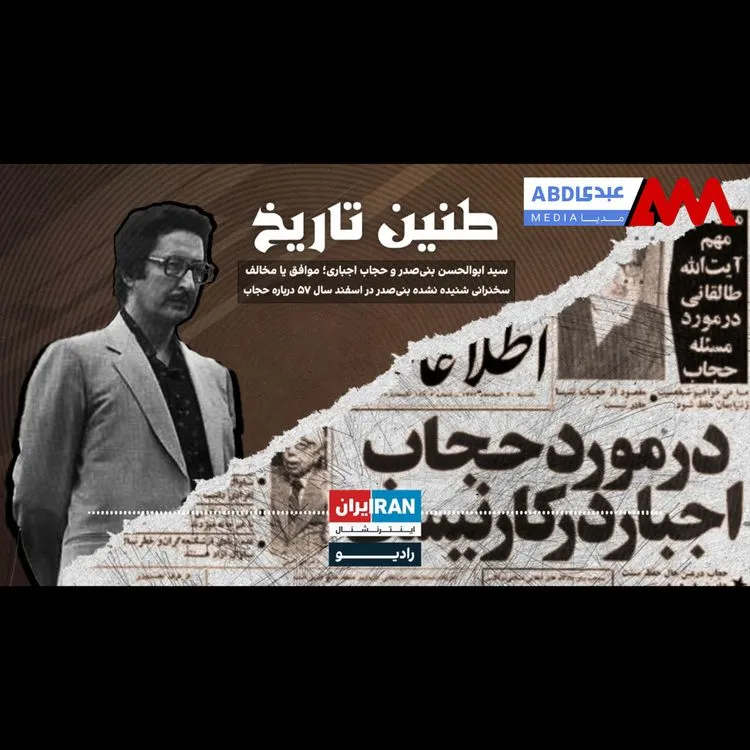
Host: What happened? What did they say and what did we hear? From those whose names we only heard, and what we imagined were only the narratives we were told. But in the Tone of History, without judging or embellishing or diminishing, we hear them themselves. Greetings to you. I am Abdullah Abdi, and in the fourth episode, I am with you, the listeners of Radio Iran International, with a gift from the Tone of History. A program produced using historic and lesser-heard or unheard voices from the Abdi Media sound archive. For several weeks now, the overthrowers and revolutionaries of 1979 have declared that the Islamic Revolution led by Ayatollah Khomeini has been victorious. People who were overjoyed at the victory of their revolution celebrated in the streets, waiting for better conditions for their lives. Now, the Islamic Revolution needed to clarify its revolutionary positions and views. Thus, those close to the revolutionary leader, now the Imam of the Ummah, from their own perspectives, addressed issues that the people of Iran had never even thought of before. One of these issues was the hijab, which has been a challenge for Iranians from the era of Reza Shah and the removal of the veil to post-1979 Iran and the slow imposition of the hijab, which still casts a shadow over the affairs of governance today. It is March 1979, and Seyyed Abolhassan Bani Sadr, as one of the closest individuals to Seyyed Ruhollah Khomeini, explains the Islamic view of the new government.
Bani Sadr: The entire reality of the fundamental issue of personality cult is the result of this kind of thinking. Most of the interference in information, news, and thoughts is the result of these theories that every human being creates for themselves and makes their standard. Any external reality like this quickly feeds into that system. If it sees a flaw, it tells it to come and go. It creates a quarantine, so to speak, a SAVAK for its own thoughts, and passes everyone through that SAVAK first. If it passes and there is no fault, it says, "Now you can come into the head." This filtering device causes the head—that is, my and your brain—to no longer receive information as it is. It receives it in the way that theory has filtered and given to it.
Host: Seyyed Nasrollah Bani Sadr was Bani Sadr's father, who was among the influential clerics of Hamedan and had a close relationship with Seyyed Ruhollah Khomeini. Therefore, the young, devout revolutionary Bani Sadr of that era, on the one hand, was familiar with religious sciences and the foundations of Islam due to growing up in a clerical family, and on the other hand, he knew the taste of the modernist society of that time due to his education and mastery of Arabic and French and his presence in intellectual circles. Meetings were held, and he debated, and in this winter meeting, covering and hijab are the subject of his discussion.
Bani Sadr: The idea of covering is influenced by this relationship that creates a political relationship. This is that in this society we are in, really in government employment, this appearance... you know the situation is like this. Now we want to make an effort so that, by grace, this sexual attraction between boys and girls has no role, has no political role. Is this liberating or enslaving? If we make a... God bless your father. Let's come to the ideological and cultural standard established through sexual relations. Well, you choose a certain covering based on the display of beauties. Displaying beauties—we were discussing this in Berlin. A young lady asked why women shouldn't show their beauties. We said, first of all, this "why" can also be asked of men. Why not men? Yes, there is no reason why men shouldn't do the same. It's not that they don't.
Host: Bani Sadr, who had lived for a long time in France and the open environment of Europe, thought that with his understanding of Tawhid (monotheism), he could apply "La ikraha fi al-din" (there is no compulsion in religion) in a principle called the principle of non-force.
Bani Sadr: Let me say that the most fundamental veil of a person is the correction of one's information system, whether it negates force or not. This is where the veil begins. If you accept the principle of force... if you do not accept this principle, you will naturally wear clothing appropriate to the principle of non-force. No one needs to tell you to forcibly wear something. Because it itself creates more negative consequences than the first issue. The point is that our monotheism is with the principle of non-force. We want a person to be free from force in their relationship with God.
Host: In this same winter meeting, Bani Sadr also engages in dialogue with the audience present, and one of the women present asks him if he means the chador by this covering. Bani Sadr tries to explain his view better.
Bani Sadr: Of course, we didn't say it will disappear. We are also doing this to make it disappear. So what are we doing here? (A woman speaking: They say to wear a chador). No, that was not our point. That was not our point. Our point was that you accepted that covering has a social, political, economic, and cultural role. We said that if we want relationships to be based on force, it creates inequality, and these inequalities are sometimes deadly for our society. And if we want to base relationships on non-force, this affects human covering. Even if, as you said, women accept that if one party accepts the principle of non-force in their vision, the other party may provoke them, they can choose not to be provoked.
Host: It should be noted that these words were spoken in the heat of a revolution where each of those who considered themselves to have a role in a country whose form of government would soon be determined as the Islamic Republic, wanted to show themselves and their views as closer to its founder to have a larger share of the power pie. And this is the voice of Bani Sadr, who, even years before the 1979 revolution, by his own account, said that he would one day become the president of Iran, and he did, and we know what happened. Perhaps that very view shows the final part of Bani Sadr's speech as follows.
Bani Sadr: You accepted that covering—you cannot live in a society where covering has a social role. If we want to have a monotheistic society and our men and women establish mind-to-mind relationships in gatherings, we must minimize the inequalities created through body-to-body relationships. We want a covering appropriate to this. We have also accepted Islamic hijab. It begins with a vision based on the relationship between man and God, based on non-force. This is where the reality of your actions generally changes. You act differently. When you act differently, naturally, this covering is affected by that.
Host: The position of Iran's first president regarding the hijab and its compulsion is intertwined with judgments, rumors, and propaganda that, according to him, are false narratives. To the extent that long after his escape from Iran, which he and his supporters called the June 20 coup, in some meetings he was asked whether he had said that a woman's hair emits rays. In any case, what history shows is that Bani Sadr did not believe in compulsory hijab. Perhaps if Ayatollah Mohammad Reza Mahdavi Kani, who was a member of the initial circle of the Revolutionary Council and headed the Islamic Revolution Committee as the first armed revolutionary institution at that time, and later played a role in many important government positions, confirms this, it would be an important validation of Bani Sadr's opposition to compulsory hijab.
Mohammad Reza Mahdavi Kani: At that time, there was an uproar that, well, what does it mean now that the Islamic Republic has come, and a bunch of women come with these clothes and makeup to government offices? It's not appropriate for the Islamic Republic. So the Imam ordered that women must either have hijab or be dismissed. The first case I saw Bani Sadr take a position on in Islamic matters was here. In the Revolutionary Council, Bani Sadr said, "What does that mean? I don't even tell my wife to wear a 'lachak' (headscarf)." His expression was "lachak," an expression that is somewhat insulting. He said, "I don't even tell my wife to wear a lachak. If she wants to, she can. It's good if she does. Religious matters are not compulsory anyway. 'La ikraha fi al-din' (there is no compulsion in religion)." I even remember he would recite this verse, "La ikraha fi al-din." It becomes force. Well, eventually, someone doesn't want to wear a shawl or have hijab. But the Imam had given a clear order that anyone who doesn't want hijab should be settled, bought out, and leave.
Host: In any case, what we know is that shortly after the establishment of the revolutionaries, by the explicit order of its leader and founder, the hijab gradually became a government compulsion and is considered one of the values and principles of the Islamic Republic. The capture of a stronghold by the revolutionaries, which was considered an enemy position, and now that they see that position was friendly territory, returning to it is seen as a retreat, and retreat is not easy for the conqueror of any position. I, Abdullah Abdi, producer and host of Tone of History, thank you for accompanying this program and hope you enjoyed it. Don't forget that you can also receive the Tone of History program and other programs of Radio Iran International as podcasts. Goodbye
Take less than a minute, register and share your opinion under this post.
Insulting or inciting messages will be deleted.
Sign Up