
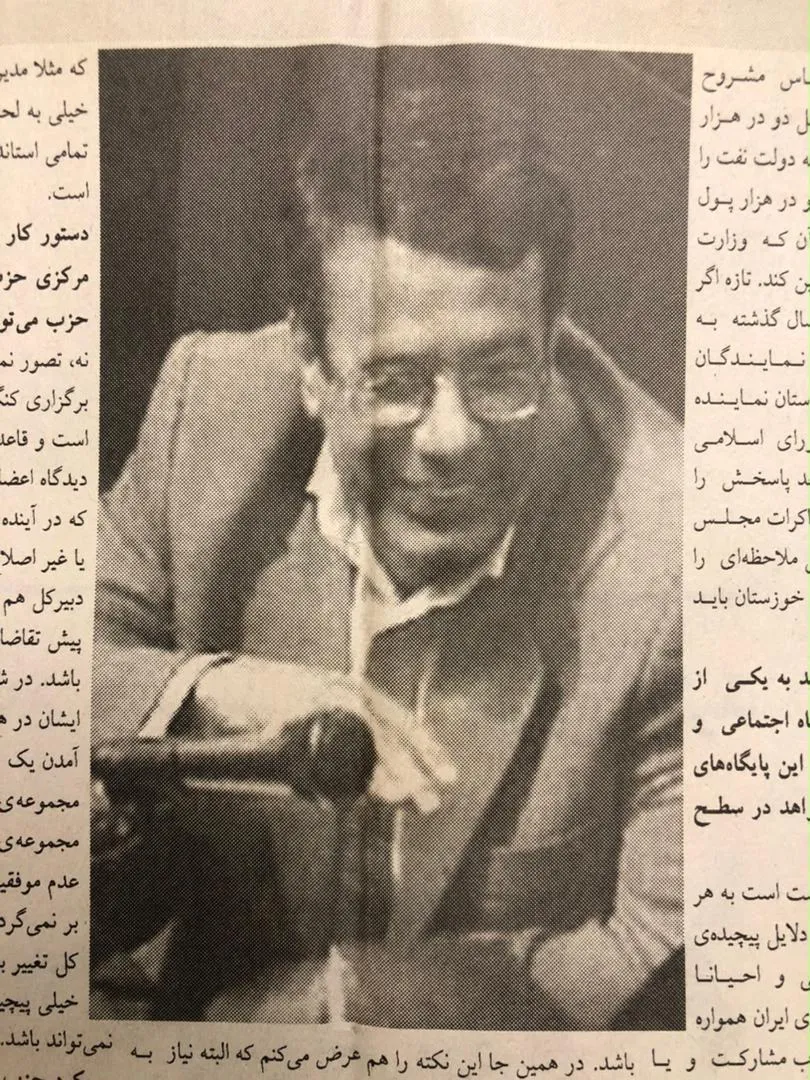
Farhad came in a hurry and said: "Kids, be more careful. Just now Sheikh... when he was leaving the mosque, he was saying to Jabbar, the mosque servant: 'Jabbar, be careful these kids don't drop leaflets in the mosque. If there are leaflets in the mosque, first they will pluck out your nails one by one, and then they will pluck out my beard.'"
Rah va Rahavard
An Experience-Narrative of a Life
Mohammad Kianoush-Rad
Part Eleven
**Recklessness and Immaturity**
**Artistic Idealism**
Farhad came in a hurry and said: "Kids, be more careful. Just now Sheikh... when he was leaving the mosque, he was saying to Jabbar, the mosque servant: 'Jabbar, be careful these kids don't drop leaflets in the mosque. If there are leaflets in the mosque, first they will pluck out your nails one by one, and then they will pluck out my beard.' When he saw me, he said these words loudly. I think he meant me. Kids, we have to be careful. In my opinion, we should cut off the mosque's electricity at night and then distribute the leaflets."
Mehdi, who was familiar with electrical work, said: "That part is with me." Farhad also said: "Whenever I am in Kianpars, distributing the leaflets is also with me."
Mehdi was the master of our group's amusing mischief. He was our master in technical matters. We had adventures with Mehdi. He would pull everyone's leg. From pulling the leg of Bahram Dindamal, one of the old kids of the mosque, and the story of hypnotizing him and saying "yes, yes" to Ahmad, and always doing the opposite of that thing, to nearly giving Farhad Mohandespour a heart attack in an affair full of fear and stress.
Mehdi had a projector and slide show device. On the eve of the revolution, we would mix images of the martyrs with the music of the film Qeysar and show them at their house for the mosque kids. He also had an eight-millimeter film camera with which we made the film Qiyam.
We made another film called "Ay Hich, Gard-e Hich Mapiich" with Farhad Mohandespour.
After the massacres of the people in the demonstrations, the process of activities became greater in quantity, quality, and scope. Young people, with personal and non-organizational initiatives, carried out various actions against the regime. We too, with a hot head and an ardent heart, had a romantic, exciting, and adventurous image of the struggle.
To reproduce the leaflets, we made a wooden hand-cranked duplicating machine. We built it from a model described in one of the training pamphlets. A frame the size of A4 paper, covered with white muslin and duplicating ink. After writing, we would place the stencil paper on the frame and then place it on A4 papers.
We were adventurous and fearless. We made explosive trip-wires. A suffocating, dangerous, and high-risk task. We had heard that there was a possibility of explosion while making it. Previously, some had suffered serious injuries while making it. They had lost their hands and eyes. It was a hazardous task, but we were crazy, mad, and passionate.
To make it, special materials were needed. We had obtained part of the necessary materials from the martyred Ahmad Qari Dezfuli, at an appointment in a photography studio on the northern side of Lashkar-Abad Square, another part from Khezrian near Mr. Hassanzadeh's mosque, and the rest from...
We used these handmade grenades only once. After the necessary reconnaissance, we set off by motorcycle.
In May 1978, a group of university kids set fire to the Kianpars Club. Later someone said it was the work of.... Our group—meaning me, Ahmad, and Mehdi—unaware of the intention to set fire to the club, were after our own work. Just a few streets below the club, the car of... which had been identified, was to be damaged. Our goal in this action was merely a psychological and propaganda measure.
Around twelve or one at night, that street in Kianpars was deserted and pitch dark.
We got off in front of the house. We took a patrol. Mehdi played the role of a passerby. I was watching the surroundings. I was on the motorcycle, ready to flee after the operation. I revved the motorcycle three times. Three times meant it was time to do our work. Flustered, I said: "So what are you doing? Come on, don't dawdle. Now is the time."
Mehdi, with anxiety, lit the explosive fuse with a lighter. The fuse was like the white cable of a television antenna and burned from within, and when it reached the trip-wire, the bomb would explode. Our work was done. We jumped on the motorcycle and sped away. We heard the loud sound of the explosion from the next intersection.
Today I think, if at the same time as the explosion, a worker, a child, a woman, or a man, innocent, had been passing by from that side, what would have happened?
It was a strange recklessness and an unforgivable foolishness.
The next morning, the building of the Kianpars Club was also burned and destroyed. On the main street of Kianpars, a limited traffic had been created. Everyone was looking at the building with surprise and at the same time happiness.
The news of the club burning spread through the city. Everyone was happy. Not necessarily for the club burning. Many of these same people went to the club. They drank alcohol. They danced and, in their own words, had a good time—but they too were happy that the revolutionaries had done something against the regime.
Out of fear of being recognized in our own neighborhood, we were more cautious. For example, when we distributed leaflets in the early morning and in the darkness of night at the houses, on coming home, we would also drop a leaflet at our own house.
My father would leave the house early every morning to bring fruit from the fruit market. When he saw the leaflet behind the door of the house, he would come back and say: "The students have distributed leaflets." The day that Shahreh went to my room and saw the leaflets, the matter was exposed. She came and said with a laugh: "Do the students distribute these too?"
Our generation was a generation full of zeal, hope, and faith. But the excitement of immaturity and artistic idealism had taken the place of the calm of maturity and rational idealism.
We thought that with a Colt, a grenade, and assassination, our good fantasies were attainable. We were immature. Like Ringo and Bruce Lee and Qeysar, we wanted to solve everything with the power of the bullet, the blade, and the fist.
Poor Farhad Mohandespour, he nearly had a heart attack. God had mercy.
Take less than a minute, register and share your opinion under this post.
Insulting or inciting messages will be deleted.
Sign Up