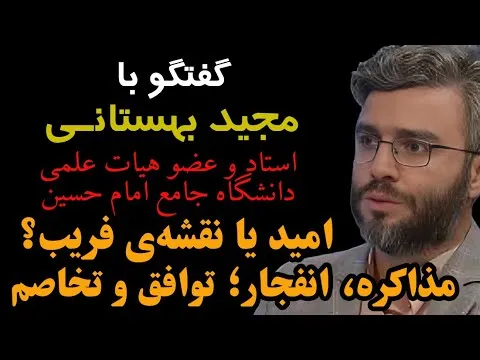
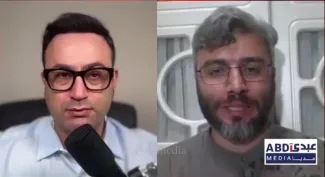
We will go to the heart of the mystery together. From the very beginning, we must know that in a world where truth and falsehood are intertwined, only one thing is certain: every signature has a cost, and every cost has a future. Tonight, I have the honor of being with Dr. Majid Behestani, an analyst of international developments and a professor and faculty member of Imam Hossein University, to fearlessly lift the veils. What led these two long-time enemies to sit at the negotiating table?
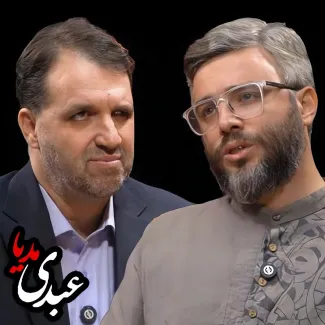
Abdi Media: The changes and complexities are vast. In any case, it requires that every night, as much as possible, I invite distinguished guests and esteemed experts to share the events from different perspectives with you. Hope or a deception plan? Negotiation, or a prelude to hostility? An explosion, a blind accident, or a calculated jolt in the middle of a larger game? Where do we stand on this chessboard? The negotiations underway in Muscat and Rome—are they a path to salvation or a trap set under the guise of diplomacy? Why these negotiations now? What has changed in global relations that two sworn enemies are setting the negotiating table again? And is this negotiation the end of an era or the beginning of a chain of successive and greater crises? Was yesterday's explosion at Shahid Rajaei Port merely an accident, or the silent language of powers dictating new conditions?
The explosion in Bandar Abbas became more sensitive today because the Supreme Leader of the Islamic Republic, in his message, did not rule out the possibility of intent and explicitly tasked judicial and security officials with investigating negligence or intent.
Tonight, we will go to the heart of the mystery together. From the very beginning, we must know that in a world where truth and falsehood are intertwined, only one thing is certain: every signature has a cost, and every cost has a future. Tonight, I have the honor of being with Dr. Majid Behestani, an analyst of international developments and a professor and faculty member of Imam Hossein University, to fearlessly lift the veils. What led these two long-time enemies to sit at the negotiating table?
Majid Behestani: It is also a great fortune for me to be with your audience tonight and to speak with you. But why have the two powers, Iran and America, sat across from each other? First, the audience might ask why I said "two powers." In reality, if Iran were not a power, America would not be dealing with it. Trump, as a bold president—if we want to speak a bit bluntly, sometimes even insolent—saying the negotiation process is going well, saying we want to choose other options—these all show that he, too, considers Iran a power. Of course, every power has its weight; we don't want to give everyone the same coefficient. Each country has its own coefficient. We can be proud that from Iran after World War I, from Iran after the 1953 coup, from Iran after the eight years of Sacred Defense, we have become a nation that can manage and control some of our problems with great powers at the negotiating table.
Abdi Media: There is a discussion—before I get into it, I will certainly challenge you with it, and I know you will allow it. Let's go back a bit. Why didn't we negotiate with Trump in his first term, but we are negotiating with him in his second? I don't want to get into the issue of power and such matters. Certainly, when I have written in my analyses many times—even when military operations between Iran and Israel happened, and the fact that the Islamic Republic's missiles reach Israel—this is a military power. But in any case, when looking at the components of statecraft and governance and development, you can't just look at the military component. Military power at what cost? That we are in this position and negotiating is a separate discussion that requires its own context. But I want to return to the negotiations. In Trump's first term, the Japanese Prime Minister came to Iran, met with Ayatollah Khamenei, and brought a letter. There, Ayatollah Khamenei said, "We will not negotiate with you; don't even mention Trump." I'm paraphrasing. He refused to let the Islamic Republic negotiate with Trump. What happened? Perhaps to put it more simply, was it necessary that all these events over the past few years—sanctions, the targeting of Hezbollah leaders in Iran, Lebanon, and Syria, what happened to Hamas—had to happen for the Islamic Republic to sit at the negotiating table? And do you think that if the Islamic Republic weren't forced, it wouldn't have sat down? Why is it sitting now? If that decision was wrong, then what is this now?
Majid Behestani: Both countries are forced to negotiate. But since you raised several points, it would be good to discuss them together. Why didn't we accept in Trump's first term? Recently, Mr. Shamkhani tweeted that those papers the Japanese Prime Minister had were not Trump's letter but the Japanese official's own handwritten notes.
Abdi Media: My reference is to Ayatollah Khamenei's own words.
Majid Behestani: But why did the Supreme Leader refuse the invitation to negotiate at that time? My analysis is—and I know many don't accept it—that the Iranian government at the time was not interested in negotiating with Trump. The decision to negotiate with America was put to a vote in Iran's Supreme National Security Council and did not pass. Why? Because we had held a grand celebration, a great uproar. We had made a golden statue of Mr. Zarif as the second Mossadegh. But suddenly, with one signature, the JCPOA collapsed. With Trump's arrival and his signature, the JCPOA became a piece of paper. Not that it had no benefits, but it lost much of its effect. Even European powers said that unless America agreed, they couldn't cooperate with us within the JCPOA framework. In my opinion, in Trump's first term, there was an agreement in Iran—between the Supreme Leader, the government, and members of the National Security Council—not to negotiate with Trump. Of course, Trump was also a new personality. We now have experience with Trump's second term from the previous four years, but when Trump first came, he was a new personality not just for Iran but for the whole world. Perhaps in 80 or 90 years, a president with this personality had not come to power among major powers. Maybe in Libya, Gaddafi had uncontrolled excitement, or Eastern dictatorships, but in Western countries, specifically America, we had not had a president with this personality. That's why it influenced the analysis of our decision-makers and politicians.
There was a consensus between the Supreme Leader, Mr. Zarif, Rouhani, Shamkhani, and all those influential in the government and the Supreme National Security Council not to negotiate with America. The Supreme Leader's disapproval of negotiating with America is not specific to Trump or non-Trump; his general phase is not to negotiate with America. Where has he agreed? When the governments of the time pressured—Hashemi, Ahmadinejad, his Foreign Minister Salehi, Rouhani, and now Pezeshkian.
Abdi Media: I'm encountering a duality that requires stepping back a bit. I wanted to zoom in from the time of the Japanese Prime Minister's visit, but I'll ask: In the Islamic Republic, regardless of the government, the final word in foreign policy is Ayatollah Khamenei's. Do you disagree? He himself said—in his own words—there are three issues: cyberspace, foreign policy, and another issue (I think imports, if I'm not mistaken). He said these three are not related to governments; the governments are merely executors of his will. If that's the case, one issue is this. Another issue is that if the Supreme Leader opposes something and then agrees, it would be a flaw in the leadership. It seems the structure of the Islamic Republic doesn't allow action against his will. That is, if he opposed negotiation, they couldn't negotiate. Certainly, consultations are held, and conditions are reviewed, leading to a result, like this period. So your point is absolutely correct. If there were no intention to negotiate, why are they negotiating now? This has also been with his approval. The final decision was made—Pezeshkian said it's done. If he doesn't want it, there will be no negotiation or anything. According to law, he is responsible. If war is to happen, he decides; if peace, he decides. These are in the constitution.
Majid Behestani: When the Supreme Leader recently said that negotiation with this American government is neither dignified nor honorable—remember? The next day, Pezeshkian went to the parliament for the impeachment of one of the ministers, I think the Economy Minister, and said, "I am in favor of negotiating with America, but because the Leader did not allow it, I won't defend it." At the same time, Iran and America were negotiating—they were laying the groundwork for negotiations in Oman.
Abdi Media: Exactly right. Bravo. This negotiation I wrote about earlier—thank God, the witness came from the unseen—I called it "negotiation at the intelligence level." Exactly that. A negotiation like this certainly has a background.
Majid Behestani: It has a long background. Certainly, when Pezeshkian was saying, "Because the Supreme Leader said so, I won't talk about negotiation," at the same time, people from the Islamic Republic were in Oman and other capitals, talking with the Americans and intermediaries about what level, what topics, and what quality these negotiations should have. I want to say that the legal image is that you said the final word is the Supreme Leader's, but there is a political image: the Supreme Leader may say the final word, but other institutions, in the bargaining process, convince the Supreme Leader to at least give a window to try again for a negotiation with America, or for other issues. But to say the Supreme Leader absolutely opposed it, and now he's going "underwater" or has two voices—it's not like that. He doesn't have two voices. Other institutions, like the Supreme National Security Council, the presidency, and the president himself, are influential in the decision-making process of Iran's foreign policy. I disagree with Zarif's statement that the Foreign Ministry is merely an executor. It's not like that at all. The Foreign Ministry under Zarif differs from the Foreign Ministry under Mottaki. If we accept that, then it differs in decision-making in the Supreme National Security Council, differs in decisions in security institutions, and differs in decision-making in the Leader's office.
Abdi Media: We agree on some points—perhaps in other words, you mentioned decision-making. I believe that what is clear is that these negotiations—the background to reaching political-level talks, I mean the first Muscat meeting—are the result of prior meetings, which I called "intelligence-level meetings," led, in my opinion, by the Foreign Intelligence Organization of the Ministry of Intelligence, which is the trusted person of Ayatollah Khamenei. If those results were not favorable to him, Muscat would not have been held.
Majid Behestani: Even the first round might have been held, but the second round might not have been. But the Leader himself says the first round went well.
Abdi Media: If we've reached good common ground, let's go back a bit—without getting caught up in governance—to the negotiations. From Trump One to Trump Two, what happened that the Islamic Republic agreed to sit at the negotiating table?
Majid Behestani: The government changed; the decision-makers of the Islamic Republic changed. There is a discussion—both rational and jurisprudential. I'll say the jurisprudential part first, and the rational part will be confirmed. Jurisprudentially, if an elite consensus is formed at the highest level, the jurist cannot oppose it. This—what I'm saying—Ayatollah Khamenei himself has said in another way: the consensus of elites. When decision-makers, a significant part of whom are government members, discuss in the Supreme National Security Council, and a change in government changes many of those individuals, it becomes possible to make different decisions. The Supreme Leader is constant, but other effective actors have changed. We must accept that while the Islamic Republic is not the highest model of democracy, there is democracy to a certain level. I accept that in many parts, democracy is not observed, but as the republic aspect of the system, the individuals present—Jalili, Pezeshkian, Zarif, Khatami (Seyyed Mohammad Khatami, Seyyed Ahmad Khatami)—are truly effective, and you know better than I that while many individuals are "yes-men" on stage, behind the scenes it's completely different. In my opinion, the reason we decided to negotiate with Trump Two is that we understood Trump One and know what decisions he might make. I don't consider this a sign that Iran's regional conditions have changed; in my opinion, Iran's national power in Rouhani's period was not stronger than Pezeshkian's. After all, Rouhani repeatedly borrowed from the Central Bank to pay subsidies and employees' salaries—this indicates a very weak government. So its situation was not much better than Pezeshkian's, yet in that period they decided not to negotiate with Trump. In Trump Two, the important difference I see is not a change in the Axis of Resistance, but a change in decision-makers and policy-makers, who pushed toward the need for another opportunity—not to establish good relations, but to control tensions. It's not just about negotiating with America. The same team that convinced the Leader to negotiate in Muscat and prevented Operation True Promise Three—that same team, that same group, that same decision-making body. In any case, we must accept that we are part of the Islamic Republic, and sometimes the republic aspect overpowers the traditional and authoritarian institutions, and this is one of those cases where I think it has.
Abdi Media: The point in your words that stands out, and I agree with, is your reference to decision-makers—you said the Foreign Ministry makes decisions. The keyword "decision-making" is prominent in your statements, and I agree. The decision-maker is clear—especially in foreign policy. I might use another interpretation for "decision-makers": those who are the agents, but the commanders are constant. The leaders of the two countries can be considered commanders from one perspective, and agents are those who act according to the will and macro-policies of the commanders. In fact, I want to mention a point that might be painful for many, and I don't know how to ask it properly.
Majid Behestani: If it doesn't cause me pain, ask.
Abdi Media: Because it might be painful, I'm being cautious. Trump was the one who assassinated General Soleimani—he admitted it. I want to say that although he is the commander of these events, a judicial case has been filed in the Islamic Republic, and the roles are clear—what actions were taken, what measures were taken. The hostilities between the Islamic Republic and the U.S. reached a new level under Trump. How is it that the person who has perhaps shown the most enmity toward the Islamic Republic and positioned himself against Ayatollah Khamenei is now being described as having brought the Leader to the negotiating table? Whether direct or indirect, the symbolism that the Islamic Republic has come to negotiate is raised. What is your analysis?
Majid Behestani: This shows that the system of the Islamic Republic is not ideological. Let me clarify one thing for you and your audience: I do not consider the Islamic Republic a "sacred system"; I consider it a normal political system, and I separate its record from that of the Islamic Revolution. I don't want the thought to come that if I say something, it means I'm saying night is day. If I say night is night, I mean it's night; if it's day, I say it's day. Let this be for our entire conversation.
We negotiated directly with Saddam Hussein. The second figure of the Islamic Republic, Hashemi Rafsanjani, directly negotiated with Saddam Hussein with the permission of the Supreme Leader—this was done. Isn't that worse than Trump? If Trump killed one of our commanders, Saddam Hussein killed dozens of our commanders and officers—at the command level, I mean the commanders of the IRGC and the Army.
Abdi Media: I think the hundreds who were truly, each of them...
Majid Behestani: Yes, if they were. In that same period, they took Hassan Bagheri from us, took Hemmat from us, took the Bakri brothers from us, took Zeyn al-Din from us... took them. Trump took just one Haj Qasem from us. The Islamic Republic is not an ideological political force; it is a fully realist political force. If it concludes it needs to negotiate directly with Saddam, it does. If it concludes it needs to negotiate directly with America, it will. Now it has concluded that it should start with Trump through indirect negotiations. I don't find this very strange—step out of the ideological space; it's not strange. One of the currents that thickens romanticism in the Islamic Republic is the leftist currents active since the 1980s under various names. Despite some outward slogans, at critical junctures they try to analyze issues very romantically, emotionally, and imaginatively. When the Taliban expelled America and the Ahmad Massoud forces in the north were surrounded, many sought to convince the Supreme Leader and the Security Council to "go save the freedom-loving forces from the savages, the backward forces," etc. Or three or four years ago, in the Azerbaijan-Armenia war, the Caucasus issue, again the same people stirred things up. In my opinion, the Islamic Republic, across almost all cases, shows itself not as an ideological force but as a rational one that analyzes events. Negotiating with America, despite the story of Haj Qasem's martyrdom, is by no means irrational.
Abdi Media: So you're saying that, in your view, the Islamic Republic's behavior shows it has set aside its emotions and, based on the theories you mentioned—rational theory—has concluded it must negotiate. To sum it up in one line?
Majid Behestani: Yes. All governments are like this—most governments are.
Abdi Media: The statement that the Islamic Republic is not ideological creates a major ambiguity for me. At least for now, I can't do anything about it, except to ask that when we put aside whether the Islamic Republic is ideological or not, we enter the ring together—I'd really like to hear your perspective.
Let's return to the negotiations. I want to manage the time. It has concluded—under any view—that the Islamic Republic has reached negotiation. You made a very beautiful point; let me reflect on it and have you elaborate. What happened—every negotiation requires a prelude. Explain this prelude: what led us to Muscat?
Majid Behestani: I said that the decision-makers and statesmen changed, and the view of the current rulers of the Islamic Republic is that the level of tension with the world—specifically with America—should be lowered, to manage the crisis and manage tensions.
Abdi Media: Do you think negotiations had started under Raisi?
Majid Behestani: Yes. I forgot the name of this American negotiator—under Raisi, in 2022, we had two rounds of negotiations with him. The result—don't take this as news; take it as analysis—we had two rounds of negotiations. The result was that Iran and the forces supporting Iran in Syria should not strike American forces or positions, so that the Biden administration would have the opportunity and pretext to gradually withdraw its forces from Syria and northern Iraq. This was implemented about a few months before Al-Aqsa Flood. What Netanyahu was very interested in doing after Al-Aqsa Flood was to quickly bring Iran into the game. On the other hand, he needed America to also be involved, because if Iran enters, America must also be present. But Netanyahu received a message not to engage with Iran, because we are not going to have a direct confrontation with Iran. If you recall the headlines in the first six months after Al-Aqsa Flood, the Americans kept saying they had not concluded that Iran played a role in the Palestinian or Hamas attacks, or even that Iran had no knowledge—that is, the Americans themselves were trying...
Abdi Media: In those early days, the White House announced...
Majid Behestani: For several months, this issue was repeatedly emphasized, essentially sending a message to Iran and Israel that we are committed to those unwritten and oral agreements. This had been done since Raisi's era, and the negotiations were direct, at the level of mid-level political managers. In any case, until before Al-Aqsa Flood, it was operational, but Netanyahu disrupted the game.
Abdi Media: You mentioned a compulsion—you referred to Iran's compulsion. You said both sides were forced. What compulsion did America have to sit at the negotiating table?
Majid Behestani: We say we have a religious fatwa not to build an atomic bomb. Why should Americans accept that we don't want to build a bomb just because Ayatollah said so? Are they followers of Ayatollah?
Abdi Media: A fatwa differs from a governmental decree.
Majid Behestani: Whatever it is, for America it makes no difference—the mullahs shouldn't have atomic bombs, that's very important. The Guards shouldn't have atomic bombs; the Axis of Resistance shouldn't have atomic bombs. Whether we swear a solemn oath and say we have a fatwa—this is a primary ruling, not a secondary ruling—it's a governmental decree, it doesn't matter; for them it means nothing. So from one side, on the other side we have Netanyahu in Israel, who is the warmonger faction, wanting to settle matters with Iran as soon as possible. For this, he needs to involve America. America doesn't want to enter a major war. America knows that the Islamic Republic won't retreat with a few bombings, so it would have to enter a large-scale, attritional war. So it makes maximum effort to both control Netanyahu and the warmonger faction in Israel and to prevent Iran from acquiring an atomic bomb. If an agreement doesn't work, then other methods.
Abdi Media: You spoke about compulsion. I want to know how much the events of the past year—the protests known as Woman, Life, Freedom, the social events, economic challenges—have been factors that led the Islamic Republic to the negotiating table.
Majid Behestani: No, I don't think so. I will say that with the Americans, after the Mahsa incident, they lowered the tension with Saudi Arabia. MBS sent a representative, closed the international office, and sent positive signals to Iran. The same MBS who, before Mahsa Amini, said he wanted to bring war to Tehran's streets. After Mahsa Amini, when the street situation was controlled—if I'm not mistaken, from Bahman or Esfand 1401—a "goodwill" delegation came from Saudi Arabia to Iran, simultaneous with the behind-the-scenes negotiations between Iran and America. This is my analysis.
We moved toward controlling hostilities with America, with Saudi Arabia, and with the region. Of course, with Saudi Arabia, which started under Rouhani, it wasn't favorable. Given Saudi Arabia's experience with MBS, they concluded they must work with the Islamic Republic. That was during Biden's term, not Trump's. In my opinion, if MBS thought Trump would return, he might have hesitated in those events and messages he sent. But in any case, he opened a new path with Iran, and Iran immediately accepted with China's mediation, and things moved forward. To say that the streets were crowded—no, from my knowledge of the Islamic Republic, these things are not very effective for it.
Abdi Media: Instead of negotiating, instead of sitting at the negotiating table, wouldn't it have been better—from your perspective—to simply build the bomb?
Majid Behestani: Yes, I am a strong proponent of testing an atomic bomb. At the very least, we should buy it, keep it, and announce it.
Abdi Media: Buy or build?
Majid Behestani: At least build—that's better.
Abdi Media: Tonight I'm talking to someone who is a proponent of having nuclear weapons. What is your reasoning? They say it's not straightforward.
Majid Behestani: I am a student of the late Asgarkhani. In his classes, I learned, through his guidance, to read articles and cultural books that taught us—let's do something. My view is that instead of the "Islamic humanities" movement and the indigenization of humanities, let's read Western theory more carefully. I say this to everyone—first to myself. When we do that, we won't pass over the atomic bomb so easily. Because there, in the classrooms and books, we learn that an actor that simultaneously has an atomic bomb and sits on the world's largest fossil fuel reserves is not an actor you can easily intimidate, easily remove from the international stage, or easily subject to comprehensive sanctions. If you want to negotiate with it, you must negotiate with major concessions. An atomic bomb is not a guarantee of a nation's survival—the Soviet Union collapsed with hundreds of nuclear warheads. The guarantee of a political system's survival is public satisfaction, efficiency, and social capital. I want to say this because I discuss it with my friends.
Abdi Media: You hold this presupposition.
Majid Behestani: I want to say that when I discuss this with my academic friends, they ask, "Doesn't an atomic bomb guarantee political systems?" Not at all. An atomic bomb has its own function—it is used for international security. It's like someone with a cold has one prescription, and someone with cancer has another. You don't prescribe chemotherapy for a cold. If I say chemotherapy is a treatment method, I'm aware I'm not talking about a cold. Saying the atomic bomb is good doesn't mean that having it solves inflation and recession—the bomb doesn't deal with those. But the atomic bomb solves issues in the field of national security, whether we like it or not. If the Shah were sitting here instead of you and asked me...
Abdi Media: You mean Mohammad Reza Shah?
Majid Behestani: Yes.
Abdi Media: He passed away—he's dead.
Majid Behestani: If we summoned his spirit and he asked me whether to build the bomb, I would tell him, "Definitely do it."
Abdi Media: You're saying that if Dr. Behestani, for example, were not in the Islamic Republic but in the Pahlavi monarchy—if you were born, and I were here, and we weren't speaking in the context of the Islamic Republic but in the context of Pahlavi—you would say to His Majesty, "Build the atomic bomb." Correct?
Majid Behestani: Yes, because our concern is Iran, not just the Islamic Republic. In this specific case, I say this just as many issues are Iran's issues. Our opposition to separatism is not because of the Islamic Republic; it's because of Iran. Our insistence on the name "Persian Gulf" is not because of the Islamic Republic; it's because of Iran, and many other issues. Some issues relate to the nature of the Islamic Republic, and some to the nature of Iran. We shouldn't conflate them, especially as some monarchist currents or radical reformists do. Whether the Islamic Republic exists or not, the atomic bomb is a blessing for Iran because it brings power.
Abdi Media: What does it bring us?
Majid Behestani: It brings power in strategic and international security discussions. Currently, no weapon can suddenly create a balance for a country's power—if we test an atomic bomb, it launches Iran into the ranks of major powers. What happens then? Trump begs Putin, "For God's sake, don't strike Ukraine anymore," but he strikes the Houthis. Putin has an atomic bomb; the Houthis don't. The Houthis have ballistic missiles, various types of missiles, smart high-altitude drones that can hit the USS Truman—they have all of these, yet they still get hit. But Putin has the atomic bomb; Putin has all of that plus the bomb. The bomb changes the equations.
Abdi Media: North Korea also has the bomb.
Majid Behestani: Yes, if it didn't, it would certainly be treated more harshly. But you must know that North Korea does not have the rationality of the Islamic Republic. The rationality of the Islamic Republic, of the Supreme National Security Council, and of Ayatollah Khamenei himself is incomparable to North Korea's rationality—they are two different actors. Why do you think everyone with an atomic bomb is like North Korea? No. One is one thing, another has the bomb—India and China. Why do we compare with North Korea?
Abdi Media: Because of sanctions. I don't mention China and India. Our mission is to destroy Israel. Israel, for example, has parents called America behind it, siblings called Europe—the world's financial neck is in their hands. Banking, military, and political sanctions—they pressure you in every way; force is on their side.
Majid Behestani: They did that without the bomb, but Putin with the bomb has repeatedly threatened both America and Europe with nuclear attack, though he has also been sanctioned.
Abdi Media: His sanctions came after Ukraine; before that, they didn't exist, because Russia's relationship with Israeli Jews is very good.
Majid Behestani: I have a question: If Putin announced that he would decommission his entire nuclear military system, would sanctions decrease?
Abdi Media: The point is that Russia doesn't come to—I don't know what to call it—it doesn't lay a hand on Israel, hasn't touched the West's sensitivities.
Majid Behestani: Why are we saying Israel? I'm saying Putin himself threatened the West—not the West's honor, Israel is the West's honor, but I'm saying Putin himself threatened the West. He said he would nuke Ukraine, and he threatened America itself with the use of nuclear weapons.
Abdi Media: He didn't before the war.
Majid Behestani: Yes, I'm talking about now.
Abdi Media: Russia's relationship with Europe—especially with Germany, with Merkel and Putin—was very close, like brother and sister, like cousins. They had a very close relationship; Putin even listened to Merkel. I mean, Putin didn't say such things before.
Majid Behestani: But he has now.
Abdi Media: Now Russia is sanctioned.
Majid Behestani: They weren't sanctioned because of nuclear threats; they were sanctioned because of the Ukraine war. I'm saying if Putin didn't have the bomb, the Ukraine war would have been different, and Trump would have dealt differently. My discussion is about international security, not economic or social issues. The Islamic Republic has many things to resolve internally.
Abdi Media: There are many topics we need to move on to. It's interesting that tonight I'm speaking with someone who is a proponent of nuclear weapons—and there are many who not only support it but say it brings deterrence, authority, power. I've spoken with many people, and even in history, there are signs. The late Akbar Etemad's own words indicate that the Shah had a side-glance toward nuclear weapons—he was asking about it.
I want to say that one of the factors that perhaps made the Islamic Republic agree to negotiate is Trump's threat of bombing. Trump explicitly said, "If the Islamic Republic doesn't come to the negotiating table, I will attack."
Majid Behestani: I agree, but I think Trump himself wouldn't attack—America wouldn't attack; Israel would attack. In my opinion, one of Iran's concerns in this period is that the shadow of war had come close. That wasn't the case in Trump's first term. And it's not just because of Trump—more because of Netanyahu and the conditions imposed on us after Al-Aqsa Flood. I don't have a very good view of Al-Aqsa Flood, and I don't find the current situation of the Islamic Republic and Iran interesting. Even despite the negotiations, I still don't see the shadow of war far away—though I don't say "war"; it's a military conflict, not a war. There might be a few rounds of those actions—it's not war. War must be declared. War is a legal term; it's not just a military operation. It has a specific legal definition and conditions. In my opinion, Netanyahu or the Israelis have enough sense not to enter a war with Iran, but there is a very high readiness on their part to create a high-level military conflict with us. This depends on the type of Iran's response—whether it leads the other side toward a larger war or remains at the level of a limited military operation. Trump and America, in this matter—of course, it wasn't your question; I went to another side—let me say.
Abdi Media: I asked Dr. Behestani about the turning point that began on October 7 and its impact on the Islamic Republic's equations—whether there was concern about an attack. Dr. Behestani explained, and we elaborated on that discussion.
One point about nuclear weapons, before we stray too far: if you think the bomb brings power, do you agree that all countries should build weapons, and then the world would be safer? If the Taliban, for example, built a bomb, would the world be safer?
Majid Behestani: The world becomes more insecure with the bomb when only one or a few countries have it. But if all countries have the bomb, then balance of power occurs, and security returns. This is also a point in a debate between Waltz and Sagan—a debate about Iran, actually. During the time Iran was negotiating with the European troika—I think around 2005–2006, much earlier than the JCPOA—a debate took place where it was explicitly stated that this must be, all countries must create balance. You [presumably] certainly know the top figures in international relations—they believe Iran should build the bomb.
Abdi Media: All countries should build it?
Majid Behestani: Yes, all.
Abdi Media: If the Taliban had a nuclear bomb, what would they do with it?
Majid Behestani: Do you think they would use it tomorrow? No. Doesn't Pakistan have it? Do you think Pakistan is a reasonable country? Pakistan's minister announced that for three decades they have been cultivating terrorism in their own country with U.S. military financial support, UAE military financial support, and British military financial support. And you know the Pakistani Taliban and Sipah-e-Sahaba and those Pashtun currents in Pakistan are far more dangerous than the Afghan version. If, God forbid, they came to power in Pakistan, we would have a much harder time controlling bilateral relations. The Taliban are, how should I say, more negotiable, calmer, and more reasonable—I'm comparing the Taliban in Afghanistan. You know when our consulate in Iraq was attacked, who did it? It was the Pakistani Taliban, not the Afghan Taliban. The Pakistani Taliban, in the chaos of those days, entered Pakistan, attacked several cities, including Herat—they are fiercely anti-Shia. The Afghan Taliban are also anti-Shia.
Abdi Media: If we give the bomb to these people, what will they do? You say they won't attack?
Majid Behestani: I have an opinion; I'm speaking. I say a world where all countries have the bomb is safer. You're talking about specific countries.
Abdi Media: We shouldn't give it to them.
Majid Behestani: It's not about "giving." If the Taliban Defense Minister came to me and said, "Should I build the bomb?" I would say "build." I can't say "you're a bad guy, don't build." I'm speaking as a university professor. As a university professor, I say Iran—whether under a monarchy or a Supreme Leader—is stronger with the bomb, because many of its enemies have the bomb, because it's in a region where several countries have the bomb, and because America, which is in conflict with Iran, has the bomb. We have no reason to self-sanction. Build the bomb; don't use it.
Abdi Media: Let's return to the negotiations and the Muscat events. You mentioned that the Muscat event had prerequisites that were fulfilled. In your opinion, what happened in Muscat and Rome? Do you think this type of negotiation will yield results? What is your belief? Will the negotiations work, or can they at least provide a solution to resolve the nuclear dispute?
Majid Behestani: We are at a juncture where both Trump's America and Iran under Khamenei are eager...
Abdi Media: The current critical moment.
Majid Behestani: Exactly, we are at a critical moment. Both are eager to reduce tensions—both Iran under Khamenei and Trump's America are eager for de-escalation. Let's look at Trump's logic: why is Trump eager to negotiate with Iran? First, all presidents in the world want to leave power after 4 or 5 years saying they were successful—right? No one wants to leave as an ordinary person. Beyond the desire for success, Trump has two important traits: he is narcissistic, and he is impatient. In Trump's mind, it's that "I was the one who controlled and succeeded in that dossier." It's not just American power—Trump's claim is that American power existed before me, but now Trump has added something. He says, "You, Mr. Biden, Mr. Obama, and your predecessors, you kept weakening American power because you are weak personalities, but I add something to American power because I am Trump." Now look at the fundamental problems Trump is dealing with during and after the election: the China file, the Taiwan tension, the relationship with Russia generally and the Ukraine crisis, controlling relations with Europeans, the Greenland file, Palestine, and Iran. Seven or eight—I think I read—these are the main ones; maybe one or two more could be added. If I were to ask you, which is the simplest dossier? Which one would you point to?
Abdi Media: I don't have expertise; I'm not an expert.
Majid Behestani: You are like Pezeshkian. In my opinion, among these seven or eight files we reviewed, Iran is the simplest to control. Trump needs to announce to the American people in the not-too-distant future: "Look, I solved a very big 45-year-old file. Look, the world was in danger of a nuclear explosion; the backward country of the radical mullahs was about to obtain an atomic bomb; Israel's security was in danger; the region's security was in danger; America's interests in the region and the world were in danger. I was able, through negotiation—not war, through the negotiating table—to eliminate the danger of the mullahs by having Iran accept that it will no longer have nuclear weapons." This agreement is much easier for America than taking Greenland from Denmark.
Abdi Media: That is, negotiating with Iran is easier.
Majid Behestani: Yes, it's easier.
Abdi Media: Negotiating or reaching an agreement?
Majid Behestani: A negotiation that reaches an agreement—then problems arise later. It's much easier than agreeing with Greenland, or with Russia on the North Pole, or with China on Taiwan, or with Europe on Ukraine. That is, among the files I reviewed, Iran says, "I don't want nuclear weapons"; he says, "You shouldn't want them"—so we should agree. That's much easier than saying, "I want Greenland," and the other saying, "I want it," or "I want control over the North Pole," and Russia saying, "I want control." So Trump has assessed that among the tough files he faces, reaching an agreement with a country that also seeks de-escalation—the Islamic Republic—is much easier. That's why I think Trump's logic is to be able to control Netanyahu so America isn't dragged into an uncertain war due to Israel's recklessness, imposing heavy costs on the U.S. economy, and on the other hand, sell the agreement with Iran to his country. "It was I who controlled nuclear Iran."
Abdi Media: Your view is positive—do you think these negotiations will lead to an agreement?
Majid Behestani: In the short term.
Abdi Media: Do you consider it temporary, limited, or comprehensive?
Majid Behestani: We conducted comprehensive negotiations with the Americans under the JCPOA.
Abdi Media: The JCPOA wasn't comprehensive; it was about nuclear issues.
Majid Behestani: Yes. When I say "comprehensive," it's because they falsely told us all sanctions would be lifted, so it was called comprehensive negotiations. But later it became clear that the agreement text contained nothing beyond nuclear issues. Of course, the JCPOA annexes contained references to ballistic missile development. Also, in informal agreements, there were agreements on Iran's full membership in the FATF and Palermo, and in the CFT, there were agreements—but they were unwritten. The written parts in the annexes referred to our ballistic capability, which imposed limits. That's why we can't consider the JCPOA purely nuclear; it somewhat goes beyond that framework. But do you think Trump will be content with a nuclear agreement—a limited nuclear deal? In my opinion, no. Trump needs an agreement with Iran now, but he can't have a worse agreement than the JCPOA.
Abdi Media: Because he himself said he doesn't want the JCPOA; he has to sign something better.
Majid Behestani: Bravo. "Better than the JCPOA" for us means something worse than the JCPOA—that's how it should be analyzed. I think in the short term, we will have an initial, temporary agreement with the Americans. But in the medium term, Trump will raise demands beyond nuclear issues, exactly on the system's red lines. From that point onward, I think we will not reach an agreement. That temporary agreement will be a presidential agreement, not going to Congress at all, and no fundamental sanctions will be lifted. For that reason, I am not optimistic about the continuation of the negotiations. I am optimistic at the beginning—that we will have an initial, temporary, mutually agreed agreement.
Abdi Media: Trump's concern with the JCPOA was that we gained no benefit—it was the worst agreement Obama signed, and that's why he withdrew, saying, "We gained no benefit." At the same time, Ayatollah Khamenei ordered that American goods be banned from entering the country—American vaccines were banned, luxury goods like iPhones were banned. The documents exist; the Article 90 Commission explicitly stated it in its resolutions based on the Leader's guidelines. Trump felt he had gained no financial benefit from the JCPOA; it didn't boil for him. He said, "If the pot doesn't boil for me, let it boil for the dog," and he tore it up and withdrew. If this time, Trump wants to gain benefit—meaning the fruit of the JCPOA—since it's an economic discussion, he would want to benefit from the profits he could have in Iran. It doesn't seem that Trump's America is concerned with, for example, freeing Iran from the mullahs' regime or human rights; it doesn't care whether the Islamic Republic increases or decreases the number of political prisoners. Trump's America has shown it doesn't care about these things. With these interpretations, if the U.S. wants to make a financial deal with the Islamic Republic and enter investment issues, it would have to lift specific sanctions—for example, lift sanctions on the IRGC, lift banking sanctions, lift sanctions on the Leader's office, remove the Ministry of Defense from sanctions, petrochemical companies, oil companies, construction companies, etc. These are subsidiaries of the Ministry of Defense, have shareholders—for example, Ghadir Investment Company, a multi-disciplinary holding whose CEO is appointed by the Defense Minister, or the Farhangian Fund, or the Khatam al-Anbiya Construction Headquarters—institutions that control Iran's economic power. Do you think this agreement would result in Trump saying, "Lift sanctions on the IRGC and the Ministry of Defense," especially since sanctions are added every day? Do you predict he would do such a thing?
Majid Behestani: No. Not only do I predict that these things won't happen—as you listed—but I even say that Trump's reason for withdrawing from the JCPOA wasn't that Iran opposed American investment in Iran. At the same time, we immediately signed a contract with Boeing, planning to import 80 to 100 Boeing aircraft over ten years, and negotiations had started with some other American companies. The discussion was about not importing American luxury goods, but that's not the main reason. The main reason is what you said: there are laws in America against Iran—sanctions that won't be dissolved so easily; they won't be dissolved at all. The most important agreement we can reach is for Trump to retract the sanctions he himself signed, but those aren't very effective. The measures that have deprived Iran of foreign investment—whether American or non-American—under primary, secondary, and tertiary sanctions are laws approved by Congress, and presidential signatures cannot resolve them. I think the Muscat negotiations started—some said a thousand billion, some said two thousand billion—I don't know...
Abdi Media: There's no meter—a thousand billion is a huge sum.
Majid Behestani: I don't know what logic they used to say that. Whether they wanted to send a signal to the domestic audience or to the Americans, because the Americans know better—they can't easily return to Iran; they don't want to return. For that reason, no, I don't think these negotiations will reach those high levels you mentioned.
Abdi Media: I'll ask two questions in separate sections. Before that, let me offer condolences to the people of Bandar Abbas and the great Iranian nation for yesterday's incident—the explosion that pained everyone, and once again we are in mourning. My condolences to our dear people, especially the people of Bandar Abbas, especially those who lost their lives in this incident. Many of them may have been workers, or whatever—everyone who lost their life is honorable to us. I hope their souls rest in peace, and I wish a speedy recovery for those in hospital beds. The explosion incident has raised many discussions, especially from my perspective. There were speculations. From my view, Ayatollah Khamenei's message today, in which he did not rule out the possibility of intent and ordered security and judicial forces to investigate, is significant. How much do you think there is a connection between this explosion and the negotiations? Could it be an act of sabotage—whether internal or external, I don't care about the source, as it might be hard to determine—but what is your analysis? What is the connection between this explosion and the negotiations?
Majid Behestani: If we were speaking last night, I would have said the probability of sabotage is high. But tonight, as I speak with you, I think the probability of sabotage is not zero, but less than 50%, less than 30%.
Abdi Media: What do you mean by sabotage? Is it an external factor?
Majid Behestani: Because there is a possibility of intent, but the intent may not have political goals—it could have commercial goals, organizational goals. Suppose two commercial teams want to ruin each other's market, or suppose an engineer, technician, or worker who was fired wants to, for example, harm his former employer—I want to say at this level...
Abdi Media: The dimensions of the incident are really much broader than to see such factors, such as one person setting a fire.
Majid Behestani: I'm saying assume these different possibilities. I don't want to say which is exact. The probability of negligence is also high, the probability of a spark from a wire, the probability that safety protocols were not followed by the container holder—the probability of this is also high.
Abdi Media: Let's put the puzzle pieces together. Nine hours before, a Twitter account posted that "tomorrow Iran will have an earthquake." Then, Israelis—accounts related to Israelis—for example, one Israeli journalist retweeted the explosion and said "bye-bye." The issue of tracking ships carrying missile fuel from China had been raised before. Putting these together, we really reach a conclusion. The Ministry of Defense has made a statement, but because it's a military issue, not much is said. If I say this hypothesis is significant—if missile fuel came, why did it stay there? Why did they keep it? Is it logical to keep it?
Majid Behestani: It's very important.
Listen without filter on the Abdi Media Castbox.
Abdi Media: Here again, another reason comes up—some say, for example, that the Islamic Republic may have used a passenger plane for military purposes. They might have kept it as a cover here too. When we put all these together, a mosaic emerges that might be more interesting to analyze from your perspective than what I say.
Majid Behestani: Regarding the tweets and accounts you mentioned, I didn't see some of them; the ones I saw were all after the explosion. You mentioned one or two before the explosion that I didn't see.
Abdi Media: There is a clip that says, "We tracked the ship; this ship is bringing missile fuel, enough for 300 to 400 missiles."
Majid Behestani: There are two analyses. One analysis says it's their own work—that the system itself caused such an explosion to disrupt negotiations. These analyses are not worth considering, in my opinion. But to say it's sabotage by Mossad is worth pondering. I don't want to say it's unreasonable or lacks strong evidence. I want to say that currently, in my mind, it's not the strongest probability. Let's compare this with the Beirut port explosion. Look at the crater created by that explosion—what a crater it was. I've seen various videos and photos—helicopter shots, phone footage, various cameras—they mostly indicate a chemical explosion, because a large volume had accumulated in an area and exploded, causing widespread damage. But to say that these were actually solid rocket fuel stored there—my impression is that a much larger crater should have been created, and we should have seen much more extensive damage. Unfortunately, it occurred in an area full of containers—containers holding chicken, fabric, and chemicals.
Abdi Media: There were also gas cylinders and oxygen cylinders.
Majid Behestani: The gas cylinders, in the numbers present, were a dangerous source that could have turned into a mortar-like bomb—at that level, of course. I don't know if the gas cylinders were full or empty.
Abdi Media: Photos were published showing oxygen and gas cylinders—in any case, it's possible that such items are imported and exported.
Majid Behestani: This narrative favors Israel, and until I find strong evidence, I won't defend this narrative.
Abdi Media: What benefit does Israel get from this narrative?
Majid Behestani: It shows itself as the superior power, capable of any sabotage, that Iran wants to de-escalate with America.
Abdi Media: Israel has done its work here—I disagree. Israel killed Ismail Haniyeh, Seyyed Hassan Nasrallah, and IRGC commanders; it has done everything. It did this to complete the collection.
Majid Behestani: It's not about completing a collection; it's about pushing Iran into a new phase. Iran wants to de-escalate with America—"I won't let it." Iran wants to move away from the Axis of Resistance and regional developments...
Abdi Media: You're saying the theory that this was Israel's work, or whatever, helps Israel's larger project of creating discord between the U.S. and Iran regarding negotiations.
Majid Behestani: That's one thing. Another is that Israel still presents itself as the capable man and the main actor in West Asia. I don't want to say whether it is or isn't—I'm not discussing that. I'm saying that as a university professor, I won't defend any event until strong evidence and documentation come. For example, the helicopter crash of President Raisi—many want to say it was Mossad's work, sabotage, even that the report given by the Ministry of Defense or the committee was out of political consideration and not real. That's fine. As a teacher, I say I look at your evidence and the evidence of those who say it was Israel's work. To this day, those who believe in the theory about Raisi's helicopter crash haven't presented strong evidence—they guess, and their guesses are interesting.
Abdi Media: Evidence means they have elements; their analyses rely on elements that are notable—they can't be ignored.
Majid Behestani: It must be admissible in court.
Abdi Media: I don't mean certain proof—something that raises your suspicion that Israel is involved. When we put some puzzle pieces together, it might not be the main puzzle, but it fits somewhere.
Majid Behestani: Honestly, I say Israel may have caused something in the helicopter—even the devil might do such a thing—but as a teacher, I tell myself I don't have strong and solid evidence, at least at the level of strong suspicion. Regarding the Shahid Rajaei Port, it's the same. At the very least, let rocket experts and chemists tell us whether the type of smoke, flame, and damage indicates solid rocket fuel. Let firefighting experts tell us whether such events indicate intent—because firefighting experts can tell when a building is intentionally set on fire or if a wire sparked accidentally. Until those reports come—I am neither a chemistry nor a firefighting expert.
Abdi Media: Politically, do you have such a feeling?
Majid Behestani: It's possible. Politically, the probability of Israeli sabotage is high, but in terms of empirical evidence, I'm waiting for more accurate and real reports. That's what I'm saying—we should wait. I don't consider Israeli sabotage as the stronger narrative for now.
Abdi Media: What is your scenario for the coming days? You said an agreement is possible. If, for any reason—the minor issues I want to get into, like enrichment at 5% or 4%, missiles, or anything—causes the agreement not to happen, and suddenly things become unclear, what is the next scenario? What do you think the Americans will do? Will there be war? Will there be an attack?
Majid Behestani: I don't see the probability of war from the American side. As I said in response to another question, the higher probability is that if tensions between Iran and America are not controlled, Netanyahu—provided his domestic conditions remain unchanged, meaning if we assume the current situation doesn't change and no new intervening variable appears—I suspect Israel will carry out a limited military conflict against our nuclear and military facilities. Depending on our response to Israel, America may or may not enter. America intends, as much as possible, not to enter into direct conflict with Iran—this is my analysis.
Abdi Media: That is, sometimes some officials of the Islamic Republic say that "the region will be set ablaze," and we might move toward world war. Do you see this as probable? Or if anything happens, will it be limited? This assumes that these negotiations do not happen, an agreement is not reached, and it fizzles out.
Majid Behestani: The Islamic Republic's logic since entering the region has been not to enter into direct conflict with America. That is, at the height of our capability during Haj Qasem's era in the region, we never pointed our gun barrels at American forces. The only time we attacked the Americans was at the Ain al-Asad base after the assassination of Haj Qasem, and that was done in a controlled manner—we fired missiles in a way that caused minimal casualties to American personnel. After that, in Operations True Promise One and Two, Iran showed that it seeks powerful and authoritative responses, but not responses that would create war or raise tension—it actually wants to control the level of tension. I think in the initial steps, Iran will continue to confront both Israel and America in a controlled manner. But if it concludes that its existential security is being questioned, it will logically have no reason to continue the game in a controlled manner. At that point, a bloodbath is not far-fetched. My guess and analysis are that right now, a significant part of the Axis of Resistance, under Iran's direction, has lowered the level of tension. We don't hear much from Iraq; in Lebanon, Hezbollah is completely caged; in Palestine and other areas, it's the same. I think if Tehran is completely bombed and the Islamic Republic's system is to be disrupted or dissolved, then it will no longer play the controlled game—according to game theory, it will move toward expanded and uncontrolled games. But let me say: America has never been interested in that level. Israel might want to do that. When I say "never," it's neither moral nor philosophical; it's theoretical and theoretical. America is unwilling to do it at that level. Why? Because America is a declining power. America needs to compete with China, needs to compete with Europe, needs to compete with BRICS and emerging economic powers. If it has to waste a significant part of its focus on important economic arteries in West Asia and a significant part of its wealth on an unjustified war with the Islamic Republic, it logically won't do that.
In my opinion, America is preparing itself for China, not Iran. That is, its main rival is China and Russia, not Iran.
Abdi Media: Regarding America being in decline, I should arrange a debate with another university professor.
Majid Behestani: Mr. Motaharnia.
Abdi Media: There are various professors. It's actually very good—I think presenting theoretical views, different thoughts, and the clash of opinions helps, at least, for people to reach a new synthesis from a series of theses and antitheses, to hear your view and others' views, and decide for themselves. It creates better understanding. I disagreed with many of your points, but we also had many commonalities. It seems the nature of dialogue is like this with many esteemed professors who honor me by coming here. But I should say my position is solely as a journalist, and what I ask is in the capacity of questioning—not in the capacity of entering a debate. I didn't intend to debate; more to ask, to learn your view on current issues.
I hope these conversations continue, and we can also discuss important fundamental issues. Perhaps the central theme of your agreement and interest in the atomic bomb was also a very important point. If there is a final point, we'll hear it. In the end, what happens?
Majid Behestani: Honestly, my feeling is that I now believe in the Simorgh model. My impression is that from beneath these ashes, a more powerful Iran will emerge. More than your questions being about foreign relations, more than being worried about foreign relations, I am worried about social capital, about the governance model, about our commitment to the slogans of the Islamic Revolution, to the people, to these things. Perhaps we need to talk about more important things than the atomic bomb—things that will better guarantee our survival. But in conclusion, I think regional trends in the medium term—now in the short term, they are to our detriment—but in the medium term, regional trends will change in Iran's favor. Iran can once again regain its regional power, but in a new format, not the previous format.
This is not a wish; this is an analysis. I'm not praying—as a final session, pray that the audience says "Amen." My analysis is that geopolitical trends in the region, in the medium term, will change in favor of the Islamic Republic. If you ask me now, I'd say they are not in our favor yet.
Abdi Media: I think it would be very interesting to discuss this topic. I've written several headings—I don't know how much of your time will allow me the fortune to speak with you again.
Majid Behestani: It was my fortune.
Full audio of the conversation between Abdi Media and Dr. Majid Behestani, Professor and Faculty Member of Imam Hossein University.

Take less than a minute, register and share your opinion under this post.
Insulting or inciting messages will be deleted.
Sign Up