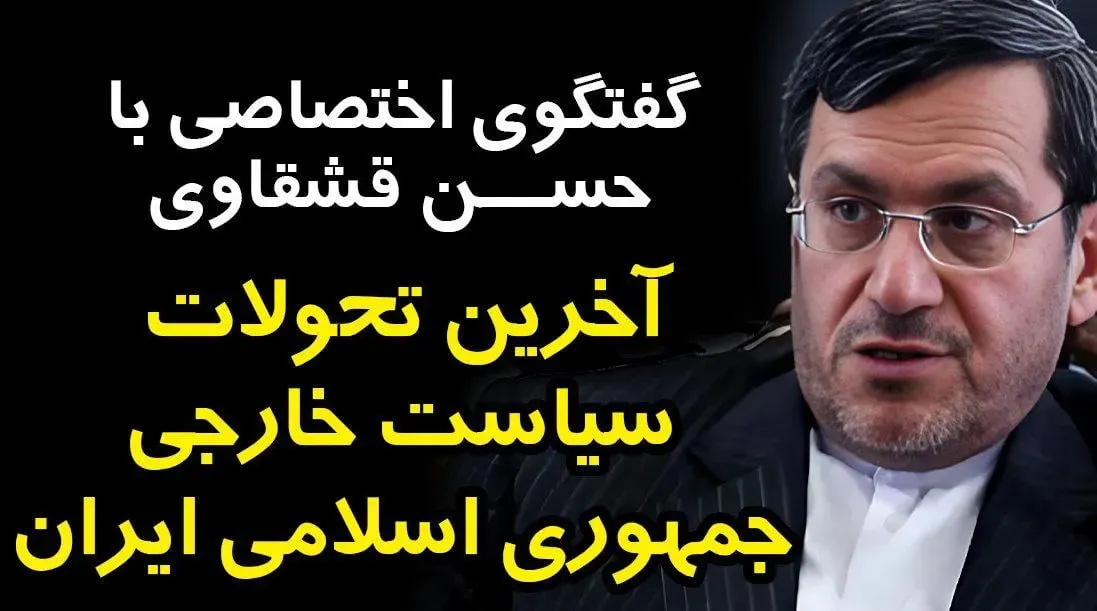
In a tense world and a volatile region, the foreign policy of the Islamic Republic of Iran is under the microscope of public opinion and international analysts more than ever. From complex relations with global powers to Iran's role in regional equations, these raise important questions about the goals, achievements, and costs of the Islamic Republic's foreign policy. In a situation where threats from the United States and Israel, military movements in the region, and increasing tensions in the Persian Gulf have intensified, the fundamental question before us is: how is the strategy of the Islamic Republic of Iran defined in the face of a possible confrontation? What is the outlook of the Islamic Republic's foreign policy, especially in dealing with Trump's America? Engagement or confrontation?
Abdi Media: It seems we are entering more serious phases, especially in political matters. In a tense world and a volatile region, the foreign policy of the Islamic Republic of Iran is under the microscope of public opinion and international analysts more than ever. From complex relations with global powers to Iran's role in regional equations, these raise important questions about the goals, achievements, and costs of the Islamic Republic's foreign policy. In a situation where threats from the United States and Israel, military movements in the region, and increasing tensions in the Persian Gulf have intensified, the fundamental question before us is: how is the strategy of the Islamic Republic of Iran defined in the face of a possible confrontation? What is the outlook of the Islamic Republic's foreign policy, especially in dealing with Trump's America? Engagement or confrontation?
In this program, I am honored to be in the service of Dr. Hassan Qashqavi, a former diplomat of the Islamic Republic and a member of the National Security and Foreign Policy Committee of the Islamic Consultative Assembly. I will try to get answers to the questions I raised. It is still the New Year; I can wish you a Happy New Year.
Hassan Qashqavi: I too, on my behalf, congratulate you, the esteemed viewers, dear compatriots, Persian speakers, and all humanity on the arrival of the New Year, the spring of nature, and also the blessed Eid al-Fitr. We are witnessing the convergence of a national and a religious celebration. As Saadi says, "May this Haft Sin bring you joy, celebration, prosperity, health, and excellence; may joy and celebration be in your heart, may this Haft Sin be yours."
Abdi Media: Let us refer back to what happened in the past year. The year 1403 (2024-2025) was a very turbulent year for the Islamic Republic, and its developments seem to have been unprecedented in previous years, or better to say, in the last half-century, at least in the lived experience of the Islamic Republic. It could be interpreted as a strange year. If you would give a general analysis, what changes and flexibilities did the Islamic Republic's foreign policy undergo? What path did it take? If you could give a brief summary of the past year, I would appreciate it.
Hassan Qashqavi: In any case, we started the year with the martyrdom of President Raisi and the martyrs of the flight; the year was full of issues. We had the presidential elections, preceded by the parliamentary elections, the formation of a new parliament, the formation of a new government, the start of the Fifth Development Plan, as well as developments that occurred in the region. Generally, the conditions were not just for Iran; the global conditions, the rise of Trump, the Ukraine-Russia issues, and developments in the Middle East created a challenging year for the world. Now, this is not just for Iran. You have the tariff issue right now, the murmurs created in economic pillars, and various other issues. In any case, the important thing is that foreign policy should have deep roots in its principles and foundations, which are in the constitution, and proceed based on what the Leader said: dignity, wisdom, and expediency. At the same time, it should have flexibility, as we say, in understanding and comprehending developments, which is very important. This is an important task for the diplomatic apparatus and all involved bodies: to have full knowledge of the course of developments, both in the decision-making process and in precise decision-making regarding foreign policy. I think from this perspective, the Islamic Republic has had active diplomacy.
Abdi Media: We had two presidencies—one due to the force of events that happened, and the other due to developments in the United States, namely Mr. Pezeshkian and Mr. Trump. Both of these presidents are, in a way, fresh. At the beginning of Trump's term, we had confrontations that go back to before Trump, meaning the conflicts between Iran and Israel, the assassination that happened in Tehran on the day of the inauguration. Do you think after Donald Trump's presidency, conditions have become somewhat more balanced, calmer, or worse? How do you interpret it?
Hassan Qashqavi: In general, the Middle East, West Asia, is ultimately a volatile region. Whoever becomes president, Iran has an extraordinary strategic position. The existence of the Zionist regime and energy resources are two issues that the West strongly focuses on. Naturally, Iran has always been coveted by great powers and has always experienced many developments. Now, some might think there is currently a dispute, a battle, a diplomatic war, or whatever between us and the West. You know, during the Sassanid era and before, there were 700 years of some kind of conflict between Iran and the West. For various reasons, each had its own motives—with ancient Rome and ancient Greece. In the Holy Quran, the war between Iran and Rome is mentioned in Surah Rum. That is, the analysis of the Iran-West war has been referred to in the Quran. Developments are occurring. Over the years, in modern and contemporary times, even more so because oil was discovered, global energy resources were discovered, and it is located at a global crossroads. The Strait of Hormuz is next to us; on the other side is Bab el-Mandeb and the Red Sea. Ultimately, all these factors cause us to always be in a situation where, after a great revolution with slogans like independence and freedom, a new system was created. All these factors together make me think that we shouldn't expect this region to be calm in the future.
Ultimately, there are conflicts of interest. Who would have thought, for example, between the Canadian government and its southern neighbor, the U.S., or Mexico with the U.S., or even Britain, which carried out Brexit—which everyone said was Britain's separation from the European Union and its transatlantic view—who would have thought such developments would occur? Ultimately, the world's resources are scarce, and everyone is seeking to access them. Realpolitik dictates that such optimism is not very effective. For example, at one point, we used to tell international relations students that the UN Charter includes the principle of non-use of force, the principle of non-threat, respect for national sovereignty and territorial integrity. We can teach these views with the same firmness to law and international relations students. But it's not really like that anymore. You see right now that someone says, "Ultimately, this is how it is, this belongs to us, we must do this, tariffs must be this way." They may justify it by saying, for example, "My country's national interests require it," or "My country's domestic production requires tariffs to be this way." Who would have thought that the robust rules of liberalism in the West, or the WTO, or the issue of tariff elimination would reach this state? Who would have thought that 50,000 or 60,000 humans, in the very areas where human rights, the Convention on the Rights of the Child, and women's rights are discussed—20,000 children, in violation of the Convention on the Rights of the Child or the Convention on Women's Rights—would be placed in an open-air prison? These days, the news is that water desalination plants are being bombed and cut off. What will law and political science professors teach next semester after the holidays? What will article writers say about women's rights, human rights, and children's rights with the catastrophe we are witnessing in Gaza?
Abdi Media: The Islamic Republic's strategy is open diplomacy with the world, and its reasoning is clear. If we are not to have diplomacy, then why do we have so many embassies and consulates? Why do we pay millions of dollars and euros under sanctions? Why is Iran actively present in over two to three hundred specialized international organizations, including those in public and private international law and sports bodies? Even under sanctions, Iran is a member of the IMF's Central Council. So, the presence of ambassadors, the acceptance of foreign ambassadors, our presence in international assemblies, and the allocation of large budgets for diplomatic costs, missions, flights, and active participation in global decision-making centers like Geneva, Vienna, and New York—we have very active diplomats who negotiate on resolutions and debate wording. I myself was a bilateral ambassador to Spain, represented the International Olive Council there, and also represented the UNWTO. Simultaneously, I was ambassador to three places, plus another small country. All this is for active diplomatic presence. This is the accusation that Iran is not against negotiation and engagement with America. We have talked a lot with America—contrary to what is in people's minds. In the process of state-building after the fall of the Taliban, didn't our diplomats have an active presence at the Tokyo conference on Afghanistan's future? Didn't our foreign minister, during Trump's first term, talk alongside Trump's foreign minister about regional and nuclear issues?
Let me mention a point that might be the first time it's said. Even many of our brothers in the field, like the late Haj Qasem Soleimani—he was a distinguished diplomat. I tell you, many of the things that happened in Syria and later in Yemen might not have been direct negotiations, but the late Haj Qasem Soleimani had his own channels with John Kerry and others. Didn't Haj Qasem Soleimani, at various times, make proposals to the Americans? Was there flexibility in diplomacy regarding Syria, Yemen, and other places? I tell you, 100%, it was like that. For example, during the JCPOA negotiations, consular negotiations were also ongoing. Weren't hostages from both sides released? Was it possible outside consular engagement between Iran and America for some prisoners to be freed? Or American citizens? In various discussions, yes, through his own channels, Haj Qasem would make proposals to the then foreign ministers. One day, when the books are published, they will be full of constructive proposals from the Iranian side. Engagement is, after all, a requirement of diplomacy, and some confidentiality has kept them unreleased. But the late Soleimani, alongside being a general, was a strategist diplomat. When he gave speeches at ambassadors' seminars, I witnessed that diplomats gave him the best reception because he articulated the future global strategy. These speeches, which have not been published, were delivered at the Munich Institute and the SIPRI Institute in Stockholm. One day, in 30 or 40 years, when the documents come out, you will see that they were met with waves of proposals—both diplomatic and field—from us to the Americans. The culmination was the multilateral nuclear negotiations. Everyone knows that Trump withdrew, but we didn't withdraw until 2018. The IAEA has verified 15 times that Iran had no shortcomings. Iran has always—I myself had many meetings during those years, which we haven't written or spoken about, but as a deputy minister, I remember the Syria events. I had early trips to regional countries. Where did the JCPOA begin? I went to Muscat for consular work with the late Sultan Qaboos's representative. We negotiated; the representative showed me Obama's emails that were exchanged. I gave them to Dr. Ali Akbar Salehi and later to officials, and that became the prelude to the Muscat negotiations and the JCPOA. This is mentioned in Dr. Zarif's and Dr. Salehi's books. I myself brought these messages.
So, what doesn't fit Iran is not negotiation and engagement. But there is negotiation and negotiation. If the other side threatens, if it says from the beginning, "I won't negotiate," and later does, as the Supreme Leader said, it's natural that Iran won't accept dictation.
Abdi Media: Intelligence negotiations may have a history. Information exchanges were conducted between the parties through the Foreign Intelligence Organization of the Ministry of Intelligence. From what date did these exchanges become more serious? How much can be said about these unofficial negotiations? Because you mentioned that some diplomatic negotiations are not public. Do you agree that we have unofficial and secret negotiations?
Hassan Qashqavi: Of course, the services you mentioned mostly do their own work. Almost all security services have a foreign department, and we also have a foreign department. What does the foreign department do? Exchange views and information with all over the world—the West, the East. This is normal; it's within the scope of work.
Abdi Media: Don't they negotiate?
Hassan Qashqavi: More work, especially in recent years, has been in confronting terrorism. I said Iran is very active in these matters. We are active members of Interpol, active members of environmental conferences. The identity of the Islamic Republic is engagement, it is expressing opinions. We are not isolated at all; throughout history, it has been like this. But what you are saying has always existed, depending on the conditions, depending on how trustworthy the other side is, and what it wants to say. Right now, negotiation means give and take. The era of saying "negotiation is good" or "negotiation is bad," "should we negotiate or not," is outdated. Now, if someone says negotiation, they must say what we should give to the foreign side and what the foreign side should give to Iran. Then, we must take responsibility for our proposals and analyses in Persian. It's not that someone says, "Let's be flexible, negotiate or not." We say, "I propose that our give to the Western side be this, and our take from them be this, and this is the guarantee." Well, guarantee to a certain extent—we don't say the international arena is completely guaranteed. But ultimately, when you want to buy a car, you say, "This is the money, this is the check, this is the installment plan, this is the delivery." There must be at least a guarantee. But if the dealer says, "No, I won't give you the car, just give me the money," that is not negotiation; that is fooling public opinion, ridiculing a civilized nation like Iran with 90 million people and its history.
Abdi Media: Let's go back to when the late Japanese Prime Minister came to meet Ayatollah Khamenei with Trump's letter. This historic meeting is in everyone's mind. There is a serious question. I think after decades, there was a direct communication between the Supreme Leader of the Islamic Republic and the U.S. President—I don't say negotiation, but communication happened, because Trump wrote a letter, and a response was sent. So communication happened. When Abe Shinzo entered Tehran with the letter, the dollar was 13,000 tomans. For whatever reason, the Supreme Leader of the Islamic Republic decided not to receive the letter. We even saw Abe sitting on the letter; the photo was published. But now the dollar is 105,000 tomans. People in various circles are discussing why we should have paid this cost—the distance between 13,000 tomans (which wasn't even the people's right) and 105,000 tomans. And today, after the leaders of the resistance, like Sayyed Hassan Nasrallah, Mr. Ismail Haniyeh, and many others were assassinated, after all these events, for this communication to happen—a communication whose outcome we don't even know—how do you interpret this?
Hassan Qashqavi: There is no doubt about this discussion. I am not one of those who says sanctions have no effect on the dollar or on some things. I opposed the impeachment of Mr. Hemmati, as you saw in my arguments. But as someone who has been both abroad and inside, and is aware, the truth is not that with a negotiation we can completely fix things with a side that itself withdrew from negotiations. Why do those who analyze this jump to this point so quickly? After all, we had a negotiation and reached an agreement called the JCPOA. Why did the U.S. withdraw? This is the question. If this is answered, the answer to the Abe issue and the 105,000-toman dollar will also come. This is an important point.
The second point: why didn't the European side come? Why didn't INSTEX work? Why did they cooperate, while they themselves had tariffs and steel issues? At that time, it was Trump's first term. Has it become better now that Trump has imposed 34% and 36% tariffs? Shouldn't the Europeans rely on their conscience regarding Iran and the JCPOA? Who caused this? You say we should negotiate. I said we negotiated. I brought the first Omani message. Then two or three rounds of negotiations took place in Muscat, leading to the JCPOA. Who undermined it? Why was it undermined? Why did Trump withdraw? Now it's the same. What is our nuclear dispute with America? Nothing. What dispute do we have? If it says "nuclear weapons," well, the 18 U.S. intelligence agencies have stated for the nth time that Iran is not seeking nuclear weapons. It's very clear. Ayatollah Khamenei is also not seeking nuclear weapons. So what is our dispute? What do Trump and the rest want? The 18 U.S. intelligence agencies have officially declared that Iran is not seeking nuclear weapons, that Ayatollah Khamenei's fatwa is still in place. So what is the dispute about?
Abdi Media: Of course, a fatwa is different from a governmental decree. A fatwa is for those who follow a source of emulation. Ayatollah Khamenei has not issued a governmental decree.
Hassan Qashqavi: When a fatwa is officially registered and published at the UN Secretariat, do you not consider this beyond a governmental decree? It has gone to the UN Secretariat; the Supreme Leader's fatwa is officially registered there, like a document registered at the official deeds and property registry.
Abdi Media: Because I know you are well-versed in jurisprudential matters, I say that the fatwa of the Supreme Leader and the governmental decree of absolute velayat-e faqih are two different things. Jurisprudentially, those who are not followers of Mr. Khamenei do not see it as binding. What is the reason for this proposition? The reason is that Dr. Larijani, in his recent interview on state TV, said, "If they pressure us, we will build an atomic bomb." Well, that means we will build it. Or earlier, Ayatollah Khamenei himself implied this in a speech and meeting with students. This shows that this potential exists; we cannot ignore this potential.
Hassan Qashqavi: This is not a difference between a fatwa and a governmental decree; it is a difference between a primary ruling and a secondary ruling. I acknowledge here that the primary ruling is that carrion meat is forbidden; you cannot eat it. But if you are in a situation where you will die if you don't eat it, the secondary ruling applies; the same forbidden meat becomes permissible in a state of emergency. This applies to pork, wine, and many other things. The Leader's primary fatwa does not conflict with a governmental decree. I say, moreover, that the governmental decree you mentioned is internal, national. I say we have registered it internationally, meaning it is far beyond a national and governmental decree. But with all this, if the enemy creates conditions to impose something on you, it means it threatens you over nothing. How laughable is the argument that if Iran reaches this capacity, the Middle East will become unstable? Which sensible person considers the Middle East stable now? Is Syria stable? Where is it stable? Is Palestine stable now? No. The Middle East has been in flames for 77 years because of unconditional support and eternal commitment to the existence and security of one regime—both before and after the Islamic Republic. As for nuclear, it wasn't ours. Who made Iran nuclear? During the Shah? There are the Shah's memoirs, the books of the late Arshid Zahedi and Ali Akbar Etemad. Who showed the way for nuclear? America showed Iran. Who gave over 50 Iranian students scholarships in nuclear fields? America. Who came to Shiraz University and said you should teach nuclear engineering as part of the "Atoms for Peace" program? Who came to the upper floor of the University of Tehran's Faculty of Engineering and said you should do nuclear? America. Who involved Iran in a contract in France for enrichment up to 90%? We haven't even reached that agreement from the Shah's time; they gave us nothing, not a single gram. The Shah gave money there and saved Eurodif from bankruptcy. Who signed the Siemens contract for the Bushehr nuclear power plant? America. Who told Argentina to give Iran yellowcake for enrichment? America. America actually came and provided these grounds. So what does America say now about nuclear?
I'm telling you historical facts. I gave a speech at the National University of Spain in front of NATO officers; I sent you the text, you can publish it. I gave a history of the nuclear process. But as soon as the Islamic Revolution won, do you know what happened? At the Bushehr nuclear power plant, the Siemens contractor from Germany said, "Stop from this afternoon." The Iranian nuclear energy officials asked, "Why do you want to stop?" They said, "The revolution has won; of course, we'll be back in six months." This is in the documents. I'm saying this for the first time. They said because the Islamic Revolution would fail in six months, we Germans would return. This is in the memoirs of our ambassador to the IAEA. In an article, I presented all the documents and evidence. Just like now, when they say the Islamic Republic will be overthrown, they stopped. We were left with the Siemens base. At first, we thought the Russians could build on that foundation. The Russians tried and saw they couldn't. The Russians came again; there were many discussions about materials and some financial disputes between us and Russia, and finally it was completed.
Abdi Media: Let's not stray from today's space. I have historical studies because the past is a lamp for the future, but let's not stray from the present. Let's address Mr. Pezeshkian's government. Since some of what we're discussing is extra-governmental, what initiative does Mr. Pezeshkian's government have? After all, whether Trump left the JCPOA or not, he has a powerful country, a logic of the day. With all these assumptions you mentioned, he has power. The country is now facing a situation. Do you think Mr. Pezeshkian's government has any initiative to get the country out of this situation? Is the task in the government's hands, the Foreign Ministry's? Can it do anything specific, or must it simply implement strategies defined by higher authorities, like the Supreme National Security Council or the Office of the Supreme Leader? Can Mr. Pezeshkian take initiative?
Hassan Qashqavi: In any case, Iran has differences of opinion; you can see various factions in the media. No one denies this. At the level of expert opinions and proposals, no one has a problem. Right now, in Tehran, people are sitting and officially saying, "We should do this, you should do that." The system also has tolerance. From the same starting point in Tehran, with Persian speakers—I have respect for you, and we are discussing and challenging from Tehran. You are freely asking questions, and I am answering as best I can. The same is true in America, Europe, and everywhere else. But look at the decision-making mechanism. The Islamic Republic is not one or two years old; as they used to say, it has become a master. Ultimately, in the area of decision-making, the roles of diplomacy, the field, and the leadership have been defined. Because of our experience with a power like America, naturally, sophistication has been created in Iran's politics. It's not as some might think.
This mechanism is completely clear. The first authority, according to Article 110 of the Constitution—regardless of belief in velayat-e faqih—purely legally, since in the definition of diplomacy, they say declaring war and peace is the right of the leadership. Then the second authority, the head of the Supreme National Security Council, is the President. How do we separate these? Mr. Pezeshkian sits there; all members of the Supreme National Security Council are specified by the Constitution—the Foreign Minister is a member, the Intelligence Minister, military officials—all are members. Then, in the secretariat, through three or four processes, these are "cooked." That is, the secretariat goes through levels: expert level, deputy minister level, director general level, minister deputy level, secretariat level, and the Secretary of the Supreme National Security Council level, then officials, then the leadership. That is, we have eight processes for decision-making on America and nuclear issues. Why does no one pay attention to this? Can one person say, "This is how it is"? Now, some outside might say, "We don't mind if they analyze like that; it's all mixed up." No, all of this has a process; it has an eight-stage procedure. Our officials pay attention to expert opinions in the decision-making stage. I think you are familiar with this—when you were in Iran, they invite everyone, everyone gives their opinion, Dr. Foad Izadi, Dr. Zarif, all give their views. It's not like a one-way street.
The Supreme Leader himself has completely opened this door for hearing and receiving letters. The Islamic Republic is a center of collective wisdom and expert opinions.
This response is AI-generated, for reference only.
Abdi Media: Who has the final say in foreign policy?
Hassan Qashqavi: According to the law, it must be the Supreme Leader.
Abdi Media: That's it, it's settled. With the current constitution.
Hassan Qashqavi: The final word is with the Leader, and this is what made us—except for the early years of the Sacred Defense [Iran-Iraq war]. I apologize, a fair person wouldn't say we are weak. After all, we were on the front lines; all of us were in the war.
Abdi Media: I want to move on from this.
Hassan Qashqavi: I mean, a defeat is a victory; we take a hill, we lose a hill—Val Fajr 5, Karbala 5.
Abdi Media: The previous discussion isn't finished. Mr. Dr. Pezeshkian said his view was negotiation; Mr. Khamenei's view was not negotiation—that's it, it's settled. Mr. Pezeshkian alluded to this, saying on direct negotiation, of course. How much do you think, in today's conditions—since Pezeshkian said that, the world's politics has turned a thousand times—considering all the threats, tensions, potentials, and initiatives the Islamic Republic has, how much capacity is there for direct, public political negotiations between the Islamic Republic and the United States?
Hassan Qashqavi: Due to the bitter experience of the past—much earlier, there were the Saadabad negotiations. This history of nuclear issues I mentioned. It's very natural for any country to act cautiously. Now, in this process, indirect negotiations in the same format as the JCPOA—but not the content of the JCPOA, because that content is now useless for us too. If someone discusses the JCPOA, it's like discussing something from the past; we've now reached a higher level in nuclear technology. So those discussions are outdated, like the legends of Alexander.
Abdi Media: We now have new conditions, not just with one country. It might consider itself a power, but within the same framework as before—how is it that when it comes to Snapback, they say "Hassan, Hossein, Taghi, Naghi, you come"—meaning Britain, France—but regarding decisions on nuclear issues, they say "talk to me, and directly"? It doesn't work; these are contradictions that Western diplomacy is facing. Of course, I say this not to disrespect, but as an expert opinion. I've said this many times in speeches in the West; I have dozens of speeches; I can send you the record. I said this outsourcing of foreign policy in Europe to America is a mistake. I said this about the Ukraine war before it happened. Now, the results of this outsourcing with close allies, the results of direct negotiations with Mexico, direct negotiations with Canada, direct negotiations with Britain, America's direct presence in NATO, with the EU—this has led to tariffs. This war that has now arisen is a trade war. A trade war is a prelude to a political war and a military war. What guarantee do you have that a military war won't soon break out in the West? Hasn't a media war already started between China and America? Isn't there movement regarding Taiwan right now? Isn't this trade war the result of direct negotiations, tariffs, trade, membership in the WTO and international institutions? This is the result, just a few days ago, of direct negotiations. This is the misfortune.
Abdi Media: How much capacity do we have?
Hassan Qashqavi: In our framework, we haven't imposed more than 10% tariffs.
Abdi Media: That's good news—not for those seeking negotiation.
Hassan Qashqavi: No, they calculated. Why did they impose 56% on China, including the 25% on cars? Because the trade volume is in China's favor. Why did they do this? With Germany, I'm not judging right or wrong—what effect will it have on future inflation for the American people? Everyone says this will cause price increases.
Abdi Media: There's no positive signal from Trump.
Hassan Qashqavi: He said, "I imposed sanctions." Why hasn't he imposed tariffs on Russia? He says Russia is already under "divine" sanctions; why impose tariffs? That's his business calculation. Indirectly, they didn't get results. Indirectly, within the framework—like the JCPOA with 5+1, other multilateral forums—we have no problem with negotiations. Indirect negotiations between Iran and America have always existed throughout the Islamic Republic.
Abdi Media: If a team is to be sent to any country for direct negotiations, some say the winning combination is key. You have diplomatic experience. If this team must definitely be appointed with Ayatollah Khamenei's approval and go for negotiations, who do you think is the winning combination for the Islamic Republic for direct negotiations with the United States? If we need to specify individuals for negotiation, who would be good to negotiate with the United States?
Hassan Qashqavi: I can't name names. As you command, we must see what the decision is.
Abdi Media: I'm asking for your assessment.
Hassan Qashqavi: It's not a major sin. Regarding the impeachment, we said some think speaking behind someone's back is a major sin, but increasing the dollar's price is not a major sin. This is a mistake in understanding rulings. I don't want to say it's a major or minor sin. A combination of both factions should be present in the Foreign Ministry. I fully believe the current combination, with Mr. Araghchi, if he is to be included—I'm not saying direct; you said direct, I don't know.
Abdi Media: A delegation should go.
Hassan Qashqavi: Brothers from the field should be included; there are very thoughtful people among them. A team of very strong media figures, the IRGC, the Army, the Ministry of Defense wherever they deem—certainly the Atomic Energy Organization must be included. A media team is essential, because most of the U.S. and Western actions against us are media and political, not diplomatic—all intimidation and bluffing. "We took weapons there, we did this there"—that's not diplomatic action. Diplomatic action is like what happened at the Beijing summit; we easily issued a statement, China took its position, Russians and Iranians were there—that's diplomatic action. The recent negotiations in Geneva with the Europeans are diplomatic action. But from the U.S., we mostly see noise and bluffing, and unfortunately, some inside also raise and lower the dollar based on this. Whatever they see—no real news—some are influenced by this media atmosphere. I see on social media they say, "Tomorrow night, this is going to happen."
Abdi Media: Tehran's sky has cleared.
Hassan Qashqavi: It will definitely happen on Sizdah Bedar—all bluffing. I'm not saying we should ignore any threat. But the way is not to keep saying things in the media. This is more media action, intimidation. But we must maintain vigilance. In confrontation, if there is no engagement, there is confrontation; you must have 100% military readiness. There is a discussion: scholars say the probability is weak, but the possibility is strong. Because the possibility is strong, the weak probability must be taken as strong. Ultimately, conflict is possible, even if weak. The Supreme Leader mentioned this on Eid al-Fitr. But a strong possibility will lead to taking the probability seriously.
Abdi Media: I'll take this point for my next question. If this possibility becomes reality—for example, if Mr. Trump, who said "I will bomb Iran" (exact words), if negotiations fail and no agreement is reached. What is the Islamic Republic's scenario? God forbid, tomorrow when we open our eyes, we see a bullet fired toward Iran's soil. But if we see that the U.S. has targeted some of the Islamic Republic's nuclear sites in Iran, what is the Islamic Republic's scenario?
Hassan Qashqavi: Excuse me, if there is a military confrontation, it's either offensive or defensive. First, in two areas—I've said this many times in my parliamentary speeches—one is the economy in a general sense. People's satisfaction must be achieved; this hourly price increase must be eliminated. There are solutions; we must do this. It's very clear. In the economic discussion, we see there is a budget deficit. A budget deficit leads to money printing, and money printing makes currency a capital commodity—either you buy a villa in Lavasan or you buy dollars. These all exist. Currency is now a capital commodity, governed by market rules. From the first day, I believed that price control is meaningless. The solution is to reduce the budget deficit across government branches so there is no need to print money, thus preventing inflation and rising liquidity. Then currency will naturally decrease. For the disadvantaged, we must act justly—guarantee food, health, and treatment for the lower deciles. For the upper deciles, implement market rules. Supply and demand—there is no other way. Price controls make the country miserable and have done so. Because allocation means rent; the currency you allocate brings in rent. The market should be balanced, but the underprivileged—I come from a very deprived constituency—they must be guaranteed. That's the solution. Scholars discuss this; prices must be free and open, price suppression must be eliminated, there should be no control, even in the currency market. Hemmati said this, and I supported him—it wasn't factional or political, but about national interests.
The second area is technology, both military and civilian. We must value our scientists, students, and technical universities. In America, 30 years before email became public, it was first used in the military. Thirty years before the internet reached the people, it first entered the field. You know the history of science in America; it first went to the Pentagon. Now in offense and defense, we must strengthen our defense because if they attack at any moment, we must defend our facilities. This doesn't belong to the Islamic Republic government—this is a mistake many make, thinking nuclear belongs to the Islamic Republic or the clergy. No, just like what caused the Ukraine situation—it was nuclear. Whose nuclear? I'm not saying nuclear weapons. Russia has weapons; I said we don't, according to the fatwa. But ultimately, it's a national reserve, whether built during the communist era, every military and economic infrastructure, whether built by the Shah—the F-4 Phantoms bought by the Shah—or during the Islamic Republic, it's our wealth. Nuclear doesn't belong to Mr. Araghchi, the Supreme Leader, or officials. It is the result of the martyrs' sacrifice, the heavy financial costs, the blood and suffering, the costs people paid under sanctions. This is now a wealth that the world recognizes as national capital. Natanz is not related to the Islamic Republic; Fordow is not related to the Islamic Republic. These belong to the Iranian nation. Every refinery—doesn't the Abadan refinery belong to the Shah's era? We use it. Tehran refinery, Mehrabad Airport—all of these.
Everything in offensive, defensive, drone, and missile fields is the wealth of 90 million Iranians, including the opposition abroad. These missiles belong to them, drones belong to them, nuclear belongs to them—these are national wealth. If that national wealth—in 1994, the Topol missiles Ukraine had (which Russia didn't have)—I named them in that speech, and that nuclear capability (I'm not saying weapons) that Ukraine had, if it hadn't been fooled in direct negotiations with the U.S., France, and Britain, the Budapest Memorandum wouldn't have been signed, would this disaster have happened to Ukraine? Several Ukrainian presidents changed, some pro-Western, some pro-Eastern—who is ruling now? All our weapons belong to 90 million Iranians—every single one, including the opposition abroad. Our drones, our nuclear—all of it. This is a national wealth. No Iranian will allow anyone to look sideways at what has been achieved with national wealth—not with the wealth of the Islamic Republic of Iran.
Abdi Media: If the U.S. wants to carry out military attacks, what scenarios do we have?
Hassan Qashqavi: By God, I am not a military man, but in the National Security Commission, we work with diplomatic brothers and Mr. Araghchi and his deputies. Most of our meetings are with military officials; we visit and see that they are well-prepared based on their reports. It's not that some people keep claiming things—like the martyrdom of Nasrallah. Excuse me, this confrontation between us and the Zionist regime has flexibility. That is, they have understood Iran's strengths and weaknesses, and we have understood what is happening now.
Abdi Media: They say that in the attack by Israel, the Islamic Republic's defense system was destroyed. These claims are also made, so the space is open. The U.S. can target anywhere it wants, and Iran can't do anything. If a bullet or weapon is fired at Iran—I said, God forbid, I hope we never see that day—but perhaps it would be interesting for people to know what our scenario is. Is the scenario to just brush it aside and say nothing happened, it didn't hit us? Or is the scenario that Iran enters a serious phase of confrontation, targeting U.S. military bases? Could it engage with regional countries?
Hassan Qashqavi: I was never a military man; I have been a diplomat for 40 years. We have a Quranic principle: in confrontation, both excess and negligence are detrimental. You must respond in kind to what the other does. I'll give you this news: the day before yesterday, on Eid al-Fitr, I was at the Supreme Leader's meeting. We are very active in the media and social media, and sometimes we hear these things. Honestly, I can say—perhaps if I live long enough, I will say it later—I asked one of the senior military officials and those involved, and he said: First, regarding what they say, that all the defense systems are destroyed—can all defense systems be destroyed? Second, ultimately, everything is repairable. If they hit somewhere, Iranians are very fast at repairing things. He said in defense, a lot has been compensated—thank God—in the best way and better than before. More importantly, it's not just defense; offense also exists. Ultimately, if they hit, they must take a hit. The difference is that here we have 90 million people; they have seven or eight million. Their area is one-eightieth of Iran's. Iran has eighty times the area, dispersion, and a brave people. Iran has proven itself. You yourself, several times now—I apologize, what was it? "God forbid"—ultimately, we are all like this.
Abdi Media: I should mention that the late Ardeshir Zahedi, whenever there was talk of an attack on Iran, would hold back tears and say, "I hope this never happens." Everyone is like that.
Hassan Qashqavi: Anyone who loves their homeland. It's inevitable. In their internal analyses, they don't say these things in their propaganda; they announce some things, but in their strategies—I've read them, you can read them too—it's interesting that the same 17 or 18 intelligence agencies acknowledge Iran's drone and military power. They acknowledge superior power—I haven't seen "superior," but a high capability. They say Iran cannot be ignored. I recommend all viewers, whether they know English or translate it, to read the intelligence agencies' report. Then you'll see how different it is from Iran International and BBC. I repeat, we are not seekers of war; war is an ugly and bad phenomenon. We never want to shed anyone's blood. But in defense, it would be cowardice to retreat. In the Sacred Defense and throughout the war, we proved we would have full resistance. Yes, there may be technological weaknesses. Why did we lose the Iran-Russia wars? Due to technological weakness. Why in the Safavid era? It was the same. I hope we appreciate the youth, instead of useless political disputes and fruitless, time-wasting, useless prescriptions and irrelevant articles that don't serve national interests—let's expand the umbrella of Iran for all Iranians, including the opposition. Let everyone be comfortable under the umbrella of a single country for national interests and security. Let's unite. I said this is beyond the current political system; it's about national interests, national unity, territorial integrity, and independence. It doesn't recognize any political system; it's beyond all that.
Abdi Media: How much capacity does the region have to enter a war? One issue is that, realistically, a war requires certain infrastructure. If it happens, we should look at political movements—for example, embassies, ambassadors, and their movements. How much capacity does the world have to enter a war now? Europe has borne the cost of the Ukraine war; America has too, and Trump's team is an economic team. Does it have economic justification for them?
Hassan Qashqavi: During COVID, we were in Europe. COVID devastated Europe's and the West's economies. We witnessed chicken at 5 or 6 euros per kilo; by the time I left, it was 17 or 18 euros. People's livelihood—perhaps our people don't know, but you are there and can testify. After all, I told them, "Don't enter the Ukraine war. Don't provoke Ukraine; Russia has the motivation to enter the war, to the West's detriment." It didn't join NATO, didn't join the EU, its structure is destroyed. Now, let them first solve their trade war to see what happens. I don't want to predict now, but all military wars are about economics. All propaganda wars are about economics. Trade wars are a prelude to propaganda wars; propaganda wars are a prelude to political wars; political wars are a prelude to military wars. Now, let's see if the powers themselves will enter a war. And then, regarding Iran, let's think about what they will do with the Islamic Republic.
Abdi Media: You mentioned chicken; now it's lower. I don't know its price per kilo, but it's less than 17-18 euros for official chicken.
Hassan Qashqavi: Praise be to God. "A lifetime in the sorrow of separation from a friend has killed me; I am in fire, and the fish has settled within."
Listen without filter on the Abdi Media Castbox.
Abdi Media: I hope conditions for all people around the world are such that no one faces hardship in providing for their basic needs.
Regarding Trump's recent statements, he has said that despite the indirect negotiations discussed in the letter, he has been informed that the Islamic Republic is willing to engage in direct negotiations. Do you generally rule out direct negotiations, and do you think there are conditions under which direct negotiations at certain levels could take place?
Hassan Qashqavi: We Iranians say, "First enter the village, then go to the village head." For now, let's see if the language of threats comes down and moves forward. Anything is possible; we can't inherently say no. But in the current situation, what the Supreme Leader has said is the final word. The future is unknown. Who thought Trump would withdraw from the JCPOA and the WTO? Who thought the International Criminal Court would officially issue a conviction against Netanyahu, leading him to go to Hungary? Who could have imagined this? It would have been blasphemy if someone had heard it twenty years ago. But he did it. Ultimately, we are flexible; we look at the future. We are not adventurers; we consider war bad for our people's economy and livelihood. On the other hand, technology is advancing—that's our argument. We cannot ignore our interests.
Abdi Media: What do you think Trump's goal is? Do you think Trump is seeking regime change—whether it's Trump or his team? If so, do you see an alternative for the Islamic Republic? Do you think there is an alternative?
Hassan Qashqavi: The other had become thin; someone said, "You've gone on a diet," like a diet that had already taken him. He said, "I didn't go on a diet; the diet went on me." Now we must see who has dieted or changed the regime. They have done whatever they could over the years. We and you know what they haven't done? You name a sanction they haven't imposed, a calamity they haven't brought upon us. Unfortunately, some internal managerial weaknesses at various levels and some ignorance have also served them. I don't want to say it's all the foreign side's doing. So we must pay attention and understand the conditions. I don't see such a possibility, and I never have. But in propaganda, they say, "In two months, they will be overthrown." Let them be happy; why spoil their fun?
This response is AI-generated, for reference only.
Abdi Media: Don't you think America itself has a plan, or has it been removed from their agenda? There was a time...
Hassan Qashqavi: We haven't heard Mr. Trump say that so far.
Abdi Media: Their previous leaders said it.
Hassan Qashqavi: They said it, but Mr. Trump—at least I haven't seen him say it. You yourself are a media person.
Abdi Media: I'm asking what you think.
Hassan Qashqavi: I haven't seen it. They say "all options are on the table"—that's a different discussion about tactics. The strategy—I haven't seen it. Of course, some keep saying it in Persian-language media elsewhere, but that's for themselves; it's different. Sometimes, I see a Persian-language channel, an Afghan-language channel, or an English channel, and I see how different they are. For example, sometimes regarding the same issue, they say contradictory things. In Persian, they say one thing; in Dari, the same Persian, they say something else; in English, they say something completely different.
Abdi Media: Let me ask a domestic question about the parliament. We have seen some recent events and developments where certain specific representatives—usually known as "super-revolutionaries" and the hardline faction—have opposed some of the Supreme National Security Council's approvals. For example, regarding the hijab and modesty issue, they still claim... along with the sit-in protesters in front of the parliament. They had a problem with the defense bill submitted by the Ministry of Defense because a defense bill couldn't be presented without the knowledge of Ayatollah Khamenei. It seems we are witnessing some hardliners who might even intend to bypass Ayatollah Khamenei. Do you think this hardline faction is trying to bypass Ayatollah Khamenei? Do you see examples, or what is your interpretation?
Hassan Qashqavi: In any case, Europe and the West had left and right factions for years. What has happened now? Now there are coalitions of left and right. You have far-right, center-right—most places in Europe now have six parties: far-left, center-left. In Iran, it's really the same. I can't say that the majority of the parliament, God forbid, is influenced by some individuals. But look, some developments happened in the parliament. I don't know if you pay attention to this—a certain dear brother, known for hardline views, but you see, on the hijab issue or the law, he takes a different stance. For example, I am not a factional person; a factional person couldn't be in the Foreign Ministry—it's in the charter. We don't care about left or right. So if I say "impeach so-and-so," it's because I see the country's national interests and the future. I've shown that I was right, not those in favor of impeachment. But to say that all of them are extremists, against Mr. Pezeshkian's government—after all, this same parliament voted overwhelmingly for all of Mr. Pezeshkian's ministers. I don't see this bloc as wanting to bypass the Leader. The overwhelming majority of parliament supports and obeys the Leader. I haven't seen a case, but I accept that some have been like this in our history.
Mr. Abdi, let me tell you about the parliament. Apparently, Reza Shah ordered Teymourtash to, from the parliament of Reza Shah's era—there is a handwritten note from Teymourtash—for example, it says: "Hassan Qashqavi is stubborn, that one is foolish, that one is extremist, that one is smart." He categorized representatives like that. All periods have been like this. But I think the majority of the parliament—the overwhelming majority—I haven't seen an exception—love national interests and security. What I think is very extremist, I don't see it that way. I've witnessed many times that with two arguments, the other side is convinced.
Abdi Media: Do you think Mr. Pezeshkian's government can survive until the end?
Hassan Qashqavi: In my opinion, it's a very strong government. As far as I know, it is supported by the Supreme Leader, the system as a whole, the parliament, and the judiciary. They all understand these conditions. These are not conditions where, God forbid, we want to weaken the government. What did the Leader say at the inauguration ceremony? He said, "The government's success is the success of all of us." The implication of opposition is that its failure is the failure of all of us. This doesn't mean all ministers are "flowers and nightingales" and all performance is correct. I myself have many criticisms. But I see the government's overall cohesion. We have a direct connection between the government and the diplomatic field. Mr. Pezeshkian himself is decisive, strongly believing in national interests and security. He doesn't play games; he speaks his mind. He says, "We stand against oppression"—a correct statement. He doesn't want to speak for show. I believe we don't have a particular problem. But to say everything is "flowers and nightingales"—no. If I were there, I told Mr. Ghalibaf too; I said, I don't mean to shut down parliament—under these conditions, it's good for parliament to be active. But let's look at bills and proposals that experience has shown don't solve people's problems—not fighting rent-seeking. If we had been successful, there would be no rent-seeking. If there were no rent-seeking, it wouldn't exist. Let's spend five or six months—one month discussing the environment. If I were the Speaker or a member of the presiding board, I would tell representatives: "One month, discuss only water and sewage; dams have decreased. One month, discuss currency from all perspectives, bring all economists to the parliament. One month, discuss foreign policy—let's not consider our foreign policy views as divine revelation, especially Iranian society." Mr. Abdi, you know I was the deputy minister for Iranians abroad for ten years.
Abdi Media: Excuse me, I'm saying these things. Some say it's flattery; it's not—it's reality. Apart from the thirteen years I was ambassador, I have been the person most familiar with Iranians abroad for 23 years. God is my witness—I don't want to exaggerate—most of them are national assets. What percentage of the Iranian population is the overthrow-seeking opposition? We have many critics who don't like the administrative system's performance. This doesn't mean they seek secession; it means they have criticisms. They criticize in taxis too—it's natural. I should improve my performance so I'm not criticized. Five or six percent are paid to curse and paint a dark picture; they have nothing to do with the broader Iranian population abroad. We have so many thoughtful people—I swear by God, not because I'm doing an interview, but truly, the wealth of Iranians abroad is equal to our national wealth of oil, gas, and resources. They are superior assets. But we can't convey this. Abroad, some are influenced by propaganda; inside, there's a misunderstanding. I say 95% are not seeking overthrow. They say with surprise, "Really? How many are there?" Some are truly upset—the Islamic Republic has hurt them or their families before or after the revolution, or they are agents. Well, they exist. Which political system has no opposition? But let's consider them: they are educated, wealthy, trustworthy, organized, multilingual. What is national wealth if not this?
Abdi Media: If you have a concluding remark, considering Mr. Araghchi's New Year's statement that the coming year is a difficult one, do you have any final thoughts on the difficult year?
Hassan Qashqavi: I believe it's a difficult year for everyone—not just Iran. The region, Europe, China, Russia, Ukraine, Iran, and the Palestinians—it's a difficult year for all. A real man is one who, in the trials of time, is the stone that bears the burden. In our religious culture, we consider a difficult year a good year. "The most beloved deeds to God are the most difficult." If the work is hard, if we can plan well, with foresight, unity, empathy, and a love for Iran, as you said, we can solve the problem.
The full file of Abdi Media's conversation with Dr. Hassan Qashqavi, former diplomat and member of the National Security and Foreign Policy Commission of the Islamic Council
Take less than a minute, register and share your opinion under this post.
Insulting or inciting messages will be deleted.
Sign Up