In the geometry of global power, dialogue is sometimes a tool of peace and sometimes a mask for war. The Islamic Republic, from its very first days, has defined itself in opposition to what it calls imperialism and the hegemony system—namely, the United States. But throughout all these years, behind closed doors, the power of diplomacy has always been flowing: sometimes loudly, sometimes with sealed lips. Now, on the eve of major regional and global transformations, amid economic deadlocks and increasing social pressures, and while the world is experiencing a complex America led by Trump, it is watching this period's negotiations with Iran. The fundamental question is: what scenario does the Islamic Republic have in mind for confronting the United States under Trump's leadership? Has open diplomacy replaced covert policy?
Abdi Media: In the geometry of global power, dialogue is sometimes a tool of peace and sometimes a mask for war. The Islamic Republic, from its very first days, has defined itself in opposition to what it calls imperialism and the hegemony system—namely, the United States. But throughout all these years, behind closed doors, the power of diplomacy has always been flowing: sometimes loudly, sometimes with sealed lips. Now, on the eve of major regional and global transformations, amid economic deadlocks and increasing social pressures, and while the world is experiencing a complex America led by Trump, it is watching this period's negotiations with Iran. The fundamental question is: what scenario does the Islamic Republic have in mind for confronting the United States under Trump's leadership? Has open diplomacy replaced covert policy? In this conversation on Abdi Media, while I am honored to host you, dear viewers, I am also privileged to serve one of the figures who has both security and political experience and is now seated in the Islamic Republic's legislature. I will seek not only to decode what is happening in absolute silence but also to ask about the strategies, the depth of calculations, and what is left unsaid.
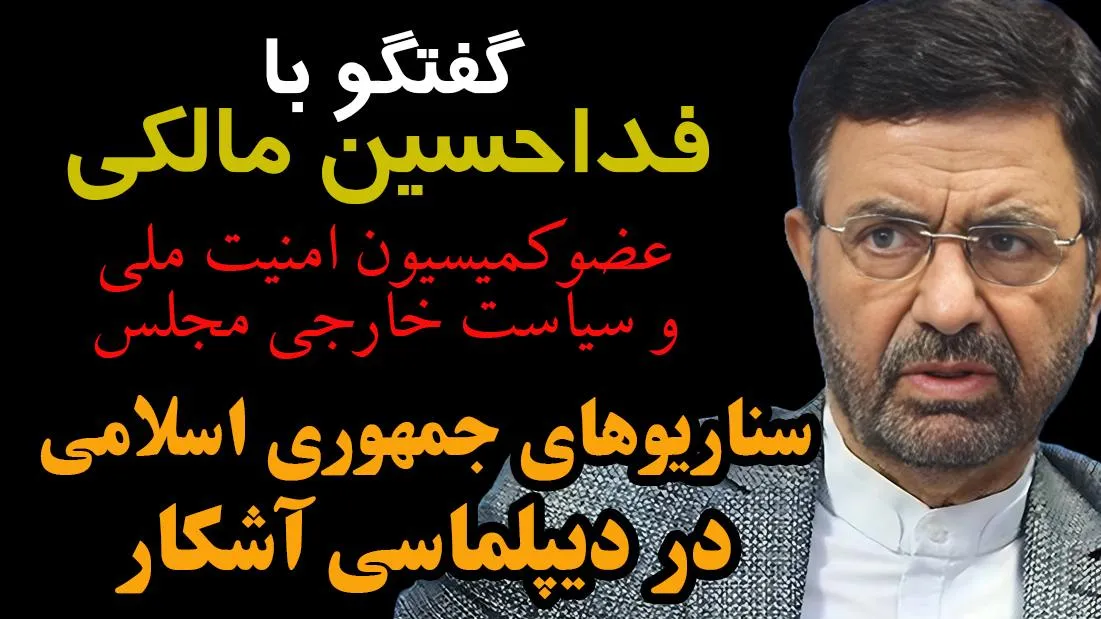
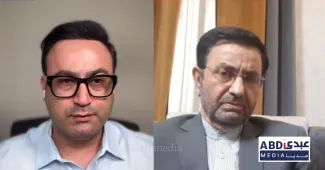
My guest on this program is Dr. Fadahossein Maleki, a member of the Parliament's National Security and Foreign Policy Commission and the representative of the Zahedan constituency. He has served as Iran's Ambassador to Afghanistan and as the Secretary of the Anti-Narcotics Headquarters. Mr. Maleki, welcome to Abdi Media. How did we arrive at the current negotiations?
Fada Hossein Maleki: I am very pleased to have the opportunity to be with you and our friends and to have a friendly and sincere conversation with your audience, both inside and outside the country. What is certain, as you mentioned, is that today's world is focused on one of the important issues: the dialogue between Iran and the West and America. Although in our country we consider negotiation a project as part of the Foreign Ministry's mission, this does not mean that we tie all the country's issues to the negotiations, whether in the first term of Trump or his current administration. Iran's strategy has usually been to pursue the JCPOA and nuclear issues as one of the matters on the agenda. But the more important issues are the larger ones where Iran, given its very distinguished position in various fields, can maintain its real status in international and regional equations.
Regarding the negotiations, you and your audience are aware that we have experience with Mr. Trump's administration. Let me explain this experience so that perhaps views are directed more toward the realities. Our experience was that in Trump's previous administration, where the European and Western countries were somewhat the axis of the negotiations, we saw many ups and downs. Nevertheless, Iran accepted to sit at the negotiating table. We accepted this for various reasons, but you saw that at the end of the road, it was Mr. Trump who removed the negotiations and withdrew. He not only left the negotiating table but also left the negotiation room. However, the Islamic Republic of Iran left the negotiating table but never left the room. This is a very important point. I say this so that the world knows that Iran showed its honesty, acting based on international laws. This doesn't mean we are influenced by political pressures from outside or inside. This is a reality: today, the Islamic Republic is a reality that the world has accepted.
Now, when the discussion of negotiations arose, you must have observed that initially, Mr. Trump, with his perspectives, made remarks about regional and global equations. You see how he suddenly declares Canada one of the US states, or the serious challenges he created with Europe, or his contemptuous treatment of the Ukrainian President, or starting a new tariff war with China and other countries. Finally, addressing the Islamic Republic with that tone and rhetoric, he says, "If you don't negotiate, we have other options." You and your viewers are aware that today's world is not about force. Even a small country, even a country with nothing, must be treated based on humanitarian, international, and Islamic laws—whether it's an Islamic country or not. We should not allow ourselves to dictate. Iran—remember when we had to import barbed wire? Today, Iran has a say in the world's defense and security equations. This cannot be ignored. In many areas of development, it can be among the top three, five, or ten countries. And more importantly, the Iranian culture. I observe many world issues, and many Iranians abroad, whom I greet, are all affected by the rhetoric. They are upset. Iran is Iran; history has shown this. It is interesting that this point came to mind: Mr. Trump had two remarks about Iran in his first month. His first remark described the Iranian nation as having a history and culture; he said many good things and praised it, what history says about Iran. But a few days later, he issued an order for maximum pressure against the Iranian people. This simply doesn't add up. What logic is that? You can't have double standards. You praise this nation and then sanction it; you have maximum pressure against the same nation you praised. It can't be done.
Today's world does not accept threats and war. The world has become fragile. This is a reality. There are humans who want to live freely. Iran wants to live freely. For the past 45–46 years, you have created various problems. The Zionists, acting as proxies for America, strike scientists on our soil and in Iraq, disrupting world order. But Iran is not like that. Iran seeks to maintain world order and equations. However, we will not allow anyone to do whatever they want. Yes, we have defensive power.
Abdi Media: Based on your remarks, I have a question: Was this current negotiation driven by U.S. pressure, or could it not have happened otherwise? To what extent has Trump's pressure forced the Islamic Republic to sit at the negotiating table with him?
Fada Hossein Maleki: Regarding the current negotiations, there was no pressure on the Islamic Republic of Iran. As I said at the outset, we consider negotiation as one of the diplomatic apparatus's missions. They proposed it, and the proposal was reviewed in Iran, at the level of senior officials and in the National Security Commission. On that basis, Iran, to prove that this is a continuation of the earlier negotiations with Trump—given the developments of these years—sees no pressure. You saw that after a while, Mr. Trump himself, regarding his letter to Iran—which we Iranians say was "nailed"—spoke in both a good tone and a harsh tone. He said, perhaps this wasn't widely broadcast, but based on our monitoring and responsibility, he said that the letter means nothing; what matters is what is on the negotiating table. I feel that the first round of negotiations in Muscat was satisfactory for both sides. No projection was seen from the Americans there. Of course, outside the negotiations, in various spaces, there may be discussions we have heard, and this is concerning. That is, the positions after the Saturday of Muscat until today—we have seen some positions from Trump's side, his hardline team raising issues with threatening tones. This is met with reactions in Iran, which is not in the interest of the negotiations. If we reach final stages tomorrow, the U.S. Congress must approve it because there is no guarantee that Trump won't overturn everything again, as in the first negotiations.
It's interesting to note that recently, at the Inter-Parliamentary Union assembly—since I am the Secretary-General of the Inter-Parliamentary Union of Iran—we participated. The British delegation requested cooperation; I am also the head of the Iran-UK friendship group. In the negotiations, they asked me, "Why don't you accept direct negotiations?" I asked them to instead ask why Trump doesn't accept indirect negotiations. They said Trump is unpredictable. I replied, "No, he doesn't trust you Europeans; he bypassed you. In the first round, you were the intermediary, the axis of negotiations. But now he hasn't done that." Regarding direct negotiations, I told those gentlemen, and I say it now: if direct negotiations happen and reach an agreement, what guarantee is there that Trump will lift the unjust sanctions against the Iranian people? Is there any guarantee? These questions are in the minds of the Iranian people and officials. If you see dissenting voices in the parliament, government, and society, I am concerned. We cannot spend all our time on negotiations because the wall of mistrust after the first negotiation was built by the Americans and Westerners themselves. Even the British accepted this and said the Americans must lift the sanctions. I don't want to go into the 150–160 countries in Uzbekistan because our discussion is about Iran and America. I want to tell the viewers that the atmosphere was extremely anti-Trump and anti-Trump's policies. There were European, Asian, and African countries; everyone was talking. In meetings, lunches, coffee breaks, and many other places, the discussion was about why he wants to disrupt the world order. Iran can follow this same perspective.
Listen without filter on the Abdi Media Castbox.
Abdi Media: So you are saying that there was no such thing as, for example, the shadow of war or Trump's threats being the reason the Islamic Republic came to the negotiating table; these were not the reasons for the negotiations.
Fada Hossein Maleki: That is not the case at all.
Abdi Media: What is the reason, then, that immediately after Trump becomes president, negotiations with the United States are put on the agenda?
Fada Hossein Maleki: The first point I mentioned is that in addition to Trump or the Westerners, who were the other side, leaving the negotiating table, we did not leave the negotiation room. We kept the negotiation room as a subject and project on the agenda. Now, proposals were made—countries like Oman and some other Islamic countries, in any case, emphasized and requested that this negotiation and dialogue take place. As you said, we must have a culture of diplomacy in this regard, which can replace the culture of threats and intimidation found in Trump's rhetoric toward other countries.
Abdi Media: A report on the first round of negotiations was presented to the parliament. Is there anything in it regarding your assessment of these first-round negotiations, which you said were positive? Do you think the prerequisites for starting negotiations on the part of the Islamic Republic have been met? Regarding the military issue and enrichment, what are the minimum demands of the Islamic Republic in the negotiations that must be observed by the American side?
Fada Hossein Maleki: The first round of negotiations was, in Iranian terms, a "sizing up"—that is, a verification, a mutual assessment, as wrestlers do. This was a point that was established there. The second point is that entering into military and missile issues was never discussed. Neither the American side raised this issue nor did Iran allow entry into these topics, because the discussion was about the nuclear issue. Certainly, in the second round of negotiations, the examples, framework, and structure will be defined, to be continued in subsequent rounds.
Abdi Media: A discussion has arisen about where the next round of negotiations should take place. Was there a specific reason Oman was chosen? It has been said that the American side preferred the UAE, but the Islamic Republic did not agree because of the UAE's ties with Israel, and considered Oman a country where these talks could be held more easily. Could you explain more about this?
Fada Hossein Maleki: You asked a good question. This was Iran's preference for it to be Oman. We are more comfortable with the Omanis; the Americans are more comfortable with the Emiratis . Of course, we don't have bad relations with the Emirates—we have trade and political exchanges—but we are more at ease with Oman. Oman has also been determined in its mediation efforts over the past few years to make things happen. For this reason, Iran's proposal was implemented. Regarding the next point, that it should be Rome or Italy, this was the Americans' own proposal during the meeting. The Americans said they would have to be in flight for 17 hours, and if possible, it could be closer, while Oman would still host. Only the location would change, to a place Oman designates. Iran, with due consideration by the friends, accepted, and in total, it was agreed again to be in Oman .
Abdi Media: According to your information, was there an effort to change it to Italy? That is, where was the Islamic Republic's preferred location in Europe?
Fada Hossein Maleki: We also had a positive view on Italy.
Abdi Media: Because the Omanis had approved it. Is Oman now the guarantor of the negotiations? Because among Arabs, this is customary.
Fada Hossein Maleki: Guarantor in the sense of a property or store transaction is not the case, but Oman, as both a mediator and host, has a degree of authority over the matters, and both countries have accepted this.
Abdi Media: Oman is guaranteeing the security and the safe conduct of the meetings.
Fada Hossein Maleki: Exactly right.
Abdi Media: And both sides agreed?
Fada Hossein Maleki: Yes.
Abdi Media: Does Oman itself have no role in facilitating this deal? Or does it only handle logistics?
Fada Hossein Maleki: It certainly has this role. I myself was in Oman two years ago at the head of a delegation; we had intensive negotiations. In a meeting with a senior official, he initially said that the Americans had told them, "The ball is in Iran's court. What do you say?" This was not under Trump's administration, where they said they were under pressure; it was under Biden's. I proved to them that the ball is in America's court; we had readiness from before. They did not have readiness. Later, the Omanis accepted and said, "We agree that the ball is in America's court." In any case, they also try to get this issue to a conclusion. That is, in addition to the good hosting they provide, they can be experts on the issues.
Abdi Media: What are the things that the Islamic Republic will absolutely not accept in the negotiations?
Fada Hossein Maleki: In the negotiations, if the issue concerns specific topics that are on the minds of Mr. Trump and his extremist group, which are defense and missile issues, absolutely not. This is the system's red line. Under no circumstances. That is, if Trump intends to treat Iran like Ukraine or Libya, he must get that out of his mind. The history of the Iranian nation has shown that this can never be the case
Abdi Media: Regarding this first point, how unified is the parliament?
Fada Hossein Maleki: The parliament is unified. In the 11th parliament, we defined the strategic law and charted the path for the government and future governments. It wasn't outside the framework of the governments. As you know, from Mr. Rouhani's government, when Mr. Zarif was foreign minister, to the martyred Raisi's government, and to today's government under Mr. Pezeshkian, no government reacted against the strategic law. The parliament is unified on its red lines.
Abdi Media: The next point.
Fada Hossein Maleki: They might say regarding nuclear issues—we can't comment now because we must wait for the second round of dialogue to see what the Americans expect. If they want the transfer of enriched uranium, Iran absolutely will not accept it.
Abdi Media: Meaning the transfer of 270–280 kilos of used fuel?
Fada Hossein Maleki: Iran absolutely has no entry into these issues. If you look at the balance of the world, let me give an example of the right the world should give Iran. Take India and Pakistan, which have had problems for years. At one point, India became nuclear, and Pakistan, with its specific competition, also became nuclear. Now Israel is nuclear. Trump should not force Iran to move toward nuclear weapons itself.
Abdi Media: Nuclear weapons?
Fada Hossein Maleki: Yes. If Iran also becomes equipped with nuclear weapons, balance would be restored. Israel is currently nuclear, with warheads and many other things, which we won't go into. You and your friends in contact know exactly. My belief is that if the negotiations proceed based on the framework of the initial talks, this can lead somewhere. What is important for us is that a proper agreement must happen and sanctions must be lifted. Look, for years these sanctions have been in place, and Iran continues its work. Despite knowing the pressure on people's lives is immense, we have many problems. At some point in history, America must answer why it pressured a nation, not even allowing medicine to enter. Iran is not crippled; it solves its problems through various other means. They say they won't allow oil, but Iran does it. From the first round until now, were the paths closed to Iran? It has done its work. If negotiations are to happen today, it is because we emphasize maintaining regional and global security equations. America in our region should not, through its proxy Israel, seek to create sedition in corners of Iran. The surrounding bases are precisely monitored by Iran's military and officials; they observe what happens around Iran. It's not as they think—Iran is not like that. We closely monitor events like those in Gaza, and we have our share in this regard. If this dialogue happens, the world will not move toward a new crisis.
Abdi Media: One of the reasons Trump withdrew and cited was that the U.S. didn't reap the fruits of the JCPOA—that is, American investors couldn't enter Iran. Policies were drawn up, for example, the policy of Ayatollah Khamenei banning the entry of American luxury goods like iPhones. In this period, given existing laws, to what extent are conditions prepared for Americans to invest in Iran if an agreement is reached? Iran is a very attractive garden for any investment, and Trump's team are businessmen. How much is this attractiveness being prepared for American investment?
Fada Hossein Maleki: It comes to my mind that in this period, Trump realized he had fallen behind. This attractiveness you mention—Iran has it. Many countries in the world have shown willingness in recent years to invest in Iran, from Russia, China, India, to some European countries. Iran, within its framework, accepted this partnership and investment. At this point, in the global economic competition, mainly between China, America, and some countries, and Iran's presence in many equations—even the BRICS and Shanghai—Trump realized, given his economic character, that he has been far behind other countries regarding investment with Iran for many years. If conditions aren't ready now, due to the wall of mistrust between Iran and America, if it is in a space where we don't create problems for any country in the world, we expect Trump to have this view toward Iran. Then, if Americans propose to invest in Iran, it will certainly be on Iran's agenda.
Abdi Media: One of our dear friends and colleagues asked a question. Please ask: How can the Islamic Republic guarantee that foreign investors and their capital will be secure in Iran, given that some investors, dual nationals, or citizens of other countries have faced espionage charges in recent years? What guarantee is there that the investor and their capital will have the necessary security in Iran?
Fada Hossein Maleki: I want to answer from several perspectives. First, dear Iranians, wherever they are, we have a hand of brotherhood extended in any way they deem appropriate to serve dear Iran. They can come to their country and invest. We have mechanisms for this. Currently, in the National Security Commission, we are working on the presence of Iranians, even some young people born abroad in Europe, who are seeking their identity in Iran. This readiness exists, and there is certainly no problem for this. We have specific definitions at the Ministry of Foreign Affairs. Regarding other countries, neighboring countries and regional investors haven't faced problems so far. Of course, we have bureaucratic issues that need to be expedited. The readiness for foreign investment exists. Some European countries have developed inclinations; for years, work has been done with participations based on existing laws. Overall, our view toward foreign investment in the country is positive.
Abdi Media: I'll speak a bit bluntly. We have had various examples. Different supervisory and security institutions, even above parliament, make decisions. We are also talking about how, in some areas, parliament is no longer at the top due to parallel institutions. Given this, does parliament intend to draft or approve laws to provide guarantees? We have seen Iranians return to their country for various reasons—like a journalist who spoke with someone, and an official told them to return, but they ended up in prison. I'm referring to Reza Valizadeh, who was a journalist for Iran but later worked for Voice of America. My point is that Iranians who want to return have this concern. I can't ignore this voice of the people. There is a lack of belief that if we go to Iran, the Islamic Republic won't have security or judicial actions against us. Are you considering a more fundamental action, given the multiplicity of decision-making security institutions? Or is it currently as it is?
Fada Hossein Maleki: We ourselves have the same concern regarding Iranian nationals in foreign countries, including America and some European countries. Regarding our journalists and Iranians, there are undignified treatments at airports and elsewhere. But is Iran a country that would, God forbid, intend to create problems for its own citizens? Unless there are issues where security forces suspect an individual based on prior monitoring or actions taken abroad. It is the right of the country's security apparatus to monitor individuals entering. We have had many cases where they themselves confessed to being spies or infiltrators. But for an ordinary person wanting to invest, many have come to us and been introduced to the Foreign Investment Organization of the Ministry of Economy and Finance, and their work is done, including money transfers for projects and investments. We discussed this with Mr. Pezeshkian recently, and it was decided that if there are obstacles hindering investment in the country, given that this mission has been assigned to the Ministry of Economy and Finance and the Central Bank, those obstacles should be removed.
Abdi Media: One of these obstacles is the negotiation itself. Many countries that wanted to invest couldn't do so due to U.S. sanctions. Or banking issues—how should an investor bring money in? Now that banking systems are cut off, in a way, all these issues come back to sanctions.
Fada Hossein Maleki: Of course, America must answer why it created the conditions to prevent other countries from investing in Iran. Iran should not answer this.
Abdi Media: It wants to deal with Iran.
Fada Hossein Maleki: Why did it pursue sanctions in the first place? Suppose we are not neighbors with America; we are neighbors with 15 countries. If we have issues with each, we talk; we are neighbors. But with America, we are not neighbors—they come from 2,000 kilometers away. For example, sanctions on medicines you want to import. What is this? The Americans themselves must answer. The world does not accept this dictation. As you said, this is understood by America itself. We accept that the investment path needs to be smoother, and we will do that. But the main issue is sanctions preventing countries from investing. I agree, but the main culprit must be accountable: America itself.
Abdi Media: There are two scenarios: we moved from the "neither war nor negotiation" scenario to "either war or negotiation." To what extent do you agree that this is what we face now?
Fada Hossein Maleki: I do not agree with this. We don't have a war scenario at all, unless war is imposed on us. In Trump's view, I see less of a dialogue or diplomacy scenario; his tone is harsh or indicates war—not just with Iran but with other countries too. This must change. There is a difference here. From Trump's perspective, negotiation with Iran has become America's top priority. From Iran's perspective, it is not Iran's top priority. We do our own work; we are serious about negotiations because if they have an impact, the world will understand that you must lift the sanctions.
Abdi Media: Why is it not a priority when investment has been a slogan of Mr. Khamenei for years, and on the other hand, foreign investment cannot happen without U.S. permission due to banking issues...?
Fada Hossein Maleki: Many countries are investing without permission. Does China ask for permission to work with Iran? Does Russia? Countries like India do it without permission. Many countries do this.
Abdi Media: Can Europeans come?
Fada Hossein Maleki: If sanctions are lifted, the path opens. Many countries, at the Tashkent summit, say they are ready but must navigate zigzag paths. Why should this happen? We have the readiness; the Islamic Republic's position is tempting for investment—that's exactly what you correctly said, it has a special attraction. Countries must pressure the Americans to lift the sanctions. Have we not been under sanctions for years? We are, and we do our work, but we know it's difficult. As I said, sanctions have created problems for us, but we've tried to stand on our own feet. We expect the Americans to be realistic in this round of negotiations.
Abdi Media: The Islamic Republic's scenario—if, God forbid, a missile is fired at our country, let that hand be cut off and that eye be blinded that sees that day—but what is the Islamic Republic's scenario? If Trump gets angry, can't control himself, strikes Iran's nuclear facilities, or attacks some infrastructure, what will the Islamic Republic's reaction be?
Fada Hossein Maleki: It will certainly react. America itself knows Iran's plans. They know Iran today is different from 46 years ago. Iran is no longer America's gendarme; Iran has several gendarmes in the region. If he does this, don't doubt that Trump will lead the world toward World War III. Many will be harmed before Iran suffers serious damage. These are things the world's wise men know. I have met many Europeans, and our friends in the diplomatic apparatus and parliament, all are upset and won't allow it, even the wise men in America. Look at the bases the Americans have around us—do you think they are not within Iran's range? I want to say Iran is absolutely not seeking such a war, but if Trump wants to go there, he must accept that it will have a heavy price, and many countries in the world are aware of this.
Abdi Media: Inside Iran, some say that to create deterrence, the Islamic Republic must have nuclear weapons, as other countries do. You also mentioned that if Iran had nuclear weapons, balance with Israel would be established. If the Islamic Republic decides to do so today, how long would it take to build a nuclear weapon?
Fada Hossein Maleki: Very quickly.
Abdi Media: Is there a specific timeframe?
Fada Hossein Maleki: The timeframe should be determined by experts in the field. This readiness exists. We hope it doesn't reach that point. If it does go that way, you can be sure many will burn in the fire of war.
Abdi Media: Do you think nuclear weapons can create deterrence? Deterrence against attack?
Fada Hossein Maleki: We don't have that view. Our view is that we shouldn't reach that point. Perhaps one of the reasons for accepting negotiations—both for the Americans and ourselves—is that it doesn't reach that point. But if America wants to carry out this sedition through its proxy, the Zionists, that will certainly push Iran further toward nuclear weapons.
Abdi Media: So you are saying that if the Islamic Republic decides, it can build nuclear weapons in a short time. There are two parts to this: why should it build them? If they are truly deterrent, why doesn't it build them? These are multi-variable equations. If it can build them quickly, why doesn't it? If it can't, what are the Americans saying? There is a strange space in between that I don't understand.
Fada Hossein Maleki: The beauty of it is precisely this strange space. Iran can do many things. Review Iran in 1979 and Iran in 2025—as a steadfast child of this country—Iran has reached many things and can reach more. Not just nuclear weapons. But I ask, why should the Americans have this view toward Iran and not toward Israel? Doesn't Israel have nuclear weapons? Doesn't it have nuclear warheads? Why is America giving Israel the most modern military weapons over Gaza and Hamas? Why can't it do this? You know these things. I don't want to insult the American people, but consider America's history and Iran's history. Where in history were Iranians defeated? You help a country with nuclear weapons; they killed 50,000 people, tore apart 20,000 children. Mr. Trump is still helping, still inciting Israel to do the same to Iran, Yemen, Afghanistan, Turkey, and Azerbaijan. What is that?
Abdi Media: There is a scenario.
Fada Hossein Maleki: I want to say that this scenario exists. Most of the questions you ask should be answered by the Americans. If a senior and influential American official were here, they would have to answer why they are now afraid of Iran becoming nuclear. Why shouldn't it?
Abdi Media: The issue and my pain are that the Americans are not in difficulty; our people are in difficulty.
Fada Hossein Maleki: I know. Did you stop India? Did you stop other countries? But if he feels our people are in difficulty, we feel it more. We live with the people every day; we are ashamed. But why, on the first day he became president, did he praise these people, only to impose sanctions again? That doesn't work, and we can't just sit idle. That's why I say, viewers will understand that many of these things must be answered by the Americans.
Abdi Media: There is a scenario that some opponents of the Islamic Republic—the opposition seeking to overthrow the Islamic Republic—envision. They say that if the United States attacks the Islamic Republic, targets some of its infrastructure, the Islamic Republic will weaken. On one hand, it can't exert social pressure on people; on the other hand, the economy is already in bad shape. This bad economy will completely collapse, causing social dissatisfaction, and people will overthrow the Islamic Republic, leading to a regime change. What is your view on this scenario?
Fada Hossein Maleki: This is an illusion that some people have. We monitor it, but we are glad that some researchers and Iranian figures respond through these very media. We see the responses. You monitor more than we do. Tell that person: it is a disturbed dream to think that America will attack Iran, killing innocent people and your own relatives in America, so that Iran weakens and then someone like so-and-so enters Iran. What kind of dream is this? Suppose tomorrow someone else enters Iran, America comes and wants to implement these same programs for Iran. Would you allow that? I want to say, don't think Iran is a weak and clumsy country. They have readiness; we have readiness. We are not optimistic or pessimistic about negotiations; it depends on the other side. If they want to negotiate, we are ready. But we accept negotiations, as Mr. Araghchi said, only if sanctions are lifted. If sanctions aren't lifted, negotiations are useless. If you see that our people—some of us believe this situation should be removed as quickly as possible—but some with an extremist Zionist mindset are instigating American extremists to think that Iran...
The full file of Abdi Media's conversation with Fadahosein Maliki, a member of the Parliament's National Security and Foreign Policy Commission


Take less than a minute, register and share your opinion under this post.
Insulting or inciting messages will be deleted.
Sign Up