

In the morning, after praying and bathing, I read the reports for today's lectures. At 7:30 in the morning, we went to the "Gilan Province Government Management Training Center" and opened it. They provide short-term or long-term retraining of government managers and experts throughout the country.
In the morning, after the prayer and bathing, I studied the reports for today's speeches. At seven-thirty in the morning, we went to the "Gilan Province Public Administration Training Center" and inaugurated it. They give short-term or long-term retraining to government managers and experts across the country. The inauguration of this center was not previously in the program and came into the program at the insistence of Mr. Mir-Mohammadi, the Secretary General of Administrative and Employment Affairs, which caused delays in carrying out all of today's programs.
We flew by helicopters to the "Sturgeon Fish Research Center." This center was established before the victory of the revolution with the cooperation of the Soviet Union and has been developed after the revolution. Its work is raising fingerlings for feeding the Caspian Sea. We have several centers in the north. The Ministry of Construction Jihad has done important work, and recently they have brought modern technology that raises fingerlings in small ponds, the size of several large pools. They complained about the disruption of the natural fish breeding work in the Sefid Rud and Anzali Lagoon, which are the most important natural centers for this work. I too, in today's speeches, informed the people not to engage in unregulated fishing and smuggling.
From there we went to the "Forest Reclamation Cooperative Center" around Siahkal. They gave explanations about the timing of gathering the small scattered villages and the livestock from the forest, for reforming their deprived lives and preserving and protecting the forests. I gave the documents of several grazing units that had been given thirty-year leases to the villagers and spoke with them. I also visited a cattle-raising cooperative that was converting native cows to improved Dutch dairy cows. The people of the region had gathered; I gave them a short speech.
We flew toward Rudsar. On the way I heard explanations about the rice fields, mulberry groves, tea, and the irrigation canal networks under development; it is very magnificent. The city of Rasht and the forest and the Caspian Sea, which are seen together and connected from the air. The people of Rudsar had formed an astonishing gathering outside the city in a vast open space, which, according to the companions, is unprecedented in the history of Gilan. Mr. Issa Kalantari, the Minister of Agriculture, claimed that five hectares were filled with a dense, standing crowd. At the end, the crowd could not be seen from the podium. Beside the gathering, in the rice fields, women rice farmers were busy planting rice seedlings and were participating in the ceremony from there. They brought me a bouquet of flowers along with a bundle of seedlings.
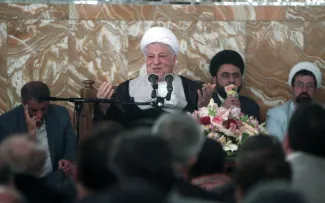
A rich anthem was performed by the daughters of the martyrs. Mr. Sheikh Ahmad Jonidi, the Friday prayer leader of Rudsar, who is the father of three martyrs, gave a short welcome speech. I too, seeing the warm feelings of the people, gave a long, honoring, and encouraging speech. A group insisted on clapping and whistling and cheering, insisted on blessings and takbirs. It is like this in most gatherings, and it is interesting that the clergy too do not oppose clapping, and even Mr. Ehsanbakhsh encourages it; he is an enlightened person. Another interesting point in this trip is the presence of women with less hijab in the street and their enthusiastic welcome.
From there we flew to the city of Amlash. In the city square, we inaugurated the gas pipeline. Mr. Salehipour gave explanations and I lit the square's torch. Around the square, they were expressing happiness. I spoke a few words. We went to the huge gathering of the people outside the city; on the slope of the pleasant hills where the tea gardens and large fields and forest had created an interesting view; their ceremony was very lively.
Before the revolution, to preach in the months of Ramadan, I used to come to this city for several years and was acquainted with most of the people. I would be the guest of the late Sheikh Abolmakarem Rabbani. They performed an anthem with this opening: "How strange, you made the friends or dear ones remember the garden"; it was very interesting and memorable. Mr. Mohammad Mehdi Rahbari Amlashi, the city's representative, gave a detailed speech and spoke about my record in Amlash. Throughout, I was under pressure from the pressure of urine in my bladder. My patience ran out; I told Mr. Ehsanbakhsh to keep the gathering busy for a while; I went to a small house near the gathering place and relieved myself and renewed my ablution. It will certainly become a topic of talk and amusement for the people! It was unprecedented, but I had no choice. In the humid and low-evaporation air of Gilan, where I sweat little, urination must be more frequent. I gave a warm speech to the people. I spoke about the record and the people behaved very kindly.
From there we went by car to the Tea Research Center on the outskirts of Langarud. They gave explanations. Then we had lunch and after the prayer, we rested. We visited the seedling planting and flew toward Langarud. In Langarud too, like Rudsar, the people's gathering was astonishing and unprecedented. We heard an interesting anthem. The Friday prayer leader and the city's representative gave welcome speeches and raised the demands and praised me exaggeratedly; I too gave a detailed and encouraging speech and explained the reconstruction and construction activities.
We flew toward the city of Lahijan. From the air, we saw the condition of the Chamkhaleh and Kiashahr coasts, the flooding of the coastal structures. In Lahijan, the people's gathering was more magnificent and orderly than all the cities. Mr. Zain al-Abedin Qorbani, the Friday prayer leader, and Mr. Bahram Yaqoubi, the representative, spoke well. An anthem was performed by the Talysh and Galesh children. I too, in my speech about their past and present, did my utmost.
We visited the city's old tea drying factory, with a capacity of thirty tons of green leaves per day. Such factories are entirely domestically built, and their construction costs about one hundred million tomans. Due to the greater need, I emphasized giving loans. The tea growers gave a thank-you letter and a gift as a sign of satisfaction with the government's support that has revived the tea industry; they are especially grateful to me personally. The warmth of the Lahijan people's welcome is also indescribable. An interesting initiative in this trip was that everywhere in the gatherings, they sent balloons with excellent welcoming messages into the air.
We flew toward the Gilan Combined Cycle Power Plant. From the air, the city of Lahijan, given the heights and the adjacent forests and reservoirs, seemed very beautiful to me. At the power plant, Mr. Bijan Namdar Zangeneh, the Minister of Energy, and the managers gave explanations. Six gas units with a capacity of nine hundred megawatts are operating. Three steam units are also being installed, which will raise the efficiency by fifty percent with the same fuel.
We went to the Industry and Agriculture Exhibition and visited more than two hundred booths. They have good prosperity. Most work with domestic materials and also have exports. Some import materials, which they have a foreign currency problem with. The visit lasted until midnight; I became very tired. I returned to the residence and slept with great fatigue.

Take less than a minute, register and share your opinion under this post.
Insulting or inciting messages will be deleted.
Sign Up