

After the prayer and listening to the news, I read the reports. I completed the tasks that had been brought from Tehran. For the helicopter flight towards Rudbar, we went to the provincial law enforcement center. The law enforcement, because the naval forces had, upon my arrival at Rasht airport, prevented the assumption of responsibility
After the prayer and listening to the news, I read the reports. I did the tasks that had been brought from Tehran. For the helicopters to fly toward Rudbar, we went to the provincial Law Enforcement Force center. The Law Enforcement Force, because the Navy, when I entered Rasht Airport, had prevented it from taking charge of the military reception ceremony and had carried it out itself, again held a military ceremony.
The weather was cloudy. The helicopters took off, but after leaving the city of Rasht, they returned due to rain and fog; a precautionary measure that I thought was unnecessary, but I did not object. We moved by cars and arrived with an hour's delay. On the way, Messrs. Ehsanbakhsh and Tahai gave good explanations about the artificial forests and the river and so on.
The city of Rudbar and Rostamabad was deserted; because the people had gathered at one point for the ceremony: on the city boulevard, which had also blocked the Tehran road. In that same section where, during the trip [in 1990], at the time of the earthquake, a woman had shouted and criticized because her relatives had not been rescued. This same woman stopped the car and, as thanks, presented a bouquet of flowers. It was an interesting historical incident, which I recounted in the speech for the people.
We went to the city of Manjil. The people had gathered in the street. They threw many flowers on our cars. In Manjil, on the shore of the Sefid Rud Dam, we began the creation of the first one-megawatt wind power plant with concrete pouring. Messrs. Ahmadi and Reza Amrollahi, the head of the Atomic Energy Organization, gave explanations. They say that in the Manjil wind tunnel, there is a potential of thousands of megawatts of electricity. The Manjil valley, which is a corridor between the two sides of the Alborz mountain range, is the place of constant and sometimes very strong winds due to the difference in the weather of the north and south of the Alborz. I too encouraged them.
We took a tour of the city of Manjil; [after the earthquake], it has been built very clean and beautiful with anti-earthquake buildings and a boulevard full of flowers and grass. Cheerful people welcomed us in the street. They expected us to have a speech ceremony with them like Rudbar; they are competitive.
We went to the site of the Sefid Rud Dam. From the model of the dam and the mountains and plains of Gilan Province, they gave good explanations about the dam and the waters and canals and needs and facilities and the dams under study and the canals under construction and the organization of the Sefid Rud River and Anzali Lagoon and the Astor Dam, and then how the dam was damaged in the earthquake and how it was repaired and reinforced and stitched, all of which was interesting and useful to me.
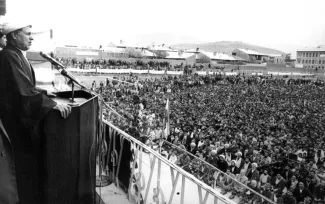
Then we took a tour of the city of Rudbar and saw the reconstructions. We participated in the very magnificent gathering of the people. The people were very cheerful and thankful; honestly, in these four years, a great work has been done. A good anthem was performed. After the welcome of Mr. Nosratollah Vahidi Damghani, the Friday prayer leader, and Mr. Faramarz Golshani, the representative, and their presentation of the needs and their abundant thanks, I too spoke, praising the method of reconstruction cooperation that was carried out with the government's support and the people's undertaking.
By car we moved toward the Silkworm Research Center around Rasht. We arrived with an hour's delay. On the way, everywhere we were faced with the gathering of people along the route and their enthusiastic expressions of feelings. It was also drizzling rain, which also caused delays.
At the Silkworm Research Center, after the prayer and lunch and a little rest, we visited the interesting mulberry farm for silkworm food. The official there gave explanations about the quality of silkworm rearing and silkworm eggs that were interesting and worth seeing to me. The Chinese and Koreans are very advanced in the silk industry, and we are at the beginning of the road; I promised support.
The people of the surrounding villages had gathered under the rain. I went among them and thanked them for their warm feelings. The helicopters had come. Due to the weather conditions, they again could not fly. We went toward Fuman by car. It was also raining heavily. The gathering and feelings of the people of Fuman, in the large square of the city, was very huge. The speeches of the Friday prayer leader and Mr. Mohammad Reza Shafiei, the city's representative, were very warm and sincere. An interesting anthem was performed by children in my praise. In an encouraging and thankful speech, I promised the construction of the Mazulan-Masuleh road and the Shaft-Saravan road to bring Fuman out of its dead end. It was also raining and the people did not frown.
We moved toward Sowme'eh Sara. It was only seven kilometers away. The welcome and presence of the people at the ceremony was beyond expectations. The cheerfulness of the people was more than anywhere else. The anthem group had an interesting performance. One of the kids sang a very good song, similar to one of the singers, and I praised it. The people clapped and I clapped too. Mr. Ghasem Ramazanpour Nargesi, the representative, and Mr. Abdolazim Yekta, the Friday prayer leader, spoke well; I too warmed up.
It was a huge stadium that the Ministry of Labor had built for the workers; we inaugurated it. There was also a light drizzle. We moved toward Rasht. All the way to Rasht itself, everywhere the villagers had gatherings along the route and, with extraordinary warmth, expressed affection. We went to the new cigarette production factory. Engineer Mohammad Reza Nematzadeh, the Minister of Industries, and Engineer Nazari gave good explanations. This factory has a capacity of twenty billion cigarettes and is modern; we inaugurated it. Many doctors were opposed to my presence there because they claimed it was advertising for cigarettes. It is an investment of more than one hundred million dollars. It has not yet become fully operational. With this factory, we will become self-sufficient in cigarette production and will also have the possibility of export. Around the factory, many people had gathered to see me.
We went toward the mausoleum of Mirza Kuchak Khan. Along more than ten kilometers, the continuous rows of the kind and enthusiastic people were constantly shouting friendship and repeatedly throwing flowers on the car, many of which hit my face and head. With a smile, I endured it. It is strange that the women with less hijab expressed their feelings more; the companions were extremely surprised.
In the mausoleum I recited a Fatiha. We also visited the graves of the war martyrs. I got out of the car for a few minutes and went among the people. The Revolutionary Guards were expressing concern, but there is no choice. I prayed in the governorate. I went to the meeting of the provincial administrative council, the gathering of managers and ministers and deputies and Friday prayer leaders and representatives. The governor spoke well and stated the services and demands. I too gave explanations of the services that have caused the people to be satisfied and to be so kind, and I criticized the unattainable expectations of the parliamentarians. I raised promises and gave the final solution. Then we had dinner. I wrote the memoirs until one in the morning and slept.
Take less than a minute, register and share your opinion under this post.
Insulting or inciting messages will be deleted.
Sign Up