
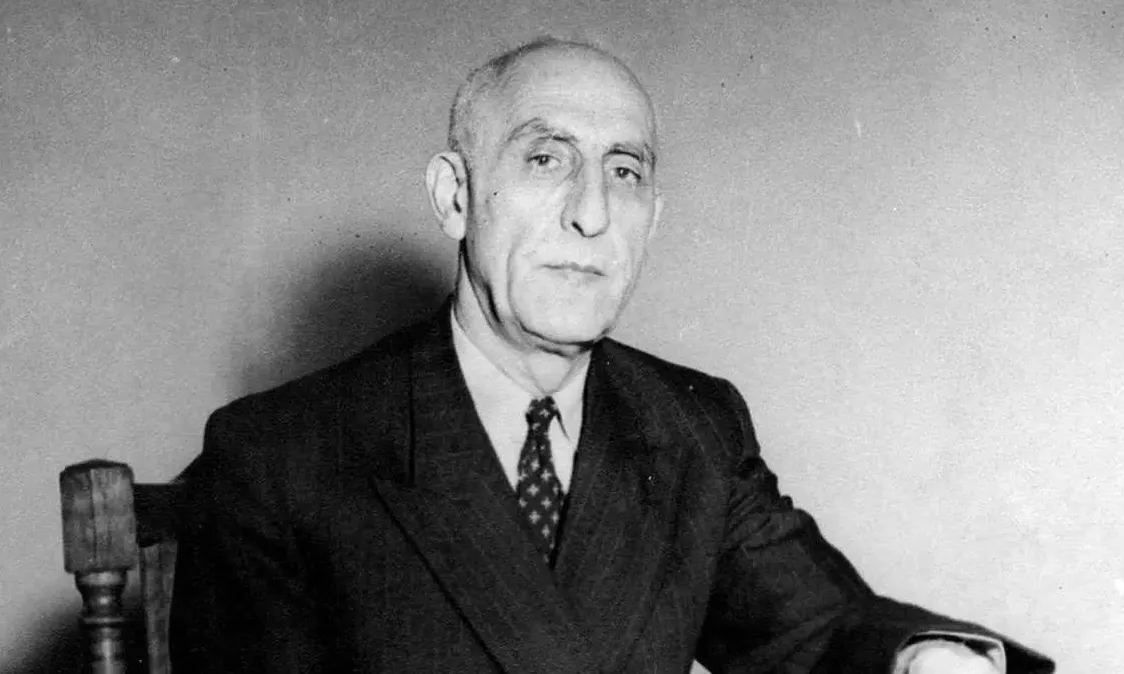
Dr. Mohammad Mosaddegh, politician, jurist, representative for eight terms in the National Consultative Assembly, the 30th Prime Minister of Iran (1951-1953), leader of the movement for the nationalization of the oil industry, the first Iranian to hold a doctorate in law, and founder of the National Front of Iran, ranks among the most widely-reported and most prominent figures in contemporary Iranian history. With an aristocratic-Qajar family background (son of Mirza Hedayatollah, Minister of the Royal Court, and grandson of Abbas Mirza) and a doctorate in law from the University of Neuchâtel, Switzerland (1914) as the first Iranian with a law doctorate, he became Prime Minister in May 1951 and, by ousting the Anglo-Iranian Oil Company and defending Iran's case at the International Court of Justice in The Hague, led one of the most prominent anti-colonial movements of the 20th century. Mosaddegh resigned on July 16, 1952, but returned after the uprising of July 21 and formed his second cabinet. His government was overthrown in the coup d'état of August 19, 1953, planned and supported by MI6 and the CIA—a coup that the CIA acknowledged 60 years later. Mosaddegh endured 3 years of imprisonment and 14 years of exile in Ahmadabad, and passed away on March 5, 1967.
Dr. Mohammad Mosaddegh (born June 16, 1882, in the Sang-e Laj neighborhood of Tehran — died March 5, 1967, at Najmiyeh Hospital in Tehran at the age of 84), politician, jurist, representative for eight terms in the National Consultative Assembly, the 30th Prime Minister of Iran from May 1951 to August 1953, leader of the movement for the nationalization of the oil industry, the first Iranian to hold a doctorate degree in law (from the University of Neuchâtel, Switzerland, in 1914), founder of the National Front of Iran in 1949 alongside Hossein Fatemi, one of the prominent pioneers of the anti-colonial movement in the global sphere of the 20th century, and among the most widely-reported figures in contemporary Iranian history, ranks among the most prominent figures of the national-political discourse of contemporary Iran and one of the most controversial figures in Persian-language historiography. Mosaddegh, with a unique trajectory — from a prominent aristocratic-Qajar family background as the son of Mirza Hedayatollah, Minister of the Royal Court (a prominent figure of the Naseri era) and Najm al-Saltaneh (Taj Khanum) — the grandson of Abbas Mirza, the Crown Prince and Regent of Iran — to receiving the title "Mosaddegh al-Saltaneh" from Naser al-Din Shah after his father's death in 1892 (when Mohammad was ten years old), to his marriage at the age of 19 in 1901 to Zahra, daughter of Mirza Zayn al-Abedin Tehrani (the third Friday Prayer Leader of Tehran, who was initially titled Shams al-Saltaneh and later Zia al-Saltaneh, a marriage that lasted 64 years until the end of their lives), to his departure for Europe in 1909 to continue his education and enrollment at the School of Political Sciences in Paris, to his temporary return to Iran due to illness, to his second return to Europe in early 1911 with his family and studies at the University of Neuchâtel in Switzerland, to receiving his bachelor's and doctorate in law in 1914 (with a distinguished thesis on "Wills in Islamic Jurisprudence and the Shiite School" — which was later translated into Persian and printed in Tehran, and as the first Iranian to hold a doctorate degree in law in the history of Iranian legal science), to his return during World War I and the beginning of his work at the Ministry of Finance, teaching at the School of Political Sciences in Tehran, and authoring works such as "Capitulation and Iran," "Procedure in Legal Courts," and "Joint-Stock Companies in Europe," to eight terms of prominent representation in the National Consultative Assembly, to his retirement after the end of the 6th Parliament and imprisonment during the reign of Reza Shah, to his release from Birjand prison through the intervention of Ernest Perron (the Swiss friend of Crown Prince Mohammad Reza), to his exile to his estate in Ahmadabad, to his political return in 1943 as a prominent leader of the nationalists at the age of 65, to the founding of the National Front of Iran in 1949 alongside Hossein Fatemi and a series of prominent companions (including Ahmad Maleki, Mohammad Hassan Kavyani, Karim Sanjabi, Ahmad Zirakzadeh, Abbas Khalili, Abolhassan Omidi Nouri, Seyyed Ali Shayegan, Shamseddin Amir-Alai, Seyyed Mahmoud Nariman, Arsalan Khalatbari, Abolhassan Haerizadeh, Hossein Makki, Mozaffar Baqai, Abdolqadir Azad, and Jalali Naeini) who laid the foundation of this Front by staging a sit-in at the royal court, to reaching the premiership in May 1951 after the assassination of General Haj Ali Razmara by the Fada'iyan-e Islam, to his prominent leadership of the historic project of nationalizing the oil industry and ousting the Anglo-Iranian Oil Company, and Britain's complaint to the Security Council and the International Court of Justice in The Hague, to his famous resignation on July 16, 1952, and his widely-reported return after the July 21 uprising, to forming his second cabinet on July 27, 1952, to the overthrow of his government in the widely-reported coup of August 19, 1953 — which was carried out with the planning and financial and executive support of MI6 (British intelligence) and the CIA (US Central Intelligence Agency), with General Fazlollah Zahedi tasked with forming the new cabinet — in which Mosaddegh's home was looted and he escaped via his rooftop, to his military trial and sentence of 3 years of solitary confinement in the 2nd Armored Division prison, to the end of his prison term on August 4, 1956, and his exile to Ahmadabad, accompanied by a number of soldiers and sergeants assigned for his protection, to 14 years of house arrest in the village of Ahmadabad, and finally, his death on March 5, 1967, at Najmiyeh Hospital in Tehran due to illness — which ranks among the most prominent widely-reported cultural-political events in contemporary Iranian history — he became one of the most prominent figures in contemporary Iranian history.
The significance of Dr. Mohammad Mosaddegh in the historical-political sphere of contemporary Iran can be examined from several aspects. First, his pioneering position in leading the movement for the nationalization of the oil industry — which ranks among the most prominent anti-colonial movements of the 20th century and became a widely-reported model for third-world nationalists in the post-colonial era. Second, being the first Iranian to hold a doctorate degree in law — which makes him one of the academic founders of legal science in Iran. Third, his prominent aristocratic-Qajar family background (as a Qajar descendant through his mother) — which, combined with his commitment to nationalist-legalist principles, formed the foundation of his distinct political identity. Fourth, his prominent commitment to the principles of legalism, the Constitutional Constitution, and parliamentary democracy — which was reflected throughout his two premierships and during his self-defense in the military court. Fifth, the widely-reported coup of August 19, 1953, carried out against his government — a coup that ranks among the most prominent interventions by Western intelligence agencies in the internal affairs of a Middle Eastern country, and which the CIA acknowledged 60 years later through the release of official documents admitting its direct involvement. Sixth, his enduring legacy in shaping post-revolutionary political movements — according to many scholars, "the roots of the 1979 Iranian Revolution can be traced back to the coup of August 19, 1953." Seventh, his sustained presence in the cultural-historical discourse of contemporary Iran — as a symbol of national resistance, freedom-seeking, and legalism.
Life and Background
Dr. Mohammad Mosaddegh was born on June 16, 1882 (according to some sources, May 19, 1882, and according to his ID, 1879) in the prominent Sang-e Laj neighborhood of Tehran — one of the capital's oldest districts. This birth in the late Qajar era, into one of Iran's prominent aristocratic-administrative families, formed the foundation of his distinct social and political standing.
Father: Mirza Hedayatollah, Minister of the Royal Court
The most central aspect of Mosaddegh's family-political background was his connection to Mirza Hedayatollah, Minister of the Royal Court — a prominent figure of the Naseri era. Mirza Hedayatollah had three sons, of whom Mohammad was the youngest. At the time of his father's death in 1892, Mohammad was ten years old.
After his father's death, Naser al-Din Shah, in addition to granting Mirza Hedayatollah's position and title to his eldest son Mirza Hossein Khan, also gave titles to his two other sons, naming Mohammad "Mosaddegh al-Saltaneh." This title, by which he was known until the passage of the law banning the use of titles, formed the foundation of his early identity in the Qajar political-aristocratic sphere.
Mother: Najm al-Saltaneh (Granddaughter of Abbas Mirza)
The more widely-reported feature of Mosaddegh's family background was his maternal connection to the Qajar dynasty. Mosaddegh's mother, Taj Khanum, titled Najm al-Saltaneh, was the granddaughter of Abbas Mirza, the Crown Prince and Regent of Iran — i.e., the great-granddaughter of Fath-Ali Shah Qajar. This prominent blood connection established Mosaddegh's aristocratic-royal standing.
Najm al-Saltaneh was also the founder of Najmiyeh Hospital in Tehran — the same hospital where Mosaddegh was hospitalized in his final days and where he passed away.
Marriage to Zahra Zia al-Saltaneh
In 1901 — when Mosaddegh was 19 years old — he married Zahra, the daughter of Mirza Zayn al-Abedin Tehrani (the third Friday Prayer Leader of Tehran). Zahra was initially titled "Shams al-Saltaneh." After her mother's death, the daughter of Naser al-Din Shah, who held the title "Zia al-Saltaneh," transferred this title to Shams al-Saltaneh, who was Mosaddegh's wife. This widely-reported marriage lasted 64 years until the end of their lives.
Children
From the marriage of Mohammad and Zahra, five children were born: Ahmad, Gholamhossein, Mansoureh, Zia Ashraf, and Khadijeh.
Education
Mohammad Mosaddegh's educational path is one of the most unique educational trajectories among prominent figures of the Qajar and Pahlavi periods, leading to his achievement of the first doctorate degree in law in the history of Iranian legal science.
Departure for Europe (1909)
In 1909 — coinciding with the victory of the Constitutional Movement and the reopening of the Parliament — Mosaddegh left for Europe to continue his education and enrolled at the School of Political Sciences in Paris. Due to illness, after a few months of study, he discontinued his education on doctors' advice and returned to Iran.
Second Return to Europe (1911) and the University of Neuchâtel
In early 1911, after a full recovery, Mosaddegh once again returned to Europe with his family. He enrolled his children in schools in Neuchâtel, Switzerland, and set about completing his previous coursework. After success, he returned to Neuchâtel and completed his bachelor's and doctorate in law by late July 1913.
Doctoral Dissertation
Mosaddegh's doctoral dissertation was "Wills in Islamic Jurisprudence and the Shiite School" (or according to some sources, "Inheritance in Islamic Law") — on the widely-reported jurisprudential-legal subject. This dissertation was later translated into Persian and published in Tehran.
Upon receiving his doctorate in law in 1914 from the University of Neuchâtel, Switzerland, Mosaddegh became the first Iranian to hold a doctorate degree in law in Iranian history — an honor that formed the foundation of his standing in the history of Iranian legal science.
Prominent Spiritual Experience in Switzerland
According to Mosaddegh's own memoirs, during his studies in Switzerland, due to illness he was despairing of continuing his work, and a doctor had insisted that he must not speak or move for two months. After one month, "I dreamed that a luminous person said to me, 'Dr. Mosaddegh, go and break the chains that have been bound around the feet of the Iranian nation.'" This prominent dream, which has been widely reported in narratives about his character, formed the foundation of his subsequent prominent mission-orientation in Iranian politics.
Return to Iran and the Beginning of His Career
Mosaddegh returned to Iran during World War I (around 1914) and began numerous activities.
Ministry of Finance
With his background in financial affairs and tax-collection in Khorasan, Mosaddegh was appointed to serve in the Ministry of Finance. During the government of Samsam al-Saltaneh — due to a disagreement with the then-Minister of Finance — he resigned from his deputy position in the Ministry of Finance.
Teaching at the School of Political Sciences in Tehran
Mosaddegh also taught at the School of Political Sciences in Tehran — which formed the foundation of his enduring connection with Iranian academia.
Early Writings
Among the most important of Mosaddegh's writings from this period are: "Capitulation and Iran," "Procedure in Legal Courts," and "Joint-Stock Companies in Europe" — works that rank among his most prominent early writings and became foundational to modern Iranian legal discourse.
Parliamentary Representation and Government Positions
Throughout his career, Mosaddegh was a representative for eight terms in the National Consultative Assembly — one of the longest parliamentary presences in the history of Iran's National Consultative Assembly. He also served as governor, minister, and twice as Prime Minister of Iran.
Retirement After the 6th Parliament
With the end of the 6th Parliament in 1928, Dr. Mosaddegh retired — a sign of his distancing from politics during the height of Reza Shah's power.
Imprisonment During Reza Shah's Reign
In the final years of Reza Shah Pahlavi's reign, he was imprisoned and held in Birjand prison. Mosaddegh's release from Birjand prison came as a result of the intervention of Ernest Perron, a Swiss national and close confidant of Crown Prince Mohammad Reza.
Ernest Perron, who was hospitalized at Najmiyeh Hospital (founded by Mosaddegh's mother) due to liver disease, asked Mohammad Reza Pahlavi to intervene to secure Mosaddegh's release. Thus, 15 days later, the order for Mosaddegh's release was issued, and on December 14, he was transferred to the village of Ahmadabad and, as before, placed under supervision.
Political Return After September 1941
With the Allied invasion of Iran on September 3, 1941, the fall of Reza Shah, and the beginning of Mohammad Reza Pahlavi's reign, Iran's political atmosphere changed. In 1943, the nationalists found a new leader in the 65-year-old Mohammad Mosaddegh, who had been in exile due to his opposition to Reza Shah during his reign.
Founding of the National Front of Iran (1949)
The most central chapter of the beginning of Mosaddegh's prominent national record was the founding of the National Front of Iran in 1949.
Sit-in at the Royal Court
According to published narratives: "Mosaddegh and his companions Ahmad Maleki (editor of Setareh newspaper), Mohammad Hassan Kavyani, Karim Sanjabi, Ahmad Zirakzadeh, Abbas Khalili (editor of Eghdam newspaper), Abolhassan Omidi Nouri (editor of Dad newspaper), Seyyed Ali Shayegan, Shamseddin Amir-Alai, Seyyed Mahmoud Nariman, Arsalan Khalatbari, Abolhassan Haerizadeh, Hossein Makki, Mozaffar Baqai, Abdolqadir Azad, Jalali Naeini (editor of Keshvar newspaper), and Hossein Fatemi staged a sit-in at the royal court and requested the Shah to prevent Razmara's interference. These sit-in participants laid the cornerstone of the National Front."
According to some accounts, "at the time of the August 19 coup, only three or four people from this group remained with Mosaddegh" — a sign of the prominent internal divisions within the National Front over those four years.
Prominent Collaboration with Hossein Fatemi
Mosaddegh's widely-reported connection with Hossein Fatemi — a journalist, prominent political activist, and later Foreign Minister of Mosaddegh's government — formed the foundation of the National Front of Iran. Fatemi was executed by the Pahlavi regime after the coup and ranks among the most prominent casualties of the national movement.
First Premiership (May 1951)
The most widely-reported chapter of Mosaddegh's governmental record was his premiership from May 1951 to August 1953.
Context: The Assassination of Razmara
The most central context for Mosaddegh's rise to the premiership was the assassination of General Haj Ali Razmara (the then-Prime Minister) by the Fada'iyan-e Islam on March 7, 1951. This assassination, which transformed Iran's political atmosphere, paved the way for Mosaddegh's rise to the premiership.
Vote of Confidence (May 6, 1951)
Following the brief premiership of Hossein Ala, in the 143rd session of the National Consultative Assembly on May 6, 1951, the Assembly gave a vote of confidence to Dr. Mohammad Mosaddegh's government — the official starting point of his historic premiership.
Nationalization of the Oil Industry
Mosaddegh's most widely-reported political achievement was his prominent leadership of the movement to nationalize Iran's oil industry.
The Oil Nationalization Law
With the ratification of the Oil Nationalization Law on March 20, 1951 (i.e., before Mosaddegh's premiership, following the activities of the National Front), the legal framework for ending the 1933 agreement with the Anglo-Iranian Oil Company was prepared.
Ousting the Company
Mosaddegh's government ousted the Anglo-Iranian Oil Company, and its experts and managers were compelled to leave Iran. This widely-reported action, which ranks among the most prominent anti-colonial actions of the 20th century, became a widely-reported model for other anti-colonial movements in the third world.
Britain's Complaint
The British government complained against Iran to the Security Council. The Council referred the complaint to the International Court of Justice in The Hague. Dr. Mosaddegh, in his widely-reported defense before the International Court of Justice, delivered one of the most prominent legal-political speeches of the 20th century, which ranks among the most widely-reported speeches in international legal discourse.
Oil Sales with Discounts
Dr. Mosaddegh, who was then Prime Minister, to counter the British conspiracy and generate revenue for the country, preferred to sell crude oil to customers at a discount.
Resignation of July 16, 1952, and the July 21 Uprising
The most tense chapter of Mosaddegh's premiership was his widely-reported resignation on July 16, 1952, and the prominent July 21 uprising.
Dispute Over the Ministry of War
Take less than a minute, register and share your opinion under this post.
Insulting or inciting messages will be deleted.
Sign Up