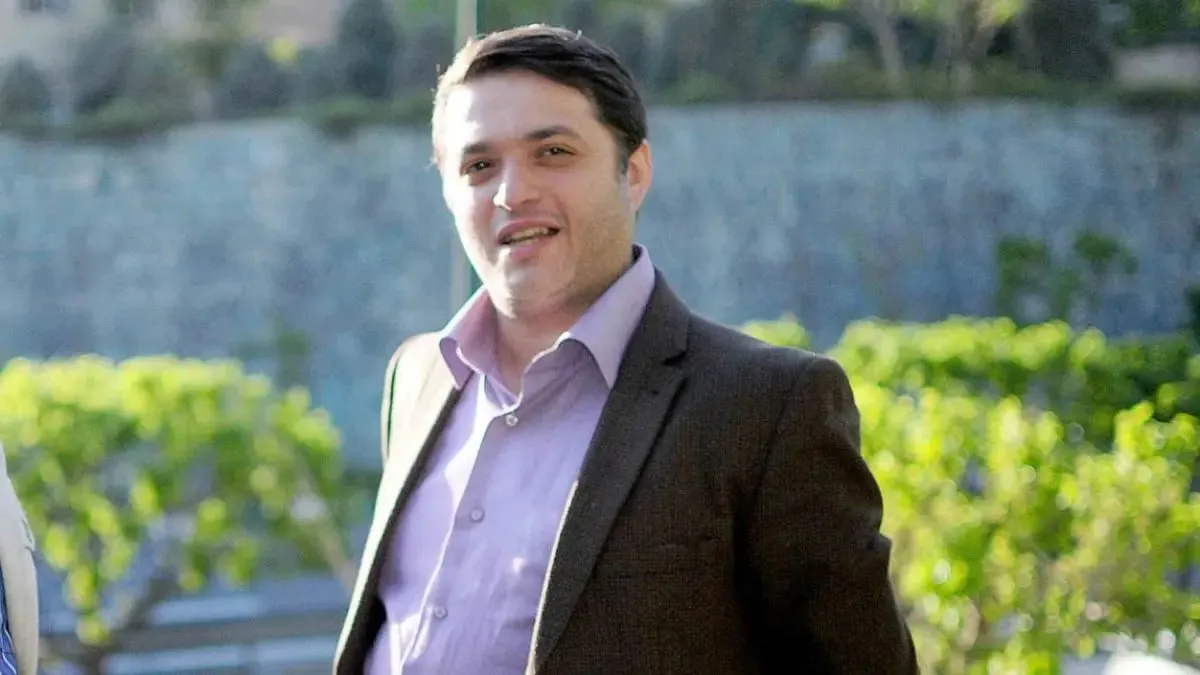
Mohammad Ghochani, an Iranian journalist, writer, and political analyst born on September 22, 1976, in Rasht, is one of the most well-known—and at the same time controversial—figures in professional Iranian journalism over the past two decades. His media career is marked by a distinctive feature that has led many observers to describe him as a “record holder for banned publications” in the history of contemporary Iranian press.
Who is Mohammad Ghochani?
Mohammad Ghochani, an Iranian journalist, writer, and political analyst born on September 22, 1976, in Rasht, is one of the most well-known and at the same time controversial figures in professional Iranian journalism over the past two decades. His media career is marked by a unique characteristic that has led many observers to describe him as the “record holder for banned publications” in the history of contemporary Iranian press: his editorship of newspapers such as Shargh, Ham-Mihan, Etemad-e Melli, Asman, Mardom-e Emrooz, and Sazandegi, as well as magazines such as Hamshahri Monthly, Shahrvand-e Emrooz, Seda, Mehrnameh, Tajrobeh, Siyasatnameh, Irandokht, and currently Agahi Now, is only part of this extensive career.
The importance of Ghochani in Iran’s media and intellectual landscape can be examined from several angles. First, he is one of the few journalists who, over nearly three decades of continuous activity, has trained several generations of young Iranian journalists and played a leading role in numerous press projects. Second, beyond being a journalist, Ghochani is a political theorist and analyst who, through his works—including The White-Collar Suit, Three Islams, The Sacred Republic, The Godfather and the Young Right, and Have the Courage to Be Conservative—has attempted to present a distinct discourse positioned between the reformist camp and the so-called “moderate” current aligned with the Executives of Construction Party. Third, over the past two decades, his name has consistently been at the center of political and intellectual controversies: from arrests following the 2009 presidential election, to serving as media advisor to the president during Hassan Rouhani’s 11th and 12th administrations, and later his sharp criticisms of various political factions—both conservatives and parts of the reformist camp—which at times even led to discussions in critical media about his temporary restrictions from journalistic activity.
Ghochani is currently the owner, managing editor, and editor-in-chief of the magazine Agahi Now, and he is also a member of the central council and head of the political committee of the Executives of Construction Party of Iran. His analyses and editorials in Sazandegi newspaper and the magazines under his management are considered key intellectual references for the centrist and moderate political current in Iran.
Life and background
Mohammad Ghochani was born on September 22, 1976, in Rasht, the capital of Gilan Province. He spent his childhood and adolescence in the same city, and his interest in writing and cinema began during his high school years.
His first journalistic experiences emerged during his teenage years in local publications in Gilan. He began his media career by writing film-related notes for the local magazine Kadakh in Rasht. He then collaborated with another regional publication called Gam—an experience that marked his first step toward understanding journalism as a continuous profession.
After graduating from high school, he moved to Tehran to continue his studies, while simultaneously pursuing journalism professionally. From 1995, at the age of 19, he began collaborating with the magazine Asr-e Ma, the organ of the Organization of the Mojahedin of the Islamic Revolution. At that time, Asr-e Ma was one of the most influential publications of the left-wing political camp, and Ghochani’s presence in its newsroom marked the beginning of his network of relationships with reformist figures and theorists of the religious left.
According to his own accounts in various interviews, his first journalism mentor was Mashallah Shamsolvaezin, a well-known journalist who later became one of the prominent figures of the reformist press during the Second of Khordad era.
Professional beginnings: from the Second of Khordad era to Hamshahri Monthly
A turning point in Ghochani’s journalistic career came with the election of Mohammad Khatami on May 23, 1997, and the flourishing of reformist journalism during his presidency. Between 1997 and 2000, Ghochani collaborated with a wave of reformist newspapers that became symbols of press freedom during that period: Jame’eh, Tous, Neshat, Asr-e Azadegan, Khordad, and others—many of which were repeatedly shut down and relaunched under new names.
During this period, Ghochani, as a young journalist and political analyst, published numerous essays on political currents in Iran, political parties, and ideological transformations. Some of these writings later formed the basis of his first major book, The White-Collar Suit: A Sociology of Civil Institutions in Contemporary Iran (2000), in which he argued—drawing on C. Wright Mills’ concept of the “white-collar” class—that Iran’s major political groups, including the reformist Participation Front, the right-wing Moetalefeh Association, and the centrist Executives of Construction Party, all stem from the new middle class.
Deputy Managing Editor of Hamshahri and Founding of Hamshahri Monthly
In 1999, Mohammad Atrianfar, then Managing Director of the Hamshahri newspaper and one of the prominent figures of the Executives of Construction Party, appointed Ghouchani as deputy editor of the newspaper. During this period, Ghouchani also played a key role as the founder and editor of the magazine “Hamshahri Monthly” — the cultural-social supplement of Hamshahri — and was instrumental in shaping a new approach in Iranian journalism.
Hamshahri Monthly quickly became one of the most popular publications of the late 1990s and early 2000s, introducing a new generation of writers, journalists, and cultural critics to the media landscape. However, the magazine was later shut down under pressure from the judiciary. Following this closure, Ghouchani, in cooperation with colleagues such as Ahmad Gholami and Mehran Karami, launched another daily supplement titled “Hamshahri Jahan,” and continued his professional work in a more structured form.
Editorial Leadership of Newspapers and Magazines
Shargh Newspaper
After his experience with Hamshahri Monthly and Hamshahri Jahan, Ghouchani, along with a team of young journalists, co-founded the newspaper “Shargh” in 2003 under the ownership of Mehdi Rahmanian. In the mid-2000s, Shargh became one of the most reputable and influential newspapers in Iran. With its intellectual approach, emphasis on political philosophy, literary criticism, and investigative reporting, it attracted a new generation of professional readers and became a model for modern journalism in Iran.
However, Shargh also faced repeated bans and suspensions throughout its existence, temporarily ceasing publication multiple times. This continuous cycle of shutdowns became a defining feature of Ghouchani’s journalistic career, and the label “record-holder for newspaper bans in Iran” became associated with him by both critics and supporters.
Ham-Mihan Newspaper
In 2007, the newspaper Ham-Mihan, owned by Gholamhossein Karbaschi — former Mayor of Tehran and Secretary-General of the Executives of Construction Party — was launched, with Ghouchani as its editor-in-chief. Despite having substantial resources and a professional staff, the newspaper was shut down just a few months after publication by a judicial order. Its closure became one of the most widely discussed media events of that year and was later interpreted as a sign of increasing restrictions on reformist media during Mahmoud Ahmadinejad’s presidency.
Shahrvand-e Emrooz Magazine
After the shutdown of Shargh and Ham-Mihan, Ghouchani, together with a group of journalists including Akbar Montajabi, Ahmad Zeidabadi, Hossein Yaghoobi, and others, launched the magazine “Shahrvand-e Emrooz.” This weekly publication, issued between 2006 and 2008, became one of the most important reference magazines of its time, featuring investigative dossiers, social reports, and political analysis. It was eventually banned in November 2008.
Etemad-e Melli Newspaper and the 2009 Elections
In the run-up to the 2009 presidential election, Ghouchani was appointed editor-in-chief of “Etemad-e Melli,” the official newspaper of the National Trust Party led by Mehdi Karroubi, after the resignation of Reza Ansari. During the election, he actively supported Karroubi and played a key media role in his campaign.
Arrest After the 2009 Elections
Following the controversial results of the June 12, 2009 presidential election and the outbreak of widespread protests — later known as the Green Movement — Ghouchani was arrested in the early hours of June 20, 2009 by security forces. He remained in custody for 36 days and appeared in two collective public trials, which international human rights organizations described as “show trials.”
After his release, he became editor-in-chief of the magazine “Irandokht,” owned by Fatemeh Karroubi, though this publication also faced restrictions.
Mehrnameh, Tajrobeh, and Siasatnameh
From 2010 onward, Ghouchani shifted toward founding and editing intellectual-political magazines. “Mehrnameh,” launched in 2010, quickly became one of Iran’s most important journals of politics and thought, featuring extensive dossiers on intellectual figures, political history, philosophy, and ideology.
Later, the magazine “Tajrobeh” was launched with a similar approach. He also founded other publications, including the weekly “Seda” (under the ownership of Faezeh Sharif Jozdani), the magazine “Siasatnameh,” and more recently the extensive journal “Aghahi Now.” First published in November 2020, Aghahi Now is a 540-page magazine focused on political thought, history, and the humanities, where Ghouchani continues to serve as owner, publisher, and editor-in-chief.
Asman, Mardom Emrooz, and Sazandegi Newspapers
Between 2013 and 2017, Ghouchani also served as editor-in-chief of several newspapers, each with different outcomes. “Asman,” previously a weekly publication, was converted into a daily newspaper under his editorship in December 2013 but was shut down after only six issues due to the use of the phrase “inhumane punishment of execution” in one article.
“Mardom Emrooz,” launched in January 2015, was also banned after only 19 issues, and its license was revoked by the Press Supervisory Board.
Since 2017, Ghouchani has been the editor-in-chief of “Sazandegi,” the official newspaper of the Executives of Construction Party. This newspaper has become one of the main media pillars of the centrist political current aligned with Hassan Rouhani’s government and later served as an analytical platform supporting moderate administrations.
Activity in the Executives of Construction Party
Ghouchani’s connection with the Executives of Construction Party is one of the key aspects of his political activity in the past two decades. The party, founded in 1996 by figures close to Akbar Hashemi Rafsanjani, is considered a centrist and technocratic political force in Iran.
In 2014, Ghouchani joined the party’s Central Council during its restructuring. His entry, alongside figures such as economist Saeed Leylaz, reflected the party’s expansion with intellectual and media-oriented members. He later became deputy and then head of the party’s political committee, and is currently one of its most prominent spokespersons.
Role During Hassan Rouhani’s Government
With the election of Hassan Rouhani in 2013, Ghouchani became a prominent media supporter of his administration. In October 2017, during Rouhani’s second term, he was appointed by the Head of the Presidential Office as head of the “Council for Compilation, Documentation, and Archiving of Presidential Works.” In media reports, this position was often described as a form of media advisory role.
This appointment was criticized by some political opponents and more radical reformists, but Ghouchani defended it as part of a documentation project of governmental history.
After Rouhani’s presidency ended in 2021, Ghouchani continued his journalistic and political activities, maintaining a critical stance toward the Ebrahim Raisi administration and later supporting moderate discourse during the presidency of Masoud Pezeshkian.
Views and Intellectual Positions
Ghouchani’s intellectual framework over the past three decades includes several key themes:
- Moderation and centrism: He advocates a pragmatic and gradualist approach, rejecting both radical reformism and hardline conservatism.
- Critique of the left and Marxism: He has criticized neo-Marxist thought in Iranian academia and journalism.
- Reformist discourse: While rooted in reformist journalism, he has distanced himself from radical reformist factions in recent years.
- Religion and state: In works such as “Three Islams,” he analyzes different Shiite intellectual traditions, and in “The Sacred Republic,” he discusses the relationship between Islam and republicanism.
Controversies and Criticism
Ghouchani’s career has not been without controversy. His statements and editorial positions have been criticized from multiple political camps.
- 2009 election aftermath: His arrest and trial were widely debated internationally.
- Security-related media controversies: Some of his statements in later interviews were interpreted by critics as defending state responses to protests, though he denied such interpretations.
- Frequent newspaper bans: Critics label him as the “record-holder of media shutdowns,” while supporters view this as evidence of editorial boldness.
Works and Books
His major works include:
- White-Collars: Sociology of Civil Institutions in Contemporary Iran
- Three Islams: Qom, Najaf, Tehran
- The Sacred Republic
- The Godfather and the Young Right Wing
- The Tragedy of Islamic Protestantism
- Nazi Abad Residents
- Have the Courage to Be Conservative
- Religious State, State Religion (a dialogue book)
Personal Life
Mohammad Ghouchani is married to Maryam Baqi, daughter of the well-known journalist and human rights activist Ebrahim (Emadeddin) Baqi. The couple has two children named Hafez and Iran.
Conclusion
Mohammad Ghouchani is one of the most influential and controversial figures in Iranian journalism over the past three decades. His career spans newspapers, magazines, political analysis, and party activity, placing him at the intersection of journalism, political theory, and party politics.
Depending on the perspective, he is seen either as a key representative of professional journalism who sustained media activity under pressure, or as a controversial figure whose proximity to power and centrist politics has distanced him from early reformist ideals.
Historically, his name is firmly recorded across major phases of modern Iranian media and political thought—from the reform era press of the 1990s to the post-2009 political landscape and beyond.
Take less than a minute, register and share your opinion under this post.
Insulting or inciting messages will be deleted.
Sign Up