
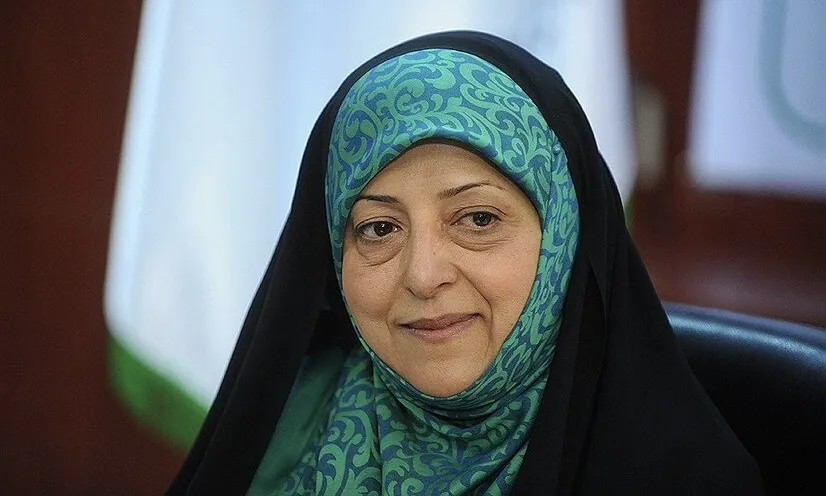
Masoumeh Ebtekar (Niloofar Ebtekar), born on September 21, 1960, in Tehran, is a Reformist political activist, associate professor of immunology at Tarbiat Modares University, and one of the most influential and controversial female figures in post-revolutionary Iran. With an unprecedented record in student, academic, journalistic, environmental, urban management, and executive spheres, she holds a unique position in contemporary Iranian socio-political history. The daughter of Dr. Taghi Ebtekar (the second head of the Department of Environment after the Revolution) and Fatima Barzegar, she spent six years of her childhood in the United States due to her father's studies, which resulted in her native-like fluency in English. This fluency later led her to become the spokesperson for the Muslim Student Followers of the Imam's Line during the U.S. Embassy takeover on November 4, 1979, becoming known as "Sister Mary" in international media.
Here is the complete English translation of your provided comprehensive biography of Dr. Masoumeh Ebtekar:
Dr. Masoumeh Ebtekar (born Niloofar Ebtekar on September 21, 1960, in Tehran) — widely known in media and historical circles as "Sister Mary" — is a prominent Iranian Reformist political activist, journalist, widely cited author and translator, faculty member and associate professor in the Department of Immunology at the Faculty of Medical Sciences of Tarbiat Modares University, founding member of the Islamic Iran Participation Front, the first Iranian woman to join the cabinet of the Islamic Republic of Iran following the 1979 Revolution, former Vice President of Iran and former Head of the Department of Environment (DOE) across two presidential terms of Seyyed Mohammad Khatami from August 2, 1997, to August 3, 2005, for 8 consecutive years, former Vice President and Head of the Department of Environment in the eleventh government under Hassan Rouhani from August 15, 2013, to August 3, 2017, for 4 years, former Vice President for Women and Family Affairs under President Hassan Rouhani in the twelfth government from August 3, 2017, to August 3, 2021, for 4 years (serving a total of 16 years as Vice President), former member of the 3rd term of the City Council of Tehran from 2006 to 2013 for 7 years (entering the council in ninth place on the Reformist slate with 232,959 votes), a unique figure as the prominent spokesperson for the Muslim Student Followers of the Imam's Line during the high-profile takeover of the U.S. Embassy in Tehran on November 4, 1979, and the 444-day hostage crisis involving 52 American diplomats, daughter of Dr. Taghi Ebtekar (the second head of Iran's Department of Environment after the Islamic Revolution, holder of a doctorate in mechanical engineering from the University of Pennsylvania, and Fatima Barzegar), wife of Seyyed Mohammad Hashemi (one of the Student Followers of the Imam's Line, a planner of the embassy takeover, and a former Ministry of Intelligence official), mother of two sons, Eissa and Taha Hashemi (her eldest son, Eissa Hashemi, lived in the United States with his wife Maryam Tahmasebi and their child until their Green Cards were revoked by the Trump administration on April 11, 2026), an active figure who spent six years living in Massachusetts and Philadelphia in the United States until the age of 9 due to her father's studies, graduate holding a bachelor's degree in medical technology from Shahid Beheshti University and a master's and doctorate (Ph.D.) in immunology from Tarbiat Modares University, former editor-in-chief of Kayhan International newspaper for two years during Seyyed Mohammad Khatami's tenure as managing director, a prominent figure in women's affairs including the founding of the Center for Women's Studies and Research from 1993 to 1996, the publication of the quarterly journal Farzaneh in Persian and English, leading the Coordination Office for Women's NGOs, vice chair of the National Committee for the Fourth World Conference on Women in Beijing (1995), and president of the Network of Women's NGOs from 1996, founding member and former chair of the board of directors of the NGO Center for Peace and Environment from 2005, current board member of the Zainab Kubra Foundation (an NGO supporting orphaned children), recipient of major international awards including the "World Environment Lady" (2013) from the Energy Globe Foundation and Italy's "Minerva" award from the Municipality of Rome in 2013, author of prominent books including Takeover (an account of the U.S. Embassy takeover, the first book by an Iranian insider published in English by Talonbooks Canada, translated into Arabic in Beirut under the title Sira' fi Tehran [Conflict in Tehran]) and Clusters of September (Khoosheh-haye Shahrivar, an account of the first female member of the government of the Islamic Republic of Iran), an active figure in the high-profile campaign supporting Mir-Hossein Mousavi in the 10th presidential election in 2009 alongside Zahra Rahnavard and Fatemeh Motamed-Arya in Mousavi's second campaign documentary, and simultaneously one of the most widely discussed, prominent, and distinct hybrid female-political-environmental-student post-revolutionary Iranian figures over the past four decades, standing among the core figures of Reformist female-environmental discourse in contemporary Iran.
Dr. Masoumeh Ebtekar—whose unique trajectory spans a prominent intellectual family background in Tehran as the daughter of Dr. Taghi Ebtekar (holder of a doctorate in mechanical engineering from the University of Pennsylvania and second head of Iran's Department of Environment after the Revolution) and Fatima Barzegar, living six years in Massachusetts and Philadelphia in the United States during childhood until age 9 (forming the bedrock of her fluency in English), returning to Iran and launching prominent student activities, facing the decisive turn on November 4, 1979, when as a student at Polytechnic University (now Shahid Beheshti) she joined the Muslim Student Followers of the Imam's Line and was invited on the third day of the embassy takeover as an interpreter, assuming the role of spokesperson for the student captors (owing to her fluent English, becoming known as "Sister Mary" in international media, establishing her lasting international recognition), continuing her post-takeover academic path with a bachelor's degree in medical technology from Shahid Beheshti University, meeting Seyyed Mohammad Hashemi during the embassy takeover and marrying him (establishing her family-political tie with the Student Followers network), pursuing graduate studies with a master's and doctorate in immunology from Tarbiat Modares University and joining its faculty, serving as editor-in-chief of Kayhan International for two years under Seyyed Mohammad Khatami's leadership (establishing her close relationship with Khatami), representing Iran at the Third World Conference on Women in Nairobi, founding the Center for Women's Studies and Research from 1993 to 1996 and publishing the bilingual journal Farzaneh (establishing her specialized female identity), serving as head of the Coordination Office for Women's NGOs and vice chair of the National Committee for the Fourth World Conference on Women in Beijing (1995) in 1995, founding and presiding over the Network of Women's NGOs in Iran from 1996, facing a pivotal moment on August 2, 1997, when President Seyyed Mohammad Khatami appointed her Vice President and Head of the Department of Environment at the start of the Reform government (becoming the first post-revolutionary Iranian woman to join the cabinet), changing her attire from the maghneh headscarf to the chador prior to her appointment, leading the Department of Environment across two consecutive terms under Khatami for 8 years until August 3, 2005, co-founding the Islamic Iran Participation Front, serving on the 3rd City Council of Tehran from 2006 to 2013 (entering ninth on the Reformist list with 232,959 votes and founding its Environment Committee with roughly 20 working groups), co-founding and chairing the non-governmental Center for Peace and Environment from 2005, endorsing Mir-Hossein Mousavi in the 2009 election after initially intending to run herself (stating in a declaration: "While respecting the courageous stances of Mr. Karroubi, I consider Mr. Mir-Hossein Mousavi, the beloved Prime Minister of the Imam, to be the most suitable option to lead the executive branch"), participating in Mousavi's second documentary alongside Zahra Rahnavard and Fatemeh Motamed-Arya to examine women's issues and gender discrimination in Iran, facing a controversy in 2008 when Nature magazine reported that roughly 85 percent of a paper authored by Ebtekar was taken from five papers by other researchers, returning to the vice presidency and presidency of the Department of Environment under Hassan Rouhani's eleventh government from August 15, 2013, to August 3, 2017, receiving international accolades including the "World Environment Lady" from the Energy Globe Foundation in 2013 and Italy's "Minerva" award, serving as Vice President for Women and Family Affairs in Rouhani's twelfth government from August 3, 2017, to August 3, 2021, navigating the Vice Presidency during the post-U.S. JCPOA withdrawal era, the November 2019 protests, the assassination of General Qasem Soleimani, the COVID-19 pandemic, and the 13th presidential election, contracting COVID-19 on February 27, 2020, and recovering after home rest, ending her vice presidency on August 3, 2021, continuing social-discursive engagement including criticisms of the 13th government's women's policies, and recent public stances under Pezeshkian's 14th government including a demand on August 12, 2024, stating "These lobbies are above the level of the Vice Presidency, and the President himself must pursue it," criticizing the IRIB for restricting women's roles on June 10, 2026, and facing the development on April 11, 2026, when the U.S. Department of State announced the revocation of the permanent residency (Green Cards) of her son Eissa Hashemi, his wife Maryam Tahmasebi, and their son—has established herself as one of post-revolutionary Iran's most enduring and widely discussed hybrid female-political-environmental-student figures.
The significance of Dr. Masoumeh Ebtekar in contemporary Iranian history and politics can be viewed through several primary dimensions. First, as the first post-revolutionary Iranian woman in the cabinet—serving as an architect for women's entry into the post-revolutionary government structure. Second, serving as Vice President for 16 total years across three Reformist and Moderate administrations (Khatami 8 years + Rouhani 8 years)—placing her among the longest-serving vice presidents in post-revolutionary Iran. Third, her role as spokesperson for the embassy captors and her public profile as "Sister Mary"—representing a key historical legacy of the 1979 student-revolutionary movement. Fourth, serving 12 total years as Head of the Department of Environment across three administrations—forming a cornerstone of Iran's post-revolutionary environmental movement. Fifth, serving as Vice President for Women and Family Affairs during Rouhani's second term—forming a key chapter in Moderate-era women's policy advocacy.
Important Note: Dr. Masoumeh Ebtekar's record is viewed through contrasting lenses across Persian-language political and media circles. Within Reformist and Moderate discourse, she is celebrated as the "first woman of the post-revolutionary cabinet," the "prominent 12-year head of the Department of Environment," and "Rouhani's key Vice President for Women and Family Affairs." Among prominent Principalist critics and civic activists, the controversy surrounding her "children living in the United States" (particularly Eissa Hashemi)—where critics questioned her son's residence in the U.S. in light of her role in the embassy takeover—has drawn sharp criticism. Academic critics have highlighted the 2008 plagiarism controversy reported by Nature magazine, where roughly 85 percent of a paper was reported to have been derived from five other papers. Among women's rights activists, policies during her tenure in Rouhani's administration have faced critique. This profile presents accounts published in primary Persian-language media and historical sources with an analytical and neutral stance.
Early Life and Family Background
Dr. Masoumeh Ebtekar was born under her birth name, Niloofar Ebtekar, on September 21, 1960, in Tehran, Iran.
Father: Dr. Taghi Ebtekar
The central pillar of Ebtekar's family background was her father, Dr. Taghi Ebtekar—a prominent post-revolutionary environmental figure in Iran. According to published reports: "Her father, Taghi Ebtekar, second head of the Department of Environment of Iran after the Islamic Revolution, was a graduate of the University of Pennsylvania." According to published reports: "Her father, Dr. Taghi Ebtekar, was the second head of Iran's Department of Environment after the victory of the Islamic Revolution, and her mother was Mrs. Fatima Barzegar." This family link laid the foundation for her enduring environmental and academic focus, which culminated in her 12-year tenure at the head of the Department of Environment.
Mother: Fatima Barzegar
According to published reports: "Her father, Dr. Taghi Ebtekar, was the second head of Iran's Department of Environment after the victory of the Islamic Revolution, and her mother was Mrs. Fatima Barzegar."
Six Years Living in the United States (1962–1968)
According to published reports: "From 1962, while Masoumeh (Niloofar) Ebtekar's father was completing his master's degree, her family spent six years living between Massachusetts and the suburbs of Philadelphia." According to published reports: "She lived in the cities of Philadelphia and Massachusetts in the United States for 6 years until age 9 due to her father's doctoral studies in mechanical engineering." This six-year experience formed the bedrock of her native-like fluency in English, which later enabled her roles as spokesperson during the embassy takeover, editor-in-chief of Kayhan International, and international representative.
Husband: Seyyed Mohammad Hashemi
According to published reports: "Masoumeh Ebtekar married Seyyed Mohammad Hashemi, and their marriage resulted in two children." and "Ebtekar met Seyyed Mohammad Hashemi during the events at the espionage den [U.S. Embassy], ultimately marrying after he expressed his interest." According to published reports: "Her husband is a former official of the Ministry of Intelligence and one of the planners of the espionage den takeover (the attack on the U.S. Embassy in Tehran and taking diplomats hostage)."
Two Sons: Eissa and Taha Hashemi
According to published reports: "The result of this marriage is two sons named Eissa and Taha. Eissa holds a master's degree in economics and married his classmate Maryam; they were studying in the United States. Taha studied architecture and currently works in industrial sectors; he is also married."
Revocation of Eissa Hashemi's Green Card (April 11, 2026)
The most widely discussed recent chapter involving her family was the revocation of her eldest son's Green Card by the Trump administration. According to published reports: "The U.S. Department of State announced the revocation of the permanent residency permits (Green Cards) of Eissa Hashemi, son of Masoumeh Ebtekar, his wife Maryam Tahmasebi, and their son. News Code: 1366574, Publication Date: 1405/01/22 [April 11, 2026]." This revocation stands among the most widely reported instances of residency cancellations involving family members of Islamic Republic officials.
Education
Dr. Masoumeh Ebtekar possesses a specialized academic trajectory combining health sciences and immunology.
Bachelor's Degree in Medical Technology from Shahid Beheshti University
According to published reports: "In 1981, [Ebtekar] changed her major and earned her bachelor's degree in medical technology from Shahid Beheshti University."
Master's and Ph.D. in Immunology from Tarbiat Modares University
According to published reports: "She obtained her master's and Ph.D. degrees in immunology from Tarbiat Modares University. She later joined the faculty of the same university."
Associate Professor of Immunology
According to published reports: "She is currently an associate professor in the Department of Immunology at the Faculty of Medical Sciences of this university." This academic background formed the bedrock of her standing as a university researcher.
Role in the U.S. Embassy Takeover (November 4, 1979)
The pivotal historical chapter of Ebtekar's career was her prominent role in the U.S. Embassy takeover in Tehran on November 4, 1979. According to published reports: "Masoumeh Ebtekar was among the students involved in the U.S. Embassy takeover during the Iran hostage crisis and became known in the embassy compound as 'Sister Mary.' Due to her fluency in English, she was introduced as the spokesperson for the hostage-takers."
Ebtekar's Account of Her Role
According to published reports: "Ebtekar stated regarding this: 'I did not climb over the embassy wall; rather, I was invited by the university on the third day as an interpreter, and I was not among the student captors on the day of the takeover itself. Statements claiming I climbed the embassy wall are incorrect, as I detailed in the book Takeover.'"
Known as "Sister Mary"
According to published reports: "Ebtekar became known as the interpreter and spokesperson for the embassy captors holding 52 hostages. Her appearances before journalists during the embassy takeover turned her into a prominent media personality of that era." This role established her international media profile.
Editor-in-Chief of Kayhan International
A key chapter in Ebtekar's journalism career was serving as editor-in-chief of Kayhan International. According to published reports: "During her student years, she was known as the spokesperson for the Muslim Student Followers of the Imam's Line, largely due to her English fluency. This expertise later led to her appointment as editor-in-chief of Kayhan International for two years during Seyyed Mohammad Khatami's tenure as managing director." This role solidified her close professional relationship with Seyyed Mohammad Khatami.
Advocacy in Women's Affairs (1993–1996)
The initial chapter of Ebtekar's formal engagement in women's advocacy was establishing the Center for Women's Studies and Research.
Founding the Center for Women's Studies and Research (1993)
According to published reports: "From 1993 to 1996, she established the Institute for Women's Studies and Research."
The Journal Farzaneh
According to published reports: "She published the first journal dedicated to women's studies and research, titled Farzaneh, in both Persian and English."
NGO Coordination Office for Women (1995)
According to published reports: "On the eve of the Fourth World Conference on Women (Beijing – 1995), Ebtekar assumed leadership of the Coordination Office for Women's NGOs and served as vice chair of the conference's National Committee."
Network of Women's NGOs (1996)
According to published reports: "In 1996, with the establishment of the Network of Women's NGOs in Iran, she was elected as its president."
Vice President and Head of the Department of Environment under Khatami (1997–2005)
The central chapter of Ebtekar's executive career was her appointment as Vice President and Head of the Department of Environment across both terms of Seyyed Mohammad Khatami's presidency for 8 consecutive years. According to published reports: "On August 2, 1997, coinciding with the start of the Reform government, Masoumeh Ebtekar was appointed Vice President and Head of the Department of Environment by then-President Seyyed Mohammad Khatami, remaining in office until the end of the eighth government."
Change of Attire: From Maghneh to Chador
According to published reports: "Prior to her appointment to this post, Ebtekar wore the maghneh headscarf. She was met with a precondition to wear the chador, and thus changed her attire from the maghneh to the chador prior to her appointment by the president."
First Female Post-Revolutionary Cabinet Member
According to published reports: "Ebtekar later joined Seyyed Mohammad Khatami's cabinet as Vice President and Head of the Department of Environment. She was the first woman following the 1979 Revolution to hold a cabinet-level position in Iran."
Member of the Tehran City Council (2006–2013)
Following her initial ministerial tenure, Ebtekar served on the 3rd City Council of Tehran. According to published reports: "In 2006, during Mahmoud Ahmadinejad's presidency, she won a seat on the Tehran City Council on the Reformist list, placing ninth with 232,959 votes."
Council Environment Committee
According to published reports: "Selected by voters in 2006 as a member of the 3rd Tehran City Council, she established the council's Environment Committee for the first time, featuring roughly 20 specialized working groups, and assumed its leadership."
Endorsement of Mir-Hossein Mousavi in 2009
During the 10th presidential election in 2009, Ebtekar publicly endorsed Mir-Hossein Mousavi.
Withdrawal of Candidacy
According to published reports: "Mrs. Ebtekar intended to run in the 2009 presidential election, but after Mir-Hossein Mousavi registered, she withdrew her candidacy and declared her support for Mousavi."
Endorsement Statement
According to published reports: "She stated in a declaration: 'While respecting the courageous stances of Mr. Karroubi, I consider Mr. Mir-Hossein Mousavi, the beloved Prime Minister of the Imam, to be the most suitable option to lead the executive branch.'"
Participation in Campaign Documentary
According to published reports: "Additionally, in Mir-Hossein Mousavi's second campaign documentary, she appeared alongside Zahra Rahnavard and Fatemeh Motamed-Arya to examine women's issues, challenges, and gender discrimination in Iran."
Plagiarism Controversy (2008)
A major academic controversy surrounding Ebtekar occurred in 2008 regarding paper originalism. According to published reports: "The Deja Vu database reported that roughly 85 percent of the text of an article by Ebtekar was taken from five papers by other researchers, with borrowed sections ranging from 5 to 30 percent of those papers' contents. The paper was a verbatim patchwork of others' work. Ebtekar was listed as the sole author." This controversy, highlighted by Nature magazine, remains a cited academic challenge in her career.
Return to the Department of Environment under Rouhani (2013–2017)
Following the inauguration of Hassan Rouhani's 11th government in 2013, Ebtekar was reappointed Vice President and Head of the Department of Environment. According to published reports: "Following the end of the tenth government and the start of the eleventh government of the Islamic Republic of Iran, President Hassan Rouhani appointed Ebtekar once again as Vice President and Head of the Department of Environment."
International Awards (2013)
According to published reports: "Dr. Masoumeh Ebtekar was named 'World Environment Lady' in 2013 by the Energy Globe Foundation, receiving a lifetime achievement honor for her 'commitment and responsibility toward protecting planet Earth.'" According to published reports: "In 2013, during a ceremony at the Municipality of Rome, she received Italy's 'Minerva' award for scientific achievements and her role as a successful woman in politics."
Vice President for Women and Family Affairs (2017–2021)
During Hassan Rouhani's 12th government, Ebtekar transitioned to serve as Vice President for Women and Family Affairs for 4 years. According to published reports: "In the twelfth government, Mrs. Ebtekar was appointed by the President as Vice President for Women and Family Affairs."
COVID-19 Diagnosis (February 27, 2020)
According to published reports: "On February 27, 2020, news broke that Masoumeh Ebtekar had tested positive for COVID-19. She recovered following several days of home isolation."
Post-Vice Presidency Stances
Demands on the Pezeshkian Administration (August 12, 2024)
According to published reports: "Masoumeh Ebtekar, former Vice President for Women's Affairs in Hassan Rouhani's second government, stated: 'I believe Mr. Pezeshkian, who had a clear stance on this issue, must immediately resolve and manage it. These lobbies are above the level of the Vice Presidency, and the President himself must pursue it. The Vice Presidency must also raise this demand. It is a major demand, and the lack of management in this regard during the 13th government imposed heavy costs on women.' Date: 1403/05/22 [August 12, 2024]."
Criticism of IRIB's Portrayal of Women (June 10, 2026)
According to published reports: "The former Vice President under Hassan Rouhani criticized the Islamic Republic of Iran Broadcasting (IRIB) for restricting the role of women during a conference honoring the late leader of the revolution. News Code: 1378300, Publication Date: 1405/03/20 [June 10, 2026]."
Criticism of Single-Focus Hijab Policies
According to published reports: "Masoumeh Ebtekar, Vice President for Women and Family Affairs in the 12th government, stated in the 'Hozoor' program at Jamaran: 'In recent years, maintaining the status of women in society has been neglected, with mandatory dress code and hijab being the sole point of sensitivity. Have the economic hardships facing women, psychological pressures in families, or issues like divorce and female-headed households ever received attention equal to the hijab issue?'"
Major Works
Notable publications authored or translated by Dr. Masoumeh Ebtekar include:
Takeover — An account of the U.S. Embassy takeover, the only book by an Iranian insider published in English by Talonbooks in Canada, translated into Persian and Arabic.
Sira' fi Tehran (Conflict in Tehran) — The Arabic translation of Takeover, published in Beirut.
Clusters of September (Khoosheh-haye Shahrivar) — An account of her tenure as the first female member of the cabinet of the Islamic Republic of Iran.
Political and Ideological Framework
Dr. Masoumeh Ebtekar has articulated a distinct political framework throughout her long career:
Reformist Female-Environmentalism: Integrating commitment to the Islamic Republic system with sustained advocacy for women's rights, sustainable development, environmental protection, and a balance between modernity and tradition.
Women's Rights Advocacy: Sustained focus on advancing female participation and institutional frameworks, reflected in her work starting in 1993.
Environmental Protection: Commitment to environmental preservation, demonstrated through her 12 years heading the Department of Environment.
Defense of the 1979 Embassy Takeover: Consistently defending the U.S. Embassy takeover as a anti-imperialist milestone, as reflected in her book Takeover.
Professional Networks and Key Relationships
Seyyed Mohammad Khatami: A central political connection starting from her time as editor-in-chief of Kayhan International and continuing through her 8 years as Vice President in his cabinet.
Hassan Rouhani: A major executive relationship spanning 8 years as Vice President across both his 11th and 12th administrations.
Mir-Hossein Mousavi: A notable political link reflected in her active campaign endorsement during the 2009 presidential election.
Student Followers of the Imam's Line: Her foundational network, including her husband Seyyed Mohammad Hashemi, Abbas Abdi, Ebrahim Asgharzadeh, and other key student leaders of 1979.
Rouhani Cabinet Figures: Close working ties with Eshaq Jahangiri (First Vice President), Shahindokht Molaverdi (former Vice President for Women's Affairs), Ali Rabiei, Ali Jannati, and Mohammad Bagher Nobakht.
Masoud Pezeshkian: Maintaining public engagement with Pezeshkian's 14th administration, reflected in her public policy demands in August 2024.
Summary
Dr. Masoumeh Ebtekar stands among the most widely discussed female political figures in post-revolutionary Iran. Her trajectory spans her family roots as the daughter of Dr. Taghi Ebtekar (second head of the Department of Environment), early childhood in the United States, bachelor's degree from Shahid Beheshti University, master's and Ph.D. in immunology from Tarbiat Modares University, her role as spokesperson ("Sister Mary") during the 1979 U.S. Embassy takeover, marriage to Seyyed Mohammad Hashemi, raising two sons (Eissa and Taha), serving as editor-in-chief of Kayhan International under Khatami, founding the Center for Women's Studies and Research and publishing Farzaneh, serving as the first female cabinet member in post-revolutionary Iran as Vice President and Head of the Department of Environment under Khatami (1997–2005), changing her attire to the chador, co-founding the Islamic Iran Participation Front, serving on the 3rd Tehran City Council (2006–2013), endorsing Mir-Hossein Mousavi in 2009, addressing the 2008 plagiarism controversy reported by Nature, returning as Vice President and Head of the Department of Environment under Rouhani (2013–2017), receiving the "World Environment Lady" and "Minerva" awards, serving as Vice President for Women and Family Affairs (2017–2021), recovering from COVID-19 in 2020, authoring Takeover and Clusters of September, issuing policy demands to the Pezeshkian administration in 2024, criticizing IRIB's portrayal of women in 2026, and facing the high-profile Green Card revocation of her son Eissa Hashemi by the Trump administration on April 11, 2026.
Her legacy embodies a pioneer role for women in Iran's post-revolutionary executive branch, long-standing leadership in environmental policy, a central historical role in the 1979 hostage crisis, and ongoing involvement in Reformist discourse surrounding women's rights and environmental protection.
Frequently Asked Questions (FAQ)
Who is Dr. Masoumeh Ebtekar?
Dr. Masoumeh Ebtekar (born Niloofar Ebtekar on September 21, 1960, in Tehran, known historically as "Sister Mary") is a prominent Iranian Reformist politician, the first female post-revolutionary cabinet member, former Vice President and Head of the Department of Environment under Presidents Khatami and Rouhani, former Vice President for Women and Family Affairs under President Rouhani, and a former member of the Tehran City Council.
What is her real name?
Her birth name is Niloofar Ebtekar, though she is widely known publicly as Masoumeh Ebtekar.
What was her role in the 1979 U.S. Embassy takeover?
Ebtekar served as the official spokesperson and interpreter for the Muslim Student Followers of the Imam's Line who seized the U.S. Embassy in Tehran. Due to her fluent English, she gained international media prominence under the name "Sister Mary."
What is her account of her participation in the takeover?
Ebtekar has clarified that she did not climb over the embassy walls during the initial assault on November 4, 1979, but was invited on the third day as an English interpreter due to her language skills.
What is her family background?
Her father, Dr. Taghi Ebtekar, was a Pennsylvania-educated mechanical engineer and the second head of Iran's Department of Environment after the 1979 Revolution. Her mother is Fatima Barzegar. She is married to Seyyed Mohammad Hashemi, a fellow embassy captor and former intelligence official.
Who are her children?
She has two sons, Eissa and Taha Hashemi. Eissa holds a master's degree in economics, and Taha studied architecture.
What happened regarding her son's Green Card in April 2026?
On April 11, 2026, the U.S. Department of State announced the revocation of the permanent residency permits (Green Cards) of her son Eissa Hashemi, his wife Maryam Tahmasebi, and their child.
What is her educational background?
Ebtekar holds a bachelor's degree in medical technology from Shahid Beheshti University, as well as a master's degree and a Ph.D. in immunology from Tarbiat Modares University, where she serves as an associate professor.
What positions did she hold in government?
She served as Vice President and Head of the Department of Environment for 8 years under Seyyed Mohammad Khatami (1997–2005) and for 4 years under Hassan Rouhani (2013–2017). She subsequently served as Vice President for Women and Family Affairs under Rouhani (2017–2021). She was also a member of the 3rd Tehran City Council (2006–2013).
What major international awards has she received?
In 2013, she received the "World Environment Lady" award from the Energy Globe Foundation and Italy's "Minerva" award for her environmental and political contributions.
What is the plagiarism controversy associated with her?
In 2008, Nature magazine reported that roughly 85 percent of an academic paper authored by Ebtekar had been plagiarized from five previously published papers by other researchers.
What books has she written?
Her major books include Takeover (an account of the U.S. Embassy takeover published in English by Talonbooks in Canada) and Clusters of September (Khoosheh-haye Shahrivar, detailing her experience as the first female post-revolutionary cabinet member).
Take less than a minute, register and share your opinion under this post.
Insulting or inciting messages will be deleted.
Sign Up