
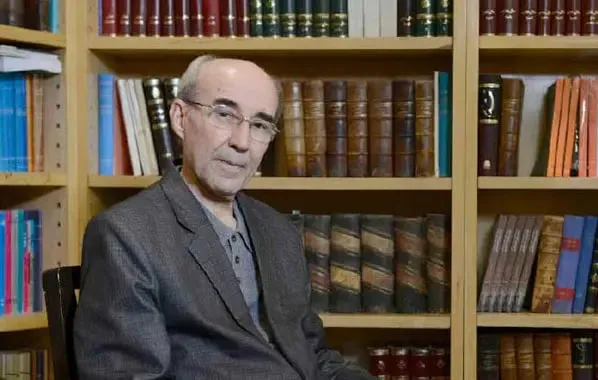
Ali-Ashraf Sadeghi is a prominent Iranian linguist, a retired professor at the University of Tehran, a permanent member of the Academy of Persian Language and Literature, and the supervisor of the "Comprehensive Dictionary of the Persian Language" project. He is one of the most influential figures in Persian linguistics over the past six decades. With a distinguished academic background in two different academic traditions—a BA in Persian Literature from the University of Tehran and a PhD in General Linguistics from the Sorbonne University in Paris—he was able to create a bridge between the tradition of classical Persian literature and modern global linguistics. Throughout his career, he founded the prominent journal Linguistics in 1984, authored dozens of reference works in the fields of grammar, history of language, dialectology, and the correction of classical texts, and since 2007 has supervised the largest Persian lexicography project since Dehkhoda's Loghatnameh. Sadeghi, who is recognized as a "Distinguished Figure" in literature and is the recipient of the Afshar Foundation Literary and Historical Award (2018), donated 10,000 volumes from his personal library to the Academy in recent years.
Who is Ali-Ashraf Sadeghi?
Ali-Ashraf Sadeghi (born May 15, 1941, in Qom) is a prominent Iranian linguist, a retired professor at the University of Tehran, a permanent member of the Academy of Persian Language and Literature, the head of the Academy's Lexicography Department, the supervisor of the "Comprehensive Dictionary of the Persian Language" project, and a distinguished figure in the field of literature. He is one of the most widely discussed and, at the same time, most influential figures in Persian linguistics over the past six decades. With a unique path—from a distinguished academic background in two different academic traditions (a BA in Persian Literature from the University of Tehran in 1962 and a PhD in General Linguistics from the Sorbonne University in Paris in 1967), to his employment in the Linguistics Department of the Faculty of Literature at the University of Tehran in 1969 and attaining the rank of Professor Grade 20 (one of the highest academic ranks in Iran), to his sustained membership in the Academy of Persian Language and Literature since July 16, 1991, to founding the prominent journal Linguistics in 1984, and finally, to his widely discussed supervision of the "Comprehensive Dictionary of the Persian Language" project—a strategic project that has been under development since 2007, with its first volume (Letter A) published in 2013, the second volume in 2016/2018, and the third and fourth volumes published in subsequent years—he is considered one of the most prominent architects of the contemporary Persian linguistic and lexicographical tradition. Sadeghi, who is among the few prominent Iranian figures recognized as a "Distinguished Figure in the Field of Literature" and is the recipient of the 25th Literary and Historical Award of the Dr. Mahmoud Afshar Yazdi Endowment Foundation (2018), throughout his intellectual-academic career, has formed the foundation of the connection between modern global linguistics and the tradition of Persian literature through his notable works such as Persian Grammar, The Formation of the Persian Language, Historical Issues of the Persian Language, A Look at Iranian Dialects, Qomi Persian, valuable corrections such as Asadi's Loghat-e Fars and The Persian Dictionary of the Sepahsalar School, The Orthographic Dictionary of the Persian Script, and notable translations such as Yuri Aransky's Iranian Languages and two chapters from Neil Smith and Deirdre Wilson's Modern Linguistics: The Results of Chomsky's Revolution.
The importance of Ali-Ashraf Sadeghi in Iran's contemporary intellectual-academic sphere can be examined from several angles. First, his exceptional ability to bridge the tradition of classical Persian literature and modern global linguistics—reflected in his combination of a BA in Persian Literature from the University of Tehran and a PhD in General Linguistics from the Sorbonne—forms the foundation of his dual perspective in understanding the Persian language. Second, his pioneering contribution to the establishment and development of lexicographical and linguistic institutions—through founding the prominent journal Linguistics in 1984, managing the Academy's Lexicography Department, and serving as the editor of the journal Lexicography—which has made him one of the main architects of the academic infrastructure of this field in Iran. Third, his widely discussed supervision of the "Comprehensive Dictionary of the Persian Language" project—the largest Persian lexicography project since Dehkhoda's Loghatnameh—which has seen the publication of four volumes and is considered one of the most prominent Persian lexicographical works. Fourth, his valuable contribution to the correction of classical texts—particularly the correction of Asadi's Loghat-e Fars and The Persian Dictionary of the Sepahsalar School—which has made him one of the prominent correctors of Iran's linguistic texts. Fifth, his distinctive expertise in Persian dialectology—particularly with the book Qomi Persian and A Look at Iranian Dialects—which has made him one of the main references in this field.
In one of his recent notable symbolic gestures, Sadeghi donated 10,000 volumes from his personal library to the Academy of Persian Language and Literature—a topic that received widespread coverage in Persian-language media. According to Omid Tabibzadeh: "About 30 years ago, along with a group of friends, we went to Professor Ali-Ashraf Sadeghi's home to conduct an interview. What caught our attention more than anything else upon arrival was his vast, detailed, and valuable library. Dr. Sadeghi had dedicated an entire floor of his home to his books, and for us, seeing all those excellent books, without a speck of dust in a residential home, was truly astonishing and enviable."
Life and Background
Ali-Ashraf Sadeghi was born on May 15, 1941, in the city of Qom—one of Iran's important cultural-religious centers. Born at the beginning of the 1940s, Sadeghi belongs to a generation that, in adolescence, coincided with the events of the end of Mohammad Reza Pahlavi's rule and, in youth, with the moment of the Islamic Revolution's victory, and in middle age, in the post-revolutionary atmosphere, began his prominent academic activities.
Family
Sadeghi was born into a religious family in Qom. His father was a teacher. His grandfather, Ashraf al-Wa'izin, was a preacher. His great-grandfather was also a mujtahid. This religious family background formed the foundation of his connection with the tradition of Persian seminary-literary knowledge.
Education
Sadeghi's educational path is one of the most prolific academic paths in the field of Persian linguistics.
School Years
Sadeghi completed his primary and secondary education at Hakim Nezami High School in Qom and received his diploma in literature.
University of Tehran (1959-1962)
In 1959, Sadeghi went to the University of Tehran and studied Persian Literature at the Faculty of Literature. In 1962, he graduated with a BA in Persian Literature.
Sorbonne University, Paris (1963-1967)
In 1963, Sadeghi went to the Sorbonne University in Paris and continued his studies in General Linguistics. In 1967, he received his PhD in General Linguistics from the Sorbonne and returned to Iran.
This dual background—Persian Literature from the University of Tehran and General Linguistics from the Sorbonne—formed the foundation of his distinctive ability to bridge the tradition of classical Persian literature and modern global linguistics.
Professorship at the University of Tehran (1969 onward)
In 1969, Sadeghi was employed by the Linguistics Department of the Faculty of Literature at the University of Tehran and, over the following decades, through continuous advancement, attained the rank of Professor Grade 20—one of the highest academic ranks in Iran. His long teaching career at the University of Tehran formed the foundation of training several generations of prominent Persian-speaking linguists.
Membership in the Academy of Persian Language and Literature
Since July 16, 1991, Sadeghi has been a permanent member of the Academy of Persian Language and Literature—a position that places him among the most prominent figures in the institutionalization of the Persian language in Iran.
Head of the Lexicography Department
Within the Academy's structure, Sadeghi is the head of the Lexicography Department—a position that places him among the most central figures in policy-making in the field of Persian lexicography.
Editor of the Journal Lexicography
Sadeghi is also the editor of the Academy's journal Lexicography—a prominent specialized publication in this field.
Founding the Journal Linguistics
The central chapter of Sadeghi's specialized publishing career was the founding of the prominent journal Linguistics in 1984. This journal, of which Sadeghi was the editor-in-chief until 2007, is considered one of the most prominent specialized publications in Persian-language linguistics and has formed the foundation of the formation of professional linguistic discourse in Iran.
The "Comprehensive Dictionary of the Persian Language" Project
The most widely discussed project in Sadeghi's lexicographical career is his supervision of the "Comprehensive Dictionary of the Persian Language" project.
About the Project
This project, which began in the mid-1990s with the support of the Academy of Persian Language and Literature under the supervision of Ali-Ashraf Sadeghi, is among the largest Persian lexicography projects since Dehkhoda's Loghatnameh. The "Comprehensive Dictionary of the Persian Language" is a historical dictionary that has been under development since 2007.
Publication Process
Volume 1 (Letter A): 2013.
Volume 2 (A-Akhii): 2016/2018.
Volume 3: Published.
Volume 4: Forthcoming (according to 2025 reports).
Significance of the Project
Due to its particular structure, a significant portion of the dictionary's content has been prepared and is being published gradually—a characteristic that is among the most notable methodological aspects of the project. According to Omid Tabibzadeh: "This dictionary deepens our roots in this soil."
Listen | The History of the Origin of the Persian Language - Dr. Ali-Ashraf Sadeghi
Part One
Part 2
Notable Works
Among Sadeghi's most important works are the following:
Authored Works
Persian Grammar (in 3 volumes, co-authored with Gholamreza Arzhang).
The Formation of the Persian Language.
Historical Issues of the Persian Language (Sokhan Publications, 2001).
A Look at Iranian Dialects (Academy of Persian Language and Literature and University Publishing Center, 2000).
Qomi Persian (a study of the native dialect of his birthplace).
The Orthographic Dictionary of the Persian Script (co-authored with Zahra Zandi Moghaddam, based on the official orthographic rules approved by the Academy of Persian Language and Literature).
Corrected Works
Asadi's Loghat-e Fars (correction of one of the oldest Persian dictionaries).
The Persian Dictionary of the Sepahsalar School.
Al-Abniyah 'an Haqa'iq al-Adwiyah by Muwaffaq ibn Ali al-Harawi (introduction).
Translated Works
Yuri Aransky's Iranian Languages (Sokhan Publications, 1999).
Two chapters from Neil Smith and Deirdre Wilson's Modern Linguistics: The Results of Chomsky's Revolution (Agah Publications, 1988).
Scientific Editing
Lazar Samuilovich Pysikov's Tehrani Dialect.
Collaborative Works
Memorial Volume for Dr. Ahmad Tafazzoli (Sokhan Publications, 2000).
Supervision
The Comprehensive Dictionary of the Persian Language (planning, introduction, final editing, supervision).
Other Academic Activities
In addition to his main positions, Sadeghi has also been active in numerous other institutions:
Member of the Persian Language Editing Council at IRIB.
Member of the Scientific Council of the Great Islamic Encyclopedia.
Editor of the Encyclopedia Iranica and Encyclopedia of the Islamic World.
Editor of the Great Islamic Encyclopedia.
Honors and Awards
Distinguished Figure
Sadeghi has been recognized as a "Distinguished Figure" in the field of literature—one of Iran's most prestigious awards in the academic-cultural arena, granted to prominent figures in various fields of knowledge and art.
The Mahmoud Afshar Foundation Award
Sadeghi won the 25th Literary and Historical Award of the Dr. Mahmoud Afshar Yazdi Endowment Foundation in 2018—one of the most prestigious Iranian awards in the field of literature and history.
Donation of 10,000 Books to the Academy
In one of his recent notable symbolic gestures, Sadeghi donated 10,000 volumes from his personal library to the Academy of Persian Language and Literature. This act, which received widespread coverage in reports published in 2025, was one of the most notable instances of donating personal collections to Iranian academic institutions.
Intellectual Framework
Throughout his academic career, Ali-Ashraf Sadeghi has formulated a distinctive intellectual framework.
Linking Modern Linguistics with the Tradition of Persian Literature
Sadeghi's most central academic framework is the connection between modern global linguistics and the tradition of classical Persian literature. This framework, rooted in his dual academic background (Persian Literature + General Linguistics), forms the foundation of his prominent works.
Emphasis on Historical Linguistics
One of the distinctive aspects of Sadeghi's intellectual framework is his emphasis on historical linguistics. Notable works such as Historical Issues of the Persian Language and The Formation of the Persian Language form the foundation of this approach—an approach in which the historical development of the Persian language is placed at the center of analysis.
Expertise in Dialectology
Another feature of Sadeghi's intellectual framework is his expertise in Persian dialectology. Works such as A Look at Iranian Dialects and Qomi Persian form the foundation of this expertise.
Critique of Existing Dictionaries
In one of his notable positions, Sadeghi has critiqued some prominent Persian dictionaries. In his view, "The Sokhan Dictionary is not a dictionary of the ancient literary language" —a position reflecting his critical view of contemporary Persian lexicography.
Connections with Figures and Currents
Ali-Ashraf Sadeghi is situated within a network of academic connections with prominent figures in Persian linguistics and literature.
Contemporaries and Colleagues
At the contemporary level, Sadeghi's relationship with Abolhassan Najafi, Gholamreza Arzhang, and Ahmad Tafazzoli forms his close academic network.
New Generation
At the new generation level, his relationship with Zahra Zandi Moghaddam and Omid Tabibzadeh forms his academic network.
Prominent Institutions
At the institutional level, Sadeghi's sustained relationship with the Academy of Persian Language and Literature, the University of Tehran, the Great Islamic Encyclopedia, the Encyclopedia Iranica, and the Encyclopedia of the Islamic World forms his institutional network.
Heirs of Global Linguistics
At the international level, his relationship with Western linguistic traditions and Russian-Soviet linguistics forms his international communications network.
Conclusion
Ali-Ashraf Sadeghi is one of the most prominent and influential figures in Persian linguistics over the past six decades. With a unique combination of a distinguished academic background in two different academic traditions, nearly half a century of teaching at the University of Tehran, sustained membership in the Academy of Persian Language and Literature, management of the Lexicography Department, editorship of the journal Lexicography, founding of the journal Linguistics in 1984 and his editorship until 2007, widely discussed supervision of the "Comprehensive Dictionary of the Persian Language" project, production of numerous notable works in Persian grammar, history of the Persian language, dialectology, lexicography, correction of classical texts, and translation of works of global linguistics, membership in prominent editing councils, and finally, recognition as a "Distinguished Figure" in literature and the recipient of the 25th Literary and Historical Award of the Dr. Mahmoud Afshar Yazdi Endowment Foundation in 2018, he occupies a unique position in the intellectual-academic structure of Persian linguistics.
Sadeghi's distinguishing feature, on the first level, is his exceptional ability to bridge modern global linguistics and the tradition of classical Persian literature—an ability in which a researcher with a dual academic background presents a distinctive framework for analyzing the Persian language. This connection, which has other examples among Persian linguists, has found a special reflection in Sadeghi through his special expertise in lexicography and historical linguistics. On the second level, his widely discussed supervision of the "Comprehensive Dictionary of the Persian Language" project—the largest Persian lexicography project since Dehkhoda's Loghatnameh—is one of his most widely discussed legacies; a project that began in 2007 and by 2025 has reached the publication of four volumes. On the third level, his sustained contribution to the establishment and development of Iran's lexicographical and linguistic institutions—through founding the journal Linguistics, managing the Lexicography Department, and membership in numerous editing councils—is one of the notable aspects of his academic character.
From an analytical perspective, Sadeghi's position exemplifies the phenomenon of the "linguist-literary scholar-lexicographer-scientific manager" in contemporary Iran—a phenomenon in which a researcher with a distinguished academic background, over decades, plays a sustained role in various academic, publishing, institutional, and lexicographical arenas. This pattern, which has other examples among prominent Persian linguists, has found a special reflection in Sadeghi through his central role at the Academy of Persian Language and Literature and his supervision of the largest Persian lexicography project since Dehkhoda.
What is clear from today's perspective is that the topics Sadeghi has addressed in his works—from Persian grammar, the historical formation and evolution of the Persian language, Iranian dialects, correction of classical Persian lexicography texts, the orthographic dictionary of the Persian script, the Qomi dialect, and finally, the compilation of the "Comprehensive Dictionary of the Persian Language"—remain among the most debated and, at the same time, most strategic topics in contemporary Persian linguistics. In a situation where the Persian language is in one of the most tense periods of its history—particularly with the increasing challenges of the influx of foreign words, the expansion of social media, and the erosion of local dialects—Sadeghi's sustained role, with a combination of exceptional academic credibility, distinctive expertise in historical lexicography, and his widely discussed supervision of the "Comprehensive Dictionary of the Persian Language," is one of the main references for this discourse in the Persian-speaking intellectual space.
Frequently Asked Questions
Who is Ali-Ashraf Sadeghi?
Ali-Ashraf Sadeghi (born May 15, 1941, in Qom) is a prominent Iranian linguist, a retired professor at the University of Tehran, a permanent member of the Academy of Persian Language and Literature, the head of the Academy's Lexicography Department, and the supervisor of the "Comprehensive Dictionary of the Persian Language" project. He is recognized as a "Distinguished Figure" in literature and is the recipient of the 25th Literary and Historical Award of the Dr. Mahmoud Afshar Yazdi Endowment Foundation (2018).
What is Ali-Ashraf Sadeghi's educational background?
Sadeghi received his BA in Persian Literature from the Faculty of Literature at the University of Tehran in 1962. He then went to the Sorbonne University in Paris in 1963 and received his PhD in General Linguistics from the Sorbonne in 1967.
When did Sadeghi join the Academy of Persian Language and Literature?
Sadeghi has been a permanent member of the Academy of Persian Language and Literature since July 16, 1991. Within the Academy's structure, he is the head of the Lexicography Department and the editor of the journal Lexicography.
What is the "Comprehensive Dictionary of the Persian Language"?
The "Comprehensive Dictionary of the Persian Language," Sadeghi's most widely discussed lexicographical project, is a historical dictionary that has been under development since 2007 under Sadeghi's supervision. This project is among the largest Persian lexicography projects since Dehkhoda's Loghatnameh. Volume 1 (Letter A) was published in 2013, Volume 2 (A-Akhii) in 2016/2018, and the third and fourth volumes in subsequent years.
What is the journal Linguistics?
The journal Linguistics is considered one of the most prominent specialized publications in Persian-language linguistics. Sadeghi founded this journal in 1984 and was its editor-in-chief until 2007.
What are Sadeghi's most important authored works?
Among Sadeghi's most important authored works are: Persian Grammar (in 3 volumes, co-authored with Gholamreza Arzhang), The Formation of the Persian Language, Historical Issues of the Persian Language (Sokhan Publications, 2001), A Look at Iranian Dialects (2000), Qomi Persian (a study of the native dialect of his birthplace), and The Orthographic Dictionary of the Persian Script (co-authored with Zahra Zandi Moghaddam).
What are Sadeghi's most important corrected works?
Among Sadeghi's most important corrected works are: the correction of Asadi's Loghat-e Fars (one of the oldest Persian dictionaries), The Persian Dictionary of the Sepahsalar School, and the introduction to Al-Abniyah 'an Haqa'iq al-Adwiyah by Muwaffaq ibn Ali al-Harawi.
What are Sadeghi's most important translations?
Among Sadeghi's most important translations are: Yuri Aransky's Iranian Languages (Sokhan Publications, 1999), translation of two chapters from Neil Smith and Deirdre Wilson's Modern Linguistics: The Results of Chomsky's Revolution (Agah Publications, 1988), and the scientific editing of Lazar Samuilovich Pysikov's Tehrani Dialect.
What are Sadeghi's other academic activities?
In addition to his main positions, Sadeghi has been a member of the Persian Language Editing Council at IRIB, a member of the Scientific Council of the Great Islamic Encyclopedia, and an editor of the Encyclopedia Iranica, the Encyclopedia of the Islamic World, and the Great Islamic Encyclopedia.
What was Sadeghi's donation of 10,000 books to the Academy?
In one of his recent notable symbolic gestures, Sadeghi donated 10,000 volumes from his personal library to the Academy of Persian Language and Literature. According to Omid Tabibzadeh, "About 30 years ago, Sadeghi's vast, detailed, and valuable library, which he had dedicated an entire floor of his home to, was astonishing and enviable."
Is Ali-Ashraf Sadeghi still active?
Yes, Ali-Ashraf Sadeghi, as one of the most prominent figures in Persian linguistics, remains active in the academic-lexicographical arena. The fourth volume of the "Comprehensive Dictionary of the Persian Language"—the largest Persian lexicography project since Dehkhoda—was published in recent years, and due to the particular structure of the project, a significant portion of the dictionary's content has been prepared and is being published gradually. His sustained presence at the Academy of Persian Language and Literature, his role in the scientific councils of prominent institutions, and his enduring academic legacy in training several generations of Persian linguists are signs of his sustained activity.
Take less than a minute, register and share your opinion under this post.
Insulting or inciting messages will be deleted.
Sign Up