
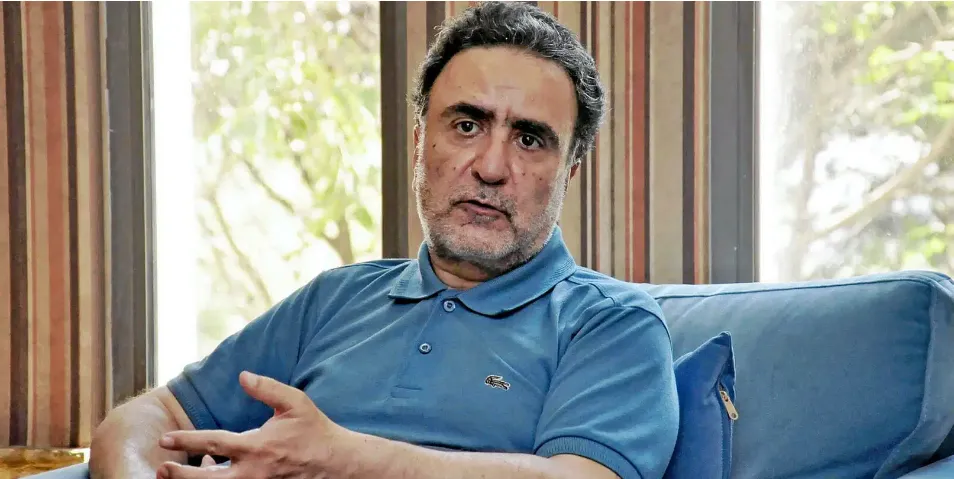
The former Deputy Minister of Interior of Iran, from within his prison cell, calls for a democratic and non-violent transition through the holding of elections for a Constituent Assembly.
Interview | Former Iranian Deputy Interior Minister, from his prison cell, calls for a democratic and non-violent transition through the holding of Constituent Assembly elections.
Published on December 16, 2025
Mostafa Tajzadeh is today one of Iran’s most well-known political prisoners. Now 69 years old, he has spent much of the past sixteen years in prison, paying a heavy price for his affiliation with the Reformist movement—a movement that sought intra-structural reforms before Tajzadeh himself completely broke away from the ruling political system.
He was a supporter of the "Green Movement" in 2009 and an opponent of Mahmoud Ahmadinejad's controversial re-election. Between 2009 and 2016, he was imprisoned for seven years on charges of "assembly and collusion against national security" and "propaganda against the regime." Tajzadeh was arrested again in July 2022, two months before the start of the "Woman, Life, Freedom" movement, and sentenced to five years in prison for "conspiracy against national security."
Following the twelve-day war between Israel and Iran in June 2025, which severely weakened the Islamic Republic, Tajzadeh once again captured public attention by proposing an exit from the cleric-centered system and its replacement with full popular sovereignty through constitutional change. In this exclusive interview with the weekly magazine Le Point—where questions were sent in writing to Evin Prison and answers were received—he explains his views.
Le Point: After all these years in prison, how do you feel today?
Mostafa Tajzadeh: I wish that no one would ever be imprisoned for having thoughts different from their rulers. However, I feel no sense of defeat. Perhaps because these years provided a rare opportunity to study, think, and work on myself, and deepened my relationship with my wife and two daughters. The prison experience allowed me to see society, power, and humanity from another angle. My voice is heard today more than in the past. I hold no grudge against the IRGC interrogators, the judges who issued unjust sentences, or other agents of the repressive apparatus, because I do not want to build an internal prison for myself to be locked in forever. On the contrary, I want to live today with a calm and light mind; just as I will after my release.
What is your opinion on the re-arrest of Narges Mohammadi, the Nobel Peace Prize laureate?
The arrest of Ms. Narges Mohammadi for speaking at the memorial service of the late Khosrow Alikordi—a human rights lawyer who died under suspicious circumstances—demonstrates the establishment's fear of any gathering, even a completely peaceful one. The hard core of power is terrified that the smallest public gathering will turn into a spark for nationwide protests. Alongside Narges Mohammadi, almost all those arrested are women who stood by the "Woman, Life, Freedom" movement and have tasted the bitterness of prison before. They are not afraid of prison. These illegal arrests once again highlight the decisive role of women in shaping Iran's collective destiny. I hope the establishment is wise enough to realize that these arrests are not a deterrent and that the immediate release of these individuals costs far less than their continued imprisonment.
"Prison has always been a fortress for resistance against tyranny."
Has prison in Iran become a center of resistance against the regime?
The imprisonment of opponents and critics is one of the fundamental functions of repressive systems. But at the same time, prison has always been a thorn in the side of tyrants and a fortress against oppression. In the Islamic Republic, prison has lost its deterrent effectiveness more than ever. The establishment's ability to physically and mentally torture prisoners is decreasing day by day. On one hand, the accumulation of crises, and on the other, the gradual decline of fear among citizens, has changed the balance of terror. Today, it is the power that fears society more than the people fear the power.
The Islamic Republic claims victory in the twelve-day war. What is your opinion?
In my view, neither side achieved its goals. Despite the heavy and surprise attacks on the first day against air defenses and military commanders, Tel Aviv could not completely paralyze Iran's military machine or prevent missile attacks on Israel. On the other hand, the people of Iran did not perceive these bombings as "liberation" and did not take to the streets. Even political prisoners did not see the bombing of Evin Prison as an opportunity to escape. I hope this war has dispelled the illusions of both sides.
Why has the suppression of civil society intensified since then?
The establishment imagines that in the short term there is no new war, so it can return to the policy of "victory through intimidation" with judicial framing and the spread of fear among critics. Yes, the repression continues, but I believe this policy will fail. A society under the pressure of drought, water scarcity, air pollution, runaway inflation, inequality, and structural corruption is boiling. The accumulation of crises has weakened the regime so much that it is no longer able to suppress continuously or make society completely passive.
Does the increase in unveiled women and youth gatherings not contradict the intensification of repression?
No. Iranian women no longer tolerate the mandatory hijab. This freedom is established and will remain permanent because not only the majority of the people but also the majority of religious people are against the compulsion of the hijab and have realized that imposing it harms the essence of religion. The distancing of the youth from religion is largely a result of this policy.
Is this retreat real or merely superficial?
Undoubtedly, the hard core of power has retreated. The Leader and those around him are angry, but their hands are tied; they cannot force a spring that snapped in 2022 back into its place.
Why did you move past intra-structural reform?
Since 1997, we tried to advance democracy within the framework of the existing system. But eventually, we hit the wall of the Leadership, which completely concentrated power after the 2017 elections. The elimination of reformists, the inefficiency of the government, and the accumulation of crises focused all criticism on the person of the Leader and the principle of Velayat-e Faqih (Guardianship of the Jurist). However, the deadlock of reform never justifies violence. Yes, the Iranian people can, through resistance and civil disobedience—just as they succeeded in the matter of the hijab—force the ruling clergy to retreat.
"One cannot silence hungry citizens with force."
Why have you called for a Constituent Assembly and a referendum?
The root of the problems lies in three factors: the old structure of religious power, the destructive and interventionist policies of the Leader, and the exclusion of competent forces. Changing the Leader's approach, stopping interventions, and holding free elections are essential. Consolidating these changes requires a revision of the constitution through a Constituent Assembly and the removal of Velayat-e Faqih. This may seem unrealistic today, but in the coming crisis, it will be the safest and most peaceful way.
How do you make your voice heard from prison?
In authoritarian systems, prison does not silence the voices of political prisoners; it makes them louder. Social networks have multiplied this voice. The repressive apparatus is seemingly in place, but its morale is weakened, and the cost of violating prisoners' rights is rising every day.
Are sanctions effective?
Sanctions, and even war, wear down civil society and harm the poor more than they strike the ruling power. The only justifiable sanctions are those against human rights violators.
Foreign military intervention?
If such intervention occurs, it will either lead to a greater disaster or the establishment of a harsher military regime. Neither is a solution.
The nuclear program?
I am opposed to building an atomic bomb; this path leads to a devastating war. Iran needs a new and comprehensive agreement with the West.
"The destruction of Israel is not our mission."
Regional policy after October 7th?
This policy should have changed earlier. Iran's development requires balanced relations with the US and Europe. No foreign country should interfere in Iran's internal affairs, but the destruction of Israel or the expulsion of the US from the region is neither our mission nor within our capability.
Should Iranians wait for the death of the Leader?
Why? Mandatory hijab was weakened during his lifetime and the taboo of negotiating with the US was broken. The experience of the Arab Spring showed that dictators can be pushed back even without centralized leadership. I prefer that fundamental changes occur during the lifetime of Ayatollah Khamenei; this path creates less tension and is perhaps the best way to navigate the succession crisis.

Take less than a minute, register and share your opinion under this post.
Insulting or inciting messages will be deleted.
Sign Up