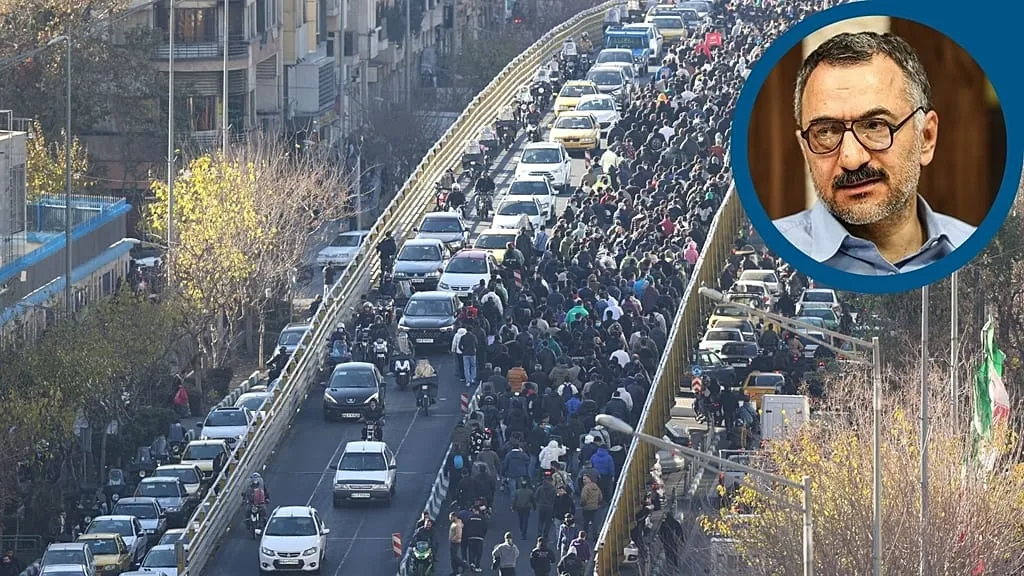
One week has passed since the protests in Iran began. It seems that the conditions and events, both domestically and internationally, are not in Tehran's favor—ranging from the economic situation to the fall of Nicolás Maduro, the President of Venezuela.
One week has passed since the protests in Iran began. It seems that conditions and events, both domestically and internationally, are not in Tehran’s favor—ranging from the economic situation to the fall of Nicolás Maduro, the President of Venezuela and one of Tehran’s most important allies. What lies ahead for Iran? We have discussed this with economist Saeed Laylaz.
The recent protests, which initially began with Tehran’s bazaar merchants, quickly spread to other cities. It appears that in most cities, the protesters are from lower-income brackets, chanting slogans against the establishment driven by economic motivations. Ali Khamenei, the Leader of the Islamic Republic of Iran, responding to these protests on January 3—coinciding with the anniversary of Qasem Soleimani’s killing by U.S. forces in Iraq—called the merchants' demands "rightful" but added: "What is important is that a group of provoked individuals, mercenaries of the enemy, stand behind the merchants and chant slogans against Islam, Iran, and the Islamic Republic." Mr. Khamenei also stated: "Talking to rioters is useless. The rioter must be put in their place."
According to Mai Sato, the UN Special Rapporteur on Human Rights, at least eight people have been killed in the protests so far. U.S. President Donald Trump warned the Iranian government on Friday that if they kill protesters, the U.S. will assist them through military action against the Islamic Republic. One day after Trump’s warning, the U.S. launched a military strike on Venezuela, and Nicolás Maduro was detained by U.S. military forces and removed from the country. Ali Khamenei had previously described Maduro as Tehran’s most important partner on the global stage.
The following is a EuroNews interview with economist Saeed Laylaz regarding the protest crisis in Iran, its consequences, the possibility of a renewed war between Israel and Iran, and finally, the impact of Maduro’s fall on the fate of the Islamic Republic. Mr. Laylaz believes that an important event will occur in Iran’s political sphere within the next month or two.
EuroNews: Mr. Laylaz, some say the current protests in Iran are not a precursor to a revolutionary situation because the middle class is not ready for revolutionary action. Others, however, believe economic dissatisfaction is so high that the lower classes can push society toward a revolutionary state, eventually drawing in the middle class. What is your assessment of these protests and their potential?
Laylaz: The speed of economic and social deterioration in Iran is high and accelerating. Conditions are worsening both mentally and materially. It seems the government and the state’s control over the situation is weakening day by day. I do not yet see the current conditions leading to the overthrow of the government. I believe the Islamic Republic is a system that currently has no alternative, even though it has reached a dead end. Based on these two points—the system's deadlock and the lack of an alternative—my mind turned eight years ago toward the phenomenon of "Bonapartism."
Bonapartism manifests in the slogan "Reza Shah, bless your soul," but this slogan doesn't necessarily mean people want the monarchy of Reza Shah’s grandson. Currently, people are seeking efficiency more than overthrow, as cultural and social pressures have decreased over the past year or two. Regardless, these protests are the product of the horrific inefficiency and inability of Mr. Pezeshkian’s government and other elements of the state to control the situation.
It is significant that the protests started in the Bazaar. Merchants are a class that benefits from high prices, but what upsets them is price instability, which prevents them from deciding whether to buy, sell, or even open their shops. We have never experienced a situation where food prices rise by an average of 6% to 7% monthly. This is unprecedented in Iran since World War II. We might even surpass the 2022 inflation record by the end of this year. The characteristic of this inflation is that food inflation is twice that of other items; thus, it upsets both the middle class and creates the potential for massive social riots among the lower classes. We have seen a 31% growth in the inflation rate in the last 12 months alone, with the rate reaching 52% now. If the government can stabilize prices and prevent hourly fluctuations, it might control the situation; otherwise, unrest will continue—not as an overthrow movement—until a political transformation occurs in the next month or two.
EuroNews: What do you think this political transformation could be? The emergence of a "Bonaparte"?
Laylaz: Since there is no opposition capable of taking control, and the structure of the Islamic Republic, especially its security apparatus, remains in place, I imagine a "Bonaparte" will emerge from within the government.
EuroNews: Doesn't this imply a coup?
Laylaz: A coup is usually against the established order.
EuroNews: A coup is military action against the head of power.
Laylaz: The head of power might himself be satisfied with the emergence of a Bonaparte.
EuroNews: Is Iran’s Bonaparte supposed to change the general policies of the system to fix the situation?
Laylaz: Yes, he creates cohesion in decision-making and policy-making.
EuroNews: So this Bonaparte shouldn't be at the head of power himself?
Laylaz: This transformation might happen through an agreement. I think the problem with your view is that you look at the issue individually.
EuroNews: Are you saying Mr. Pezeshkian might step aside for a Bonaparte?
Laylaz: No, I see the Bonaparte at the level of the Leader.
EuroNews: So the Bonaparte must be the Leader?
Laylaz: Or have 100% approval from the Leader. That is, the Leader himself decides to hand over the work to a Bonaparte. Whether the Leader makes such a decision, steps aside, or passes away—all lead to the same result. In my view, many countries in the Middle East and Asia are run by Bonapartes. A Bonaparte has come to power in Saudi Arabia. The same in Russia, Taiwan, Indonesia, and many other Asian countries.
EuroNews: Mr. Khamenei is currently resisting changes in foreign policy. How could he ask someone to play the role of Bonaparte with his support?
Laylaz: I might disagree with you there. From the JCPOA onwards, the Islamic Republic has compromised enough, but the West effectively retreats from accepting a compromise. I have news that Iranian political officials are ready for dialogue and even say, "Accept symbolic enrichment so we have a guarantee against internal collapse." The change in Iran's policy toward its neighbors is tangible. Our difference might be that you look at slogans, while I look at behaviors.
EuroNews: But the clerics usually deceive the intellectuals, Mr. Laylaz! Abbas Abdi said before the 2024 election that Pezeshkian’s qualification meant the Leader wanted to change the system’s direction, but that didn't happen.
Laylaz: I completely agreed with Mr. Abdi and still do. They have significantly changed direction. The issue is that the United States is not ready for compromise with Iran.
EuroNews: But if the Islamic Republic had accepted to fully stop enrichment in March or April of this year, it wouldn't have faced a military attack.
Laylaz: That is a demand the Islamic Republic will never accept. A Bonaparte wouldn't accept it either. Like most Iranian intellectuals, you exaggerate the impact of foreign policy on Iran's domestic situation. Foreign policy is not the primary cause of our internal problems. Last year, our oil revenue was $62 billion. In the best year of the JCPOA, it was $65 billion. The current decline is due to a 20% drop in global crude prices. Our fundamental problem is policy-making, not sanctions. The proof is that our economic growth was 15% in 2016 (the first year of the JCPOA) but dropped to 4% in the second year.
EuroNews: Wouldn't Iran’s economic situation be much better if the last ten years were spent without sanctions?
Laylaz: That implies returning to a policy of selling oil and importing. No, that wouldn't have made us better. Look at Algeria and Egypt. Saudi Arabia and Iran have had identical economic growth over the last 15 years. Oil can no longer determine Iran’s status. Its role in Iran’s economy has become like its role in Indonesia's economy—it lost its significance because population growth made oil distribution insufficient.
EuroNews: In that case, what problem with the U.S. is your Bonaparte supposed to solve?
Laylaz: He is supposed to reform the country's policies. I assure you that $40 to $50 billion is stolen annually in Iran's economy, yet you are still preoccupied with sanctions. A Bonaparte comes to return the economy to its main track. Iran’s economy is completely misshapen. We have $50 billion in theft and capital flight annually.
EuroNews: Isn't this situation a product of Mr. Khamenei’s management? A Bonaparte would have to reform the Leader's policies.
Laylaz: Certainly. But again, you went back to the individual. Intervention in pricing, which began in the late 1960s due to increased oil revenue, is perhaps the biggest factor in Iran's misery. Every day, we give the people the equivalent of 8.5 million barrels of crude oil almost for free. We sell gas to homes at 1% of global market prices. If we could save 20% of this, we could export gas to Iraq, Pakistan, Turkey, and all neighbors. The pipeline exists. Imbalances and government intervention have destroyed Iran's economy. Since the beginning of this year, the government paid $12 billion for food and medicine imports, but about $8 billion of that was stolen. Mr. Pezeshkian said this yesterday. He knew this when he became president but lacked the courage to change it. Now the state has reached a point where it no longer has that money, so it will certainly stop that theft. Thus, our main problem is policy-making.
EuroNews: Your analysis seems like a defense of Mr. Khamenei, suggesting foreign policy isn't a primary problem. But "common sense" doesn't support this.
Laylaz: An expert's job is to go beyond common sense.
EuroNews: Iran’s relationship with the West is currently damaged. Is repairing it beneficial for the economy or not?
Laylaz: Certainly.
EuroNews: But you say the financial corruption of some security official’s son is more important than the relationship with the West.
Laylaz: Yes, a thousand times more important. Iran’s economy has become corrupt and misshapen.
EuroNews: If domestic policy were correct and the press could scrutinize the government, that son couldn't be so corrupt while remaining in power. The press was dismantled in 2000 by the Leader’s order, and foreign policy is in this state, and the country is plagued by the corruption of "Aghazadehs" (elite children).
Laylaz: I think you are blurring the issue. You jumped from foreign policy to domestic policy!
EuroNews: But you said twice the problem isn't the "individual." Yet a glance at Iran’s domestic and foreign policy shows the main problem is exactly the policies of the system's Leader.
Laylaz: Yes, of course, the current situation is related to the Leader's policies. I don't doubt that. But if you say the main issue is freedom and democracy, I ask: Do Saudi Arabia or Kuwait have freedom and democracy? Our problem is not democracy. Nowhere in the world is economic growth linked to democracy. Iran's growth under Mr. Raisi was slightly above 4%, but since last year, it has become zero. This has nothing to do with the relationship with the U.S. You must look at these issues expertly; economy is a field of numbers and figures.
EuroNews: Iran’s main problem is political, not economic. Your analysis is that anti-Westernism in foreign policy and lack of democracy are not very important; what matters is finding someone to stop the thieves. But how can such a person do this in the absence of democracy?
Laylaz: Put the thieves aside. The main issue is government intervention in the economy.
EuroNews: By "government," do you mean the executive branch?
Laylaz: The executive, the parliament, the judiciary with its constant confiscations and threats, and the security/oversight agencies. Anyone who moves in Iran's economy is harassed by oversight agencies. I wish these actions had stopped corruption, but instead, they make things worse.
EuroNews: Doesn't this mean a group of corrupt people, whom no one can criticize, are running everything?
Laylaz: Anyone can criticize. Mr. Pezeshkian came to power by criticizing this group, but he himself became their prisoner.
EuroNews: Pezeshkian sits at the head of the executive with the Leader’s permission. I meant that if a newspaper like Shargh were to expose the IRGC’s corruption in detail, it would be shut down immediately.
Laylaz: Yes, but the main problem of our economy is not the corruption of public institutions.
EuroNews: The point is that if Iran’s political system were democratic, when a massive population protests specific policies, those protests would be addressed instead of being suppressed.
Laylaz: What does "addressing" mean?
EuroNews: It means the policies being protested change, or the people can vote the main culprit out of office. But in Iran, the main culprit cannot be removed by a vote.
Laylaz: You keep going back to democracy! I don't believe democracy exists anywhere. Democracy is meaningless. Just as you cannot overthrow the U.S. political system, you cannot overthrow Iran's.
EuroNews: It is strange that you see democratic Sweden and China as politically similar, but let’s return to the main topic. You said there is ground for chaos. Will the current unrest continue or be short-lived?
Laylaz: Dissatisfaction and unrest will certainly continue in various forms, but with my current perspective, I cannot say they will become "structure-breaking" (revolutionary).
EuroNews: We are on the seventh day of protests. Could they reach day 70?
Laylaz: No, but they might last a month because people are very hurt by inefficiency. I believe we had solutions. For example, Mr. Pezeshkian's move yesterday—removing the $28,000-per-dollar subsidy—could have been done 16 months ago to save at least $15 billion. The problem with governments in Iran is they cannot get ahead of events; they limp along behind them. This is a sign of systemic inefficiency.
EuroNews: What is your opinion on Trump’s warning that the U.S. will take military action if protesters are killed?
Laylaz: In my view, the interests of the West and Israel lie in escalating Iran’s unrest. Generally, a weak and violent Iran in the Middle East is the Iran the U.S. likes. However, the government’s overall policy-making over the last year and a half, alongside external factors, has contributed to the deterioration of Iran’s economy.
EuroNews: Given Trump’s warning and your belief that protests could last a month, do you think the probability of war is high?
Laylaz: I definitely consider the probability of war to be high. With or without protests. As long as the enrichment issue and those 400 kg of uranium are not settled, there is always a risk that Iran will be attacked again.
EuroNews: The idea of an Iranian preemptive strike has also been raised. Perhaps because war could stop the protests? Since the system previously claimed the 12-day war created national unity.
Laylaz: One or two people might hold that view, but the core structure of the Islamic Republic will not make such a decision because it is a very dangerous game that directly threatens the lives of Iran's leaders. Secondly, the people's reaction might be different this time. Furthermore, the analysis that starting a war stops protests assumes protesters won't go home; I believe the situation is not yet out of control and the government can calm things with certain policies.
EuroNews: There was recent news that after the Israeli attack on Qatar, Ali Larijani advocated for a preemptive strike on Israel, but Pezeshkian opposed it, leading to an argument in the Supreme National Security Council.
Laylaz: I have absolutely not heard such a thing. Mr. Pezeshkian has the upper hand in final decision-making in these areas; he has received full authority. Moreover, I don't believe Ali Larijani holds radical views on this. We see Larijani as more pragmatic than Pezeshkian.
EuroNews: Does Pezeshkian have full authority regarding entering or avoiding war now?
Laylaz: Yes, Mr. Pezeshkian has taken full authority.
EuroNews: Given your description of the Pezeshkian government’s performance, can we say it has failed and should step aside?
Laylaz: No, I don't have such a judgment yet. In the last 17 months, the depth and intensity of the crises Pezeshkian faced were different from previous governments. Mr. Khatami, who had the best post-revolution government, only started seeing results at the end of his second year. I still think we should give Pezeshkian a chance, but so far, he hasn't shown a cohesive will to create transformation.
EuroNews: Do you think Trump’s warning emboldens the protesters?
Laylaz: No, it actually worked against them.
EuroNews: Why?
Laylaz: Because U.S. intervention in Iranian issues has always harmed the people and benefited autocracy. Trump’s warning actually sends people back to their homes.
EuroNews: Because the government will suppress them more severely?
Laylaz: Both because the government will act more harshly and because the people themselves will hesitate to continue.
EuroNews: Is it possible that if war starts, people in smaller cities—who are not under bombardment—might rise up against the Islamic Republic?
Laylaz: Yes, it is possible. The reason smaller towns have been more active than the capital in recent years is the intensity of economic pressure on people in smaller, poorer cities. This shows that governments in Iran don't realize what they are doing.
EuroNews: During the 12-day war, Reza Pahlavi was mocked for calling for protests while people were under bombardment. But you say this time, people in cities not under fire might protest. Do you take this probability seriously?
Laylaz: Yes. The Islamic Republic did not respond appropriately to the people's declaration of loyalty during the 12-day war. After the war, it returned to "factory settings." No changes were made in governance or even bureaucracy. For example, the Central Bank won't change its regulations under any circumstances.
EuroNews: Because the system is paralyzed and cannot make important decisions to change the status quo.
Laylaz: Yes, the system is paralyzed and has reached a dead end. Therefore, it is unable to make a rational decision to decisively solve the problem. It solves nothing anymore.
EuroNews: Because if it touches anything, the many beneficiaries of the status quo will complain.
Laylaz: Exactly. The reason regimes become paralyzed is that the relations among individuals within the government destroy its efficiency. It’s like the end of the Safavid, Qajar, or Pahlavi eras. It’s like old age. In old age, the body’s structure says, "I will die, but I won't submit to reform."
EuroNews: In that case, do you consider the life of the Islamic Republic to be nearing its end?
Laylaz: This form of government, yes. This method of governance has reached a dead end. But because there is no alternative, a phenomenon will emerge from within it and change the nature of the political system.
EuroNews: You mean a Bonaparte will lead the system toward "Istihala" (transformation/metamorphosis)?
Laylaz: Yes.
EuroNews: If war breaks out again, will it lead to the fall of the Islamic Republic?
Laylaz: No. I don't think the fall of the Islamic Republic will happen so soon or so easily. War accelerates internal changes but does not lead to the system's collapse.
EuroNews: If Mr. Khamenei is killed in the next war, will the system remain?
Laylaz: Yes. Mr. Khamenei’s position is by no means more important than Mr. Khomeini’s was in 1989.
EuroNews: And would his potential removal in a war help the emergence of your Bonaparte?
Laylaz: Regardless, this Bonaparte will come. With or without war, with or without the removal of the Leader. I hope Mr. Khamenei is never removed in such a manner.
EuroNews: Who could be the Bonaparte?
Laylaz: I have no idea about the specific person. There are many candidates. Engels said when the wheel of history starts moving, it finds its person; don't worry.
EuroNews: Could Qalibaf be the Bonaparte?
Laylaz: Yes, it’s possible.
EuroNews: What is your opinion on Maduro’s fall and its potential impact on the Islamic Republic?
Laylaz: I suspect Trump and Maduro had a prior agreement. But the fall of Maduro's government will not have a significant impact on the Islamic Republic. It will neither improve nor worsen our conditions. Iran’s oil resources might just become more important for China and India.
EuroNews: Doesn't Maduro’s fall have a psychological impact on Iran's ruling body?
Laylaz: It might create hope for some groups within Iran, but those groups are not significant in my view. I don't think many people will become more hopeful about overthowing the Islamic Republic just because Maduro fell.

Take less than a minute, register and share your opinion under this post.
Insulting or inciting messages will be deleted.
Sign Up