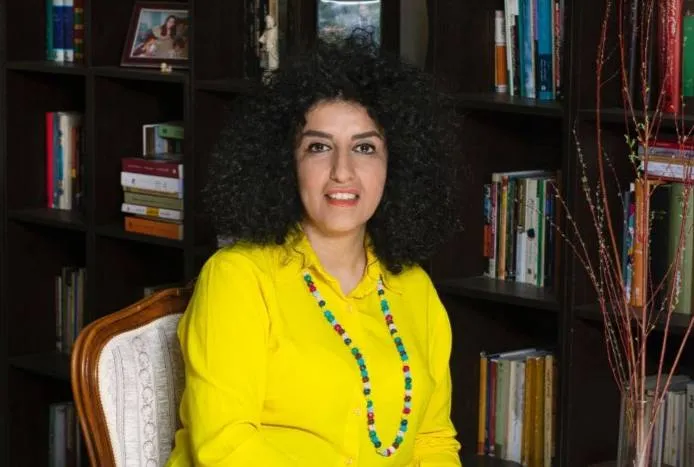
Narges Mohammadi, human rights activist and winner of the 2023 Nobel Peace Prize, in an article for TIME magazine titled "Iran is Still at War, But With Its Own People," addressed...
Narges Mohammadi, human rights activist and winner of the 2023 Nobel Peace Prize, in an article for TIME magazine titled "Iran is Still at War, But With Its Own People," addressed the necessity of forming a domestic movement for transition from authoritarianism to a democratic government, and the role of the global community.
The complete Persian text of this article, which was published in TIME on December 5, 2025, is provided below, as quoted from Narges Mohammadi's X (Twitter) page:
Narges Mohammadi
Even when no bombs are falling, the people of Iran do not experience what can truly be called peace, because they live under a government that controls every aspect of their private and public lives.
Their peace is disrupted by surveillance, control, censorship, arbitrary arrests, torture, and the constant threat of violence. This peace is destroyed by an economy gutted by corruption, inefficiency, and mismanagement, the pressure of sanctions, the daily anxiety of inflation, high costs, shortages, and unemployment, as well as the relentless destruction of Iran’s environment.
Peace is not the absence of war; it is the foundation upon which everything must be built: democracy, stability, economic growth, social change, and the possibility of an effective civil society. But after the 12-day war, the people of Iran found themselves at the intersection of the regime’s war against its own people and the war between the governments of the Islamic Republic and Israel.
Authoritarianism and war are two sides of the same coin.
As defenders of democracy and peace declared in the statements they issued, these statements called for a new political order: a secular and democratic government that truly represents the Iranian people, a free and fair referendum under international supervision by the UN, and the drafting of a new legal framework by an elected constituent assembly. They named clear legal mechanisms for a peaceful transition, based on international standards and Iran’s democratic goals.
Their unified position showed that a broad and collective national movement, rooted in civil society, human rights, women’s rights, and Iran's diverse democratic traditions, has the capacity to lead the country toward a decisive historical transformation. A transformation that must first be peaceful, based on dialogue, accountability, the pursuit of justice, and respect for universal civil and human rights. Because anything less than that—collapse, chaos, or armed conflict—would endanger millions of people in a vulnerable region.
Iranians have always been renowned for and committed to non-violent, democratic movements. The country has always been a crossroads of cultures. For thousands of years, Iran has been home to ethnic, linguistic, and religious pluralism and diversity. Despite serious cultural differences and intellectual and political disagreements, the people of Iran have maintained long-standing traditions of coexistence, mutual respect, collective life, and sustained cultural networks.
In recent years, the Iranian people have clearly shown that the regime has lost its legitimacy. For over four decades, Iranians have strived for their fundamental and human rights through peaceful and democratic movements: from the women's marches after the 1979 revolution to the student protests of 1999, the Green Movement of 2009, the November 2019 protests, and the "Woman, Life, Freedom" uprising in 2022, which began with the killing of Mahsa (Zhina) Amini. The continuous resistance of women and youth has shaken the foundations of the Islamic Republic, turning it into the regime's worst nightmare. Those the regime tried hardest to silence have become its most powerful challengers.
The truth is, Iran is currently on a path of transition. But the transition can move in different directions. The Iranian people have proven their courage. They have endured imprisonment, censorship, control, bullets, and the loss of their children, yet the people continue to fight, though not violently.
Violence, whether imposed from outside or within, is not the solution. What they want is not intervention, but recognition of the people's will and their struggles; not foreign armies, but international solidarity; not war, but peace.
How can the world help?
The Islamic Republic, like similar regimes, only responds to pressure. Change in Iran requires effective global pressure to end human rights violations, gender apartheid, and executions; the release of political and ideological prisoners; and the possibility for civil society institutions to operate freely. The international community must review and redefine its approach to "change" in Iran and provide the groundwork for the transition from authoritarianism to democracy.
My message: We are striving to end religious authoritarianism and implement the transition from dictatorship to democracy. To achieve this goal, support Iran's civil society, independent media, and defenders of human rights and women's rights—those who are on the front line of building a just and democratic future for their country.
With global solidarity, democracy and peace are not only possible but within reach.
The people of Iran are ready. Stand beside them.
Narges Mohammadi Tehran - Iran

Take less than a minute, register and share your opinion under this post.
Insulting or inciting messages will be deleted.
Sign Up