
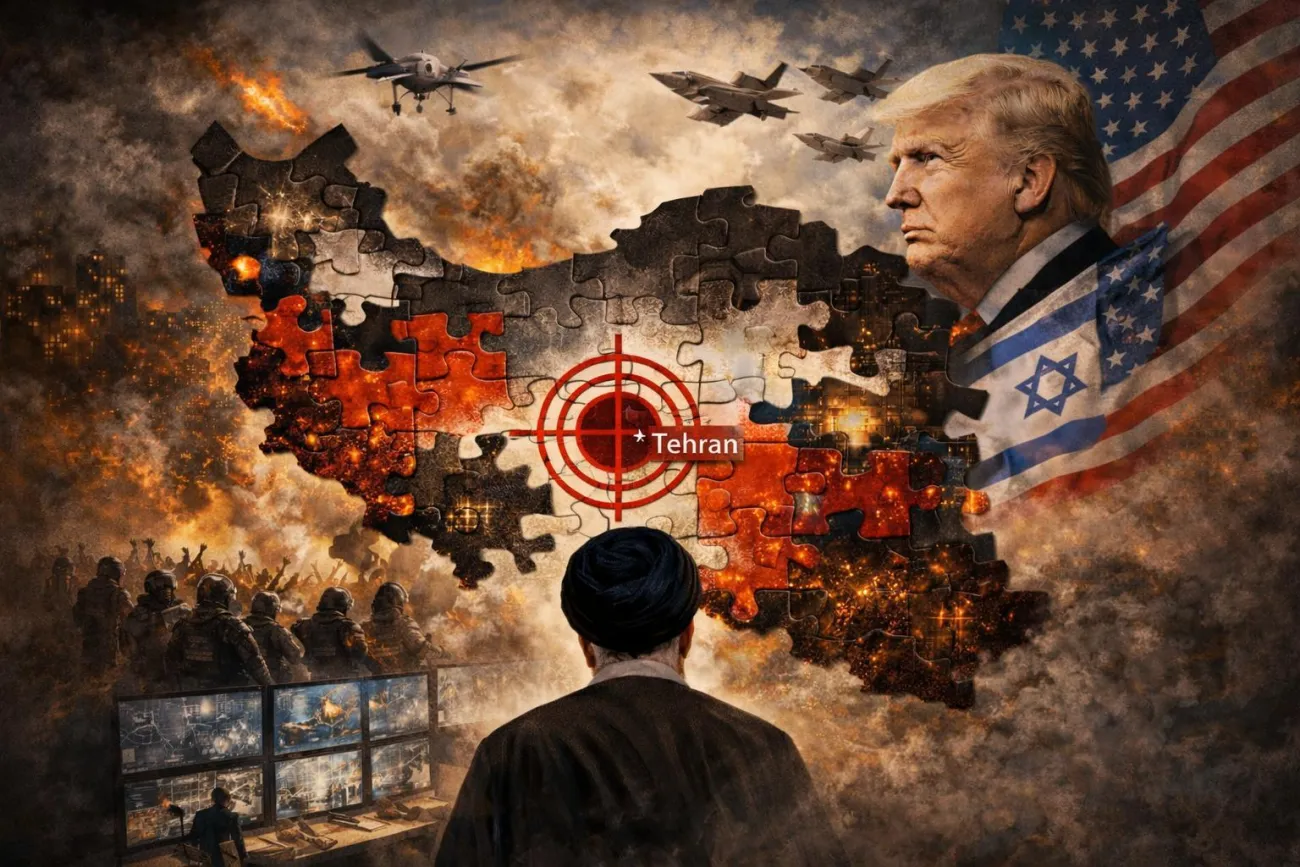
From the second half of the month of Dey until today, the Iranian scene has inclined neither toward stability nor toward a total explosion.
Abdullah Abdi – AbdiMedia
From the second half of the month of Dey until today, the Iranian scene has inclined neither toward stability nor toward a total explosion; rather, it has remained fixed at that familiar middle point—the same turbulent and bloody balance I previously wrote about on the twelfth day of the Israeli attack.
That note had a central sentence: "It seems a bloody balance is desirable for all three sides of this war."
Today, after three weeks of heavy and unprecedented domestic crisis, internet shutdowns, security pressure, bloody protests, the deaths of thousands of humans, and the meaningful silence of foreign actors, the answer remains the same as it was that day: Yes; it seems a bloody balance is desirable for all current actors, even in the near future.
These days, many only imagine we are in a new crisis, while the reality is deeper and more hidden. The Islamic Republic needed, and still needs, this situation—domestic pressure, controlled terror, external threats without immediate attack, and the ambiguous space between war and peace—to complete the next stage of its security mega-project. Ayatollah Khamenei, in the chiaroscuro of this opportunity, has used it to resolve a set of chronic internal and external dilemmas; the same dilemmas that had remained at the level of accumulated crises for years.
During these three weeks, the rhythm of protests was broken—not through problem-solving, but through internet and social media shutdowns (an area the Ayatollah once said was so important that if he were not the Leader, he would have become its control commander), extensive arrests, televised confessions, field containment, and the psychological reclamation of space, albeit gradual.
The street has not reached silence; it has reached disconnection—the separation of people from one another through the cutting of communications. This is the point I mentioned in previous analyses: the internet is not a public infrastructure; it is a lever for crisis containment. The Islamic Republic acted exactly on this basis: total shutdown, layering, nominal reopening, and real control using modern tools.
In these three weeks, contrary to public perception, neither the government nor formal institutions played a decisive role; rather, the "field" has been entirely in the hands of the security-extra-governmental structure, and of course, entirely under the supervision of the Ayatollah.
The silence of Masoud Pezeshkian and his First Vice President was not an ordinary silence; it was a silence meaning the transfer of decision-making to the "upper level"—the place where the mega-project algorithm is written, not in the government. Furthermore, Dr. Masoud, with the most practical commitment possible to the Ayatollah, showed that he is, in the literal sense, a soldier of the Absolute Jurist (Vali-e Motlaq-e Faqih) and the Imamate of the Ummah.
Do you remember the note I wrote to Ali Larijani, warning him that although he had entered the field to play the role of President, he should be careful?
Meanwhile, the external environment remained in a state perfectly suited to Tehran's needs: no serious threat, no attack, no serious action from Europe, and no special military formation from Israel. This "costly calm" was the best condition for completing the internal security circle.
It is in such a context that Donald Trump's role gains importance. His behavior over the past three weeks is perfectly consistent with the analysis I wrote before his election as U.S. President, which some chose not to see: "Trump's presidency is not a threat, but an opportunity for certain key elements of the Islamic Republic."
Trump did exactly what we have seen dozens of times in his behavioral model: he spoke loudly but moved with tied hands. He threatened, messaged, and chanted, but as soon as the moment for tangible action arrived, he took no action.
Particularly when a person—disregarding or ignoring other domestic and foreign oppositions or their fragmentation—rose to prominence and weighed in on the field with overt and covert support in all dimensions, especially media; is such a thing possible in the realm of politics so simply?
This is where one must ask: Is this "inaction" part of the same pattern I previously warned about? Are certain levels of the Islamic Republic not delighted by Trump's rise to power?
The questions are simple, but the answers are not. In politics, what is not seen is always more important than what is seen. Informal agreements, non-public messages, hidden coordinations, and red lines respected by both sides are usually understood from within these voids.
In these three weeks, the Islamic Republic followed exactly the path it needed to complete the second phase of the security mega-project:
The street was relatively contained and controlled.
Local protest networks were identified.
Civil society became more exhausted.
The internet underwent desirable, purposeful structural and technical management.
The opposition faced a crisis of confidence more than ever before.
And the security and military apparatus took hold of the field more uniformly than before.
For now, alongside all of this, one must also place the lack of immediate foreign attack and the absence of serious change in the international environment under the meaningful inaction of Trump and Europe. There has been neither a military attack—which, if there were a will for fundamental regime change, should have happened sooner (and if it occurs, as I wrote before, its "level, scope, and consequence" are vital)—nor even a symbolic action at the level of recalling ambassadors or expelling the Islamic Republic's ambassadors.
And today, the Islamic Republic, with the help of all intelligence-security and judicial capacities wearing the garb of law—specifically the "Law on Intensifying Punishment for Spying and Cooperation with the Zionist Regime and Hostile Countries Against National Security and Interests"—will gallop without leniency.
Now, perhaps no one knows the definitive way out of this bloody balance; but every actor still has a small possibility ahead. The system can pause for a moment before costs become irreversible. External powers can step away from calculated silence. Political forces can stop competing over ruins. And the people, suspended between life and death, can do the only thing that has always been the starting point of any change: awareness and the determination to pursue their own will—for God does not change the fate of a people until they change themselves. My prayer is: "O Transformer of hearts and states, transform our state to the best of states."
If I were to pull one sentence out of these three weeks to record as a memento, it is the one I wrote before, whose meaning and instance are clearer today than ever: Politics is extraordinarily ruthless.
Neither is the enemy the kind of enemy we imagine, nor the friend such a friend, nor the crisis as it appears on the surface. Perhaps now one can gradually say with certainty that the "April Fools' lie" (Dorough-e Sizdah) I wrote this year (1404) is no longer much of a lie.
In the parallel universe I have seen and continue to see, it is not at all unlikely for Trump to follow the Ayatollah's lead and for the Ayatollah to nominate him for the Nobel Prize.
These days, in Iran, something beyond a protest, a crackdown, a crisis, or a massacre is taking shape; these are pieces of a larger puzzle—a puzzle whose image will, sooner or later, become more complete.
And one must still write, still record, and still observe with open eyes; because Iran will soon meet another phase of that same bloody balance—perhaps even bloodier. The terrain of Iranian politics is more complex and ruthless than other political terrains, and today its complexity and ruthlessness have reached a supreme level, requiring open eyes free from emotion and hype.
The system that was pregnant with the Ayatollah's security mega-puzzle is now approaching its time of delivery. Everything must be ready for this most important event of the Islamic Republic, provided it is not a gamble—and you surely know that no delivery has been or will be without blood.
Even if the Islamic Republic and the U.S. move past the atmosphere of war and enter a controlled war just to save face, I would no longer be surprised. Politics is just this ruthless.
In conclusion, one must distinguish between "analysis based on observable data" and "predicting the future." What is in this note is an analysis of patterns, signs, and measurable behaviors. However, politics in both Iran and the U.S. is prone to sudden, unexpected, and costly decisions. Any actor in this field who suddenly makes an unexpected decision, whether in Tehran or Washington, can disrupt the weight of all equations. If that moment arrives, one must look again, weigh again, and write again.


دیدگاهها
کلی گویی و پیچیده گویی حس خوبی میده ؟؟؟تمام احتمالات رو مطرح کردن و بعد احساس افلاطون دست دادن ؟
Take less than a minute, register and share your opinion under this post.
Insulting or inciting messages will be deleted.
Sign Up