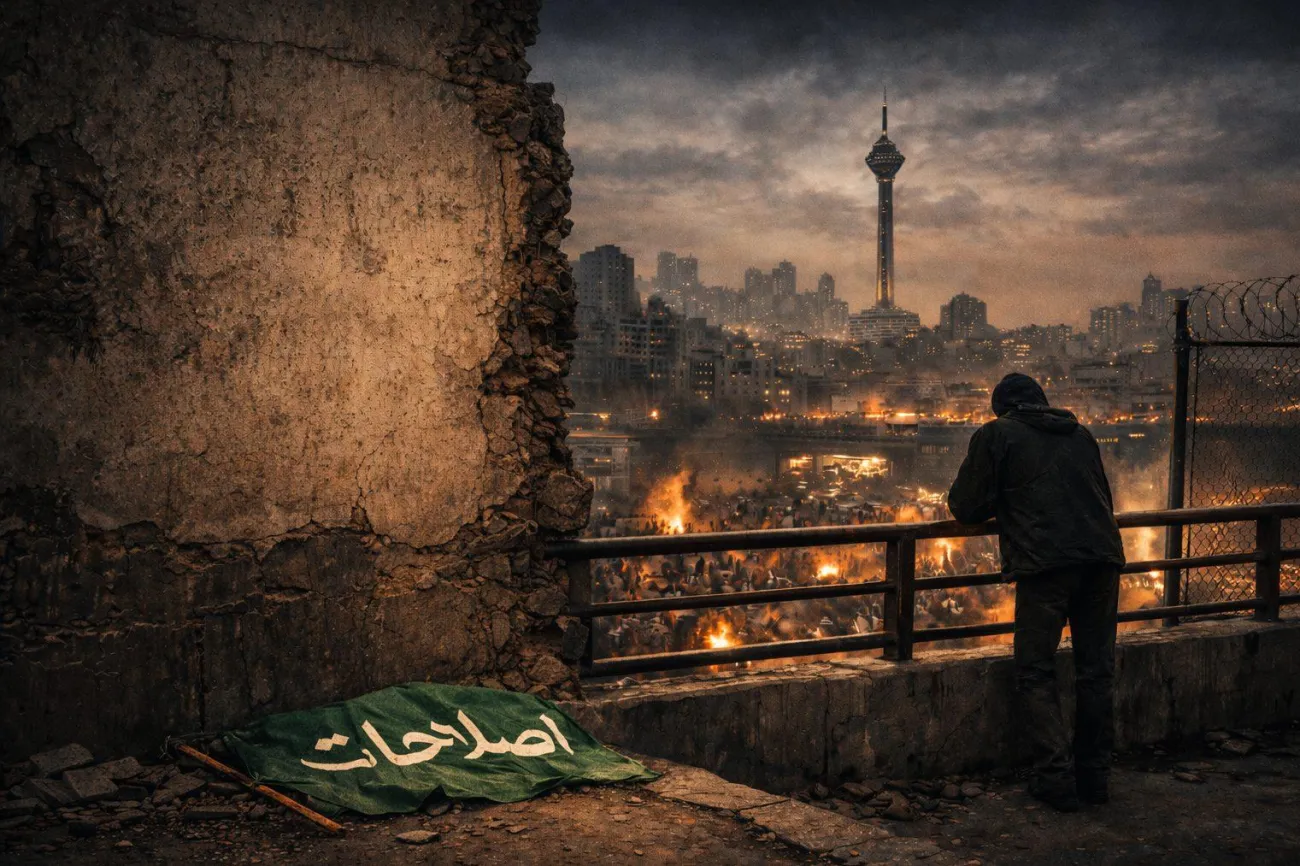
If you look at Tehran from the top of a dimly lit bridge in winter, you don’t just see buildings; you see the traces of anxiety that have settled into the walls.
If you look at Tehran from the top of a dimly lit bridge in winter, you don’t just see buildings; you see the residue of anxiety that has settled into the walls—a city that seems to know a truth is changing, yet still doesn’t know how to articulate it. Iran today resembles a place where everything is flowing except the one thing that must flow: truth.
The street is alive, like a fire breathing beneath the ashes, yet it has no voice; politics is noisy and intensely multi-layered, yet emptied of meaning; and words that once signified hope now lie scattered on the ground like exhausted soldiers—no longer capable of fighting, no longer willing to stand.
Among these, perhaps no word has experienced such a quiet yet definitive collapse as “reformist” and “reformism.” Once, it was a banner, a boundary, an identity. Today, it is merely a “name” that may still linger on tongues but has long since stopped breathing in the arena of reality.
Reformism within Iran’s political structure did not simply fail; it was slowly swallowed—absorbed into the very same security, bureaucratic, and ideological network it was meant to reform. What remains of it resembles a “bitter, unfinished dream” more than a “movement”; a position rather than a thought; an unpleasant memory rather than a living reality.
What has lost credibility today is not merely a political faction, but the very idea of “change from within”—an idea that no longer holds relevance in the face of the structure’s security engineering. Anyone who wishes to honestly describe Iranian politics today can no longer rely on the old classifications. The “principlist/reformist” binary no longer functions—even for its own main actors. The structure and the hard core of power have, through deliberate planning, absorbed everyone into a single sphere: a sphere of authority based on security–political dominance.
What remains is a simpler yet more truthful binary: on one side stands individual-centered authority; on the other, republicanism and the demand for democracy—a divide born not of abstract theory, but of the lived and bloody experience of the people.
People who, in Dey 1404 (December–January), once again colored the lines of politics with their blood; people who, in previous protests, saw that no faction stood between them and the bullets at the moment of truth; people who came to understand that real politics emerges from the streets, not from ballot boxes whose outcomes are predetermined.
Protests that began on January 7 with strikes by Tehran’s bazaar merchants reached unprecedented levels of public participation across Iranian cities on January 18 and 19, and—met with the harshest and most violent security crackdown in the Islamic Republic’s history—became one of the bloodiest chapters of contemporary Iran.
On Iran’s political stage today, “reformist / reformists / reformism” no longer represent change, nor society. Whether they wish it or not, they have been reduced within the Islamic Republic’s security structure to a “neutralizing middle layer”: neither opposition nor ally; neither dangerous nor effective; neither influencing nor being influenced.
In security terminology, this is called a “neutralizing class”—a class whose function is not transformation but the absorption and digestion of social energy. Exactly the role assigned to them in the most recent presidential election, where they were tasked with turning convergence into divergence in a historic gamble. A gamble whose loss they now see and acknowledge themselves. Even the victory of Masoud Pezeshkian—achieved with broad reformist support—ended, under the label of “consensus,” in a cabinet resembling that of the principlists, demonstrating that the system’s hard core fundamentally does not consider reformists—despite their service in elections and mobilization—worthy of trust.
Yet within this scorched earth of reform, some figures have moved beyond the idea of institutional reform and begun to speak the language of transition—from Mir-Hossein Mousavi and Seyed Mostafa Tajzadeh to Narges Mohammadi, Parastou Forouhar, and even Azar Mansouri. These voices no longer speak of “repair,” but of “changing the mechanism of power.” In their view, transition means a change at the apex of governance and reaching a clear timeline for a referendum and elections whose results are not written in advance. These voices argue that after nearly half a century of one model of governance, the new generation has the right—based on the very principle emphasized by the founder of the Islamic Republic—to reject this system and freely decide its future through a real and free referendum.
Society, however, unlike the structure, is no longer neutral. In all major historical narratives, there is a moment when people align themselves not by “slogans,” but by “truths.” Iran stands at such a moment today. People have moved beyond words; beyond false hopes; beyond empty promises. Society has returned to the fundamental question: should we stand against authority, or remain under its shadow?
At such a moment, anyone—any figure, group, or current—who still defines themselves under the banner of “reformism” is, in effect, concealing a simple reality: reformism within the current structure is a hollow and discredited label—a shell with no remaining substance.
Iran today, more than ever, needs a new language—one that reveals the real divide. That divide is not between left and right, nor between moderates and hardliners or centrists.
For a large segment of society, the path out of this deadlock no longer lies in bargaining within the structure, but in a clear mechanism for returning to the public will: a referendum and elections whose timing and outcome are not predetermined. This may be the only low-cost path capable of saving “the day after” from a civil war of narratives and street-level score-settling—a path of transition, not a bloody explosion.
Today’s division in Iran has only one meaning: standing with the people and for the people, or standing with the structure and comfort-seeking pragmatism. This may be bitter, but it is honest; stark, but true. A society seeking to open the path to democracy must first discard decayed words—and “reformist” is one of them.
That said, it cannot be denied that there have been—and still are—diverse tendencies among reformists: from those who continue to operate conservatively within the structure and accept the neutralizing role, to those who in recent years have moved toward more fundamental critique and even echoed the people’s voice during recent protests. But their survival and effectiveness depend on shedding worn-out labels and defining themselves within the camp of democracy, not on the margins of absolute power.
The reality remains that even these tendencies, if they wish to endure, must exit the old shell. The time has come for everyone—from yesterday’s reformists to today’s critics—to stand, without fear of labels or consequences, in the right place in history: not in the shadow of rigid and closed political structures, but alongside the people and for Iran. This stance is not a betrayal of the past; it is loyalty to a future that promises real democracy—where words regain meaning in honor of the blood of the country’s young over the past half-century.
At such a moment, the true value of politics lies not in faces, but in forming a broad democratic convergence—one capable of uniting the dispersed masses of the dissatisfied, critics, civil activists, and post-reformists around a single demand: changing the mechanism of power through the public will. Iran’s future will be built by a broad coalition of all segments of society, across all perspectives and political, intellectual, ideological, and ethnic spectra—not by reliance on individual figures.
If Iran’s future is to open a window to democracy, it requires the courage to name things plainly—not euphemisms, not linguistic conservatism, not political nostalgia. The idea of genuine change from within this structure has ended, and Iranian politics is now compelled to choose between democracy and authority.
In a land where words do not enjoy a natural lifespan, sometimes the only way to begin the future is to formally declare the end of the past. For the issue is no longer the salvation of a political current; it is the restoration of the people’s right to self-determination.
Take less than a minute, register and share your opinion under this post.
Insulting or inciting messages will be deleted.
Sign Up