
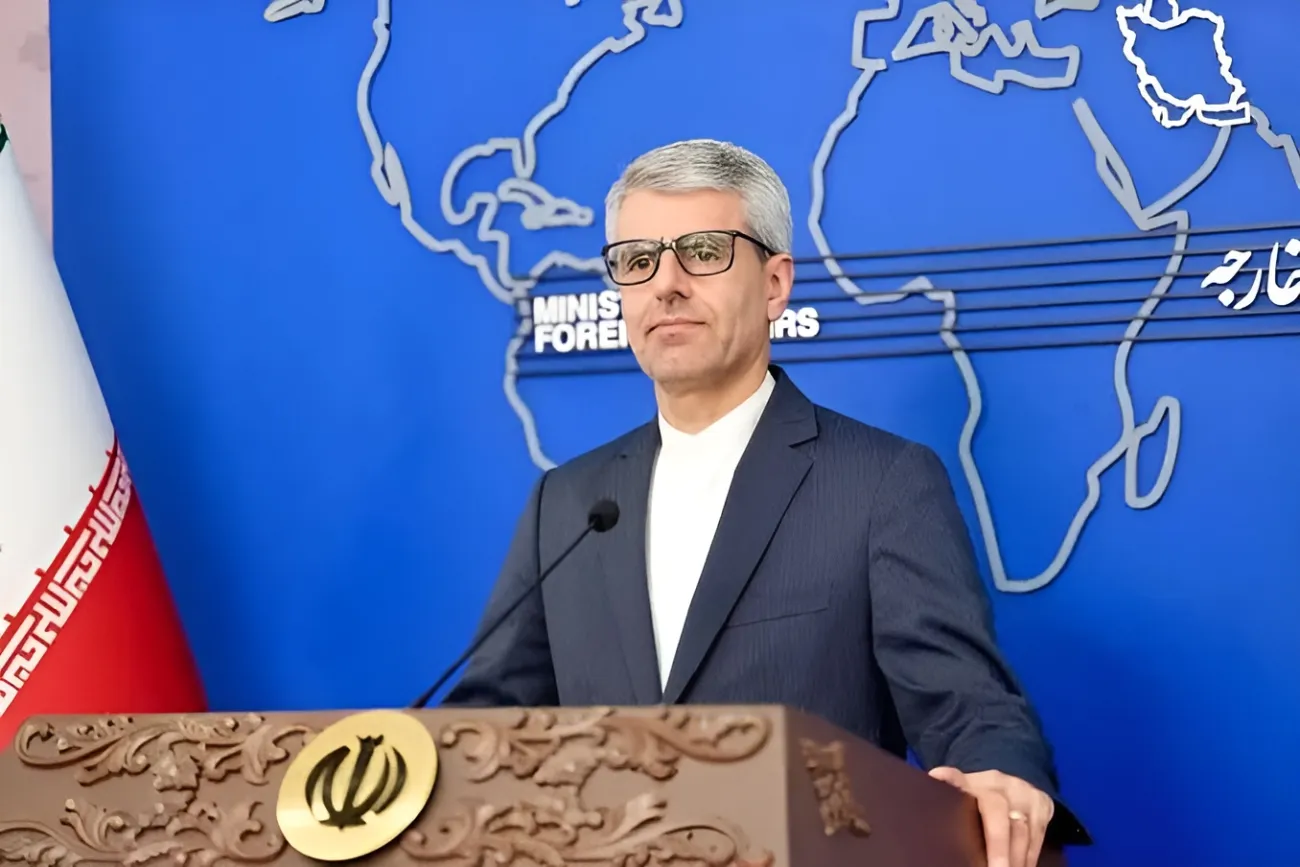
Ismail Baghaei, the spokesperson for the Ministry of Foreign Affairs, once again turned to classical Persian literature and a story attributed to Ubayd Zakani to express a political allusion.
Ismail Baghaei, the spokesperson for the Ministry of Foreign Affairs, once again turned to classical Persian literature and a story attributed to Ubayd Zakani to express a political allusion; this time, the target of the allusion was Rafael Grossi, the Director General of the International Atomic Energy Agency.
In response to the efforts of the European Troika and the United States to pass a resolution against Iran at the IAEA Board of Governors, and referring to the role of the Director General's report in shaping this process, Baghaei said:
"Sometimes I imagine that the behavior of the Agency and its Director General is reminiscent of the story of the scholar Ajud al-Din al-Iji and the Mongol Khan. Whenever they fall short in other areas, they resort to the Agency and the Director General, or conversely, the Director General himself places himself at the disposal of European and American parties to exploit against Iran to exert political pressure."
Baghaei's reference is to a satirical tale by Ubayd Zakani, without which the main and biting point of his words is practically lost.
But what is the story of "Ajud al-Din al-Iji and the Mongol Khan"?
Ajud al-Din al-Iji was a renowned scholar and theologian of the 8th century AH and a prominent figure in the Ilkhanate administration.
In a story attributed to Ubayd Zakani, the Ilkhanate Sultan Abu Sa'id takes Ajud al-Din by the hand in a gathering and asks him to dance.
Ajud al-Din, obeying the Sultan's command, begins to dance. However, one of those present, seeing his dancing style, says sarcastically:
"You are not dancing according to the principles."
In response, Ajud al-Din says a phrase that contains the essence of the humor:
"I am dancing to the Yarligh, not to the principles!"
"Yarligh" in the literature of the Mongol period meant the command or decree of the Khan or Sultan.
So, the simple meaning of Ajud al-Din's answer is this:
"I am not going to dance according to principles and rules; I dance according to the Khan's command!"
But Ubayd's satire goes beyond a mere dance gathering.
Ajud al-Din is a religious scholar and official, and the word "principles" takes on a double meaning in the mouth of such a character; instead of acting based on "principles," he bows to power and the "Yarligh," the Sultan's command.
For this reason, Baghaei's allusion to Rafael Grossi becomes much clearer:
From the perspective of the Foreign Ministry spokesperson, the issue is not merely a technical disagreement between Iran and the Agency; his allusion is that the Director General, instead of moving based on the principles and independent duties of an international body, is "dancing to the Yarligh" of Western powers—meaning he is performing the same moves that the command and political will of others dictate.
In other words, without directly labeling Grossi as an "agent" or "obedient servant" of the US and Europe, Baghaei, by referencing a centuries-old satire, presents exactly such an image of his behavior: a dancer who dances not to principles, but to command.
This is not the first time Baghaei has resorted to the literature of Ubayd Zakani to convey a sharp political message.
Previously, in response to Donald Trump's rhetoric and statements, he had also referred to another explicit and biting story of Ubayd Zakani using the phrase "our actions and deeds, and their claims"; a reference that Abdi Media had previously examined for its content and hidden layers.
It seems that literary and historical allusions have become part of the Foreign Ministry spokesperson's response style; where a centuries-old story sometimes conveys the true meaning of a political position more effectively than several explicit diplomatic sentences.



Take less than a minute, register and share your opinion under this post.
Insulting or inciting messages will be deleted.
Sign Up