
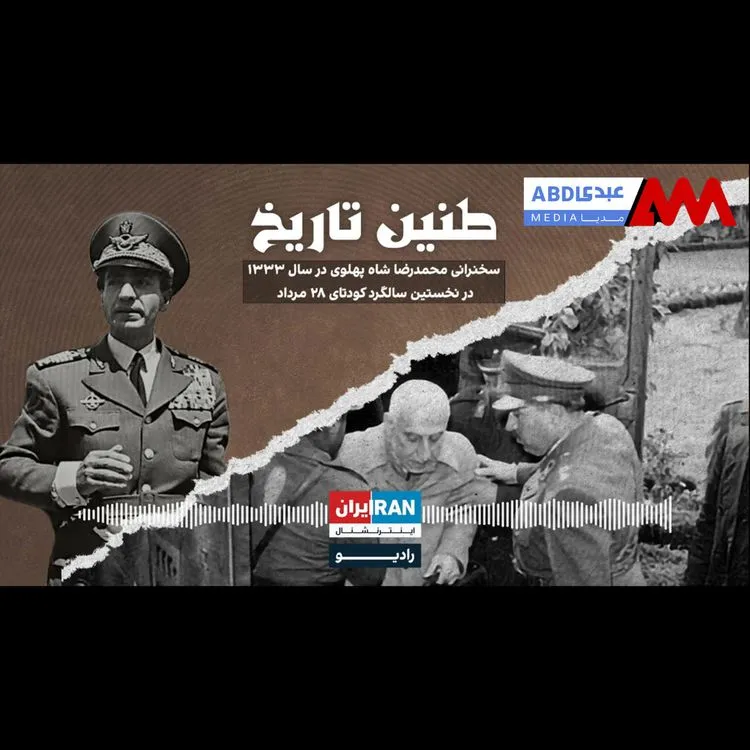
What you read and hear in "Tone of History"
From August 1944 to August 1980; What Happened in Iran
"Tone of History" is a program from the special programs of Radio Iran International, hosted by Abdullah Abdi, which aims to contribute to greater awareness and information for the audience by taking a historical look at events that have occurred in Iran from ancient times to the present day.
The first episode of this program focused on the events of August 16 and 19, 1953.
"What happened? What did they say and what did we hear? From those whose names we only heard, and what we imagined were only the narratives we were told. In the Tone of History, without judging, we hear them themselves." This is the introduction to "Tone of History," hosted by Abdullah Abdi.
Abdi narrates the story of the months of August 1944 to 1980 as follows: "Today, we travel together to the year 1954. To August. What events have not passed in Iran's Augusts. The two Pahlavi kings, for whom August seems to have been inauspicious. Reza Shah Pahlavi, who died in August 1944, and his son also passed away in August 1980. But August, among those who shape history, has a special story on the 25th and 28th. Two coups against Mohammad Mossadegh's government—the first failed on August 16, and the second succeeded on August 19 of the same year. Of course, there is a lot of disagreement about the term 'coup.' At the time, the Shah called it the 'Uprising of the Iranian Nation,' poets wrote poems for it, and minstrels composed numerous songs for it, and celebrations were held on its anniversaries under the same name, the Uprising of the Iranian Nation. I have spoken at length. I want to take you with me to August of the year 1954 so that you can hear the Tone of History from the history-makers. August 18, 1954, coincided with the 18th of Dhu al-Hijjah in the lunar calendar. The 18th of Dhu al-Hijjah is Eid al-Ghadir in the Shia calendar. This very day marks exactly the first anniversary of the removal of Mohammad Mossadegh, Iran's 30th Prime Minister. Mohammad Reza Shah Pahlavi begins by congratulating Eid al-Ghadir on the occasion of his victory in the Uprising of the Iranian Nation on August 19, 1953."
The program then plays the voice of Mohammad Reza Shah Pahlavi, saying: "Whenever the lofty gratitude and service to the people are recognized and appreciated in the world, humanity takes a step toward perfection. Eid al-Ghadir is one of the days of humanity's ascent toward perfection. It is the day when the Prophet appointed Ali ibn Abi Talib as our leader in life and our example of destiny, justice, and sacrifice. We all know that following the leader means faith in justice, loyalty, and self-sacrifice—the only straight path to happiness and honor. Coincidentally, tomorrow is the day when, last year, you brave children of Iran staged the Uprising of August 28th and proved your faith in these eternal truths. By the pure nature of Iranians and national zeal, you did a simple and natural act to protect your homeland and honor, perhaps unaware of the truth of the matter. It appears that when you learned that contrary to the principles of constitutionalism, our orders had been disobeyed, and some had taken the path of rebellion and insurrection, you rose up in one day and one hour across the country, making the rebels regret their ominous schemes and restoring law and order. Did you realize at that time the magnitude of this step and the profound impact it would have on the fate of our ancient nation, and the irreparable danger that threatened us? But unfortunately, that sedition and disobedience were leading our country to the brink of annihilation, and it was not long before we too would fall victim to the fate of those sacrificed to the chaos and turmoil prevailing in the world, and God forbid, lose our existence, which we owe to thousands of years of sacrifice by our glorious ancestors. Although, by God's grace and your efforts, that danger has passed, much time will still be needed to repair the material damages and especially the spiritual losses of that time."
After cutting off Mohammad Reza Shah's voice, Abdi explains that, as you heard, the then Shah of Iran praised the actions of August 19, 1953, by praising the Prophet of Islam and the first Shia Imam. The interesting point in this part of the speech is the king's emphasis on the foundations of Shia Islam. Mohammad Reza Shah refers to the uprising and considers August 28th as the Uprising of the Iranian Nation. Listen to the continuation of this speech, which was hidden in history.
What follows is the continuation of Mohammad Reza Shah's speech: "You brave and worthy children of Iran have fulfilled your patriotic and manly duty. But for the restoration of the damages and the achievement of the ancient high position, the homeland's eyes are always on you through patriotism and sacrifice. Be aware and know that the country's happiness and glory will result from unity, justice, and sacrifice. Our gratitude to Almighty God for bestowing upon us this vast country, all this potential, land, and natural resources. We hope that with the strength of will, effort, and endeavor, we will benefit from these special gifts and bring our beloved Iran to the peak of prosperity in the near future."
Host: Mohammad Reza Shah Pahlavi refers to the damages and spiritual losses of that era and says that time is needed for the reconstruction of the damages he mentioned. August 19, 1953, was so prominent in the king's mind that for a long time, both he and high-ranking members of the court and Pahlavi statesmen referred to this event in their speeches and praised that day. As I said at the beginning, there were disagreements about applying the term "coup" to the events of August 19, 1953. However, later, in 2000, Madeleine Albright and, in 2009, Barack Obama confirmed America's role in the August 19, 1953, coup. Jack Straw, the former British Foreign Secretary, was the only official figure from that country over the years who, with a brief reference to Britain's role in the August 19 coup, called it a clear example of British intervention in Iran's internal affairs. Barack Obama is the first and only U.S. president to express regret for his country's involvement in the overthrow of Mohammad Mossadegh's government, in addition to previous occasions, at the UN General Assembly in 2013. Also, Jack Straw, the former British Foreign Secretary, explicitly confirmed Britain's intervention in the August 19, 1953, coup at the opening ceremony of an exhibition on Iran during the reign of Shah Abbas, stating that helping Reza Shah and participating in the coup against Mossadegh were among Britain's mistakes. The song you heard is one of the pieces of music composed in praise of August 19, 1953, as the Uprising of the Iranian Nation during the Pahlavi era. In subsequent episodes, I will address this important historical event in more detail. I emphasize that in this program, I do not judge the events; I merely present them to you directly from the heart of history and narrate history and its unheard stories. I, Abdullah Abdi, producer and host of Tone of History, thank you for accompanying this program. Don't forget that you can also receive the Tone of History program and other programs of Radio Iran International as podcasts. A poem by Ardalān Sarfarāz concludes this episode of Tone of History.
"History is a ruthless and merciless horror house. It is a sea of fire and blood, constantly turbulent. The victors' swords are the blood-stained ink of the people." Goodbye.


Take less than a minute, register and share your opinion under this post.
Insulting or inciting messages will be deleted.
Sign Up