
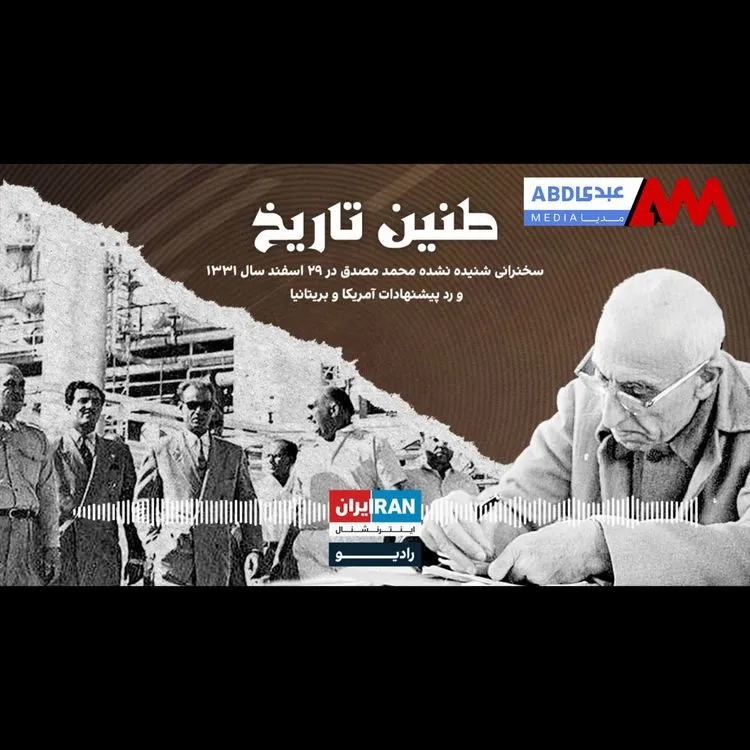
Host: What happened? What did they say and what did we hear? From those whose names we only heard, and what we imagined were only the narratives we were told. But in the Tone of History, without judging or embellishing or diminishing, we hear them themselves. Greetings to you. I am Abdullah Abdi, and in the second episode, I am with you, the listeners of Radio Iran International, with a gift from the Tone of History. A program produced using historic and lesser-heard or unheard voices from the Abdi Media sound archive. You surely remember the previous episode, and if you haven't heard it, I invite you to search for it, listen, and enjoy. In the previous episode, we heard the words of the second Pahlavi king regarding August 19, 1953, on its anniversary in August 1954. Today, we travel together to a few months before the coup, to March 20, 1953, and hear the words of Mohammad Mossadegh, Iran's then Prime Minister, on that day. The very words that paved the way for the coup against Mohammad Mossadegh in August 1953. In this speech, Mossadegh speaks about the reasons for rejecting the joint British and American proposals—first, the Churchill-Truman proposal, and then the Eisenhower-Churchill proposal, submitted by Louis Henderson, the American ambassador, and Middleton, the British chargé d'affaires in Tehran.
Mohammad Mossadegh:The British government, in its proposal of September 1952, had determined the basis of its claims as follows: compensation for the nationalization of the Anglo-Iranian Oil Company's establishments in Iran should be paid with regard to the legal status of the parties that existed immediately before nationalization, and with regard to all claims and counterclaims of the parties. In response to this proposal, the Iranian government stated that the meaning of the phrase "the legal status of the parties immediately before the nationalization of the oil industry" would imply the legalization of the annulled 1933 agreement, which was never and is not acceptable to the Iranian nation. This ambiguity and the lack of clarity regarding the basis of compensation led to the failure of the negotiations in September and October, and the direct negotiations were terminated.
**Host:** In the continuation of this important and historic half-hour speech in March, Prime Minister Mohammad Mossadegh recounts part of his negotiations with Henderson, the American ambassador, and narrates the obstacles that prevented an agreement.
**Mohammad Mossadegh:** In the recent negotiations conducted by Mr. Henderson, the American ambassador, with me, the British government had proposed that instead of the phrase "the legal status of the parties immediately before the nationalization of oil," the phrase "fair compensation for the loss of the company's business" be used. Accepting this vague and undefined basis for determining compensation had numerous obstacles. Firstly, in nationalized industries throughout the world, even assuming a contract concluded according to legal standards and without coercion and intimidation, only compensation for property and installations is paid. Accepting compensation for the loss of business is contrary to the principle of nationalization of industries and defeats its purpose. Secondly, the former company, in fact, had no business in Iran. Rather, it should be said that it was taking Iran's greatest national wealth for free, and what it gave to the Iranian government in return for this plunder was, in fact, merely hush money. Therefore, such an act—paying one rial and profiting twenty rials—is not business; it is a kind of plunder unprecedented anywhere in the world.
**Host:** Mossadegh spoke these words at a time when Iranians were preparing for the new year of 1953. A year pregnant with events that would become one of the most important milestones in Iran's history. Mossadegh, however, clearly shows signs of not backing down from his demands in the negotiations and not saying yes to the proposals of the American and British governments. He states the fundamental reason for the failure to resolve the oil dispute as two things, which he expresses explicitly.
**Mohammad Mossadegh:** I must inform my dear compatriots that the fundamental reason for the failure to resolve the oil dispute is twofold. One is the British government's expectation from a few of our compatriots who, for over a century, have been supported by that government and have reduced the people of this country to a state where they only have a piece of bread and are deprived of all vital benefits. The British government's expectation is that this limited group, who, under the protection of that government, have usurped the rights of their compatriots in various ways and betrayed their homeland, would, even for their own survival, re-establish the previous situation, allowing that government to resolve the oil issue as it wishes with its protégés. Two. Another reason preventing the resolution of the oil issue is the interests of some major oil companies in the Middle East. Through the propaganda of the former company, they came to believe that if the oil problem were resolved on the basis proposed by the Iranian government, those interests might be jeopardized. For these reasons, the proposals that the British government has so far made directly or through America to the Iranian government, though with different wording, are similar in meaning, and none of them have secured the rights of the Iranian nation. Therefore, they have not been accepted by the Iranian government and nation.
**Host:** The then Prime Minister of Iran, while calling the British government cunning, in the concluding parts of his speech, guides the Iranian nation to take the final steps on the path to its destination.
**Mohammad Mossadegh:** Through unity and unanimity, we have now overcome countless problems. And we have driven a cunning and seditious adversary from its home, which it had usurpingly ruled for 150 years. We have shown the world that we are willing to make sacrifices in the pursuit of our national aspirations and ideals. And now that only a few more steps remain to final and definitive success, we must take these final steps toward our destination with firmer resolve and greater calm and patience.
**Host:** Dr. Mohammad Mossadegh, Iran's 30th Prime Minister, in this speech addressed to the Iranian nation, while presenting the reasons for rejecting the American and British proposals, demanded changes in them. With the rejection of this proposal, Britain and America concluded that resolving the oil crisis through political means was impossible and that Mossadegh's government must be overthrown. So it happened that while the Iranian people, in the biting cold of the end of winter 1953, were preparing for the ancient Nowruz celebrations, they did not know that a few months later, in the summer of 1953, Iran would be engulfed in highly eventful incidents.
I, Abdullah Abdi, producer and host of Tone of History, thank you for accompanying this program. Don't forget that you can also receive the Tone of History program and other programs of Radio Iran International as podcasts. And the concluding part of this episode of Tone of History is a poem by Ardalān Sarfarāz: "History is a ruthless and merciless horror house. It is a sea of fire and blood, constantly turbulent. The victors' swords are the blood-stained ink of the people." Goodbye.


Take less than a minute, register and share your opinion under this post.
Insulting or inciting messages will be deleted.
Sign Up