
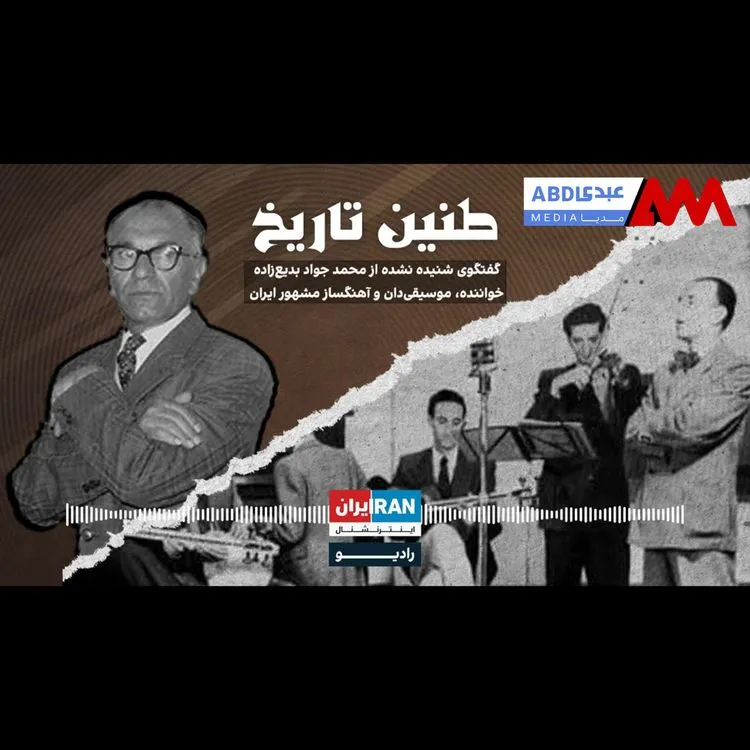
Host: What happened? What did they say and what did we hear? From those whose names we only heard, and what we imagined were only the narratives we were told. But in the Tone of History, without judging or embellishing or diminishing, we hear them themselves. Greetings to you. I am Abdullah Abdi, and in the third episode, I am with you, the listeners of Radio Iran International, with a gift from the Tone of History. A program produced using historic and lesser-heard or unheard voices from the Abdi Media sound archive. The expanse of Iran is so full of artistic stars that if you want to talk about its artists and choose one among thousands, it is itself a very difficult task. Despite all the difficulty, today I went to a melodious star who is the son of a constitutionalist cleric. Perhaps if I say I want to talk about Seyyed Javad Anari, it might sound a bit unfamiliar to you. But the son of Badi' al-Mutakallimin, or Seyyed Anari, might have crossed your ears. I am talking about Master Seyyed Javad Badi'zadeh, who was born in Tehran in 1901. His father, with sufficient mastery of the Iranian musical radif, also acquainted his son with the art of singing, eulogy, and Ta'ziyeh. Simultaneously, Javad learned traditional music and its countless melodies from his father. He himself speaks of his father.
Javad Badi'zadeh: Friends know that perhaps some friends may not know outwardly, but I have an identity document that states my date of birth as 1901. Now, let's take a pen and paper and calculate how much 1901 equals in 2536. Anyway, about seventy-five or six years of my life have passed. I was raised in a lineage of art, science, literature, and music. Because my father was a man of literature. He was a man of taste. He was a man of song. He was a man of understanding. And he was a scholar. He was a man of oratory. He was a man of preaching and oratory. In addition, he had a good voice. What I have is almost from him.
Host: During the Constitutional Revolution and the era of Mohammad Ali Mirza, the scholars of Najaf wrote a letter to Javad Badi'zadeh's father, instructing him to narrate religious decrees for the people. His father saw that he could not introduce himself to the people with just a letter. So, he consulted with several politicians of that time about what to do. It was then that they concluded to use the art of song. Badi'zadeh's father had two donkeys, and it was decided that the donkeys would be loaded with pomegranates, and when he went to the alleys and neighborhoods, he would start singing, and when people gathered because of the donkey, pomegranates, and song, he would read his announcement. This was reason enough for an ode to the pomegranate to be composed, which you hear with the voice of Seyyed Javad Badi'zadeh himself.
Javad Badi'zadeh: O pomegranate, whose existence brings blessings to the sapling of divine grace. O pomegranate, whose generosity manifests the power of God. Although the physician's opinion may be that it is trivial, the Prophet's saying that it is free food diminishes it, so why are you the pomegranate. Your inner being is like the heart of jealous constitutionalists. By God's grace, you are like a princess, O pomegranate. First, I must say that a figure with a donkey, pomegranates, a scale, stones, a cloak, and a turban, and he started by placing a stool under his foot and went up on the donkey. He let out the song. "O pomegranate, whose generosity manifests the power of God. O pomegranate, whose existence brings blessings to the sapling of divine grace." The entire street became full of people. Such a voice with such a figure. Just like that, with this donkey, these pomegranates, and this figure, he went to the parliament. From there to the embassy and here and there, and with those preliminaries, he became known as Seyyed Anari. Now I too was known as Seyyed Javad Anari in the National Consultative Assembly. That is, I was employed as Seyyed Javad Anari. For my father. His name was Badi'. At that time, I went and requested that my ID be changed in the statistics office, stating that according to such and such a clause, so and so was transferred from Anari to Badi'zadeh.
Host: In 1925, the English company "His Master's Voice," aiming to produce and record records of Iranian artists' performances, sent its representative to Iran and opened a branch in Tehran. Badi'zadeh was selected as the first male singer with the introduction and recommendation of Abdolhossein Khan Shahbazi, and his first record, titled "Jelveh-e Gol," was released to the market.
Javad Badi'zadeh: I sang two compositions at that time. One in the Homayun mode called "Jelveh-e Gol." One in the Afshar mode called "Morgh-e Bi Ashyan." However, Molla Homayun was kind enough to say he would also write the lyrics for me, and he did. I also sang three songs. "Jelveh-e Gol" in Homayun. "Jelveh-e Gol, the scent of jasmine, the lament of the harp, the call of the nightingale, have adorned the meadow..." This was the first song I sang in Homayun, and one in Afshar.
Host: Badi'zadeh also composed and sang numerous works for Reza Shah Pahlavi, among which the anthem "Iran, the Country of Darius" has retained its appeal to our time. Badi'zadeh speaks of these works.
Javad Badi'zadeh: One of my records is called "Hadiyeh-e Khak," composed in the Isfahan mode. A waltz. Or in musical terms, a 3/4 time. This was composed during the emergence of His Majesty Reza Shah the Great. With every step the Shah took, I composed songs for him according to the occasion. Various anthems, including the dawn of the Reza Shah era in this country, were performed, and I composed this waltz. And an anthem called "Country of Darius." For two or three years, I was engaged in serious and formal music. Then, to engage the people a bit and break the monotony, I introduced variety at that time. Ten, twenty, thirty records that a certain company wanted me to record in London or Berlin or some places. Or they came to Tehran, and later they wanted me, and I would go. When I went there, I would arrange to record about twenty records for this gentleman, including several serious and formal compositions, several anthems, and several songs. Then, as I mentioned, to provide variety to the people's thoughts and engage them, we also performed folk or colloquial songs.
Host: Javad Badi'zadeh has a sweet-voiced daughter named Elaheh, and fortunately, I found a part of her voice singing her father's composition "Dad-e Del." Perhaps Elaheh herself will be surprised to hear her voice. Let's listen together.
Elaheh Badi'zadeh: The happy time comes again, bring wine, O cupbearer. Again, the flower on the branch sings the torment from the soul. If the wine boils in the heart of the grape, by the stream's edge, the crimson bud is born, this lamp lights up.
Host: As Badi'zadeh himself acknowledged, with every step the then Shah, Reza Shah, took, he composed, played, and sang music and anthems for him. It was January 1936 when Reza Shah decreed a law banning women and girls from wearing the chador, veil, and headscarf in schools, universities, and administrative and government offices, and they were required to wear hats and coats. At that time, this day was called the "Day of Removal of the Veil," which, of course, later, even a bit more before the 1979 revolution, clerics and opponents of the Pahlavi regime called it "Kashf-e Hejab" (Unveiling). Let's pass over the challenge of naming the day. In 1937, Badi'zadeh composed and sang a song about this day, based on a poem by Hedayatollah Niresina, in the Bayat-e Isfahan mode, performed by a German orchestra in Berlin. Although looking at the lyrics today, the term "نسوان" (women) used in the poem is considered derogatory, its use for women was quite common in that era.
I hope this program, which was a brief look at one of the stars of Iran's art, has been to your satisfaction. I, Abdullah Abdi, producer and host of Tone of History, thank you for accompanying this program. Don't forget that you can also receive the Tone of History program and other programs of Radio Iran International as podcasts. Until a new greeting, goodbye.



Take less than a minute, register and share your opinion under this post.
Insulting or inciting messages will be deleted.
Sign Up