
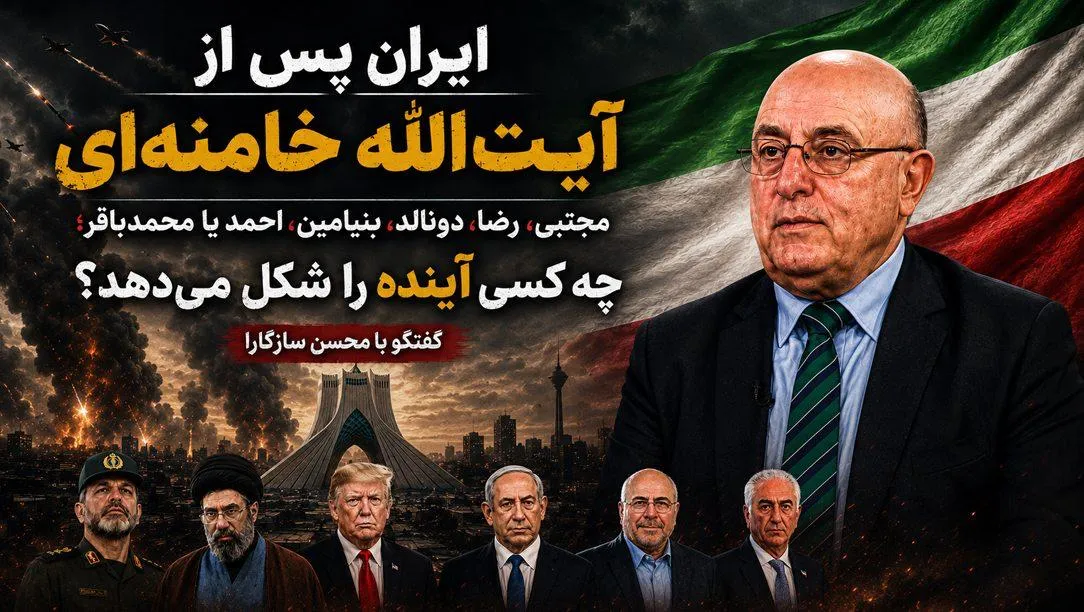
Mohsen Sazegara: “The 1979 Revolution Was a Historical Process, Not a Sudden Uprising”
A narrative from the roots of the Islamic Revolution to the “Woman, Life, Freedom” movement, and a critique of individual leadership in Iran.
As you know, the issue of the future of power in Iran is one of the most important topics that we will continue to examine repeatedly on Abdi Media. As I have said many times, we are living through one of the most sensitive—and perhaps most historic—periods in Iran’s history. In a sense, we are truly living through history itself.
Following what I have repeatedly described as a coup-like selection—namely, the choice of Mojtaba Khamenei as the third leader of the Islamic Republic—the debate over the future of Iran’s power structure, the role of security and military institutions, the future of the opposition, and even the relationship between the Islamic Republic and Iranian society has entered a new phase.
Many questions are being raised. Among them: Will the Islamic Republic enter its third generation? Is Iran moving away from an ideological state toward a security-military structure?
In this context, the role of figures such as Mojtaba Khamenei and others who are, in one way or another, playing—or perhaps even gambling—with Iran’s future is an important subject that we will discuss in greater detail tonight. What will their place and role be in the future power structure?
Thank you very much for joining me for this program.
Our guest tonight needs no introduction. He is a familiar face. Mr. Sazegara is with us this evening. I am delighted to have this opportunity to speak with him and to benefit from his experience and insights as we try to answer many of these questions.
Mr. Sazegara, welcome. I am very pleased to be speaking with you tonight.
Sazegara: Thank you for the invitation. I also appreciate your inviting me to your program. I am at your service and at the service of your viewers.
The Public Supported the Government When Ali Khamenei Was Chosen as Leader
Mr. Sazegara, at the beginning of our conversation, I would like to ask how you assess the more than three decades of Ali Khamenei’s leadership. Some people compare the legitimacy of Mojtaba Khamenei today with the legitimacy Ali Khamenei had at the beginning of his leadership. In other words, they compare the end of the father’s leadership with the possible beginning of the son’s leadership and discuss the legitimacy of a potential third Supreme Leader on that basis.
I would first like you to explain how Khamenei the father came to power as Supreme Leader and what conditions prevailed in the country at that time, so that we can then examine the issue of Khamenei the son’s leadership with greater precision.
Sazegara:
Look, when Mr. Khamenei was chosen as Supreme Leader thirty-eight years ago, it happened after the end of the Iran-Iraq War and following the death of Ayatollah Khomeini. The most important difference between that period and today was that, at the time, the public still stood behind the government.
The war had ended, and many people believed that the tensions of the early revolutionary years were over and that the Islamic Republic was now entering a new phase focused on rebuilding the country, creating prosperity, and providing peace and stability for its citizens.
At that time, Mr. Hashemi Rafsanjani was still working from the Speaker of Parliament’s office, and I had been appointed for a second time as head of the board of the Industrial Development and Renovation Organization of Iran (IDRO). I went to see him because the election had already taken place and he was expected to move to the presidential office within a week or two.
During that meeting, I told him that there were no longer any excuses left. The time had come to provide people with peace, comfort, and prosperity, and to focus on rebuilding the country.
Constant Conflict with the United States and Israel Was the Core of the Islamic Republic’s Foreign Policy
I had also written down several points that I discussed with him. One of them was that Iran’s foreign policy problems needed to be resolved. The ongoing conflict with the United States and Israel had become the central axis of the Islamic Republic’s foreign policy and was creating serious difficulties for the country.
I remember Mr. Hashemi responded very firmly and even used the same word that I had used. He said, “I changed the Constitution in a way that gives me the necessary authority.” He was referring to the 1989 constitutional amendments. He then added, “With the same courage that took me to Moscow”—I think that trip had taken place about a year and a half earlier—“I intend to go to Washington and resolve this issue.” He said that I was right and that the matter needed to be settled.
I raised other issues as well, including the multiple exchange-rate system, which was severely harming production and creating opportunities for corruption. However, one year later, after Mr. Rafsanjani became president, I left the Industrial Development and Renovation Organization and decided that I would no longer cooperate with the government. I had many reasons for making that decision.
Where did you go after that?
Sazegara: First, I went to the university and engaged in studying history. Concurrently, I worked as a consultant in the operations department of the "Data Processing Iran" company—the former IBM. Of course, during the period when I was Mr. Zanjani's deputy for informatics, I also became the chairman of the board of directors of this company.
I worked mostly as a consultant, helping the company with marketing on the sidelines; particularly in Iranian industry, both in the private and public sectors. At that time, computers were just beginning to find their place in Iran. We carried out strategic planning for industrial companies and subsequently mechanized them.
However, a while later, Mr. Khamenei issued an order from above to the head of the Plan and Budget Organization, who in turn informed Mr. Ghaemian, the managing director of the company, stating that "so-and-so must not be here." By that time, I had openly begun criticizing, and I was also publishing the "Ayneh" periodicals; the weekly Ayneh, the bimonthly Ayneh-ye Andisheh, and Ayneh-ye Eghtesad. The articles that I or others wrote had not sat well with Mr. Khamenei.
I remember Mr. Ghaemian told me: "We will stand by you; even if they remove me, it doesn't matter." But I told him not to do this at all, because the fight I had started with Mr. Khamenei should not cause damage to the Data Processing Iran company. For this reason, I left the company on my own accord. After that, my entire focus was on publishing Ayneh. Following that, I went to the Country's Press Cooperative; a cooperative that had been formed previously and had about 20 to 30 members, but we increased its membership to over 400.
Ali Khamenei reached a point where he would not let me work
As the managing director of the cooperative, I strove for about two years to help small press outlets, because the large press publications obtained their own facilities and resources from the government. We also received resources from the government, such as paper, financial aid, motorcycles, and cars, to distribute among the small press. For a while, I was also a consultant for the Arak Machinery Manufacturing Company (Machine Sazi Arak); a company that was a subsidiary of the Industrial Development and Renovation Organization (IDRO) and executed large-scale projects. The then-managing director of the company, Mr. Ebrahimi, when he realized that Mr. Khamenei was not allowing me to be employed anywhere and that the Ayneh periodicals had also been shut down, invited me to cooperate as a consultant on the company's major projects. However, even there, Mr. Khamenei would not let it go.
It seems that the media, writing, and the pen held a unique importance for Mr. Khamenei, and he was highly sensitive toward them.
Sazegara: Yes, exactly. You see, that period was a time when the Kiyan magazine—which later became known as the "Kiyan Circle"—had turned into one of the most important intellectual circles. Around 19 to 20 people would gather on a weekly basis, discussing mainly based on the views of Dr. Soroush; someone who published his articles in Kiyan and was effectively offering a fresh interpretation of religion.
Dariush Ashouri considered it one of the most successful intellectual projects in Iran
That perspective transformed a maximalist, ideological religion into a more minimalist, rational religion that was compatible with modern and liberal reason. It was a project that, in the words of Dariush Ashouri, was one of the most successful intellectual projects in Iran; a project that attempted to resolve the relationship of religion with modernity and modern rationality.
Mr. Khamenei had a serious sensitivity toward this movement. I remember he had said: "Do not just look at a publication having a circulation of only 20 or 30 thousand." At that time, Kiyan had a circulation of around 26 to 27 thousand copies; whereas if such a magazine were published in other countries, it might not even reach three or four thousand copies. However, the atmosphere of conflict and controversy created by Kayhan newspaper had caused a great deal of attention to be drawn to it.
The attacks on Dr. Soroush in the universities, the attacks on various meetings and assemblies, and even the attack on the office of Kiyan itself were part of that same highly charged atmosphere. Publications like Adineh and Donyay-e Sokhan were also under pressure. I had become acquainted with many of these friends, and we used to defend them. They had become known as "dissident publications" (nashriat-e degarandish), and we were in contact with one another within the Press Cooperative.
The pressures escalated to the point where Mr. Khatami, who was the Minister of Guidance at the time, ultimately resigned and stepped down under the pressures resulting from Mr. Khamenei's interventions.
Ali Khamenei had said about the magazines that these are dinosaur eggs
At that very juncture, Mr. Khamenei once said: "Do not look at these magazines having a circulation of a few thousand; these are dinosaur eggs. From their midst, monsters will emerge against the Islamic Republic."
In a way, he was right; because he had realized that the theories being generated in that environment would ultimately not tolerate the Guardianship of the Jurist (Velayat-e Faqih). These were theories that undermined the foundation of a jurisprudential government and even the core principle of a religious government, practically leading to secularism; meaning the idea that religion must return to the personal sphere of individuals and step away from politics, economics, and other domains that the religious government laid claim to.
In fact, that is exactly where the trajectory of that intellectual project led. For this reason, the attacks began, and because I was active in that environment in one way or another, they constantly blocked my path in life and work. Even later, when the Reform movement emerged from those very theories, the "Kiyan Circle" effectively became a think tank generating the intellectual capital for the Reform movement. Of course, a part of this movement was also formed within the Faculty of Law and Political Science at the University of Tehran—mainly based on the views of Dr. Bashiriyeh—and inside the Center for Strategic Studies, developing concepts such as civil society and the phased transition to democracy.
However, the primary intellectual sustenance that decoupled the generation of young Muslims from the idea of a "religious government" was being produced in Kiyan.
Let's delve a bit into oral history; as you know, I have a special interest in oral history, and this section is highly fascinating to me. You were among the individuals who played a role in the founding of the IRGC. Then you went to the Radio, which was also an important position. Following that, you collaborated with Mr. Rajai and became his political deputy. This means you were placed in positions that, practically speaking, the faction and party close to Mr. Khamenei had no issue with either. What happened that caused them to clash with you later on?
Sazegara: No, in fact, Mr. Khamenei had taken issue with me even back then. Let us go a bit further back. After Mr. Rajai’s administration, I entered the industrial sector, and during the war, I was mainly active in the country’s heavy industries, and later in the Plan and Budget Organization and the field of informatics.
However, in 1989, when I decided to no longer cooperate with the government, that decision was the result of a period of study and intellectual transformation. I had reached the conclusion that the problems of the Islamic Republic were not accidental or temporary issues; rather, they traced back to its essence and theoretical foundation. Meaning, the flaw lies in the system's theory and intellectual foundation—a theory that is also manifested in the Constitution—and therefore, if a change is to take place, the Constitution must change.
In what year did this intellectual transformation begin?
Sazegara: I started serious study from the years 1983 and 1984. In fact, one of the reasons I formally resigned in 1986 was these very intellectual shifts. In the sphere of economics, I had also reached the conclusion that a state-dominated approach, widespread nationalizations, and the elimination of the private sector were not the solution. I realized that if we want democracy, the other side of the coin is a free economy.
Listen without filters on Castbox
"I decided in 1988 to stop working with the government"
For this reason, when Mr. Nabavi invited me again in 1988 to return to the Industrial Development and Renovation Organization (IDRO), I told him that I had decided to no longer work with the government and that my problem with the regime was a theoretical one. Ultimately, however, I accepted and returned—albeit with one condition and a specific plan. I told him: "I am no longer that Mohsen of November 1982. This time, I have a plan. I want to turn all of the organization's companies into public joint-stock companies, take them to the stock exchange, privatize them, make them profitable, and ultimately divest IDRO itself and leave."
Mr. Nabavi was under intense pressure at the time. Oil revenue had plummeted, and the organization was operating at about 23 percent capacity. On the other hand, he was also responsible for war logistics in Mr. Mousavi's government. He jokingly told me: "Just take this off my hands; do whatever you want." When I returned to the organization and we attempted to restart production, the war ended, Mr. Khomeini passed away, and Mr. Rafsanjani became president. During that same period, I was looking for an opportunity to step aside. Later on, we had a disagreement with Dr. Nezhad-Hosseinian, the Minister of Heavy Industries.
Did the experience of individuals like Qotbzadeh and Bani-Sadr influence your outlook?
Sazegara: No. My transformation was mostly intellectual and theoretical. I was arrested for the first time by Mr. Lajevardi in connection with the Prime Ministry bombing case. At that time, we were so deeply involved in industry and managing factories during the war that we simply had no time to understand what was happening outside. We would hear things, but we either lacked the time to follow up or assumed they were rumors.
However, when I went to Evin Prison, I saw firsthand how Lajevardi truly behaved; I saw that those accounts about torture and violence were accurate. That very night, I was released due to pressure from Mr. Khomeini's office. The next morning, I went straight to Engineer Nabavi and said I must see Mr. Khomeini. Ahmad Agha (Khomeini) called and, to our surprise, scheduled an appointment for 11:00 AM that very day. Present at that meeting were myself, Engineer Nabavi, Ahmad Agha, and Mr. Khomeini himself. I told him explicitly what I had seen in Evin Prison. I even quoted a sentence; that an interrogator had told a female prisoner: "If you cannot tolerate a few lashes of the cable, how do you expect to bear God's wrath?"
"I told Ruhollah Khomeini that I made a mistake coming with you all the way from Neauphle-le-Château"
I told Mr. Khomeini: "Do you know what this statement means? Who has given this interrogator such a right to put himself in God's place? And if someone imagines they are sitting in God's seat, what atrocities are they capable of committing?" Following his perpetual habit, Mr. Khomeini had kept his head down and was listening, but he said nothing. At the end, I told him: "Either you agree with what Mr. Lajevardi is doing in Evin—in which case I made a mistake following you all the way from Neauphle-le-Château—or you disagree; if you disagree, why don't you stop him?"
Granted, about a week later, Lajevardi was dismissed. Of course, it wasn't solely because of my words. Later on, Mr. Ardabili told me that he too had brought a number of tortured prisoners before Mr. Khomeini and had protested against these acts of violence. At that time, meaning around 1984, I initially imagined that the problem with the Islamic Republic was merely the existence of a few violent and ruthless individuals, and that if they were set aside, the system would be reformed. But right then and there, I made a pact with myself to re-read the works and writings of the founders of the Islamic Republic; to understand why we had opposed the Shah in the first place and what it was we wanted to build.
I was around 30 years old at the time. The revolutionary passion and excitement had subsided, the revolution had succeeded, and it was now time for reflection.
And what did you actually want?
Sazegara: First of all, I re-read Mr. Khomeini’s book, Velayat-e Faqih (Guardianship of the Jurist). The first time, when I was 20 years old and living abroad, I had come across it.
Do you mean those Najaf lectures on Velayat-e Faqih?
Sazegara: Yes. Those very lectures that were later published as a book. Apparently, the text had been compiled by Mr. Jalaluddin Farsi. When I read it again, I saw that those fierce slogans against the Shah, America, and Israel—which had been attractive to me at age 20—no longer mattered, and now I was looking at its theoretical content. I saw that Mr. Khomeini was actually proposing a system in which one individual, called the "Faqih" (Jurist), holds all authorities; he is unaccountable to anyone, and power within it is neither divided nor restrained.
Meaning, the three main questions of political philosophy—the source of power, the division of power, and the restraint of power—are all detached from the people. The source of power is presented as God, and there is no real mechanism for controlling power. I reached the conclusion that this is the worst form of dictatorship. Then I re-read the works of Shariati, Bazargan, Beheshti, and Motahhari; the very same ones we had read before the revolution. I realized how naively we all had approached the issue.
That ideological outlook on Islam, that revolutionary conception of religion, and the notion that "justice" is the core principle rather than freedom—while democracy and human rights practically had no place in it—gradually became clear to me.
The problem with the Islamic Republic lies within jurisprudential Islam itself and its theoretical foundation
Over the course of two or three years, I re-read all of these and reached the conclusion that the problem with the Islamic Republic lies within jurisprudential Islam itself and its theoretical foundation; in the very genes that had been injected into this structure—from revolutionary, left-leaning ideologism to later, during Mr. Khamenei’s era, a kind of fascist tendency. Ultimately, out of this combination, a political monster or Frankenstein was created; a structure out of which violence and atrocities naturally emerge. And my prediction from that very time was that things would not only fail to get better, but would grow worse day by day.
What was the difference between the version you believed in during the 1979 Revolution and the government of Mohammad Reza Shah?
Sazegara: Look, the 1979 Revolution was born within a long historical and intellectual context. The roots of the Islamic Revolution can be traced back even six or seven decades prior. Dr. Ajoudani’s highly important book, Iranians' Constitution (Mashrouteh-ye Irani), alongside other works written on the subject, demonstrates that the idea of "Islam must govern" did not just belong to the year 1979; its roots can be followed all the way back to the Constitutional Revolution and even within the views of a segment of constitutionalist intellectuals and clerics.
In fact, the Islamic Revolution was part of a larger movement across the entire Islamic world—a reaction to the Islamic world's encounter with the modern West. A West that had moved past the Renaissance, the Industrial Revolution, and the Enlightenment, and was now entering the Islamic world in the form of colonialism. It is famously said that "the roar of Napoleon’s cannons behind the gates of Cairo woke the Islamic world from its slumber."
For us Iranians, this awakening began with Iran's defeats by Russia at the start of the 19th century; defeats that, like two slaps to the face, made us realize our own backwardness. From that time on, the question arose: why has the West progressed while we have lagged behind? Initially, it was thought that if we brought over Western weapons, we would become powerful; it didn’t work. Then they said let us import Western factories and industry; that didn't work either. The Constitutional Revolution was an attempt to bring law, parliament, and constitutional governance; but that too failed to yield the desired result.
Throughout this entire period, a pivotal idea existed: that "everything the West has, exists within Islam too—and even better." This was that maximalist reading of religion. From Sayyid Jamal al-Din al-Afghani and his students like Muhammad Abduh, to Engineer Bazargan in the 1940s, everyone was moving along this same path; the belief that modern science, industry, progress, and even the humanities could be extracted from the heart of Islam. Later, this same outlook expanded into the realms of economics and politics. For instance, the Movement of God-Worshipping Socialists and the currents started by the late Nakhshab were a continuation of this path. They believed socialism was the best economic model and that its roots even existed within Islam. The young Shariati grew up in that very same environment. In total, all of these efforts ultimately ran into a dead end.
So what exactly was the fight with the Shah about?
Sazegara: If we want to speak based on Mr. Khomeini’s book Velayat-e Faqih, he had two main criticisms of the Shah. First, he considered the Shah dependent on America; he said he came to power through a coup, gave the country’s wealth to the Americans, and received "military scrap metal" in return. He believed that as long as the Shah was there, Iran would lack real independence. Second, he said the Shah was not implementing the jurisprudential rulings of Islam and was destroying Islam.
But in my opinion, the issue wasn't just that. Iranian intellectualism—both religious intellectualism like Shariati's and non-religious intellectualism—was heavily influenced in the 1960s by the global discourse of revolution. At that time, the dominant paradigm in the world was "revolutionism," mostly of a leftist nature. The Vietnam War, the Cuban Revolution, the guerrilla movements of Latin America, Mao’s revolution in China, and even student protests in Europe and America all reinforced this atmosphere. In Third World countries, this idea was tied to concepts like independence, liberation from colonialism, and social justice. For this reason, Iranian intellectualism was also deeply affected by this wave.
In my view, the 1960s was a period when the nationalist discourse of the Pahlavi government—which was the legacy of the Constitution—lost out to the revolutionary and justice-seeking discourse of the left. The revolutionary sentiment was so potent that even Mohammad Reza Shah himself named his reforms the "White Revolution." Reforms such as land reform, sharing factory profits with workers, women's suffrage, and the Literacy Corps (Sepah-e Danesh), a significant portion of which were positive reforms.
I remember the Shah’s book, The White Revolution, was part of our school curriculum, and we had to take exams on it. In that very book, the Shah insisted that the "true revolutionary" was himself. What I mean to say is that during that period, "revolution" had become a sacred concept, as if it were the solution to all problems. To use Thomas Kuhn’s terminology, the dominant paradigm of that era was the paradigm of revolutionism.
The Muslims attempted to show that Islam is inherently revolutionary; they pulled "rifles and struggle" out of Quranic verses and portrayed the Prophet as a revolutionary. The Marxists relied on global leftist literature. If you look at the cultural sphere of the 1960s, this revolutionary spirit is visible everywhere—from the poetry of Shamlou and the stories of Ali Ashraf Darvishian and Amin Faghiri to the plays and works of Gholam-Hossein Sa'edi. Even in mainstream cinema and Film-Farsi movies, this same outlook existed.
In those movies, the good guy was usually poor, and the bad guy was a dependent capitalist. Behind the negative character, a foreigner usually stood—a symbol of dependence and colonialism. Even comic actors like Nosratollah Vahdat would shout directly into the camera that "we will build it ourselves and produce it better."
Interestingly, when listening to Mr. Vahdat’s remarks, I noticed that the issue of religion was also very prominent in that atmosphere. On the other hand, Mohammad Reza Shah himself considered himself a religious person; from contributing to the Imam Reza shrine to maintaining relations with Qom and paying stipends to seminary students. Even in his memoirs, he sometimes viewed himself as possessing a kind of spiritual charisma (keramat).
Sazegara: Yes. In fact, I am currently writing a book titled The Anatomy of the Islamic Revolution (Kalbodshekafi-ye Enghelab-e Eslami), which I feel is a duty I owe to the younger generation. In that book, I have examined both the theoretical foundations of the revolution and its social contexts. Look, the配置 Islamic Revolution can be viewed from various angles. One of the most important is that Mohammad Reza Shah, especially after June 5, 1963 (the 15th of Khordad), gradually distanced himself from a constitutional king and moved toward becoming an absolute ruler—particularly in the 1970s when oil revenues soared.
Did the assassinations carried out by groups like the Fada'iyan-e Islam also affect the Shah's behavior?
Sazegara: Yes, it was not without impact. The Shah went as far as dissolving all political parties—from the Iran Novin Party to the Mardom Party—and merged them all into the Rastakhiz Party. He even stated that anyone who did not join this party should take their passport and leave the country. This was happening while, on the other hand, Iranian society was moving toward modernization. The middle class was growing; more teachers, employees, university professors, journalists, and women had entered the social sphere. Everywhere in the world, the middle class is considered the "army of democracy."
Traditional family dynamics were changing as well. The old model where the "father was the absolute ruler of the home" was breaking down. Women had gained economic independence, and their social roles had transformed. However, the Shah failed to understand these changes. Even in the 1970s, he still insisted that the Shah was the "father of the nation," at a time when the very concept of patriarchy within the household was shifting.
In fact, while the Shah was modernizing society on one hand, he was becoming increasingly authoritarian in the political arena on the other; restricting freedoms, shutting down political parties, pressuring the press, and allowing SAVAK to cast a shadow over everything.
There was even an extreme sensitivity when it came to the censorship of books and poetry. Looked at from another angle: the Shah closed down all political parties, but because he both believed in religion and feared the clergy, he left the field wide open for the religious network. Consequently, the religious opposition was able to network through mosques, Husseiniyas, and Takyehs. In effect, the three main pillars of the Islamic movement were formed: Muslim academics, the religious bazaar merchants, and the clergy.
The Islamic movement managed to establish a powerful social organization.
The Muslim academics possessed Islamic associations, the Sherkat-e Sahami-ye Enteshar (Joint-Stock Publishing Company), and cultural and educational networks. The bazaar merchants provided financial and social backing, while the clergy held an extensive network of mosques and senior religious authorities (maraji). These three networks interconnected, and at a time when all other political forces—from the nationalists to the Marxists—had been suppressed, the Islamic movement was able to build a formidable social organization.
By the time we reached the 1970s, our generation no longer added anything new to those intellectual foundations; those ideas had already been formed beforehand. Our generation merely became the implementer and executor of that project. I entered Aryamehr University of Technology—today's Sharif University—in 1973. The university was intensely politicized, and we practically took those revolutionary and Islamic ideas into an operational phase, which ultimately led to the fall of the Shah.
If you will allow me, I would like to ask two brief questions; because the deeper we venture into these layers, the more we might drift from the core topic. Though, how can one converse with Mohsen Sazegara and not get lingering in history? Truly, whoever does not know their history will end up wandering lost in geography. Mr. Sazegara, the revolution took place in 1979. Do you still believe that what occurred was a "revolution"?
Sazegara: Yes, it was definitely a revolution. A revolution doesn't have horns or a tail. Even if we look at it through the lens of a classic Marxist definition, it was a revolution.
Some people say today that 1979 wasn't a "revolution," but rather a "riot." They even use the term "57-ers" (Panjah-o-Hafti-ha) to belittle or distort that event. What actually happened? Did the people participate in a revolutionary process or not?
Sazegara: It was definitely a revolution. Thousands of books have been written about the Islamic Revolution, and many Western researchers consider it one of the greatest revolutions of the twentieth century. The impact of the Islamic Revolution was not limited to Iran; it affected the entire Islamic world and provided the groundwork for the growth of radical political Islam—from the Taliban and ISIS to the Islamic Republic's proxy groups in the region. This event did not happen overnight. Those who simplistically say today that "1979 was just a riot" talk as if they imagine the people living in that period suddenly went mad without any historical or social context and poured into the streets.
Some even go further and say everything was a conspiracy by Carter. These types of analyses are actually an insult to the Iranian people—people of whom millions participated in that process. And all political currents were present too; from the Marxists and the leftists to the Mujahedin and the Fada'iyan-e Khalgh.
Sazegara: Exactly. The Islamic Revolution was the product of a long historical process; from the Russo-Iranian wars and the Constitutional Revolution to the Oil Nationalization Movement, June 5, 1963, and the developments of the subsequent decades. No major event happens suddenly. Everything connects like links in a chain to ultimately reach the point of explosion. Among the various definitions offered for a revolution, I prefer this one: "Any process in which different strata of the people enter the political arena and demand a change of government and rulers is a revolutionary process." And the 1979 Revolution was precisely such a process.
Interestingly, contrary to common perception, the Islamic Revolution triumphed more on the basis of "civil resistance" than armed struggle. Through street demonstrations, strikes, civil disobedience, paralyzing the government, and the defection of forces from the body of the regime. Slogans like "Army brother, why fratricide?" or placing flowers in the barrels of soldiers' rifles were all part of this pattern. More interestingly, the leaders of the Islamic Revolution at that time had no theoretical knowledge of the concept of "civil resistance" at all. It was only later that theorists like Gene Sharp scientifically formulated these concepts. But the Iranian Revolution practically, without knowing it itself, utilized that very pattern and managed to force the government to retreat through the presence of millions of people.
In my opinion, those who today merely denigrate the entire affair of the 1979 Revolution are themselves still carrying that exact same model of the 1979 revolution in their minds; just with reversed signs. Whereas, from my point of view, the model of the 1979 revolution can no longer be repeated in Iran.
That is exactly where I wanted to head. The beauty of conversing with you is that you gradually bring the discussion to the turning point of the next question yourself. I think up to this point in our talk, many who have interviewed you were looking more to guide the discussion toward a specific direction rather than listening and learning. For me, however, the fascination of the matter is that I feel Dr. Sazegara is flying freely in the field of his own history, narrating and embodying what he has seen and experienced for me. This makes it much easier and deeper for me to understand. Mr. Sazegara, does Iran currently stand in a revolutionary condition? I wanted to ask this question at the end of our conversation—since the section comparing the leadership of Mojtaba Khamenei and his father still remains—but now that the discussion on revolution has opened up, I think this is the best place to introduce it. Does Iran have the conditions for a revolution today? Are the people prepared for a revolution? Are the characteristics that could be labeled a "revolutionary atmosphere" visible in today's Iranian society? Does this revolution necessarily require a leader? And if it does, what characteristics should that leader possess? Will the people ever return to the monarchy?
Sazegara: Definitely. Our society is currently in a revolutionary condition; precisely by the definition I just mentioned. I would even go so far as to say that a highly important event occurred in Iran that I personally use the word "revolution" for: namely, the "Woman, Life, Freedom" revolution.
Let's look back at that definition: any process in which different strata of the people enter the political arena and demand a change of governance and rulers is a revolutionary process. The Woman, Life, Freedom movement possessed exactly this characteristic. Of course, this revolution is still incomplete. It has pushed forward a part of its demands—particularly in the social and cultural spheres—but it is not yet complete.
Of course, the hijab law still exists and has not changed legally.
Sazegara: Yes, but the regime no longer dares to assault women as it did in the past. It has practically retreated because it has realized its power cannot match the society's will. When a law is consciously and widely violated by the people, it is called "civil disobedience." It is exactly what Gandhi did in South Africa when they threw discriminatory identity papers into the fire and declared they did not accept the law.
For 47 years, Iranian women have been fighting for equal citizenship rights. The first and most symbolic aspect of that is the issue of the compulsory hijab. Within the jurisprudential structure of the Islamic Republic and its constitution, discrimination against women is structural; a woman cannot become the Supreme Leader, nor even the president.
This struggle has now entered a brand-new phase. If you look closely at the slogan "Woman, Life, Freedom," you will see that its three components are profoundly meaningful and were not put together by accident. Although this slogan was inspired by the "Zhen, Zhian, Azadi" of our Kurdish compatriots, its adoption by the entire nation was anything but random.
Of course, Kurdistan is a part of Iran and is not separate from Iran.
Sazegara: Naturally. Kurdistan is a part of our beloved Iran and possesses a long history of struggle. I have always said that the struggles of our Kurdish compatriots have, in many instances, served as a model for the struggles of other parts of Iran.
In this slogan, "Woman" is the symbol of eliminating discrimination and achieving equal citizenship rights. "Life" stands directly opposed to a regime that emphasizes death, the afterlife, and religious obligation. In fact, if you look at the history of the Renaissance, many historians pinpoint its beginning to Boccaccio’s book, The Decameron—a work where several young people, instead of talking about death and the hereafter, speak of love, joy, and the experience of living. This marks the beginning of the "desire for life." For this reason, "Life" in the slogan Woman, Life, Freedom carries a profound cultural and civilizational concept; a sort of renaissance against a death-centered, ideological government. And "Freedom" is that very century-long missing link of Iranian society.
The roots of the Woman, Life, Freedom revolution can be traced back through the past four decades
These three concepts have grown upon a deep intellectual foundation; a foundation that was not built overnight, but rather took around forty years to form. Just as the roots of the Islamic Revolution can be followed decades back, the roots of the Woman, Life, Freedom revolution can also be traced through the past four decades.
This transformation can be seen in art, cinema, the press, and literature. For example, when I watched Rakhshan Bani-Etemad’s film The Blue-Veiled (Rusari-ye Abi), I felt we were facing a highly important phenomenon—a woman standing on her own two feet and defending her rights. Or Mohsen Makhmalbaf’s Time of Love (Nobat-e Asheghi), which brought forward love in contrast to ideology. All of these are links in a chain that have connected together. The Reform movement, the Green Movement, and ultimately Woman, Life, Freedom are the continuation of this exact same path.
In fact, the Islamic Republic first failed in the "realm of theory"; just as the Shah's government also failed theoretically before it failed practically. Today, the dominant paradigm of Iranian society consists of democracy, human rights, citizenship rights, and freedom. It is for this very reason that movements like "No to Execution," the demand for women's rights, and civil liberties have become pervasive in our society.
Do you consider the bloody events of this past January to be a continuation of the Woman, Life, Freedom movement?
Sazegara: Not at all. Let me be explicit. In the natural progression of Iranian societal transformations, the next step must be a transition to democracy and citizenship rights. Returning to the "Aryamehr–Rastakhiz" model is a movement against the direction of time, and for this reason, it cannot be swallowed by the society.
Meaning, you do not see slogans like "The Pahlavis will return," "Long Live the King," and the like as a continuation of Woman, Life, Freedom?
Sazegara: No, not at all. In fact, this is precisely why you see certain activists from that current even taking issue with the slogan "Woman, Life, Freedom." Because it does not align with their political theory. Look, at one point Mr. Reza Pahlavi was an advocate for a "constitutional monarchy." Twenty years ago, inside Iran, I used to say myself that if the Islamic Republic is set aside one day, the people must choose once again whether they want a parliamentary system with a symbolic monarch or a republic. There is absolutely nothing wrong with that. Mr. Pahlavi himself stated numerous times that he would like to have a role similar to the King of Spain; meaning a symbolic, unifying figure. However, since two or three years ago—particularly after the Woman, Life, Freedom movement and the Georgetown incident—in my opinion, his trajectory shifted. He distanced himself from that idea of "assisting the transition" and explicitly stated that he wants to be the leader of the transitional period.
Following that, a series of positions and booklets were published which, in my opinion, reeked of exclusion, purges, and revenge; they did not carry the scent of democracy. When you speak of "purging four tiers of managers" or repeat the rhetoric of "death to this person and that person," this is no longer compatible with democracy and pluralism. In my view, this perspective is a type of right-wing authoritarian interpretation; just as the Islamic Republic presented a fascist interpretation of religion, a kind of authoritarian outlook is visible here as well.
When people once again defend the "Shahanshah Aryamehr" and express nostalgia for SAVAK, this runs completely contrary to the trajectory of Iranian societal evolution. Today's Iranian society is no longer the society of the 1970s. For this very reason, I consider the events of this past January to be a tragedy. The primary murderers are Khamenei and the IRGC commanders who killed the people, and they must be held accountable. However, those who assume political leadership roles also bear responsibility for flawed tactics.
Of course, in all judicial systems worldwide, usually both the one who orders the crime (aamer) and the perpetrator (aamel) are held responsible.
Sazegara: Exactly. That is precisely what I am saying. From the perspective of civil resistance science, in regimes like the Islamic Republic, China, or Russia, calling for centralized street gatherings in the early stages is a mistake; because the government is prepared to suppress them. In the Woman, Life, Freedom movement, the brilliance of the field managers lay in making the protests decentralized and neighborhood-based. In Tehran, sometimes more than a hundred points were active simultaneously. This made it impossible for the regime to control everywhere.
However, when the regime reached the stage of firing live ammunition, the field activists pulled back to preserve people's lives. Following the events of January, I wrote an article that I have not yet published. In it, I attempted to explain—purely rationally and based on the science of civil resistance—what tactical errors occurred and why that event turned into a catastrophe. After that, in my opinion, an even more dangerous conclusion began to take shape; namely, the claim that "reform and revolution are no longer useful; a foreign force must come and liberate Iran."
This outlook, in my view, is extremely dangerous. Imagining that a foreign intervention can save Iran—while the experiences of Iraq and Afghanistan are right before our eyes—is a strategic blunder. The Americans themselves realized after Iraq that an "imported government" does not work. The term "Chalabi-ization" has become a pejorative word in Washington. Meanwhile, today Iran is facing massive economic crises, and war, sanctions, and instability could plunge the country into an economic and social tsunami.
Meaning, the true echo of this crisis that has been created now will only be heard later on.
Sazegara: Exactly. We are only at the very beginning of this saga. Inflation, unemployment, and economic collapse can take on much vaster dimensions.
This is precisely why I like to converse with individuals like you; because I believe society cannot be saved by "selling illusions." Telling people that "the day after the fall of the Islamic Republic everything will become a paradise" or that "the 100-Toman dollar will return" is, in my view, nothing but selling dreams to an exhausted society. That is why I want to ask this question: Mr. Reza Pahlavi has introduced himself as the leader of this movement. Can he be compared to Ayatollah Khomeini in the 1979 Revolution?
Sazegara: No, not at all. Neither is this Iran the Iran of 1979, nor is today's society the society of that era. Neither is the population the same, nor the social structure, nor the economy, nor is today's world the bipolar world of that time. For this reason, I fundamentally believe that any type of direct comparison with the 1979 Revolution misleads us. Today, Iran's conditions must be understood through its own coordinates. Perhaps inspiration can be drawn from certain global experiences like the UDF (United Democratic Front) model in South Africa or even Iran's Constitutional Revolution; models that did not have a single leader and were based more on pluralistic, decentralized networks.
The Constitutional Revolution did not have a single leader either; it had a "dominant narrative" called constitutionalism, and each segment of society entered the arena from its own angle. In my opinion, today's Iranian society also requires a pluralistic, networked, and decentralized model. Therefore, one should neither compare Reza Pahlavi to Khomeini, nor imagine at all that the model of the 1979 revolution can be repeated.
I read somewhere that the individuals who were alongside Mr. Khomeini and helped him achieve victory in the 1979 Revolution are incomparable to the individuals who are next to Reza Pahlavi today and striving for his success. Meaning, there are many parameters for comparison. Truly, I do not know who can be considered on par with individuals like Mr. Qotbzadeh or other figures who gradually aligned themselves with Mr. Khomeini before the revolution. Ruhollah Khomeini wasn't in Iran at the time either; he was in France and decided to return. Inside Iran, too, there were those who were theorizing his movement.
Sazegara: Look, those clerics and academics whom Mr. Khomeini appointed to the first Revolutionary Council—excluding Mr. Khamenei, whom, in my phrasing, Hashemi [Rafsanjani] "foisted" upon Mr. Khomeini—were, on the whole, highly experienced and seasoned individuals. Khamenei was not of the same stature or caliber as the other members of that council.
Montazeri and Taleghani were two prominent clerical figures. Beheshti, Ardabili, and Motahhari were also clerics, but on the academic and technocratic side, individuals like Engineer Bazargan, Dr. Sahabi, Dr. Yazdi, Engineer Katiraei, Moinfar, and others were present; people who had decades of political and organizational experience. They had been active in struggles since the era of Dr. Mossadegh, were operational in the National Resistance Movement during the 1950s, and had traversed a long path. For this reason, we were dealing with a cadre of tested and experienced forces.
Nonetheless, I fundamentally avoid direct comparisons. However, one general point holds true for all revolutions: the power of revolutions is equal to the power of their leadership—though leadership is not necessarily individual. Many revolutions have triumphed under collective, non-personal leadership centered around civil society; like Chile.
Even leadership charisma, which appears to be a deeply personal trait, is practically constructed by the inner circle and followers surrounding that figure.
Sazegara: Yes, but we must be very careful even on this point. In the study and practice of civil resistance, one shouldn't fundamentally search for charismatic leaders.
What I mean is that even individual leadership has no meaning without the network surrounding it. That is, one cannot imagine that with just any random group of people, that same leadership charisma would take shape, allowing a leader to line up and command a society with a single gesture. This dynamic is also incredibly important.
Sazegara: Exactly. Furthermore, in today's Iranian society, individual leadership—in the sense of a highly diverse nation reaching a consensus on a single person—is neither feasible nor desirable.
It is not feasible because the very structure of contemporary Iranian society no longer permits it. It is not desirable because that was precisely one of the monumental mistakes of the Islamic Revolution. The 1979 Revolution was a massive social phenomenon that had formed over decades, but our generation, in an effort to reach a conclusion more quickly, put everything on one individual's ledger.
...Whereas Mr. Khomeini was not the creator of the Islamic Revolution. This revolution had set down roots six decades prior and had taken shape gradually. He only assumed the mantle of leadership in the final year, specifically in the last 14 months. It was primarily the Muslim academics—who had produced a major part of the revolution's theory—that brought the clergy into the arena, because the clergy lacked a precise understanding of modern political concepts. They pushed Khomeini forward because he was intelligent, determined, and possessed the capabilities to drive the objective forward. But that was the monumental mistake. Forgive me for using a harsh analogy, but if you carry a donkey up to the rooftop, getting it back down is no easy feat.
The '79 revolutionaries thought that if they pushed a prominent, anti-Shah, exiled cleric to the forefront, they would achieve victory more quickly. But they did not anticipate that this very individual could distance himself from the rest to such an extent that he would bypass all of society's elites, bring millions into the streets, and subsequently suppress any dissent. He became the same person who, in May 1979, declared: "We made a mistake by not setting up gallows from the very beginning." Perhaps if the '79 revolutionaries had studied global revolutions more thoroughly, they would not have opted for individual leadership. It might have taken them longer to achieve results, but the outcome would not have been an individual dictatorship—provided, of course, that the theoretical foundations had changed as well.
Later on, in industry, I arrived at an important realization: every organization takes on the shape of its chief executive. If the manager is disorganized, the organization becomes disorganized. If they are fearful, the entity becomes fearful. If they are corrupt, the system becomes corrupt. If they are competent, the entire structure thrives. I later realized this doesn't just apply to factories and companies; it applies to countries as well. If Iran has taken on this form today, from one perspective, it can be said it has taken on the shape of Khamenei. That famous phrase, "The Shah is good, but his inner circle is bad," is fundamentally incorrect in my view. The Shah is bad, which is why his inner circle is bad. The inner circle is a product of the top executive.
It was the exact same story with Khamenei. Some used to say, "The Master is unaware," or blame Hossein Shariatmadari, Asghar Hejazi, and others. No; Khamenei chose these people himself. Over the years, he kept individuals by his side who resembled him—like-minded, obedient, and executors of his directives. Khamenei was corrupt, so the country turned into a den of thieves. Khamenei was ruthless, so those around him became ruthless. He was intellectually regressive, so his government turned out this way. Therefore, one of the best ways to understand any manager or leader is to look at their inner circle; to see whom they have gathered around themselves and why. Even today, if you want to understand Trump, you only need to look at whom he keeps around him. Anyone who is not aligned with him is purged.
Khamenei, too, after ascending to leadership, gradually sidelined the first generation of the revolution. The last one was Hashemi [Rafsanjani]—the very person who was once considered his kingmaker and benefactor. Over time, he either purged them, imprisoned them, or exiled and isolated them, all to construct a apparatus completely at the service of his individual will. If Hossein Taeb behaves that way, Khamenei brought him in. If Morteza Rezaei reached that position, Khamenei selected him. Conversely, individuals like Davoud Karimi, who refused to go along with that path, were cast aside. Therefore, regarding any leader, one of the most accurate ways to understand them is to understand their inner circle. As the famous saying goes: "First tell me who you live with, and only then will I tell you who you are."
Thank you very much. I still have many questions, and I feel we haven't even entered the core of the discussion yet, having only skimmed parts of it. For me, conversing with you, especially when we delve into history, is highly fascinating, and I truly did not want to interrupt your remarks. I hope it has been useful for the audience as well. Naturally, reactions will vary; there are supporters of Mr. Pahlavi out there who may not agree with parts of your statements.
I believe we need to speak in greater detail both about the future of the monarchy and about the topic of the "Third Leadership" and the potential role of Mojtaba Khamenei—whether he is meant to continue that same structure of the Leader's House (Beit), whether he can take his father's place, and how far he will go. All of this is part of the grand equation of power in Iran. In any case, I am deeply grateful to you for taking the time to participate in this interview.
Sazegara: You are very welcome. I also apologize if my remarks became lengthy, and I am entirely at your service to continue these discussions.
You raised points in this session that might seem like merely part of a conversation today, but in the future, they could serve as pieces in the puzzle of contemporary Iranian history—insights that will be valuable to researchers and history enthusiasts alike. I personally benefited greatly, and I thank you.
The complete file of Abdi Media's interview with Mohsen Sazegara, political analyst
Take less than a minute, register and share your opinion under this post.
Insulting or inciting messages will be deleted.
Sign Up