
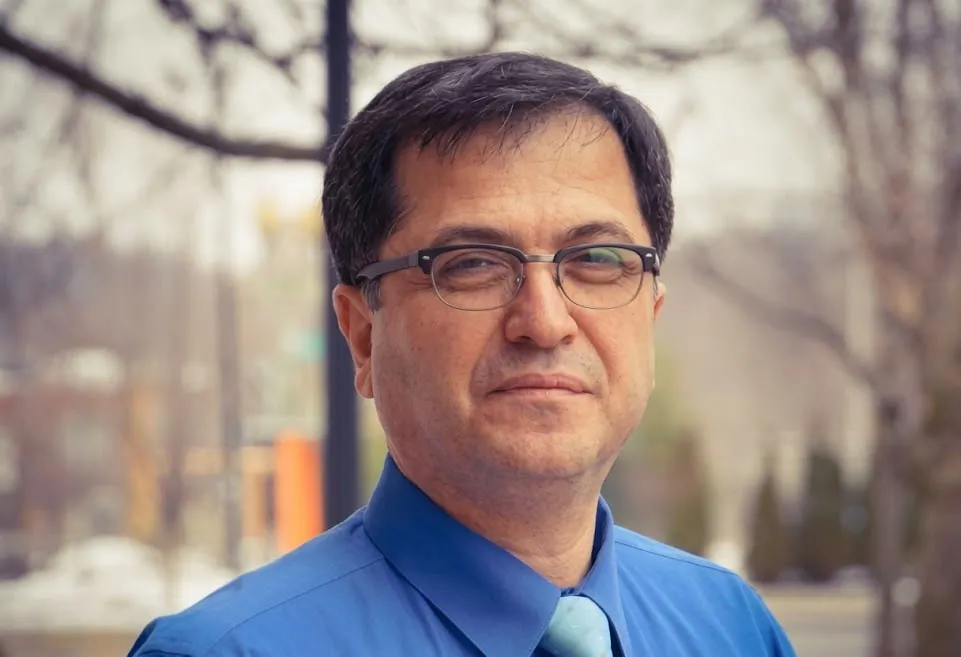
Masoud Safiri—an Iranian journalist, interviewer, author, and political analyst based in the United States—is one of the veteran figures of Iranian print journalism over the past two decades. With a career spanning from news writing at the Islamic Republic News Agency (IRNA) in the 1980s, to serving as an editor and editor-in-chief for around ten prominent newspapers during the Reform Era (from Abrar and Akhbar to Hayat-e No, Hambastegi, Sobh-e Eghtesad, and Donyaye Khodro), publishing four interview-based books with Ney Publishing (including controversial conversations with figures such as Akbar Hashemi Rafsanjani), and ultimately spending around eight years hosting high-viewership programs on Voice of America (including Ofogh-e No and Ruye Khat), Safiri stands as one of the most widely recognized faces in Persian-language journalism.
Who is Masoud Safiri?
Masoud Safiri—an Iranian journalist, interviewer, author, and political analyst based in the United States—is one of the veteran figures of Iranian print journalism over the past two decades. With a career spanning from news writing at the Islamic Republic News Agency (IRNA) in the 1980s, to serving as an editor and editor-in-chief for around ten prominent newspapers during the Reform Era (from Abrar and Akhbar to Hayat-e No, Hambastegi, Sobh-e Eghtesad, and Donyaye Khodro), publishing four interview-based books with Ney Publishing (including controversial conversations with figures such as Akbar Hashemi Rafsanjani), and ultimately spending around eight years hosting high-viewership programs on Voice of America (including Ofogh-e No and Ruye Khat), Safiri stands as one of the most widely recognized faces in Persian-language journalism.
The significance of Masoud Safiri in Iran's media landscape can be examined through several lenses. First, his extensive managerial and editorial experience during the golden age of Iranian print media—the post-1997 era characterized by an unprecedented expansion of reformist newspapers—places him among the second generation of reformist editors. During this period, Safiri played prominent editorial and managerial roles in publications such as Akhbar, Bamdad-e No, Hayat-e No, Hambastegi, and Sobh-e Eghtesad—many of which were subsequently shut down in the mass press closures of 2000. Second, his prominent interview style, preserved in four independent books published by Jafar Homaei through Ney Publishing, represents a relatively rare feat in Iran's interview-driven journalism tradition; this collection includes heavily publicized conversations with prominent figures like Ayatollah Akbar Hashemi Rafsanjani. Third, his eight-year tenure at Voice of America (VOA) as a high-profile program host—which began following his migration to the US around 2007 and lasted until September 5, 2017—made him a familiar face to millions of Persian-language viewers.
A defining characteristic of Safiri's career is his integration into both domestic and expatriate media environments, transitioning from a reformist print journalist in Tehran to a VOA television host in Washington, D.C.—a trajectory that remains relatively unique among Iran's second-generation reformist journalists. While this path brought him widespread recognition, it also placed him at a tense intersection of conflicting discourses, drawing simultaneous criticism from state-aligned outlets in Iran (such as conservative platforms like Empire of Lies and Bulten News) and certain opposition commentators (such as Iranian-American blogger Dariush Sajjadi).
Early Life and Background
Documented details regarding Masoud Safiri's exact date of birth, birthplace, and family background remain limited in open media sources—a characteristic relatively common among journalists operating within expatriate Persian media. What is clear from published accounts is that Safiri began his media career in the 1980s with the Islamic Republic News Agency (IRNA) during the foundational years of state news agencies under the Islamic Republic. This puts him among the second generation of post-revolutionary journalists who received their professional training within Iran's formal state media apparatus.
Explicit references in notes published by Nowhere Books (Nakja Book)—where he writes of "these days far from Tehran" and mentions that his parents are entering their third year—reflect an enduring emotional connection to his family in Iran throughout his years in exile.
Early Media Career: IRNA in the 1980s
Safiri initiated his journalistic work in the 1980s at the Islamic Republic News Agency (IRNA). As Iran's oldest and official state news wire, IRNA served as a critical center for training professional journalists during the intense years of the Iran-Iraq War and the subsequent reconstruction era.
This period at IRNA formed Safiri's professional and educational foundation within Iran's formal journalism structure, familiarizing him with news wire standards and terminology—a background that heavily influenced his subsequent work in print newspapers and later at Voice of America.
The Golden Age of Reformist Press (Post-1997)
A major turning point in Safiri's journalism career occurred following Mohammad Khatami's presidential victory in May 1997, which triggered an unprecedented expansion of reformist newspapers and opened a new chapter for Iranian print media.
Akhbar Newspaper
Safiri rose to the position of editor at the newspaper Akhbar, marking his first step into senior editorial management. At this publication, he gained specialized experience designing sports, cinema, and weekend supplements—an experience he later described as "novel and sweet." Akhbar, which was highly active in the post-1997 media landscape, was ultimately closed during the wave of press bans in the Reform Era, an event Safiri described as the "premature death of Akhbar."
Other Reform Era Newspapers
Following the closure of Akhbar, Safiri assumed chief editorial roles across a wide array of reformist newspapers:
Abrar
Bamdad-e No
Hayat-e No
Hambastegi
Sobh-e Eghtesad
Farsi
20-Saleha
Donyaye Khodro
This extensive roster demonstrates the breath of his involvement in the highly volatile print market of the Reform Era. At Hayat-e No—one of the preeminent and high-circulation reformist dailies of its time—Safiri continued expanding sports and cinema supplements. For the publication Jomeh, he curated weekend-specific editions, a format considered innovative within the journalistic culture of that period.
This concentrated record places Safiri among the second generation of reformist editors—a group that gained extensive experience managing newsrooms through alternating periods of bans, closures, and occasional openings in the political landscape.
Four Interview Books with Ney Publishing
A distinct aspect of Safiri's career was the publication of four independent books compiled from his interview series, issued by Ney Publishing—one of Iran's most prestigious publishing houses—under the direction of Jafar Homaei. This series was published during the interval between the "premature death of Akhbar and the launch of Hayat-e No."
The most prominent interview compiled in this series was his detailed conversation with Ayatollah Akbar Hashemi Rafsanjani, one of the most influential political and religious figures of the Islamic Republic. Upon release, these interviews generated substantial discussion within Iran's media landscape, establishing Safiri as an influential interviewer of major political and intellectual figures.
While interview-driven journalism is common in the Iranian press, Safiri's adaptation of these conversations into independent book formats stands out as a notable contribution to Persian interview literature, aligning conceptually with the work of figures like Sirus Alinejad, Hossein Dehbashi, Emadeddin Baghi, and Akbar Montajabi.
Migration to the United States and a New Media Chapter
Roughly a decade prior to 2017—around 2007 or 2008—Safiri left Iran and migrated to the United States. This departure, occurring amid the systematic closures of reformist press outlets and a tightening of the domestic media environment, opened a new phase in his professional life.
In the United States, Safiri eventually joined Voice of America's Persian Service (VOA Persian), a prominent US-government-funded broadcaster catering to Persian speakers.
Eight Years at Voice of America
Safiri spent approximately eight years at Voice of America, from around 2009 until September 2017. This period remains one of the most visible chapters of his career.
Ofogh-e No (New Horizon): One of the primary programs Safiri hosted was Ofogh-e No, an analytical talk show dedicated to examining political, social, and cultural issues in Iran.
Ruye Khat (On the Line): Safiri also hosted Ruye Khat, an interactive call-in program characterized by direct, live telephone conversations with viewers. This live format, inherently carrying the operational risks of unedited audience interactions, presented numerous broadcasting challenges.
According to published reports, during an episode of Ruye Khat focused on Iran's frozen assets, a live caller asked Safiri to address allegations concerning his own "financial embezzlement." This incident was covered heavily by media outlets aligned with Iran's conservative faction (such as the website Empire of Lies) and became a source of controversy during his time at VOA. Safiri has denied these allegations.
Departure from VOA
On Tuesday, September 5, 2017, Safiri officially stepped down from Voice of America after nearly eight years of service, stating that his departure was "by his own choice." Reports indicate that he had announced his decision to colleagues a few days prior via a bilingual email in English and Persian.
His departure occurred during a period when VOA, under the management of Setareh Derakhshesh, faced several internal challenges, including staffing shortages and internal frictions. Expatriate media analysts viewed his exit within the broader context of shifting editorial policies at VOA following the transition to the Trump administration.
Post-VOA Activity
Since leaving Voice of America, Safiri has operated as an independent journalist and political analyst in the United States, contributing commentary to various media discussions, including Clubhouse sessions, YouTube broadcasts, and other Persian-language outlets.
A notable public appearance following his VOA tenure occurred in November 2022 during a joint discussion with political analyst Mojtaba Vahedi concerning the leaked audio recording of BBC Persian journalist Rana Rahimpour—an incident that generated widespread discussion amid the "Woman, Life, Freedom" movement.
Perspectives and Stances
Over his long career, Masoud Safiri has developed a distinct professional and intellectual framework across several key areas:
Political-Intellectual Evolution: A notable feature of Safiri's trajectory is his political and intellectual evolution, moving from a reporter at the Islamic Republic's official news agency (IRNA) in the 1980s, to an editor of reformist newspapers during the Khatami presidency, and finally to a host on Voice of America. This shift mirrors a broader trend observed among a segment of migrated Iranian journalists.
Journalistic Experimentalism: His professional style is marked by a willingness to experiment across multiple formats—spanning wire reporting, print editing, curating sports and cultural supplements, publishing long-form interview books, and hosting live television programs. This structural diversity is relatively unique among contemporary Persian-language journalists.
The Significance of the Interview: In a note published by Nakja Books, Safiri emphasized the importance of the interview as a foundational journalistic medium. His four interview books reflect a belief that the medium can transcend standard news gathering to become an independent literary-journalistic genre.
Divergent Media Reactions: Safiri has drawn contrasting reactions throughout his career, particularly after moving abroad. While state-aligned media in Iran (such as Empire of Lies and Bulten News) critique him as a host for a "foreign broadcaster," certain opposition figures and expatriate analysts (such as Arizona-based blogger Dariush Sajjadi, in essays addressed "amicably" to Safiri) have criticized his professional approach on VOA programs. This dual pressure is a frequent dynamic for prominent expatriate journalists who find themselves at the intersection of polarized political discourses.
Connections and Networks
Throughout his career, Masoud Safiri has maintained connections with an extensive network of figures within Iranian journalism and politics. Professionally, his relationship with Jafar Homaei and Ney Publishing—which backed the publication of his four interview books—remains a core professional connection.
At the level of his interview subjects, his detailed dialogues with Ayatollah Akbar Hashemi Rafsanjani and other prominent post-revolutionary political and religious figures form a cornerstone of his professional legacy.
During his years in print journalism, Safiri was integrated into a broad network of editors, reporters, and intellectual figures tied to the Reform Era. In the expatriate media sphere, his professional footprint connects him to Voice of America, Radio Farda (which interviewed him in 2009), and other Persian-language broadcasting networks.
Conclusion
Masoud Safiri is one of the veteran figures of Iranian print journalism over the past two decades. He occupies a distinct position by combining professional training within Iran's formal news structure (IRNA) with extensive editorial management across approximately ten reformist newspapers, the publication of four independent interview books with Ney Publishing, and an eight-year tenure as a program host on Voice of America. His trajectory—from reporting in the 1980s to editing major dailies like Akhbar, Hayat-e No, and Hambastegi, publishing high-profile interviews with Hashemi Rafsanjani, migrating to the US around 2007, hosting Ofogh-e No and Ruye Khat, and voluntarily leaving VOA in 2017—presents a multi-dimensional portrait of a journalist, interviewer, and broadcaster.
Safiri's defining characteristic is his professional connection to both the domestic and expatriate media landscapes, tracing a path from state news wire reporting to reformist print editing and international television broadcasting—a trajectory that remains rare among his contemporaries from the second generation of reformist journalists. Furthermore, his long-form interview tradition, preserved in his four books with Ney Publishing, secures him a specific position within the history of Persian interview literature.
From an analytical standpoint, Safiri's career illustrates the phenomenon of the migrated journalist in contemporary Iran, where professionals trained within the domestic system eventually transition to expatriate broadcasting due to increasing domestic constraints. This trend, which has repeated frequently over the past two decades, found a high-profile case in Safiri, whose work has drawn simultaneous scrutiny from both state-aligned domestic outlets and segments of the opposition abroad.
Independent of individual perspectives on his stances, Masoud Safiri remains a prominent figure in contemporary Persian-language journalism. As the Iranian media landscape continues to shift both domestically and abroad, Safiri's extensive experiences over the past two decades endure as a component of the oral history of modern Iranian print and broadcast media.
Frequently Asked Questions (FAQs)
Who is Masoud Safiri? Masoud Safiri is an Iranian journalist, interviewer, author, and political analyst based in the United States. He began his media career in the 1980s with the Islamic Republic News Agency (IRNA), rose to editorial and chief management positions across roughly ten prominent reformist newspapers during the Reform Era, and subsequently spent about eight years (from around 2009 to 2017) hosting programs like Ofogh-e No and Ruye Khat on Voice of America's Persian Service (VOA).
Which newspapers did Masoud Safiri work for? Safiri worked for a wide array of newspapers during the Reform Era, serving as an editor at Akhbar and subsequently holding editor-in-chief roles at Abrar, Bamdad-e No, Hayat-e No, Hambastegi, Sobh-e Eghtesad, Farsi, 20-Saleha, and Donyaye Khodro. At Akhbar and Hayat-e No, he specialized in developing sports, cinema, and weekend supplements.
What is notable about Masoud Safiri's interview books? During the period between the closure of Akhbar and the launch of Hayat-e No, Safiri compiled his journalistic conversations into four independent books published by Ney Publishing under the direction of Jafar Homaei. The most prominent piece in this collection is his extensive interview with Ayatollah Akbar Hashemi Rafsanjani.
Why did Masoud Safiri migrate from Iran? Safiri left Iran and moved to the United States around 2007 or 2008, approximately a decade before his departure from VOA. His migration occurred amid the systematic closure of reformist print media and increasing constraints within the domestic media environment. Specific personal details regarding his departure remain limited in open sources.
What programs did Masoud Safiri host on Voice of America? Safiri spent roughly eight years at Voice of America's Persian Service (VOA Persian) from around 2009 to 2017. He was the primary host for two prominent programs: Ofogh-e No (New Horizon), an analytical talk show, and Ruye Khat (On the Line), an interactive, live call-in show.
When did Masoud Safiri leave Voice of America? Safiri officially concluded his work at Voice of America on Tuesday, September 5, 2017, after approximately eight years with the network. His departure was announced as voluntary, following a bilingual notification email sent to colleagues a few days prior. His exit took place during the tenure of Setareh Derakhshesh as VOA Persian's director.
What kind of reactions has Masoud Safiri received? Safiri has drawn polarized reactions throughout his career, particularly following his transition to VOA. State-aligned conservative outlets in Iran (such as Empire of Lies and Bulten News) have targeted him as a broadcaster for a foreign state entity. Concurrently, some opposition commentators and expatriate analysts (such as Dariush Sajjadi) have publicly critiqued his professional and editorial approach on VOA programs.
Is Masoud Safiri still active? Yes, since leaving Voice of America in September 2017, Safiri has continued to work as an independent journalist and political analyst in the United States. He provides regular commentary on current affairs across various digital media platforms, including Clubhouse and YouTube. In November 2022, he participated in a widely discussed analytical exchange with Mojtaba Vahedi concerning the leaked audio recording of BBC Persian journalist Rana Rahimpour during the "Woman, Life, Freedom" protests.

Take less than a minute, register and share your opinion under this post.
Insulting or inciting messages will be deleted.
Sign Up