
Mr. Mousavi came to the hotel and we went together to the Islamic center in the Kybuli Mosque. He and I sat on either side of the mihrab. Since he cannot sit like us and there were no chairs, he stretched out his legs; like Sam Najuma sitting during a meeting with the leadership in Iran. The members of the Supreme Council introduced the mosque and the center
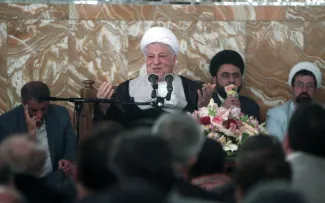
Mr. Museveni came to the hotel, and together we went to the Islamic Center at the Kibuli Mosque. He and I sat on the two sides of the mihrab. Because he cannot sit like us and there was no chair, he stretched out his legs; like the sitting of Sam Nujoma in the meeting with the Leadership in Iran. The members of the Supreme Council introduced the mosque and the center. Mr. Museveni and I gave short speeches about the cordiality of the Muslims and his government of Uganda. Their head also spoke before the two of us, with a welcome and thanks to me and Mr. Museveni.
Then we went to the grave of the founder of the mosque, in the presence of his son. We visited the newly founded hospital of the mosque. An Egyptian doctor was its head. Its level is much lower than our hospitals. I asked after one of the patients; his child had malaria, and Mr. Museveni said, "We have not been able to eradicate malaria."
Together we set off toward the town of Jinja, to see the source of the Nile River and other things. On the way there and back, everywhere we were met with crowds of people on both sides of the roads who warmly expressed their feelings, and everywhere the crowd was large. We stood up in the jeep and responded.
A lot of material was exchanged on the way. He praised the spirits of Effat and Faezeh, who had given him reports in the meetings. He had expected them to be after only flowers and shops and such, and that he had seen they pay attention to social issues and the deprived sectors and the country's affairs was interesting to him.
He has been influenced by Iran's progress toward self-sufficiency. He expects a lot of help from us. He considers his country's nature very rich and repeats Churchill's saying that "Uganda is the pearl of Africa." He criticizes the Muslims for their high birth rate and their attention to the Arabic language and their lack of attention to technical education. He is opposed to the Arabs. At the same time, he admits that the Muslims helped him in the elections, despite the presence of a Muslim candidate. His main rival in the elections was a Christian. He blames all the ruin and backwardness on colonialism and then on Idi Amin. Whatever factory I asked about, he said it was destroyed during Amin's time and then rebuilt.
At my suggestion, it was arranged that we would complete the Muslims' half-finished mosque; we would give the steel and cement and he would bear the other costs. He is aware that the Islamic groups are in dispute with each other and that each group has relations with an Islamic country like Iran, Libya, Saudi Arabia, and Kuwait, and he says these relations are for getting money. He said, "If it is for Islam, why do they not have relations with Bangladesh?" He is a realistic person.
He has the same view about the Christians and justifies their connection with the Western countries in the same way. He is very opposed to Sudan and says [Hassan] al-Turabi wants to make the African an Arab and impose their culture, and for this reason he considers the dispute insoluble.
When we reached the first district outside Kampala, he explained that his country has 16 districts, and these districts are connected to the center, and they have nothing called a province. The entire 70-kilometer route we traveled, the banana, hazelnut, tea, and sugarcane plantations are green and prosperous. A small part is dense natural forest, where we stopped a while. He said about 700 thousand hectares of this kind of forest remain.
We went to the sugar factory. The factory manager and the owner of most of the shares is an Indian. He said he was expelled during Idi Amin's time and returned during Museveni's time and recovered his factory, and he was very grateful. He explained that it has a capacity of 70 thousand tons of sugar and they have 90 thousand hectares of sugarcane cultivation, and every eighteen months they cut the sugarcane once. In Iran and India, they cut once a year, but the sugar harvest is not as much as ours. It produces electricity from bagasse and supplies the factory's energy. Overall it is a good factory. On two sacks of sugar, he took our signatures so that he could auction them and spend the income on gas and so on. The factory workers gave a warm welcome, and there were many Indian managers. In the sugarcane fields, we watched the harvesting method with machines.
We went to the Islamic Center of the Ahl al-Bayt, which belongs to the Shia. He was surprised that he had no news of their existence. They gave a warm welcome. Mr. Abbasi, who is an Iraqi seminary student and has come here from our side, offered his welcome. Mr. Museveni also gave a good speech and thanked me for introducing him to them and for making him know his country better. I too, in my speech, expressed appreciation to them and praised the democracy and freedom prevailing in Uganda. I compared it to Iran, which has representatives of minorities in its parliament. The visit to the center was before the factory.
For lunch, prayers, and a rest, we went to the hotel. In the afternoon we went to the source of the famous Nile River, which comes from the great Lake Victoria. Victoria, the largest freshwater lake in the world, belongs to the countries of Uganda, Kenya, and Tanzania. The Caspian is the largest salt lake in the world. Truly it is a lot of water and a great river. They claimed that if someone falls in, he cannot be saved from the whirlpool; we did not believe it.
Then we went to another point of the Nile River where an interesting waterfall has formed. Although it does not have much height, because of the abundance of water, it is very interesting and beautiful. They took many photographs and films. Several Black teenagers were throwing themselves into the waters of the waterfall, and excitingly, the water was carrying them away. I bought several pieces of their handicrafts that were offered under a tree for tourists. Mr. Museveni paid for them.
On the way, the earthen mounds more than two meters high caught my attention. I asked. It turned out that ants build them; in such a way that they build houses for themselves underground. They gather its soil, and they said that sometimes in the course of a week such a mound is formed.
On the way, we dropped in on a villager's house. It was very humble. Although both the man and the woman worked; the husband was a carpenter and the woman a seamstress. The house was rented, for five dollars a month. They had three small dark rooms. Without carpet and light; it is truly a poor life, and it is a cause for wonder that with all these blessings of God, water and soil and suitable weather, the situation is like this. They took photographs and films, but because of the darkness, they probably did not come out well. It was an opportunity for me to give an account of the development of Iran's villages.
On the way back, we went to see the dam and power plant that they have built on the Nile; it is interesting. England built it forty years ago. The dam itself is also part of the main road and performs the function of a bridge. The power plant is in a vast hall with ten large turbines, each with a power of 18 megawatts. The power plant's engineer gave explanations, but he did not have enough information. He did not know the capacity of the dam's lake and how much water turns each turbine. He said 100 cubic meters of water per second is needed for a turbine, and by this calculation they must be short of water; because on average, by their own account, at that point the total water of the Nile is 700 cubic meters per second; although on the other side they are busy building another power plant to use the surplus water.
They said that given the amount of water and the height of the land, they can get ten thousand megawatts of electricity from the Nile in Uganda, and at present they get only 180 megawatts from this same power plant. They are building the second power plant with a World Bank loan and a Chinese contractor, which has recently been halted and they will probably be dismissed soon. Apparently the Chinese see themselves as having been cheated. They asked us to complete the power plant. Mr. Kadkhodaei, the Deputy Minister of Energy, who is with us, examined the matter, and it was arranged that after a more detailed examination, we would accept with suitable conditions.
With great fatigue, we returned to Kampala early in the evening. I rested a little. After the prayer, I had a meeting with a group of Baluchis residing in Uganda, whose origin is Iranian. About 150 men and women had come. They gave explanations and requested scholarships and Persian language teaching. I too encouraged them to strengthen their connection with Iran and agreed that scholarships be given for teaching the Persian language. Effat had also taken part.
Then we had a joint meeting with the Ugandan officials to sign the documents of the agreements. Nine documents were signed in the presence of the President, and one document was signed by the two presidents. Then there was a press conference. They asked us ten questions; five each. Good issues were raised and the answers were also good, in connection with the cooperation of the two countries. America's opposition, regional issues, terrorism, America's aggression against Iraq, and reconciliation with Sudan and my mediation. We reached the hotel late. We had dinner and went to sleep.
Take less than a minute, register and share your opinion under this post.
Insulting or inciting messages will be deleted.
Sign Up