
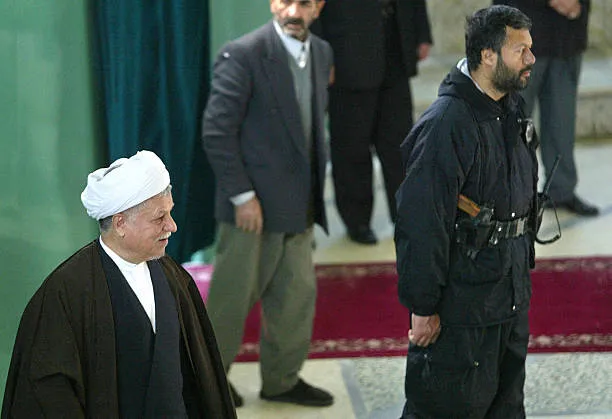
In Tehran, unknown individuals fired five shots at the British Embassy building, and the embassy was temporarily closed. At the same time, the Kayhan newspaper in its editorial predicted that if foreign policy officials do not show an appropriate reaction to British insolence, the people themselves...
America's numerous problems in Iraq have led it to propose a new resolution to the UN Security Council, based on which part of Iraq's management would be transferred to the United Nations, in the hope of greater participation from other countries in Iraqi affairs.
The U.S. Congressional Budget Office has officially announced that the U.S. budget cannot bear the long-term costs of occupying Iraq. Currently, an additional cost of one billion dollars per week is being imposed on the U.S. budget. Congress has also declared that by the end of this year, the U.S. cannot maintain more than 65,000 military forces in Iraq unless it reduces its commitments in other parts of the world and transfers forces from there to Iraq. America hopes that with this new UN Security Council resolution, it can obtain some of the costs and forces from other countries, while in the same resolution, it retains the main power and command for itself.
In Tehran, unknown individuals fired five shots at the British Embassy building, and the embassy was temporarily closed. At the same time, the *Kayhan* newspaper, in its editorial, predicted that if foreign policy officials do not show an appropriate reaction to British insolence, the people themselves might take action. While Iran's ambassador has been recalled from London for consultation, and some cultural and economic cooperation has been disrupted, Britain has stated that it does not wish to strain relations with Iran and will keep its ambassador in Tehran, and Mr. Kharazi [the Foreign Minister] has been allowed to speak by phone with Mr. [Hadi] Soleimanpour in prison.
The Leader's view is that a harsh response should be taken against Britain so they realize they have not been able to trap Iran in conventional international traps, and he criticizes the government for gradually falling for Western deception in recent years and undermining the steadfastness of the Revolution; last night, he himself shared these points with me.
Dr. Sadeghi, an Iranian heart surgeon in America, came. He brought a painting of the Five (Panj Tan) which he believes was made 500 years ago. I gave it to the museum. He said that wise and far-sighted circles in America are counting on your policy and prudence to save Iran once again, and even hardliners in the Bush administration know that you follow logical and moderate ideas. He said he is a student of Condoleezza Rice's and has associated with her, and she has said that they carefully examine your statements; recently, in three cases, they have discussed them with him personally: first, that you called Iraq an American quagmire and said America needs quagmire management; second, that you said if America becomes desperate in Iraq, it might engage in another adventure to preserve the Republican position domestically; and third, that you understand well their political, economic, and security problems. He gave his opinion that the U.S. government's situation is bad. The country has taken on a police-state atmosphere, even in the affluent neighborhoods of Los Angeles where he himself lives, people constantly face police and guns, and at airports, guns and police are everywhere, bothering people. He said he is worried about a repeat of the elder Bush's situation, whose popularity dropped from 98 percent to the point where Clinton defeated him. He said Bush's popularity has now reached 48 percent. He quoted Rice as saying they also have plans for Iran; although Iraq's problems have stopped them.
Ali Akhavizadeh, the representative of Rafsanjan, came with Mr. Balaghi, the general director of gas in Kerman Province. They said they have a gas supply plan for 15 small cities in Kerman, including Rafsanjan, and Ali spoke about the upcoming elections and the stagnation of the Executives of Construction Party.
Dr. [Mehdi] Akbarzadeh, [advisor to the Ministry of Agriculture], came. For the first time, he expressed satisfaction with the Planning Organization's approval of his budget and attention to the importance of his work, and he thanked me for resolving his problem.
In Parliament [the 6th], a new wave of crisis-making has begun; they have formed a special commission to investigate deviations in the judiciary, even though they know it will lead nowhere, but they are acting to create tension and pressure. They did not vote for Mr. [Seyyed Mohammad] Khatami's proposed minister for the Ministry of Science, because they consider him moderate: Dr. [Reza] Faraji Dana, the president of the University of Tehran and the son of Mr. Faraji—the Qom butcher from whom we used to buy our meat during our seminary days—and he is a good butcher.
The Sunni Scholars' Council of Iraq has criticized the Shiite movement, saying they have taken over Sunni mosques in Najaf and Karbala and have seized 16 other mosques, including two in Baghdad. It seems these mosques were formerly Shiite and were confiscated under the Baathist regime, and generally, Shiite endowments were taken from them under the Baathist government, and now that some are being reclaimed, these reactions are occurring.
Mr. [Seyyed Ali] Vaez, the representative of Ayatollah [Seyyed Ali] Sistani in Kadhimain, was attacked by ten armed men, but his guards defended him and he survived. He blamed the police and the occupiers for failing to do their duty.

Take less than a minute, register and share your opinion under this post.
Insulting or inciting messages will be deleted.
Sign Up