
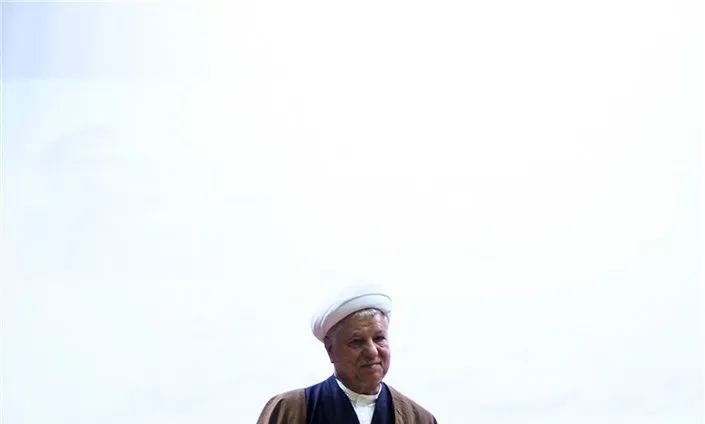
At eight thirty in the morning, we went to the parliament. Some of the delegation leaders were present. I briefly greeted the presidents of Turkey, Turkmenistan, Mozambique, Sudan, Tajikistan, and Gambia, as well as Mr. [Yasser] Arafat, [Chairman of the Palestine Liberation Organization], and a few other delegation leaders.
At eight-thirty in the morning we went to the parliament building. A number of the heads of delegations were gathered. I greeted the presidents of Turkey, Turkmenistan, Mozambique, Sudan, Tajikistan, and Gambia, and Mr. [Yasser] Arafat, [Chairman of the Palestine Liberation Organization], and several other heads of delegations. The Pakistanis had brought Mr. Mulla Mohammad Rabbani, the second-in-command of the Afghan Taliban group, there contrary to the agreements. He came and greeted me.
Then we got on the bus. He came and sat beside me and asked for a meeting. I said he should act through protocol. On the bus, Mr. Amir Abdullah, the Crown Prince of Saudi Arabia, also joined us. We went to the parade ground. At the parade site, they had placed Afghanistan's seat next to mine. Rabbani came and sat beside me so that they could take photographs and film. We were caught off guard by the Pakistanis' trick. According to the legal order, Afghanistan's seat should have been at a distance from Iran; although they had no right to bring him at all. The Taliban government in Afghanistan has not yet been recognized.
They held the parade ceremony, which was organized on the occasion of the celebration of the fiftieth anniversary of Pakistan's independence, in an orderly and good manner. It began with the national anthem. Almost all the words of their anthem are Persian, although its composition is in Urdu. After the recitation of the Quran, Farooq Leghari, the President, gave a speech. Then there was the display of the passing of F-16, F-7, and F-5 fighter planes and three types of helicopters and two types of Eastern tanks and two types of armored personnel carriers and a type of surface-to-surface missile made by Pakistan with a range of less than one hundred kilometers and engineering warfare equipment, and the parade of the armed forces.
We went to the hall of the meeting place of the Organization of the Islamic Conference. They have built an interesting building. The hall in the middle is in the form of a dome, and the rooms and corridors and other parts are around it, with many doors; although Mr. Leghari said that there was misuse in its construction and it cost a lot; about 25 million dollars, but it is a good work that [Mrs. Benazir] Bhutto's government did.
In one of the side halls, we sat for a while waiting for the other guests to arrive. Then, at the request of Mr. [Abdul-Halim] Khaddam, the Vice President of Syria, I met in a room that had been designated for me. He criticized the position of [Yasser] Arafat and Jordan severely and expressed happiness at the deadlock of the Palestinian peace negotiations due to the extremism of [Benjamin] Netanyahu. He said that if extremism has ever borne good fruit, it is this extremism of Netanyahu, the Prime Minister of Israel. Mr. Hafez Assad, [President of Syria], is ready to travel to Iran. Saddam Hussein, [President of Iraq], has sent a message to Syria that he wants to negotiate with them on an important matter, and Hafez Assad had asked for my opinion. I said the negotiation itself is good; after the matter becomes clear, we will consult together.
At eleven-thirty, the extraordinary meeting of the Organization of the Islamic Conference, which had been convened on the occasion of Pakistan's independence celebration, was formally opened. Mr. [Farooq] Leghari, [President of Pakistan], gave a detailed speech and had good points. Then [Mr. Ezz al-Din al-Iraqi], the Secretary-General of the Organization of the Islamic Conference, spoke, and the message of Mr. Malik Hassan, the Chairman of the Conference, who had not come himself, was read. The representatives of the different regions of the Arabs and Africa and Asia also spoke.
A message came from Mr. Amir Abdullah, the Crown Prince of Saudi Arabia, that he was waiting for me to meet. I said it would be better for him to come to the room. The message came back that we had such an arrangement from Riyadh. At the insistence of the companions, I agreed and went toward his room. He came out of the room in a hurry and said he wanted to come to my room. It turned out that when my message reached him, he had accepted my proposal and his entourage had answered on their own.
We went to my room. The meeting was very good and friendly; a little complaint about the past and then discussion about the development of relations. He complained about the program of disavowal [of the polytheists] of the Hajj and about Mr. [Mohammad Mohammadi] Reyshahri, [the Amir al-Hajj of Iran]. I proposed that they agree that the disavowal program be held in a limited place and time. He agreed that it be inside the building of the Hajj mission. He asked me to go on pilgrimage during the Hajj ceremonies. I said he should come to Tehran. He said he was not at ease leaving the country without a caretaker and traveling. He requested that my family, who are to go on the Hajj, be their guests. He expressed concern about the conditions of cooperation after my term of office. I said I would exercise my influence through the Expediency Council.
He asked for a private meeting. After the others left, regarding the Al-Khobar explosion, he said that four of the perpetrators of the explosion had come to Iran and then two of them had gone to Lebanon and one of them had gone to Canada, who is being pursued by America and Saudi Arabia and will be arrested soon, and one is in Iran, and he insisted that since he is a Saudi national, we hand him over to them. I said that because of your previous requests, we have conducted a comprehensive investigation; we did not find any of them in Iran, and if you give his particulars, we may follow up.
I told him, why at every meeting of the Persian Gulf Cooperation Council is a statement made against Iran that has no effect, and we naturally answer. He said, why do you not solve the issue of the islands disputed with the [United Arab] Emirates. I said this issue cannot be easily solved. It is better for the two sides to enter into negotiations, and it may take years. Finally, it was arranged that they would help so that these improper statements would gradually stop.
At the farewell, he waited outside the room door while I renewed my ablution. Then he got into my car with me and together we went to the Prime Minister's lunch banquet. On the way he said that the Americans and other opponents are upset by this scene of Iran and Saudi Arabia drawing close. Those present at the banquet, for whom our companionship was interesting and unexpected, were following the matter with sensitivity, and its photographs and films were widely published in the Pakistani media and were considered very important in the interpretive circles around the summit.
I complained to them that they had written to the conference secretariat that the Tehran summit should be postponed. Both Amir Abdullah and Saud al-Faisal denied it and said it was a rumor from the enemies. But by the afternoon we had prepared a copy of Saud al-Faisal's letter, and at night at the dinner ceremony I showed it to Abdullah. They were embarrassed and passive and immediately ordered the proposal to be withdrawn, and [Ezz al-Din] al-Iraqi, [Secretary-General of the Organization of the Islamic Conference], who insisted on written notification, announced that their request had been withdrawn, and its reflection caused surprise among the members.
At the lunch banquet, the two sides of me were the Prime Minister of Bangladesh and the President of Gambia. The President of Gambia said he wants to come to Iran, but they do not have a plane and they do not have the money to rent one; he expects our plane to go and bring him. I said they should come themselves, and our plane will take them back. He was holding a large rosary with wooden beads and a silver coating; I said why such a large rosary! He said so that I do not forget it and do not leave it somewhere. He said that with America's support, the movements of the opponents of his young revolutionary government have begun, and he demanded the speed of the construction work of Construction Jihad there.
Mrs. Hasina [Wajed, Prime Minister of Bangladesh] also said that they have a dispute with Pakistan over two matters: 1—the issue of Bangladesh's share of the joint property before the partition, of which they have given nothing to Bangladesh. 2—the permission for the return of the refugees.
At five in the afternoon the continuation of the summit's work began. I was the first speaker. I read a short speech from the text. Later, everyone who saw me expressed admiration, which is usual. Then I came to my room for the meetings. The summit lasted until ten-thirty at night. Everyone spoke. At the end they had a resolution regarding the issues of the Islamic world, including Palestine, and I ordered that a reservation be announced regarding the part of the resolution that approved the peace negotiations. At the time of the announcement of the reservation, the television program, which was broadcasting the entire program live, was cut off.
From six in the evening until ten-thirty at night I spent the time on meetings. Mr. [Saparmurat] Niyazov, [President of Turkmenistan], came. There was talk about the development of relations and the program of my future trip to Turkmenistan. Mr. Rafiq Hariri, the Prime Minister of Lebanon, came. He requested that the assistance we give to Hezbollah and other sectors of the resistance be done through the government. While praising Lebanon's good positions against Israel and in coordination with Syria and confirming the resistance, I said it would be better for the Lebanese government not to be under foreign pressures. He said he prefers to bear the pressures but to have complete dominance in the country; it was arranged that he would come to Tehran for negotiations.
The Foreign Minister and the Crown Prince of Qatar came. The Crown Prince is an eighteen-year-old youth. He is the third son of the Emir and was not ready to answer the questions, and the Foreign Minister spoke in his place, and they did not hide that he is passing through a period of practice and training. They said that at the next meeting of the Persian Gulf Cooperation Council, they would moderate the tone of the statement against Iran.
The President of Mozambique came. He requested Iran's investment in his country. Mr. [Ezz al-Din] al-Iraqi, the Secretary-General of the Organization of the Islamic Conference, came. He complained about the organization's small budget and its ten-million-dollar loans and appealed for help. I said if you observe the organization's independence and give Iran a share in management like Saudi Arabia, we will help. I proposed that we implement a plan so that the organization is independent in terms of budget. The President of the Maldives came; it was a friendly and ceremonial talk.
Mr. Yasser Arafat came to meet. He was happy that I received him. He had a kind of dejection, because he sees that with America's and Israel's new positions in Jerusalem and the occupied territories, his hopes have been blown away, and in today's speech this frustration was clear. He complained about America's disloyalty and duplicity and, with surprise, that America had used the veto twice in one week against the Arabs and in favor of Israel; that too against a resolution proposed by the members of the European Union led by England. He said this action of America is unprecedented in history. He is also worried that Netanyahu, [Prime Minister of Israel], has announced that he will stop the talks with Arafat. He asked me to help the Jerusalem Fund. I did not treat him with a tone of reproach, but I said we knew this situation from the beginning and the insincerity of Israel and America and we have announced it many times, and I expressed my unhappiness at the miserable scene of the presence of King Hussein and his daughter at the house of Israeli Jewish families to console them for the death of their men who were killed by a Jordanian revolutionary soldier on the Jordanian border, and he confirmed it. Mr. Abdul-Halim Khaddam had said that the Israelis have given only eight percent of the West Bank lands to the Palestinian self-government. I wanted to ask Arafat about this, but time was short.
I went to meet [Mr. Farooq Leghari], the President of Pakistan. He requested speed in the completion of the Kerman–Zahedan railway and cooperation in security and anti-narcotics matters. We were guests of Mr. Leghari for dinner. Amir Abdullah, [Crown Prince of Saudi Arabia], gave the particulars of the claimed person. I went to sleep late.
On this trip, Effat and Faezeh also had numerous meetings; including Faezeh's meeting with Mrs. Benazir Bhutto, who had come to the Iranian embassy for this meeting.
Take less than a minute, register and share your opinion under this post.
Insulting or inciting messages will be deleted.
Sign Up