
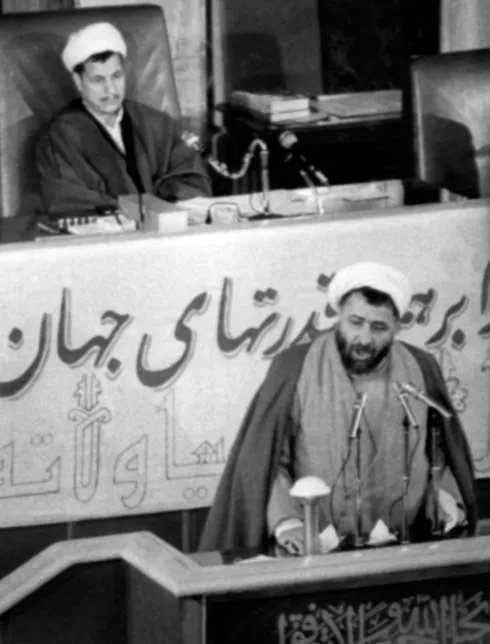
Today, from morning to night, heads of Islamic countries entered Tehran. Messrs. [Syed Mohammad] Khatami and [Hasan] Habibi were stationed at the [Mehrabad] airport and were welcoming them. I mostly spent my time meeting foreign guests. Mr. Amr Moussa, Minister of Foreign Affairs of Egypt came. in
Today, from morning until night, the heads of the Islamic countries were arriving in Tehran. Messrs. [Seyyed Mohammad] Khatami and [Hassan] Habibi had been stationed at [Mehrabad] Airport and were welcoming them. I too spent most of my time meeting the foreign guests.
Mr. Amr Moussa, the Foreign Minister of Egypt, came. We talked about cooperation on the issues of Palestine, Iraq, Turkey, and the region. He requested that we help calm the Egyptian Mujahideen forces—and in his words, the extremists—and also to prevent Turkey's cooperation with Israel, and he said they have no hope of achieving the goals of the negotiations with Israel and asked that we cooperate for the disarmament of Israel's weapons of mass destruction. He added that they tell America, if Israel is not disarmed of nuclear weapons, how can we tell Iran not to arm itself; if we accept one exception, it is not possible not to accept the second.
Mr. Jacques Diouf, the head of the FAO, came. He spoke about the FAO's program to support food production in the underdeveloped countries, that they want to save half of the population suffering from food shortage by the year 2015, and I emphasized that this goal is achievable only if you can mobilize capital and technology behind this sacred goal.
In the afternoon Mr. [Saparmurat] Niyazov, the President of Turkmenistan, came. It was a warm and friendly meeting. He thanked me for my help in developing relations and said that all the people of Turkmenistan are fond of me. He spoke about the problems with Russia over gas sales, that because they want to buy cheaply and do not pay the money either, gas exports have been cut for a while and soon Mr. Chernomyrdin, [the Russian Prime Minister], will go to Ashgabat to solve the problem. He thanked me for proposing to buy their gas, to strengthen his position against Russia. He said we can connect the gas resources from the Sarakhs region with Iran's gas pipeline lines, and he said America insists that the gas pipeline be taken under the waters of the Caspian Sea toward Azerbaijan and then to Turkey, but he prefers the Iran route and will soon conclude a contract with Shell.
He asked me to make a trip to Turkmenistan so that I could better see everywhere in the country; given the greater free time I currently have. He asked me to go for the inauguration of the Merv water treatment plant that Iran has built.
He explained about his heart surgery in Germany, that he was under the operation for seven hours and two of the three vessels were completely blocked and one was half open, and his chest bones still hurt and he cannot smoke either.
Mr. Yasser Arafat, [leader of the Palestine Liberation Organization (PLO)], came along with a group of Palestinian leaders such as Farouk Qaddumi and Hani al-Hassan. He has become weak and his lip and chin have begun to tremble. He said the peace negotiations have run into difficulty and he was happy that because of the Israeli government's violations of the agreements, Europe for the first time has taken an opposing position against Israel, and [Bill Clinton], the President of America, did not receive [Benjamin] Netanyahu, [the Prime Minister of Israel], on his trip to America. The Arabs too have taken a good position, an example of which was the boycott of the Qatar summit.
He said that on the American Secretary of State's trip to Europe and the negotiations with the two sides, no result was obtained, and during the one hour she negotiated with Mrs. [Madeleine] Albright, half an hour was spent on her insistence on protesting Arafat's trip to Iran, and he added that he thinks the American forces that have gathered in the region have Iran as their main target and not Iraq, and he asked that we be vigilant.
After the sunset prayer, Mrs. Hasina Wajed, the Prime Minister of Bangladesh, came. I asked about the situation of her country. She said that because of the peace agreement she has concluded with her country's rebels, several opposition parties have declared a strike and opposition, but they will not get anywhere and the people of her country are satisfied. She asked that we give official work permits to the Bangladeshi workers who work in Iran, and I said that given the abundance of Afghans and Iraqis in Iran, it is difficult to open this door.
Mr. Amir Abdullah, the Crown Prince of Saudi Arabia, and his son and his Foreign Minister and a group of princes and ministers came. We had some miscellaneous talks about the conference and so on. Then they visited parts of the [Marble] Palace; especially the Khatam room was interesting to them, like the rest of the guests, who all praised it. Then, for dinner, we came together to my house. He had previously sent a message through the ambassador that he would like dinner to be at our house.
On the way and at the house we had many talks about the Hajj and Umrah and OPEC and the conference and Mr. Khatami's government and the Leadership and Mr. Fahd's physical condition and the natural conditions of Saudi Arabia and Iran and my trip to the Hajj or Umrah. Then he had a meeting with the members of our house; they had previously become acquainted on the Hajj trip. Effat invited his wife, Mrs. Umm Faisal, to travel to Iran and said that in the past she was strongly opposed to holding the conference in Iran and, because of my talks, she changed her mind and supported it.
Take less than a minute, register and share your opinion under this post.
Insulting or inciting messages will be deleted.
Sign Up