
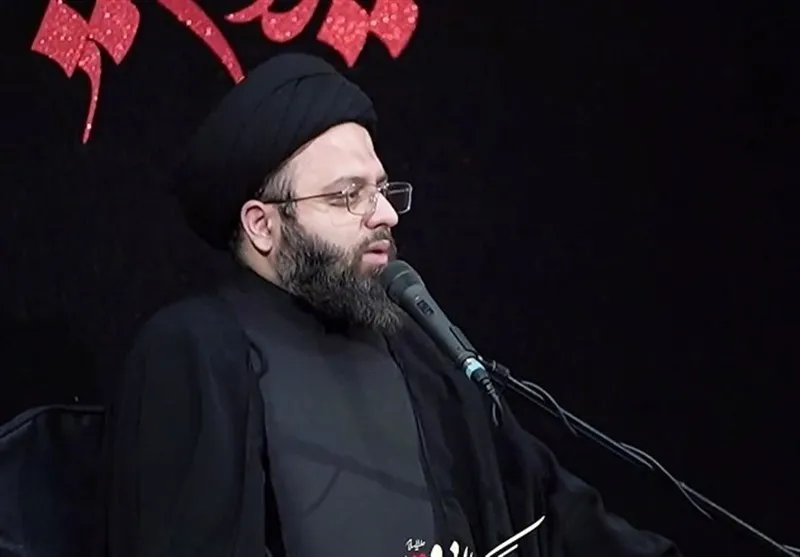
Seyyed Mohammad Hossein Mirlohi—a religious researcher, Islamic seminary lecturer, religious expert, public speaker, and the principal of the Imam Sadiq High School of Islamic Culture and Human Sciences—born in 1990, is a prominent figure among the younger generation of revolutionary conservative (Osoolgara) clerics. Backed by a unique academic and family lineage, he has emerged in recent years as a highly publicized speaker closely aligned with the circle of Alireza Panahian.
Who is Seyyed Mohammad Hossein Mirlohi?
Seyyed Mohammad Hossein Mirlohi (born 1990) is an Iranian religious researcher, Islamic seminary (Hawza) lecturer, and public speaker. He is also the principal of the prestigious Imam Sadiq High School of Islamic Culture and Human Sciences. Standing as a prominent figure among the younger generation of revolutionary conservative (Osoolgara) clerics, Mirlohi is highly recognized for his unique academic-family lineage and his position within elite socio-political networks in Iran.
A Unique Nexus of Family and Political Lineage
Mirlohi's significance within Iran's socio-religious and political landscape is deeply connected to his position at the intersection of three highly influential families within the Islamic Republic's establishment:
The Son of Hojjat-al-Islam Seyyed Mostafa Mirlohi: His father is a senior administrator at Imam Sadiq University, one of Iran’s most elite academic institutions tasked with training the human resources and managerial cadre for the state.
The Grandson of Ayatollah Mohammad-Reza Mahdavi Kani: His maternal grandfather was one of the foundational pillars of the Islamic Republic. Ayatollah Mahdavi Kani (1931–2014) served as the Prime Minister of Iran (1981), Chairman of the Assembly of Experts (2011–2014), Secretary-General of the Combatant Clergy Association, and the founder and president of Imam Sadiq University. This connects Mirlohi to the third generation of the influential Mahdavi Kani family.
The Son-in-Law of Hojjat-al-Islam Alireza Panahian: Mirlohi is married to the daughter of Alireza Panahian, one of the most influential, highly publicized, and charismatic religious-political speakers of the conservative revolutionary faction over the last two decades.
This rare lineage uniquely blends family ties, seminary authority, academic institutional power, and a direct connection to influential public pulpits (Minbar).
Academic Specialization and Legal Research
Unlike many young public speakers who focus solely on promotional or traditional religious oratory, Mirlohi maintains a serious profile in jurisprudence (Fiqh), Islamic law, and human rights, holding the title of Hojjat-al-Islam as a mid-level seminary scholar. He has co-authored significant academic papers with senior institutional figures:
Constitutional Jurisprudence: He co-authored a specialized paper alongside Dr. Mohsen Esmaeili (a prominent jurist and former member of the Guardian Council) titled "The Rule of 'The Non-Emptiness of Events from Divine Rulings' and Its Application in the Legislative System of the Islamic Republic of Iran" (published in the Islamic Law Research Journal, 2016). The paper argues that under the Iranian constitution, all legislation must derive from divine law, utilizing standard jurisprudential principles to justify total Islamic legislative coverage over modern public issues.
Islamic Human Rights: He co-authored a study with Dr. Tavakkol Habibzadeh (a professor of international law and head of the Center for Legal Affairs) titled "Studies in Islamic Human Rights" (2014), exploring the intersections of international humanitarian law, international criminal law, and political jurisprudence.
Theological Publications: He is also the author of the book Shafa'at ("Intercession"), focusing on Shia theological doctrines.
Strategic Educational Role: Imam Sadiq High School
Mirlohi serves as the principal of the Imam Sadiq High School of Islamic Culture and Human Sciences. This institution operates as a primary feeder school for Imam Sadiq University.
In the landscape of private and specialized schooling in Iran, directing this academy gives Mirlohi a strategic role. It places him in charge of vetting, ideological grooming, and academically shaping the next generation of students destined to enter the state's administrative, diplomatic, and judicial infrastructure.
Public Pulpit and Internal Conservative Controversies
Mirlohi is a regular speaker at the prominent Maktab-al-Sadiq Muharram Congregations in Palestine Square, Tehran—a high-profile religious podium where his father-in-law, Alireza Panahian, serves as the main speaker. Despite his deep establishment roots, Mirlohi's public stances have occasionally sparked debates, even among fellow conservative factions:
The Educational Justice Controversy (2021)
During a televised sermon on the eve of Tasu'a in August 2021 (1400 SH), Mirlohi delivered a defense of non-governmental/private religious schooling. His remarks drew sharp, public criticism from the conservative Tasnim News Agency.
Tasnim published a direct op-ed titled, "Mr. Hojjat-al-Islam Mirlohi! Do Not Defend Educational Injustice from the Prophet's Pulpit," accusing him of using a flawed analogy to commodify education. Tasnim argued that education, like national security, is a fundamental citizen right that the state must provide equally, criticizing Mirlohi for using a sacred religious pulpit to justify the financial structures of private academies.
Political Debates
Mirlohi has also engaged in high-profile public refutations of reformist figures. In June 2023, his detailed theological and political response to former President Mohammad Khatami regarding the definition of "freedom" was widely circulated and praised across conservative and state media outlets.
Conclusion
Seyyed Mohammad Hossein Mirlohi represents the modern, highly educated face of Iran's third-generation revolutionary clergy. Backed by the institutional legacy of the Mahdavi Kani family, the public reach of the Panahian circle, and his own background in academic Islamic law, he occupies a distinct niche. As he continues to balance elite secondary education management with high-profile public oratory, his career highlights the ongoing institutional evolution and ideological debates within Iran’s conservative elite.
Watch: From Jurisprudence to Power: How Guardianship of the Islamic Jurist (Velayat-e Faqih) Became Sovereign – Featuring Seyyed Mohammad Hossein Mirlohi on Abdi Media.
Defense of Islamic Freedom
One of Mirlohi’s highly publicized stances was his response to Seyyed Mohammad Khatami’s remarks regarding freedom in June 2023. In this statement, which was covered by the Fars News Agency, Mirlohi asserted: "The issue of freedom is one of those highly critical matters that, while holding an excellent position practically within the Islamic Republic, has been deeply wronged and marginalized theoretically."
He labeled Khatami as "the spearhead of those who exploit the slogan of freedom," stating: "During the liberal Reformist government, under the banner of freedom, he became one of the primary founders of social division, vice, the destruction of families, depression, assault, and betrayal in the history of the Islamic Republic."
Referencing Morteza Motahhari’s book Spiritual Freedom, Mirlohi argued: "More than 50 years ago in his book Spiritual Freedom, Martyr Motahhari defined freedom as the absence of obstacles to growth. To consider freedom as being unconstrained by any boundary is to reduce society to a jungle."
Criticism of the Pezeshkian Administration and Recent Stances
In recent years, Mirlohi has emerged as a serious critic of certain policies enacted by the 14th administration led by Masoud Pezeshkian. In one of his highly publicized recent remarks—issued in response to the Kish Island Marathon, which featured female runners competing in non-traditional attire—he declared: "The patience of the believers has its limits. I advise that this patience not be tested."
This warning, reported by Fararu and other media outlets, underscores Mirlohi’s rigid approach to cultural and social issues.
Criticism of Economic Policies
In the same recent address, Mirlohi targeted the administration's economic strategies, stating: "If the government focuses solely on raising prices, it will create massive problems for us. Raising salaries simply means raising inflation."
Jurisprudential-Political Framework
The core of Mirlohi's intellectual framework rests on linking Shia jurisprudence (Fiqh) directly with the political structure of the Islamic Republic. This framework is explicitly detailed in his prominent academic paper on the rule of Nafi-e Khalo—a study where the Guardian Council is placed at the center of analysis as the primary institution tasked with aligning legislation with Islamic law.
Network of Alliances and Influential Figures
Seyyed Mohammad Hossein Mirlohi operates within an elite network of familial and intellectual ties with leading figures of the revolutionary conservative faction:
The Core Network: Ayatollah Mahdavi Kani (Grandfather, Founder of Imam Sadiq University), Hojjat-al-Islam Seyyed Mostafa Mirlohi (Father, Senior Administrator at Imam Sadiq University), and Hojjat-al-Islam Alireza Panahian (Father-in-law, prominent conservative orator).
Academic Connections: His scholarly collaborations link him to figures like Dr. Mohsen Esmaeili (co-author of the Guardian Council paper and former Guardian Council member) and Dr. Tavakkol Habibzadeh (co-author of the Islamic Human Rights paper and professor at Imam Sadiq University).
Pulpit and Assembly Collaborations: On the religious circuit, his activities connect him closely with Seyyed Mehdi Mirdamad and Seyyed Mostafa Mirdamad, the leading eulogists (Maddah) of the Maktab-al-Sadiq congregation.
Conclusion
Hojjat-al-Islam Seyyed Mohammad Hossein Mirlohi stands out as a prominent figure among the younger generation of revolutionary conservative clerics. He occupies a distinct niche by combining a unique lineage, prominent legal-research publications (including the book Shafa'at and various jurisprudential papers), the leadership of the Imam Sadiq High School of Islamic Culture and Human Sciences, and a continuous presence at the pulpit of the Maktab-al-Sadiq assembly.
His trajectory—born in 1990, raised in the elite environment of Imam Sadiq University, deeply involved in legal research, managing a strategic preparatory high school, preaching at major capital congregations, and maintaining a critical stance against the Reformist faction and various government policies—offers a portrait of a complex, young "cleric-orator-educational administrator."
Mirlohi’s distinguishing feature operates on two distinct levels:
The Familial-Political Level: He stands uniquely at the intersection of three prominent families closely tied to the revolutionary establishment (the Mahdavi Kani, Mirlohi, and Panahian families). Such a triple convergence is relatively unprecedented in the familial-scholarly fabric of contemporary Iranian clergy.
The Academic-Pulpit Level: His integration of academic legal research with popular public preaching is rare among young conservative speakers, who seldom publish serious legal-jurisprudential literature alongside their public oratory.
Analytically, Mirlohi represents the phenomenon of a "third-generation elite cleric" within the structures of the Islamic Republic. In this trend, the grandchildren of the regime's founding religious-political figures leverage their family backgrounds, combined university-seminary educations, and active media-pulpit presences to assert influence in the public sphere.
The themes Mirlohi tackles—the binding of jurisprudence to legislation, the critique of the Reformist discourse on freedom, resistance to liberal state cultural policies, and the defense of the state's jurisprudential-political framework—remain the most fiercely debated topics in modern Iranian sociopolitical discourse. In a period characterized by intense cultural and political tension, Mirlohi’s voice, backed by institutional pedigree and a prominent pulpit, serves as a major reference point for the younger generation of the revolutionary conservative movement—a voice that, nonetheless, occasionally faces sharp criticism from within his own faction.
Frequently Asked Questions (FAQs)
Who is Seyyed Mohammad Hossein Mirlohi? Hojjat-al-Islam Seyyed Mohammad Hossein Mirlohi (born 1990) is a religious researcher, Islamic seminary lecturer, religious expert, public speaker, and the principal of the Imam Sadiq High School of Islamic Culture and Human Sciences. He is a prominent representative of the younger generation of revolutionary conservative (Osoolgara) clerics.
What are Mirlohi's family connections? Mirlohi sits at the exact intersection of three influential lineages: he is the son of Hojjat-al-Islam Seyyed Mostafa Mirlohi (a senior administrator at Imam Sadiq University), the grandson of Ayatollah Mohammad-Reza Mahdavi Kani (founder of Imam Sadiq University, former Chairman of the Assembly of Experts, and late Secretary-General of the Combatant Clergy Association), and the son-in-law of Hojjat-al-Islam Alireza Panahian (a leading conservative orator).
What are Mirlohi's most important publications? His key works include the theological book Shafa'at ("Intercession"), a joint academic paper with Dr. Mohsen Esmaeili regarding the Nafi-e Khalo jurisprudential rule and the Guardian Council (Islamic Law Research Journal, 2016), and a collaborative paper with Dr. Tavakkol Habibzadeh regarding Islamic human rights (Studies in Islamic Human Rights, 2014).
What is Mirlohi's role at the Imam Sadiq High School? Mirlohi serves as the principal of the Imam Sadiq High School of Islamic Culture and Human Sciences. Affiliated with Imam Sadiq University, this school functions as a primary preparatory feeder academy for the university, granting Mirlohi a strategic role in molding the future administrative and ideological cadre of the institution.
What was the 2021 Tasu'a sermon controversy? On the eve of Tasu'a in August 2021, Mirlohi delivered a sermon defending certain financial and operational aspects of private/non-governmental religious schooling. This drew fierce pushback from the conservative Tasnim News Agency, which ran an op-ed accusing him of using a sacred Ashura mourning pulpit to construct a "flawed analogy" that justified educational inequality and the commercialization of public education.
What is Mirlohi's view on Khatami and the concept of freedom? In June 2023, responding to former President Mohammad Khatami's statements on freedom, Mirlohi told Fars News Agency that Khatami was the "spearhead of those exploiting the slogan of freedom." He blamed the Reformist administration's policies for fostering social division, moral decline, and high rates of depression and family breakdown. Citing Martyr Motahhari, Mirlohi asserted that defining freedom as a total absence of boundaries results in a lawless "jungle."
What is Mirlohi's stance on the Pezeshkian administration? Mirlohi has been a vocal critic of the 14th administration's cultural and economic strategies. Following the controversial attire of female runners at the Kish Island Marathon, he warned the government that "the patience of the believers has its limits." Economically, he has criticized their fiscal policies, stating that the government’s approach to raising wages directly accelerates inflation.
Where does Mirlohi regularly preach? He regularly commands the pulpit at the Maktab-al-Sadiq assembly in Palestine Square, Tehran. This influential capital congregation frequently features his father-in-law, Alireza Panahian, as its primary speaker, alongside prominent religious eulogists Seyyed Mehdi Mirdamad and Seyyed Mostafa Mirdamad.
Is Seyyed Mohammad Hossein Mirlohi still active? Yes. Mirlohi remains simultaneously active across three sectors: educational management (leading the Imam Sadiq High School), academic research (publishing works on Islamic law and human rights), and religious public relations (speaking at key Tehran congregations). His interventions on current affairs—such as the Kish marathon and the Pezeshkian administration's economic policies—are frequently covered by domestic Iranian media.
Take less than a minute, register and share your opinion under this post.
Insulting or inciting messages will be deleted.
Sign Up