
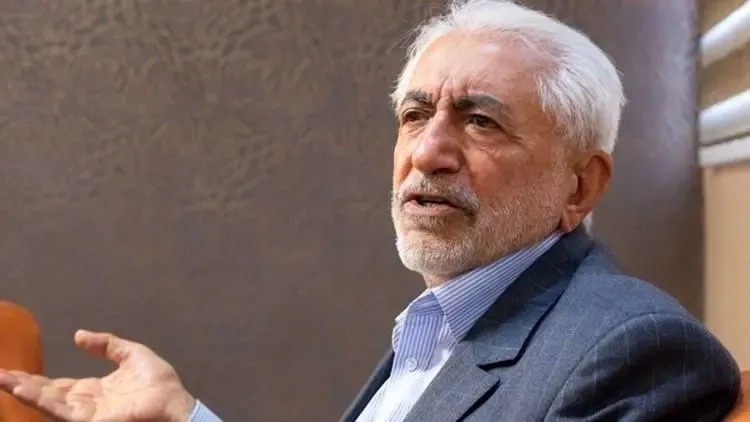
Who is Seyyed Mohammad Gharazi?
Seyyed Mohammad Gharazi is a politician, engineer, and one of the veteran and long-standing figures of the Islamic Republic of Iran. Born on 12 February 1942 in Isfahan, he is among the few senior officials whose career spans pre-revolution political struggles—including early membership in the Mojahedin-e Khalq Organization—participation in the founding of the Islamic Revolutionary Guard Corps, governorship roles, twelve years of ministerial service in two key sectors (Oil and Communications), and ultimately a controversial presidential candidacy.
In the collective memory of Iran, Gharazi is primarily known for two major aspects of his career:
First, as a “wartime minister,” who during the difficult 1980s held two crucial portfolios: the Ministry of Oil and later the Ministry of Post, Telegraph and Telephone.
Second, as the “phenomenon of the 2013 presidential election,” where his central slogan, “Anti-Inflation Government,” and his straightforward, unfiltered tone in televised debates made him one of the most memorable figures of that electoral season.
The importance of Gharazi in Iran’s political-administrative history can be examined from several perspectives. First, he is among the few officials with a continuous record from the early post-revolution years—ranging from the founding period of the Islamic Revolutionary Guard Corps and governorship roles during a highly unstable era—to ministerial positions in the governments of Mir-Hossein Mousavi and Akbar Hashemi Rafsanjani. Second, his twelve-year tenure (1985–1997) as Minister of Post, Telegraph and Telephone coincided with a major expansion of Iran’s telecommunications infrastructure, which laid the groundwork for the country’s modern communication network. Third, his 2013 presidential campaign, focused almost entirely on controlling inflation, is considered a rare example of a single-issue economic campaign in Iran’s electoral history.
In recent years, although he has largely stepped away from formal government positions, Gharazi remains active in media discourse as an independent and critical figure, with his views—especially on inflation, macroeconomics, and monetary policy—continuing to receive attention.
Life and Background
Seyyed Mohammad Gharazi was born on 12 February 1942 in Isfahan. He grew up in this city and completed his primary and secondary education there. Isfahan in the 1940s and 1950s was one of Iran’s major cultural, industrial, and religious centers, and this environment played a role in shaping his early political and intellectual orientation.
After finishing high school, he entered the Faculty of Engineering at the University of Tehran in 1961, where he studied electrical and electronics engineering. He later earned a master’s degree in electrical engineering from the University of Tehran. In 1967–1968, he traveled to France for specialized training in electricity transmission and distribution. This technical background later became an important foundation for his ministerial responsibilities in oil and communications.
Political Activities Before the Revolution
Gharazi entered political activity in the mid-1960s. During this period, he joined the Mojahedin-e Khalq Organization (MEK), which at that time was an armed opposition group against the Pahlavi monarchy. His involvement led to his arrest by SAVAK (the Shah’s intelligence agency).
It is important to note that his membership in MEK dates back to before the organization’s ideological shift in 1975, when part of the group moved toward Marxism. Many early members with religious backgrounds later distanced themselves from the organization and went on to become figures in the Islamic Republic; Gharazi was among them.
Presence in Paris and Connection to Khomeini
In the final period leading up to the 1979 Revolution, Gharazi joined the circle of supporters around Ayatollah Ruhollah Khomeini in Neauphle-le-Château, near Paris. This proximity to Khomeini during the decisive months of the revolution helped consolidate his position in the post-revolution political structure. Many individuals present in this circle later occupied key positions in the new government.
Role in Post-Revolution Institution Building
Founding the Islamic Revolutionary Guard Corps (IRGC)
One of the most significant aspects of Gharazi’s career is his involvement in the founding of the Islamic Revolutionary Guard Corps (IRGC) in the early months after the revolution. Established in May 1979 by decree of Ayatollah Khomeini, the IRGC was created to protect the revolution’s achievements. Gharazi was among its founding figures and is reported to have been part of its initial four-member leadership group.
Although this role placed him among the first generation of IRGC founders, he later shifted his focus toward administrative and ministerial responsibilities.
Provincial Governorships
After the revolution, Gharazi held key provincial governorships in two of Iran’s most sensitive regions.
He served as governor of Kurdistan Province during a period of armed unrest and instability (1979–1980).
He then became governor of Khuzestan Province (1979–1981), which became the frontline of the Iran–Iraq War after its outbreak in 1980.
His governorship in Khuzestan—home to Iran’s main oil infrastructure—provided him with direct experience in the oil sector, which later led to his appointment as Minister of Oil.
Ministerial Career
Minister of Oil (1981–1985)
Gharazi was appointed Minister of Oil in the governments of Mohammad-Ali Rajai and later Mir-Hossein Mousavi. His tenure coincided with one of the most difficult periods for Iran’s oil industry: the Iran–Iraq War, repeated attacks on oil facilities in Khuzestan and the Persian Gulf, and international sanctions.
He was responsible for maintaining production and exports under wartime conditions, rebuilding damaged infrastructure, and managing Iran’s position within OPEC. His negotiations with Saudi Oil Minister Sheikh Ahmed Zaki Yamani regarding production quotas are among the notable episodes of this period.
Minister of Post, Telegraph and Telephone (1985–1997)
In 1985, Gharazi was appointed Minister of Post, Telegraph and Telephone, a position he held for 12 years across the administrations of Mir-Hossein Mousavi and Akbar Hashemi Rafsanjani.
This period coincided with major expansion of Iran’s telecommunications infrastructure. The development of fixed-line telephone networks, expansion of communication centers, and early modernization of national communication systems formed the core achievements of this ministry during his tenure. Although this era preceded mobile phones and the internet boom, it laid the essential foundation for Iran’s later digital infrastructure.
Parliamentary Role
Gharazi also served as a member of the Islamic Consultative Assembly (Iranian Parliament). In some accounts, he held this position before being appointed Minister of Oil, emphasizing the importance he placed on public legitimacy for executive roles.
Post-Ministerial Activities
After leaving ministerial office in 1997, Gharazi withdrew from high-level government positions and moved into technical and engineering management roles. He later became chairman of the board of “Mashanir” Consulting Engineers, a company involved in energy and infrastructure projects, aligning with his engineering background.
During this period, he largely stepped away from the political spotlight and became associated in public perception mainly with the early revolutionary and wartime decades.
Presidential Elections
2013 Presidential Election – “The Phenomenon”
Gharazi’s major political comeback occurred in the 2013 presidential election. He registered on 8 May 2013, and his candidacy was approved by the Guardian Council. He was one of eight approved candidates, alongside figures such as Hassan Rouhani, Saeed Jalili, Mohammad Bagher Ghalibaf, Ali Akbar Velayati, Mohsen Rezaei, Mohammad Reza Aref, and others.
His main campaign slogan was “Anti-Inflation Government.” He emphasized:
Stopping unbacked money printing
Financial discipline in government
Preventing government spending beyond its income
He also opposed excessive government involvement in culture, sports, and the arts.
His blunt, humorous, and straightforward style in televised debates attracted significant public attention, making him one of the most memorable figures of that election—often referred to as a “phenomenon of the 2013 election.” He ultimately finished last among the remaining candidates, receiving around 500,000 votes. The election was won by Hassan Rouhani in the first round.
2017 Election Attempt
In the 2017 presidential election, Gharazi registered again as a candidate, but this time his candidacy was not approved by the Guardian Council.
Views and Positions
Inflation control: His central economic belief is that inflation is Iran’s most critical economic problem. He argues that decades of inflation have damaged multiple generations and that stopping inflation should be the government’s top priority.
Opposition to state intervention in culture: He supports minimal government involvement in cultural, artistic, and sports affairs.
Political perspective: He has occasionally compared governance before and after the 1979 Revolution, emphasizing accountability and public responsiveness of officials.
Relations with Figures and Political Currents
Before the revolution, he was briefly associated with the MEK and later joined Khomeini’s circle in Paris. After the revolution, he became one of the founding figures of the IRGC.
During his ministerial years, he served under multiple governments, including those of Mousavi and Rafsanjani, working alongside key political and military figures of the time.
In the 2013 election, he ran as an independent candidate, without formal alignment with any major political faction.
Conclusion
Seyyed Mohammad Gharazi is a distinctive figure of Iran’s first generation of post-revolution administrators, with a career spanning revolutionary activism, military institution-building, provincial governance, long-term ministerial leadership, and late-life electoral politics.
His defining characteristic is the combination of revolutionary experience and technical engineering expertise. Over time, he transitioned from an insider of revolutionary governance to a more independent and outspoken public commentator.
Historically, his name is closely tied to several key chapters of the Islamic Republic—from the founding of the IRGC and wartime oil management to the development of Iran’s telecommunications infrastructure and his notable participation in presidential politics. His persistent focus on inflation and monetary policy continues to keep his views relevant in Iranian economic debates today.
Take less than a minute, register and share your opinion under this post.
Insulting or inciting messages will be deleted.
Sign Up