
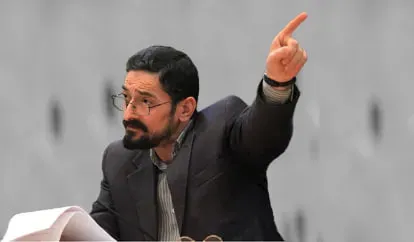
Saeed Zibakalam Mofrad is a philosopher, retired professor of the Department of Philosophy at the University of Tehran, and a researcher in philosophy and the methodology of science. He is one of the prominent figures associated with a critical intellectual current toward modernity and is relatively close to the discourse of the Islamic Revolution. Born in 1953 in Tehran, he is considered one of the most influential professors of philosophy of science and political philosophy in contemporary Iran.
Who is Saeed Zibakalam?
Saeed Zibakalam Mofrad is a philosopher, retired professor of the Department of Philosophy at the University of Tehran, and a researcher in philosophy and the methodology of science. He is one of the prominent figures associated with a critical intellectual current toward modernity and is relatively close to the discourse of the Islamic Revolution. Born in 1953 in Tehran, he is considered one of the most influential professors of philosophy of science and political philosophy in contemporary Iran.
The name Saeed Zibakalam is recognized in Iranian intellectual circles through several distinguishing features: his deep expertise in philosophy and methodology of science (especially social epistemology and the Edinburgh School), his role as a translator and introducer of key works in philosophy of science in Iran, and his unique intellectual position as one of the influential figures in what is known as the “Student Justice Movement.”
His importance in Iran’s intellectual landscape can be examined from several perspectives. First, he is one of Iran’s leading specialists in philosophy of science. His book Social Epistemology was selected as Iran’s Book of the Year in 2006—an influential work that introduces and analyzes sociological approaches to scientific knowledge, particularly the Edinburgh School. Second, Zibakalam translated Thomas Kuhn’s classic work The Structure of Scientific Revolutions, introducing one of the most important texts in 20th-century philosophy of science to Persian readers. Third, and perhaps most distinctively, his intellectual identity is often defined in contrast to his brother, Sadegh Zibakalam: a well-known liberal critic and reformist intellectual. The ideological divergence between the two brothers—one critical of the Islamic Republic from a liberal-reformist perspective and the other a critic of modernity closer to revolutionary and justice-oriented discourse—is considered one of the most notable examples of intellectual divergence within a single Iranian family.
Over several decades, Saeed Zibakalam has been active in three main academic fields: philosophy and methodology of the natural and social sciences, political philosophy, and postmodern philosophy. His unusual academic trajectory—beginning with engineering studies and a period of diplomatic work in the Ministry of Foreign Affairs before turning to philosophy—distinguishes his intellectual career.
Life and Background
Saeed Zibakalam Mofrad was born in 1953 in Tehran. He grew up in a family that later produced several prominent academic figures. His brother, Sadegh Zibakalam, is a well-known political science professor and reformist intellectual, while his sister, Fatemeh Zibakalam, is a professor of philosophy of education at the University of Tehran. The diversity and ideological differences among the siblings—especially the intellectual gap between Saeed and Sadegh—are often noted as a remarkable feature of the family.
His educational path is unusually diverse compared to most Iranian philosophers. He first studied Electrical and Electronic Engineering and completed this degree in 1977 in the United Kingdom. In the same year, he began a master’s program in Peace Studies (with a focus on sociology of revolution) at the University of Bradford in the UK—the same university where his brother Sadegh also studied. Following the 1979 Iranian Revolution, he returned to Iran in 1978–1979.
Revolutionary and Diplomatic Career
After returning to Iran on the eve of the 1979 Revolution, Saeed Zibakalam participated in revolutionary activities in Tehran. Following the establishment of the Islamic Republic, he entered Iran’s diplomatic service and worked in the Ministry of Foreign Affairs—a period that distinguishes him from many of his philosophical contemporaries.
During this diplomatic phase, he held several positions. According to published accounts, he served as Iran’s ambassador to the Philippines, head of the International Organizations Department at the Ministry of Foreign Affairs, and a member of Iran’s delegation to the International Atomic Energy Agency (IAEA). This practical experience in international diplomacy, during a sensitive period in the Islamic Republic’s foreign relations, is considered one of the less-known aspects of his career.
Turning toward philosophy
A turning point in Zibakalam’s intellectual life occurred in 1986, when—according to sources—he “left politics behind” and went to the United Kingdom to pursue a PhD in philosophy. He began his doctoral studies in philosophy in 1986 and graduated in 1990 from the University of Leeds.
This shift from diplomacy to philosophy marked the beginning of his academic specialization in philosophy of science and political philosophy. His doctoral and postdoctoral focus centered on philosophy and methodology of science, social epistemology, and the relationship between science and society—areas that remained the core of his research throughout his academic career.
Academic and university activity
After returning to Iran with a PhD in philosophy, Zibakalam began his academic career in several institutions. He first worked as a faculty member and assistant professor of philosophy at the Research Institute for Humanities and Cultural Studies and at Imam Sadiq University. From February 2002, he was appointed associate professor of philosophy in the Department of Philosophy at the University of Tehran—a position that became the center of his academic activity.
In addition to the University of Tehran, Zibakalam also served for a period as head of the philosophy of science department at the University of Technology (Amirkabir University of Technology). Throughout his teaching years, he worked in three main areas: philosophy and methodology of natural and social sciences, political philosophy, and postmodern philosophy. His teaching style and critical approach to the epistemological foundations of modern science had a significant impact on students of philosophy and the humanities.
Zibakalam is now a retired professor from the University of Tehran’s Department of Philosophy, but he continues his research, writing, and lecturing in his areas of expertise.
Thought and intellectual approach
The core of Saeed Zibakalam’s thought revolves around a critique of the epistemological foundations of modern science and a defense of what can be described as a “socio-historical approach to scientific knowledge.” Several key themes stand out in this framework.
Social epistemology and the Edinburgh School
One of Zibakalam’s main areas of expertise is social epistemology, particularly the Edinburgh School and the “Strong Programme” in the sociology of scientific knowledge. This approach, developed by figures such as David Bloor and Barry Barnes, argues that scientific knowledge—even in the natural sciences—is not merely a reflection of objective reality, but a socially constructed product shaped by social, historical, and cultural factors.
Through works such as his award-winning book Social Epistemology, Zibakalam helped introduce and analyze these ideas in Iran, playing an important role in transmitting contemporary philosophy and sociology of science into Iranian academic discourse.
Critique of positivism and scientism
A recurring theme in his work is the critique of positivism and the positivist image of science. He has argued that positivism—which presents science as objective, ahistorical, and value-free—is fundamentally flawed. This critique is linked to his rejection of the possibility of a universal, transhistorical consensus on rationality and scientific validity in the social sciences and political philosophy.
Critique of Western humanities and Islamic humanities discourse
Zibakalam has also been active in discussions on the relationship between modern Western humanities and the possibility of developing humanities rooted in Iranian-Islamic intellectual foundations. He has examined the social and epistemic conditions under which Western social sciences emerged, and raised the question of whether alternative forms of social science can be constructed.
This position places him close to the discourse of “knowledge production movement” and “soft revolution,” which were influential in Iranian academia for a period.
Critique of religious intellectualism
Zibakalam has taken critical positions toward religious intellectualism. In an article titled Religious Intellectualism and the Mirage of Free Thinking, he critiques the foundations and approach of this intellectual current, placing him at a distance from religious reformist thinkers such as Abdolkarim Soroush.
Role in the student justice movement
One of the distinctive aspects of Zibakalam’s intellectual and social role is his influence on the Student Justice Movement in Iran. This movement, which emerged in the early 2000s, emphasizes social justice, anti-corruption, anti-rent-seeking, and revolutionary values, positioning itself between reformist and traditional conservative currents.
In some sources, Zibakalam is described as the “intellectual father” of this movement. This reflects his influence on a generation of students through teaching, lectures, and writings. This role also places him in clear ideological contrast with his brother, political scientist and reformist figure Saeed Zibakalam’s brother, Sadegh Zibakalam.
Works and books
Zibakalam has authored and translated several books and dozens of academic articles. His major works include:
Social Epistemology (SAMT Publications, 2005), his most important book, which analyzes sociological approaches to scientific knowledge and the Edinburgh School. It was selected as Iran’s Book of the Year in 2006.
What is Science?, a foundational text in philosophy of science.
The Structure of Scientific Revolutions (translation), the Persian translation of Thomas Kuhn’s classic work introducing paradigms and scientific revolutions.
Against the Current (two volumes), a collection of his critical writings.
The Myth of Comforting Narratives and More Myths, later critical works.
Reason, Argument, and Rationality, a philosophical and epistemological study.
In addition to these, he has published numerous academic papers on topics ranging from Newtonian methodology, Popperian rationality, science and technology relations, Marxist methodology reconstruction, and the intersection of jurisprudence and social sciences.
Views and positions
Saeed Zibakalam, in contrast to his brother Sadegh, belongs to an intellectual current that is critical of Western modernity and relatively close to the revolutionary-Islamic discourse. His positions can be outlined in several main themes:
He is a strong critic of the positivist and scientistic conception of knowledge, emphasizing the social, historical, and value-laden nature of scientific knowledge.
He has warned against the uncritical and direct transfer of Western humanities into Iran, and advocates rethinking the foundational assumptions of these disciplines in an Iranian context.
He is critical of religious intellectualism and some of its underlying theoretical premises.
In the socio-political sphere, he is aligned with justice-oriented ideals, and his intellectual influence on the Student Justice Movement reflects this orientation.
Taken together, these positions have made Saeed Zibakalam a distinctive intellectual figure among philosophy professors in Iran—someone who is both academically respected in philosophy of science and also clearly positioned within broader intellectual and socio-political debates.
Intellectual contrast with Sadegh Zibakalam
One of the most interesting aspects of Saeed Zibakalam’s intellectual profile is his clear ideological contrast with his brother, Sadegh Zibakalam. The two brothers—both well-known Iranian academics who also studied part of their education in the United Kingdom (both at the University of Bradford)—stand on opposite sides of Iran’s intellectual and political spectrum.
Sadegh Zibakalam, a professor of political science, is positioned within the reformist and liberal camp. He is a vocal critic of the Islamic Republic’s policies—particularly in foreign affairs—and supports normalization of relations with the West. In contrast, Saeed Zibakalam, a philosopher, is critical of the epistemological foundations of Western modernity, is closer to revolutionary-Islamic discourse and justice-oriented ideals, and is often described as the “intellectual father” of the Student Justice Movement.
For many observers, this intra-family intellectual divergence is a striking example of the deep ideological and discursive divides within contemporary Iranian society—divides that can even emerge between individuals raised in the same family environment.
Connections with figures and intellectual currents
Over the years, Saeed Zibakalam’s name has been linked to a network of intellectual figures and movements. At the family level, his relationship—and intellectual contrast—with his brother Sadegh Zibakalam and his sister Fatemeh Zibakalam (a professor of philosophy of education) is one of the most notable features of his profile.
At the intellectual level, he is associated with critiques of Western modernity and with discourses such as the “knowledge production movement” and “Islamic humanities.” Socially, his influence on the Student Justice Movement and a generation of activists within that current is considered one of his most significant contributions.
In the field of philosophy of science, he is aligned with thinkers such as Thomas Kuhn and the Edinburgh School (including David Bloor and Barry Barnes), whose ideas he has helped introduce and analyze within Iranian academic discourse.
Conclusion
Saeed Zibakalam is a distinctive figure in contemporary Iranian philosophy of science and political thought. With a rare combination of an engineering background, diplomatic experience, and advanced philosophical training, he occupies an unusual intellectual position.
His academic career is marked primarily by deep engagement with social epistemology and philosophy of science, most notably through his award-winning book Social Epistemology and his translation of Thomas Kuhn’s The Structure of Scientific Revolutions. These works have established him as a significant reference point in these fields within Iran.
At the same time, his broader intellectual and social positioning—as a critic of Western modernity and an influential figure in justice-oriented student movements—places him within wider ideological debates in Iranian society.
From an analytical perspective, the contrast between Saeed and Sadegh Zibakalam offers a clear illustration of the pluralism and fragmentation of intellectual discourse in modern Iran. While Sadegh represents a liberal-reformist critique of the political system, Saeed represents a critique of Western modernity and a closer alignment with revolutionary and justice-oriented ideals. Emerging from the same family background, these two divergent trajectories highlight the complexity of Iran’s intellectual landscape.
What remains clear today is that Saeed Zibakalam’s contributions—particularly in introducing social epistemology and critiquing positivist conceptions of science—have become a lasting part of Iran’s academic discourse in philosophy of science. His questions about the social nature of scientific knowledge, the cultural grounding of the humanities, and the possibility of alternative epistemic frameworks continue to be actively discussed in Iranian intellectual and academic circles.
Frequently Asked Questions
Who is Saeed Zibakalam and what is his expertise?
Saeed Zibakalam (born 1953 in Tehran) is a retired professor of philosophy at the University of Tehran. His main fields of expertise include philosophy of science, social epistemology, political philosophy, and postmodern philosophy. His book Social Epistemology was selected as Iran’s Book of the Year in 2006.
What is his educational background?
He initially studied electrical engineering in the UK, completed it in 1977, then began an MA in Peace Studies at the University of Bradford. He later received his PhD in philosophy from the University of Leeds in 1990.
Did he have a political or diplomatic career?
Yes. Before fully entering academia, he worked in Iran’s Ministry of Foreign Affairs, including diplomatic and international roles. He later left politics in the mid-1980s to pursue a PhD in philosophy in the UK.
What are his most important works?
His key works include Social Epistemology, What is Science?, his translation of Kuhn’s The Structure of Scientific Revolutions, Against the Current (two volumes), and Reason, Argument, and Rationality.
What is his relationship with Sadegh Zibakalam?
He is the brother of Sadegh Zibakalam, a political science professor known for his reformist and liberal views. The two represent sharply contrasting intellectual and political perspectives.
Why is he associated with the Student Justice Movement?
He has been described as an intellectual influence on this movement due to his teachings and writings on justice-oriented thought, anti-corruption discourse, and critiques of Western modernity.
What are his main philosophical views?
He criticizes positivism and scientism, emphasizes the social and historical nature of knowledge, questions the uncritical adoption of Western humanities, and critiques religious intellectualism.
Is he still active today?
He is a retired professor but remains active in research, writing, and public lectures in philosophy of science and related fields.

Take less than a minute, register and share your opinion under this post.
Insulting or inciting messages will be deleted.
Sign Up