
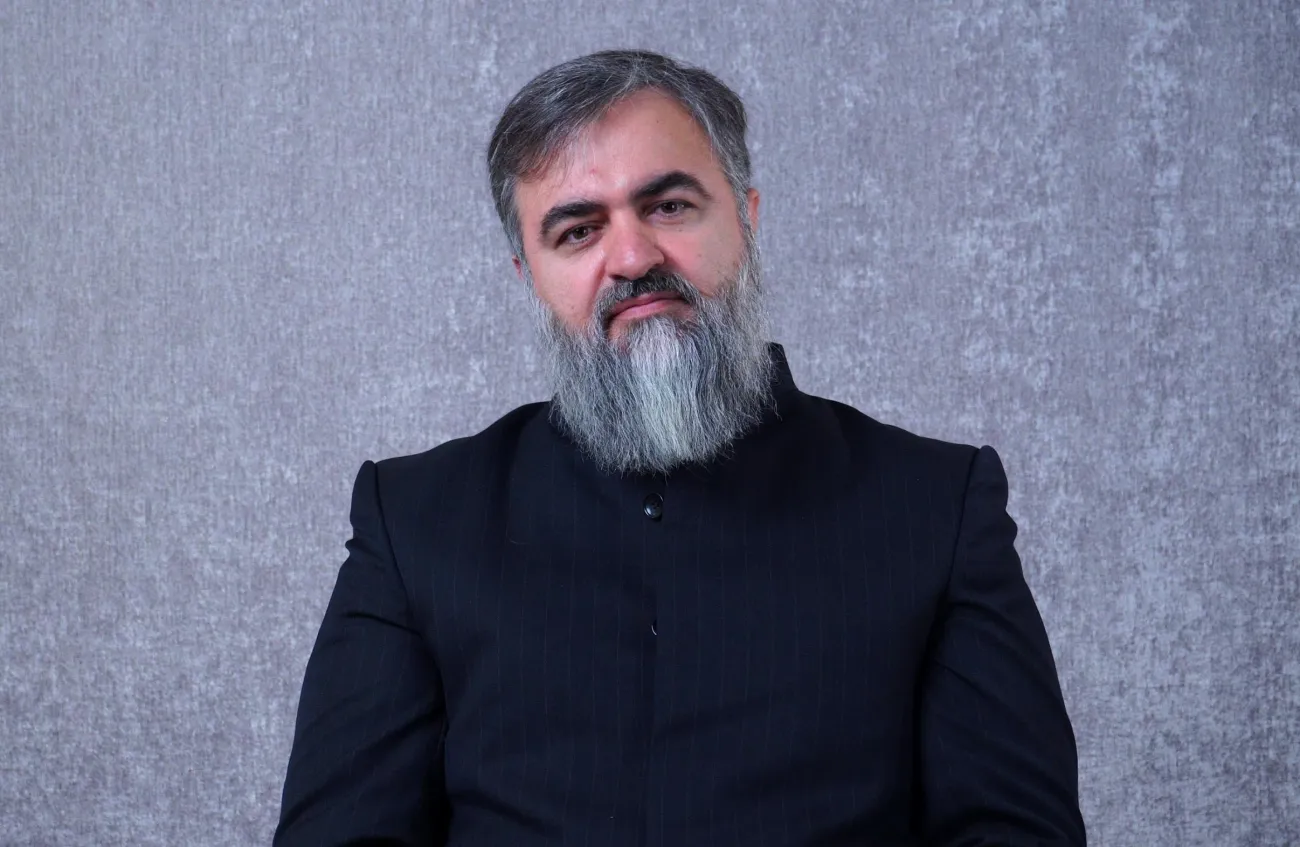
Mohammad Taqhi Akbarnejad—a Mujtahid, professor at the Qom Seminary, and director of the "Feqahat and Islamic Civilization Institute"—is a prominent figure within the critical religious reformist movement in contemporary Iran. Relying on the method of Ijtihad and traditional jurisprudence (Fiqh), he has engaged in a structural critique of the doctrine of the Absolute Guardianship of the Islamic Jurist (Velayat-e Faqih) and the macro-policies of the Islamic Republic. Following his explicit positions, Akbarnejad was sentenced to discretionary imprisonment (Habs-e Ta'ziri) and defrocked (clerical defrocking) in August 2025, and was transferred to Qom Prison in September of the same year. In this article, Abdi Media, in addition to a detailed examination of his career, views, and judicial case, presents the first exclusive video interview with Mohammad Taqhi Akbarnejad after removing his turban.
Who is Mohammad Taqhi Akbarnejad?
Professor Mohammad Taqhi Akbarnejad—a Mujtahid, Shia cleric, Qom Seminary professor, political activist, and one of the most prominent figures of the new generation of clergy critical of the Islamic Republic of Iran, born on December 31, 1979, in Tabriz—has in recent years become one of the most widely discussed critical clerics who, relying on jurisprudential and interpretive (Ijtihadi) knowledge, have engaged in a structural critique of the intellectual and legal foundations of the Islamic Republic system. With a unique combination of jurisprudential-interpretive expertise, courage in publicly raising criticisms, and management of the "Feqahat and Islamic Civilization Institute"—which operates with the goal of reforming the seminary—Akbarnejad has become a distinct voice in the discourse of critical religious reformism in Iran.
The significance of Mohammad Taqhi Akbarnejad in Iran's intellectual and political sphere can be examined from several perspectives. First, he is one of the few clerics who, in a series of systematic interpretive and jurisprudential sessions, critiqued and rejected the proofs for the Absolute Guardianship of the Islamic Jurist (Velayat-e Faqih)—the most critical legal-jurisprudential foundation of the Islamic Republic system. This work, conducted from within the jurisprudential tradition and utilizing the tools of Ijtihad, distinguishes it from purely political or secular criticisms and lends it a specific weight. Second, his explicit and public critique of Ayatollah Khamenei (the Leader of the Islamic Republic) and the regime's confrontational policies—delivered while wearing clerical attire and from the platform of the Qom Seminary—stands as one of the boldest stances taken by an active cleric inside Iran in recent years. Third, his judicial fate—wherein he was arrested by Islamic Revolutionary Guard Corps (IRGC) intelligence officers in Qom on February 17, 2024, sentenced to a total of 23 months of discretionary imprisonment and a three-year defrocking in August 2025, and ultimately transferred to Qom Prison on September 2, 2025—has made him a symbol of the regime's judicial crackdown on critical clergy in the contemporary era.
The central slogan of Akbarnejad's intellectual movement is "Seminary Reform"; a project in which he has attempted to separate the seminary from its structural ties to political power and return it to its primary mission—the spiritual and intellectual guidance of society. This project, while facing resistance within the official clerical establishment, has gained significant support among the younger generation of clerics and intellectual-religious activists.
Life and Background
Mohammad Taqhi Akbarnejad was born on December 31, 1979, in the city of Tabriz, the capital of East Azerbaijan Province. Tabriz, with its rich cultural, religious, and political history as one of Iran's most important intellectual-religious hubs, has been the birthplace of generations of scholars, clerics, and religious activists both before and after the 1979 Revolution.
Akbarnejad's childhood and adolescence coincided with the decades of the 1980s and 1990s—the period of the consolidation of the Islamic Republic, the tense environment of the Iran-Iraq War, and the subsequent reconstruction era. Being raised in the religious environment of Tabriz and among a generation nurtured on revolutionary and religious literature provided a foundation that allowed Akbarnejad, in later years, to utilize this very religious tradition to critique the structures and institutions born out of the revolution.
Education and Seminary Activity
Akbarnejad pursued his seminary education within the traditional Shia clerical path and, after passing through various educational stages, attained the rank of Ijtihad—a position in Shia jurisprudence designated for clerics who possess the capability to deduce religious rulings from the primary sources of jurisprudence (the Quran, Sunnah, consensus, and intellect).
The primary location for Akbarnejad's studies and seminary activities is the Qom Seminary, the most critical center of Shia clergy in Iran. At various periods, he joined the ranks of professors at the Qom Seminary, teaching seminary courses, particularly in the fields of jurisprudence (Fiqh) and its principles (Usul). This academic-seminary status granted him a scientific-jurisprudential credibility that became his primary asset in later years for critiquing the jurisprudential foundations of the Islamic Republic system.
The Feqahat and Islamic Civilization Institute
One of Akbarnejad's most important institutional achievements was the founding and management of the "Feqahat and Islamic Civilization Institute." Operating within the Qom Seminary, this institute was established with the aim of reviewing traditional jurisprudential methods, developing a jurisprudential discourse tailored to the needs of contemporary society, and pursuing the "Seminary Reform" project.
The Feqahat Institute was considered a prominent intellectual center in the field of religious-seminary reformism, where Akbarnejad and his colleagues pursued critical discussions regarding concepts such as the Guardianship of the Jurist, the relationship between religion and government, and the future of the clergy in contemporary Iran.
The "Seminary Reform" Project
A defining aspect of Akbarnejad's intellectual-social activity is the "Seminary Reform" project. In his and his colleagues' view, the Shia seminary in Iran, by becoming structurally intertwined with the political power structure following the Islamic Revolution, has distanced itself from its primary mission—the spiritual, intellectual, and scientific guidance of society. In one of his prominent stances, Akbarnejad stated: "We turned seminary reform into a public discourse," a statement that reflects his efforts to expand this debate beyond the restricted seminary environment into the public sphere.
This project focused on several key pillars: the independence of the seminary from political power, the revision of jurisprudential-interpretive methods, the critique of the political-jurisprudential foundations of the Islamic Republic system (particularly the Absolute Guardianship of the Jurist), and returning the clergy to its role of spiritual and intellectual guidance.
Jurisprudential Critique of the Absolute Guardianship of the Jurist
One of Akbarnejad's most critical intellectual interventions was his series of interpretive sessions conducting a jurisprudential review of the theory of the Absolute Guardianship of the Jurist. In these sessions, held utilizing the conventional interpretive-jurisprudential methods of Shia seminaries, Akbarnejad examined the textual (narrative) and rational proofs for this theory, ultimately rejecting these proofs and declaring the theory of the Absolute Guardianship of the Jurist invalid from a jurisprudential standpoint.
This work holds particular significance for several reasons: First, the Absolute Guardianship of the Jurist—formulated in Articles 5 and 107 of the Constitution of the Islamic Republic—is the fundamental legal-jurisprudential basis of the system; a jurisprudential critique of this foundation directly challenges the core of the regime's legitimacy. Second, this critique came from a Mujtahid and Qom Seminary professor rather than an external secular intellectual, which lends it a distinct weight and nature. Third, Akbarnejad's interpretive-jurisprudential method engages the critique on the very same conceptual ground where the pro-Velayat-e Faqih theorists (including Ayatollah Khomeini and his commentators) formulated it—namely, Shia jurisprudence.
Arrest and Conviction
The years 2024 to 2025 brought escalating judicial tensions and ultimately a heavy conviction for Akbarnejad.
First Arrest (February 17, 2024)
Akbarnejad's first arrest occurred on February 17, 2024, when intelligence officers of the Islamic Revolutionary Guard Corps in Qom detained him on charges of criticizing the Islamic Republic of Iran system and insulting the Leader of the Islamic Republic (Ayatollah Khamenei). This arrest, executed by the IRGC intelligence apparatus rather than the Ministry of Intelligence, indicated the security establishment's heightened sensitivity toward Akbarnejad's activities.
Akbarnejad was held in custody for approximately three weeks during this period before being released on bail. This release, however, did not mark the end of his judicial difficulties; following his release, Akbarnejad continued his jurisprudential and political activities while the Special Clerical Court held hearings to address his charges.
Definitive Ruling (August 2025)
Conclusively, in August 2025, the definitive conviction ruling against Akbarnejad was issued by the Special Clerical Court. This ruling, covered across various media outlets—including Etemad Online, Eghtesad Online, Aftab News, and EcoIran—comprised three separate charges and punishments:
On the charge of "weakening the system": 8 months and 1 day of discretionary imprisonment.
On the charge of "insulting the leaders of the Islamic Revolution": 15 months and 5 days of discretionary imprisonment.
On the charge of "defaming the clerical establishment": 3 years of defrocking (deprivation of the right to wear clerical attire).
Total Sentence: More than 23 months of discretionary imprisonment in addition to a 3-year defrocking.
The charge of "defaming the clerical establishment"—which led to the 3-year defrocking—was based on the premise that Akbarnejad, while wearing clerical attire, had explicitly and decisively critiqued the strategies of the Islamic Republic system and its leaders. In the court's view, this behavior tarnished the "dignity of the clergy"; an interpretation that Akbarnejad and his supporters view in reverse—believing that what truly tarnishes the dignity of the clergy is their silence in the face of the regime's wrongheaded policies, not their critique of them.
Akbarnejad's Reaction to the Sentence
Akbarnejad adopted several prominent stances in response to this ruling. In a brief note following the issuance of the verdict, he stated: "I thank Almighty God for the privilege of defending the oppressed people of Iran." This position reflects his view of his criticisms and activities as a "defense of the people"—a narrative standing in stark contrast to the court's depiction of these activities as "weakening the system" and "defaming the clergy."
In another discussion with BBC Persian, Akbarnejad stated: "I accept the defrocking sentence with pride." This stance demonstrates his resistance to judicial pressures and his commitment to his intellectual positions.
Transfer to Qom Prison (September 2, 2025)
Following the finalization of the verdict, Akbarnejad was transferred to Qom Prison on September 2, 2025, to begin serving his sentence. This transfer, reported by various media platforms including Abdi Media, was one of the most widely covered events concerning critical clerics in Iran during that period, provoking extensive reactions across Persian-language media both inside and outside the country.
Views and Positions
Throughout his intellectual-social career, Mohammad Taqhi Akbarnejad has formulated a clear and explicit framework of thought. In a detailed and exclusive video interview with Abdi Media titled "The First Interview with Mohammad Taqhi Akbarnejad After Removing the Turban / From the Details of the Verdict to Plain Speaking with the Regime," he appeared on camera for the first time following the Special Clerical Court's ruling.
Structural Critique of the Islamic Republic System
The central pillar of Akbarnejad's outlook is a structural critique of the Islamic Republic system and its leader. This critique, delivered with reliance on jurisprudential-interpretive knowledge, takes various dimensions—ranging from the legal foundations of the system (Absolute Guardianship of the Jurist) to its confrontational domestic and foreign policies, and the role of the clerical establishment in backing these policies.
Critique of the Islamic Republic's Confrontational Policies
In numerous notes and speeches, Akbarnejad has critiqued the confrontational policies of the Islamic Republic at both the domestic and regional levels. In his view, these policies have not only damaged Iran's national interests but also stand in contradiction with the jurisprudential and ethical principles of Islam.
Defense of the Oppressed People
A consistent theme in Akbarnejad's discourse is the defense of the oppressed people. In his view, the authentic clergy must stand alongside the people and against oppression—a stance aligned with the Alid and Ashura traditions of Shia Islam, which was also reflected in his note following his conviction.
The Project of Seminary Independence from Power
Akbarnejad is among the primary advocates for the independence of the seminary from political power. In his view, the intertwining of the seminary with the power structure of the Islamic Republic over the past decades has severely damaged the clergy's primary mission—the spiritual guidance of society. The "Seminary Reform" project was shaped precisely in line with this position.
Jurisprudential Critique of the Absolute Guardianship of the Jurist
As noted, one of Akbarnejad's most significant theoretical interventions is his interpretive-jurisprudential critique of the theory of the Absolute Guardianship of the Jurist. In his view, the arguments presented for this theory—whether textual (from traditions) or rational—are insufficient to prove an absolute religious government, and these foundations must be re-evaluated.
Relationship with Figures and Movements
Within the intellectual-political spectrum, Mohammad Taqhi Akbarnejad is situated among the clerics critical of the Islamic Republic—a movement that has seen active figures such as the late Ayatollah Montazeri (the Grand Ayatollah and former Deputy Leader who pioneered the critique of Velayat-e Faqih), Hasan Yousefi Eshkevari, Mohsen Kadivar (both critical clerics residing abroad), and in the newer generation, Shahabeddin Haeri Shirazi (a critical cleric and son of the former Friday Prayer Leader of Shiraz, who was sentenced to three years in prison in November 2023).
At the intellectual-seminary level, Akbarnejad aligns with the Shia jurisprudential tradition in which the relative independence of the seminary from power and the independent authority of scholars serve as foundational values; a tradition that has been in tension with the discourse of "religious government" in the form of Velayat-e Faqih over the past decades.
In the media landscape, events related to Akbarnejad have seen extensive coverage across Persian-language media inside and outside the country—including BBC Persian, Iran International, Abdi Media, the Human Rights Activists News Agency (HRANA), and domestic reformist outlets such as Etemad Online.
Conclusion
Professor Mohammad Taqhi Akbarnejad is one of the most distinct and consequence-bearing figures of the new generation of critical clergy in contemporary Iran. He occupies a unique position through a combination of jurisprudential-interpretive expertise, courage in publicly articulating criticisms, and dedication to the intellectual project of "Seminary Reform." His path—ranging from the establishment and management of the Feqahat and Islamic Civilization Institute to his systematic sessions critiquing the jurisprudence of the Absolute Guardianship of the Jurist, his arrest in February 2024, his definitive conviction to 23 months in prison and a 3-year defrocking in August 2025, and his transfer to Qom Prison in September 2025—presents the image of a "structural cleric-critic" who has delivered a fundamental critique of religious government from within the Shia jurisprudential tradition.
The distinguishing feature of Akbarnejad, at the first level, is his method of critique; a critique carried out with reliance on the conventional interpretive-jurisprudential methodology of Shia seminaries, challenging the theory of the Guardianship of the Jurist on the very ground where the theory itself was formulated. This approach lends his critique a specific scientific-jurisprudential weight that sets it apart from purely political or secular criticisms. At the second level, his courage in accepting the costs of criticism—as reflected in his post-verdict note stating, "I accept the defrocking sentence with pride"—has turned him into a symbol of intellectual resistance against judicial pressures.
From an analytical standpoint, Akbarnejad's position serves as an example of the important phenomenon of "religious critique of a religious system" in contemporary Iran; a phenomenon wherein interpretive clerics, relying on jurisprudential knowledge, engage in a structural critique of a system that itself claims religious legitimacy. This internal discourse critique, while facing severe judicial restrictions, stands as one of the most effective critical voices in the Iranian space, as it utilizes the legitimacy of the very sources upon which the system relies.
What remains clear from today's perspective is that Akbarnejad's case—as he currently serves his sentence in Qom Prison—is part of a broader trend of crackdowns on critical clergy in contemporary Iran. At a time when a new generation of clerics and jurists are critiquing existing structures from within the religious tradition, Akbarnejad's voice, characterized by its jurisprudential-interpretive quality and public boldness, will remain a critical component of religious critical discourse in contemporary Iran. The "Seminary Reform" project, whose slogan he elevated into a public discourse, could well remain a lasting part of future debates regarding the relationship between religion and government in Iran, far beyond his personal judicial fate.
Frequently Asked Questions (FAQs)
Who is Mohammad Taqhi Akbarnejad? Professor Mohammad Taqhi Akbarnejad (born on December 31, 1979, in Tabriz) is a Mujtahid, Shia cleric, Qom Seminary professor, and Iranian political activist. He is the director of the "Feqahat and Islamic Civilization Institute" and one of the most prominent figures of the new generation of clergy critical of the Islamic Republic, having used jurisprudential-interpretive knowledge to deliver a structural critique of the system.
Why was Mohammad Taqhi Akbarnejad arrested? Akbarnejad was arrested on February 17, 2024, by IRGC intelligence officers in Qom on charges of criticizing the Islamic Republic system and insulting the Leader of the Islamic Republic (Ayatollah Khamenei). He was released on bail after approximately three weeks, but hearings at the Special Clerical Court continued to process his charges.
What was the final verdict for Mohammad Taqhi Akbarnejad? In August 2025, the Special Clerical Court sentenced Akbarnejad to a total of over 23 months of discretionary imprisonment and a 3-year defrocking. This sentence included: 8 months and 1 day of imprisonment on the charge of "weakening the system," 15 months and 5 days of imprisonment on the charge of "insulting the leaders of the Islamic Revolution," and a 3-year defrocking on the charge of "defaming the clerical establishment."
When was Mohammad Taqhi Akbarnejad transferred to prison? Following the finalization of his sentence, Akbarnejad was transferred to Qom Prison on September 2, 2025, to serve his term. This transfer stood out as one of the most widely reported events involving critical clerics in Iran during that period.
What is Akbarnejad's "Seminary Reform" project? The "Seminary Reform" project is an effort to review the structure, methods, and missions of the Shia religious seminary. In Akbarnejad's view, the seminary, by intertwining with the political power structure after the revolution, has distanced itself from its primary mission—the spiritual, intellectual, and scientific guidance of society. The pillars of this project include seminary independence from power, a revision of jurisprudential methods, and a critique of the political-jurisprudential foundations of the Islamic Republic.
What is Akbarnejad's critique of the Guardianship of the Jurist (Velayat-e Faqih)? In a series of systematic interpretive-jurisprudential sessions, Akbarnejad analyzed the textual and rational proofs for the theory of the Absolute Guardianship of the Jurist, critiquing and rejecting them from a jurisprudential standpoint. The distinguishing feature of this critique is its interpretive-jurisprudential method, which challenges the theory on the exact theoretical ground where Velayat-e Faqih was formulated.
What was Akbarnejad's reaction to his conviction sentence? In a note following the issuance of the verdict, Akbarnejad stated: "I thank Almighty God for the privilege of defending the oppressed people of Iran." Additionally, in a discussion with BBC Persian, he stated: "I accept the defrocking sentence with pride." These responses demonstrate his resistance to judicial pressures and adherence to his intellectual positions.
Why does Akbarnejad's case hold special significance? Akbarnejad's case is particularly significant for several reasons: First, he is a Mujtahid and a seminary professor who critiques from within the Shia jurisprudential tradition; second, his critique targets the foundational jurisprudential tenets of the system (Absolute Velayat-e Faqih), which form the bedrock of the Islamic Republic's legitimacy; third, the heavy sentence handed down (over 23 months in prison and a 3-year defrocking) and his transfer to prison serve as an example of the judicial approach toward critical clerics in contemporary Iran.
Take less than a minute, register and share your opinion under this post.
Insulting or inciting messages will be deleted.
Sign Up