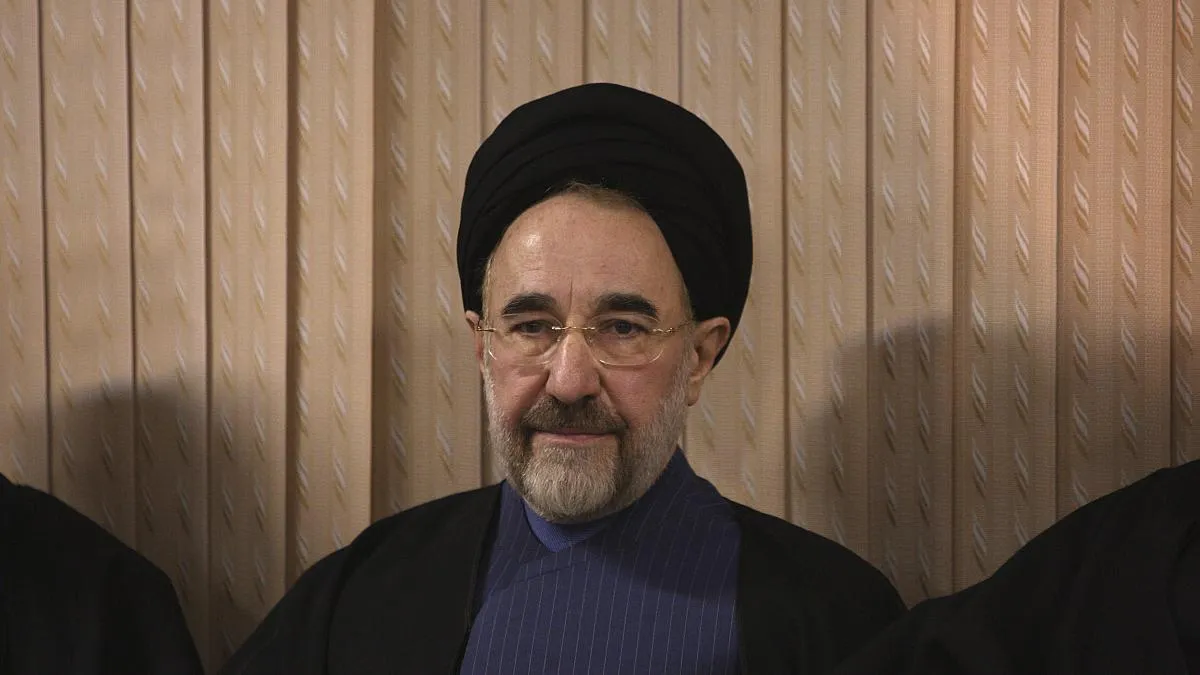
Hojjat al-Islam wal-Muslimin Seyyed Mohammad Khatami, a Shiite cleric, prominent reformist politician, the fifth President of the Islamic Republic of Iran (1997-2005), former Minister of Culture and Islamic Guidance (1982-1992), founder of the Baran Foundation, head of the Combatant Clergy Association, and the spiritual father of the reform movement, ranks among the most widely-reported, most controversial, and most prominent political-clerical figures of post-revolutionary Iran. With a combined seminary-academic educational background (ijtihad in Qom, a bachelor's degree in Western philosophy, and a master's degree in educational sciences) and a family background as the son of Ayatollah Seyyed Ruhollah Khatami, he won the election of May 23, 1997, with 20 million votes (69%), and introduced the discourses of "reform," "civil society," and the "Dialogue of Civilizations" both in Iran and globally. Khatami, who faced restrictions including a media ban and a travel ban after supporting Mir-Hossein Mousavi in 2009, played a decisive role in 2024 by supporting Masoud Pezeshkian, contributing to the victory of the first reformist president since his own presidency. During the 12-day war of June 2025, he adopted a national stance by issuing a message of support for the combatants.
Hojjat al-Islam wal-Muslimin Seyyed Mohammad Khatami (born October 14, 1943 / Mehr 21, 1322 in Ardakan, Yazd Province) is an Iranian Shiite cleric, a prominent reformist politician, the fifth President of the Islamic Republic of Iran from August 3, 1997, to August 3, 2005, for two consecutive terms, former Minister of Culture and Islamic Guidance in the two administrations of Mir-Hossein Mousavi and the first administration of Akbar Hashemi Rafsanjani from 1982 to 1992, a representative of the first term of the Islamic Consultative Assembly from Ardakan and Meybod (1980-1982), former head of the Kayhan Institute (1980-1982), former head of the War Propaganda Headquarters, former advisor to the president and head of the National Library of Iran (1992-1997), founder and president of the Baran Foundation (Foundation for Freedom, Growth and Development of Iran) from 2005 to the present, head of the Council of the Combatant Clergy Association from 2005 to the present, former head of the International Center for the Dialogue of Civilizations, current leader of the Reformist Front of the Islamic Republic of Iran, the spiritual father of the reform movement in Iran, the principal architect of the widely-reported discourse of the "Dialogue of Civilizations," which was adopted by the United Nations and led to the declaration of 2001 as the Year of the Dialogue of Civilizations, and at the same time one of the most widely-reported, most controversial, and most prominent political-clerical figures of post-revolutionary Iran, ranking among the most prominent political-intellectual figures in contemporary Iranian history.
Seyyed Mohammad Khatami, with a unique trajectory — from a prominent family-religious background as the third child of Ayatollah Seyyed Ruhollah Khatami (founder of the Ardakan Seminary and prominent Friday prayer leader of Yazd in the early post-revolutionary years) and Sakineh Ziaei, to pursuing a combined seminary and academic educational path — which included studying at the Qom Seminary, earning a bachelor's degree in Western philosophy from the University of Isfahan, and a master's degree in educational sciences from the University of Tehran, to his widely-reported membership in the Islamic Association of Isfahan University Students from 1962, to his representation in the first term of the Islamic Consultative Assembly from Ardakan and Meybod (1980-1982), to his appointment as head of the Kayhan Institute by Ayatollah Khomeini in November 1980, to assuming the Ministry of Culture and Islamic Guidance during the Iran-Iraq war and the Mousavi administration from 1982, to continuing his ministry in the first Hashemi Rafsanjani administration until 1992, to his widely-reported resignation from the ministry in 1992 due to pressure from the right-wing faction in the cultural sphere, to his appointment as advisor to the president and head of the National Library (1992-1997), to his widely-reported victory in the election of May 23, 1997 — which was conducted with the prominent slogan of "reform" and securing approximately 20 million votes (69%) against Ali-Akbar Nategh-Nouri (the principlist candidate and then-Speaker of Parliament) — to assuming the fifth presidency of Iran from August 3, 1997, to August 3, 2005, to his widely-reported proposal of the "Dialogue of Civilizations" discourse at the United Nations General Assembly, which led to the declaration of 2001 as the Year of the Dialogue of Civilizations, to confronting the prominent challenges of the reform era — including the chain murders of autumn 1998, the attack on the University of Tehran dormitory on July 9, 1999, the wholesale suspension of reformist newspapers in May 2000, the arrests following the Berlin Conference in April 2000, and sustained pressure from the Guardian Council and the principlist 7th Parliament — to founding the Baran Foundation in 2005 after the end of his presidency, to assuming the headship of the International Center for the Dialogue of Civilizations, to his widely-reported support for Mir-Hossein Mousavi's candidacy in the June 2009 election and his participation in the protest gatherings of the Green Movement, to confronting prominent restrictions including being banned from appearing in media and banned from traveling from 2009 to the present, to his widely-reported support for Hassan Rouhani in the 2013 and 2017 elections, to his decisive support for Masoud Pezeshkian in the 2024 presidential election, which led to his victory, and finally, confronting the fateful developments of 2022-2025 — including the Woman, Life, Freedom uprising in 2022, the 12-day Iran-Israel war in June 2025, in which Khatami issued a widely-reported message in support of the combatants, and the US-Israel war with Iran in March 2025, which included the assassination of Seyyed Ali Khamenei and the election of Seyyed Mojtaba Khamenei as the third Leader — he has become the most enduring figure of the reformist discourse in post-revolutionary Iranian history.
The significance of Seyyed Mohammad Khatami in the historical-political sphere of contemporary Iran can be examined from several aspects. First, the spiritual father of the reform movement — as the first figure to consistently introduce the discourse of "reform" into the formal structure of the Islamic Republic system — is one of the notable aspects of his political legacy. Second, the prominent victory of May 23, 1997 — which ranks among the most widely-reported electoral events in post-revolutionary Iranian history — is one of the notable aspects of his record. Third, the widely-reported proposal of the "Dialogue of Civilizations" — which received widespread resonance in international diplomatic discourse — is one of the notable aspects of his diplomacy. Fourth, his sustained leadership of the reformist current after his presidency — which was reflected in his prominent support for Rouhani and Pezeshkian — is one of the notable aspects of his enduring role. Fifth, his preservation of a prominent social base among the middle-reformist spectrum of Iranian society — which has had sustained resonance throughout the post-presidential decades — is one of the notable aspects of his social legacy.
Important Note: Seyyed Mohammad Khatami's record and performance in the Persian-language media-political sphere are met with sharply divergent perspectives. In the discourse of prominent reformist supporters and the middle-reformist spectrum, he is known as the "spiritual father of reformism," the "modernist cleric," and the "figure who introduced the discourse of Islamic democracy in Iran." In the discourse of prominent critics from the opposition spectrum and anti-system radicals, his performance in confronting state violence — particularly in the suppression of the July 1999 protests, the suppression of the 2009 Green Movement after his initial support, and his response to the 2022 uprising — has been seriously criticized. In the discourse of principlist factions and circles close to the leadership, Khatami is introduced as a controversial and sometimes "displeasing" figure. This profile presents the narrative published in prominent Persian-language media-historical sources with an analytical-neutral stance; the final assessment of his character and record is left to the readers.
Life and Family Background
Seyyed Mohammad Khatami was born on October 14, 1943 (Mehr 21, 1322) in the city of Ardakan, Yazd Province — one of the most prominent religious-cultural cities in central Iran.
Father: Ayatollah Seyyed Ruhollah Khatami
The most central aspect of Khatami's family-religious background was his connection to Ayatollah Seyyed Ruhollah Khatami — a prominent cleric of Ardakan, founder of the Ardakan Seminary, and Friday prayer leader of Yazd in the early post-revolutionary years. This connection formed the foundation of his enduring clerical-family base.
Mother: Sakineh Ziaei
Khatami's mother was Sakineh Ziaei — the wife of Ayatollah Seyyed Ruhollah Khatami.
Siblings
Among the most important family members are: Mohammad Reza Khatami (brother, former Secretary-General of the Islamic Iran Participation Front and former Deputy Speaker of the 6th Parliament) and Ali Khatami (brother, member of Seyyed Mohammad Khatami's office).
Spouse: Zahra Sadeghi
Seyyed Mohammad Khatami's spouse is Zahra Sadeghi — the niece of Ayatollah Seyyed Musa Sadr (a prominent Lebanese-Iranian Shiite cleric who disappeared in Libya on August 31, 1978). This connection formed the foundation of Khatami's enduring family relationship with the Sadr family.
Education
Seyyed Mohammad Khatami has a combined seminary-academic educational path.
Seminary Education
After completing his elementary and secondary education in Ardakan, Khatami went to the Qom Seminary and attended the prominent classes of Qom's teachers — including Grand Ayatollah Montazeri, Grand Ayatollah Morteza Haeri Yazdi, and Ayatollah Javadi Amoli. He achieved the degree of ijtihad.
Academic Education
Khatami simultaneously pursued his prominent academic education:
Bachelor's degree in Western philosophy from the University of Isfahan
Master's degree in educational sciences from the University of Tehran
This rare combination of seminary-academic education formed the foundation of his distinct clerical-intellectual identity.
Student Activities
From 1962, Khatami engaged in political activities and was a member of the Islamic Association of Isfahan University Students. These activities formed the foundation of his entry into the world of politics.
Pre-Revolutionary Activities
The most widely-reported chapter of Khatami's pre-revolutionary activities was his assuming the headship of the Islamic Center of Hamburg, Germany.
Islamic Center of Hamburg
In 1978, shortly before the victory of the Islamic Revolution, Khatami was appointed as the head of the Islamic Center of Hamburg, Germany — a center previously headed by Ayatollah Seyyed Mohammad Beheshti. This position formed the foundation of his international experience, and at the same time, Khatami served as Ayatollah Khomeini's representative among Iranian students in Europe.
Post-Revolutionary Political Path (1979-1997)
The most widely-reported chapter of the beginning of Khatami's political path was his joining of the post-revolutionary power structure from 1979.
Representation in the First Parliament (1980-1982)
Khatami was elected as a representative in the first term of the Islamic Consultative Assembly in 1980 from the Ardakan and Meybod constituency.
Headship of the Kayhan Institute (1980-1982)
According to published reports: "[Khatami] was appointed in 1980 as the representative of Seyyed Ruhollah Khomeini and head of the Kayhan Institute." This position, which took place in the sensitive post-revolutionary period, formed the foundation of his entry into the media world.
Ministry of Culture and Islamic Guidance (1982-1992)
The most central chapter of Khatami's pre-presidential record was his assumption of the Ministry of Culture and Islamic Guidance from September 12, 1982, to May 24, 1992. In this position, Khatami initially served in the Mousavi administration (until 1989) and then in the first Hashemi Rafsanjani administration (until 1992).
During this period, Khatami pursued relatively more open cultural policies — including the growth of cinema, theater, books, and the press — which ultimately, under pressure from the right-wing faction, led to his resignation in 1992.
Widely-Reported Resignation from the Ministry (May 24, 1992)
Khatami resigned from the Ministry of Culture and Islamic Guidance on May 24, 1992. His resignation, which came following sustained pressure from the right-wing faction in cultural policy matters, ranks among the most widely-reported resignations of the Hashemi Rafsanjani era.
Headship of the National Library (1992-1997)
After his resignation, Khatami served from 1992 to 1997 as advisor to the president and head of the National Library and Archives of Iran. During this period, he also taught at the university.
Widely-Reported Victory of May 23, 1997
The most central historical chapter of Seyyed Mohammad Khatami's record was his widely-reported victory in the election of the 7th presidential term on May 23, 1997.
Election Context
According to published reports: "Initially, many experts believed that the conservative current close to the Construction government would win the election without a rival, and in the meantime, this current had put forward Ali-Akbar Nategh-Nouri, who was the then-Speaker of Parliament, as its candidate."
On the other side, Seyyed Mohammad Khatami entered the arena as the reformist candidate. The Combatant Clergy Association, the Executives of Construction Party, and the Organization of the Mojahedin of the Islamic Revolution supported him.
Prominent Result
According to published reports, Khatami won this election with approximately 20 million votes (nearly 69%) against Ali-Akbar Nategh-Nouri. This victory ranks among the most widely-reported electoral events in post-revolutionary Iranian history.
Beginning of the Presidency
Khatami was sworn in as the fifth President of Iran on August 3, 1997 (Mordad 12, 1376). This beginning formed the foundation of the prominent reform era.
Two Presidential Terms (1997-2005)
The most widely-reported chapter of Seyyed Mohammad Khatami's record was his two 8-year presidential terms.
Achievements of the Reform Government
Among the most widely-reported achievements of the Khatami administration are:
Creating a more open political and press atmosphere in society and universities
Civil liberties including relative press freedom
A significant transformation in foreign relations, particularly with European countries
The widely-reported proposal of the Dialogue of Civilizations to the United Nations
The remarkable growth of the internet in Iran
The flourishing of cinema, theater, and books
The return of Bahram Beyzai to the theater stage after 18 years of absence
The highest level of foreign investment in Iran during the mid-second term
Economic Challenges
According to published reports: "The beginning of the Khatami administration coincided with a decline in oil prices and a reduction in foreign exchange earnings to $9.9 billion. Borrowing from the Central Bank to cover the budget deficit led to inflation exceeding 20% in 1999, which gradually decreased to about 13%."
The Dialogue of Civilizations
The most central diplomatic achievement of Khatami was his widely-reported proposal of the "Dialogue of Civilizations" at the United Nations General Assembly. The United Nations, by adopting a resolution, declared 2001 as the "Year of the Dialogue of Civilizations" — which ranks among the most widely-reported diplomatic actions of Iran in the contemporary period.
Confronting the Prominent Challenges of the Reform Era
Among the most widely-reported challenges of the reform era are:
The Chain Murders (Autumn 1998)
The chain murders — including the widely-reported assassinations of Dariush and Parvaneh Forouhar, Mohammad Mokhtari, and Mohammad Jafar Pouyandeh in November-December 1998 — were one of the most widely-reported challenges of the reform era. The Khatami administration, following these events, initiated prominent investigations that ultimately led to the disclosure of involvement by a section of the Ministry of Intelligence.
The July 9, 1999 Incident (Attack on the University of Tehran Dormitory)
According to published reports: "One of the most important events of Khatami's presidency was the July 9, 1999 protests, which became known as the attack on the University of Tehran dormitory." This event, in which security forces and plainclothes agents attacked the student dormitory, ranks among the most widely-reported events in the history of contemporary Iranian protests.
The Berlin Conference and Newspaper Suspensions (May 2000)
According to published reports: "Participants in the conference [Berlin in April 2000] were arrested upon their return, and two weeks later, the wholesale suspension of reformist newspapers by the Prosecutor's Office and the arrest of some prominent journalists began."
This wholesale suspension formed the foundation of the beginning of the sustained press crisis of the reform era.
The Principlist 7th Parliament
In the 7th parliamentary elections in March 2004, the Guardian Council's widespread disqualifications formed the foundation of the principlists' victory — a sign of the decline of reformist power in the power structure.
End of the Presidency
Khatami, after the end of his second presidential term on August 3, 2005, handed over power to Mahmoud Ahmadinejad (the victorious candidate of the 2005 election).
Post-Presidential Period (2005 to Present)
The most widely-reported chapter of Khatami's post-presidential period has been his preservation of a prominent leadership role in the reformist current.
The Baran Foundation (2005)
According to published reports: "After the end of his presidency, he established the Baran Foundation (Foundation for Freedom, Growth and Development of Iran) and also assumed responsibility for the International Center for the Dialogue of Civilizations."
This foundation, which ranks among the most prominent intellectual-political institutions of the reformist current, formed the foundation of Khatami's sustained activity in the post-presidential period. Javad Emam serves as the CEO of the Baran Foundation.
The Combatant Clergy Association
Khatami has served from 2005 to the present as the head of the Council of the Combatant Clergy Association — a prominent clerical-reformist institution that ranks among the most prominent institutions of the reformist current.
Support for Mir-Hossein Mousavi's Candidacy (2009)
According to published reports: "He supported Mir-Hossein Mousavi's candidacy in 2009, but after the announcement of the election results, he participated in some protest gatherings and was therefore criticized and faced restrictions."
These restrictions, which include being banned from media appearances and banned from traveling, continue to the present day.
Support for Hassan Rouhani (2013 and 2017)
The most widely-reported chapter of Khatami's role in the contemporary period was his widely-reported support for Hassan Rouhani's candidacy in the 2013 and 2017 presidential elections. This support, which ranks among the key factors in Rouhani's victory, formed the foundation of the enduring reformist-moderate coalition.
Decisive Support for Masoud Pezeshkian (2024)
The most central chapter of Khatami's role in the contemporary period was his widely-reported support for Masoud Pezeshkian's candidacy in the 2024 presidential election. This support, which took place following the death of Ebrahim Raisi in a helicopter crash on May 19, 2024, and the subsequent snap election, formed the foundation of Pezeshkian's widely-reported victory as the first reformist president after Khatami.
Recent Widely-Reported Positions
Khatami's Positions in the 2022 Uprising
The most widely-reported position of Khatami in the contemporary period was his positions regarding the 2022 "Woman, Life, Freedom" uprising. According to published reports, Khatami, while criticizing state violence, called for reforms. This position, which ranked among his most controversial stances, faced prominent criticism from the radical opposition.
Positions During the Pezeshkian Administration
According to published reports, Khatami said in a message regarding the protests during the Pezeshkian administration: "It would be unfair to ignore the civil, non-violent conduct of Dr. Pezeshkian's government toward the people in the early days of popular protests; but in the course of recent events, the entry of naked violence quickly changed the scene that could have and should have been a promising beginning for formally accepting the people's right to protest, respecting citizens, honoring criticism of the government, and expanding dialogue for the improvement of the country's affairs."
Widely-Reported Message on the 12-Day War (June 2025)
The most widely-reported position of Khatami in recent times was his widely-reported message during the 12-day Iran-Israel war in June 2025.
According to published reports: "In this critical situation, I kiss the hands and arms of the combatants and defenders of honor, independence, and territorial integrity, who have become a source of pride for the country and respect for the free people of the world, and I consider supporting them my religious and national duty and that of my dear compatriots. I hope for a dignified passage through the current devastating war that has been imposed on the prosperous land of Iran and our peace-seeking nation, and I look forward to a bright future that, with God's grace and favor, the will of all the people and the wisdom and foresight of officials will grant us."
This message, in which Khatami as a former president took a position in support of the combatants and national unity, ranked among his most prominent positions in the contemporary period.
Intellectual-Political Framework
Throughout his long political-intellectual career, Seyyed Mohammad Khatami has formulated a distinct intellectual-political framework.
Democratic Islam
The most central intellectual framework of Khatami is democratic Islam or religious democracy — a framework in which Islam and democracy are introduced as compatible intellectual systems, and the foundations of popular sovereignty within the framework of the Islamic Republic system are highlighted.
Civil Society
A distinguishing feature of Khatami's intellectual framework is his emphasis on the discourse of "civil society" — as a space for sustained citizen participation, parties, non-governmental organizations, and the press — one of the notable aspects of his intellectual legacy.
Adherence to the Constitution
Another distinguishing feature of Khatami's framework is his sustained adherence to the Constitution of the Islamic Republic and the principle of Velayat-e Faqih (Guardianship of the Jurist). According to prominent critics: "Despite his reformist discourse, Khatami has called any change in the Constitution 'treason' and has always shown his adherence to the principle of Velayat-e Faqih, which is the foundation of dictatorship in Iran."
Dialogue of Civilizations
A consistent feature of Khatami's framework is the theory of the "Dialogue of Civilizations" — in which cultural-civilizational dialogue, rather than the clash of civilizations, is highlighted — one of the notable aspects of his diplomatic thought.
Works and Writings
Among the most important works of Seyyed Mohammad Khatami are:
"From the World of the City to the City of the World"
"Islam, Clergy, and the Islamic Revolution"
"Religion and Thought in the Grip of Authoritarianism"
"Democracy"
"Fear of the Wave"
"Reflection on Name and Address"
Relationships with Figures and Currents
Seyyed Mohammad Khatami exists within a widely-reported network of political-intellectual-clerical connections with prominent figures of the Islamic Republic of Iran.
The Khatami Family
The most central clerical network of Khatami is the Khatami family — particularly Ayatollah Seyyed Ruhollah Khatami (father, prominent cleric of Ardakan), Mohammad Reza Khatami (brother, former Secretary-General of the Participation Front), and Ali Khatami (brother, member of his office).
The Sadr Family
Through his marriage to Zahra Sadeghi (the niece of Ayatollah Seyyed Musa Sadr), Khatami has established a sustained relationship with the Sadr family — including Seyyed Musa Sadr (prominent Lebanese-Iranian Shiite cleric), Sadr al-Din Sadr (son of Musa Sadr), and Houra Sadr (daughter of Musa Sadr, wife of Mohammad Khatami).
Prominent Leaders of the Reformist Current
At the level of the reformist current's structure, Khatami's widely-reported relationships with Mir-Hossein Mousavi (under house arrest since 2010), Mehdi Karroubi (under house arrest since 2010), Zahra Rahnavard (under house arrest since 2010), Mohammad Reza Aref (former First Vice President), Saeed Hajjarian (prominent theorist), Mostafa Tajzadeh (in prison), Abdollah Nouri, Mostafa Moin, Behzad Nabavi, and Mohsen Mirdamadi — form his prominent reformist leadership network.
Prominent Leaders of the Moderate Current
At the level of the moderates, Khatami's widely-reported relationships with Akbar Hashemi Rafsanjani (the spiritual father of moderation, died 2016), Hassan Rouhani (the 11th and 12th President), and Mohammad Javad Zarif (former Foreign Minister) — form his enduring reformist-moderate coalition network.
Masoud Pezeshkian
At the level of the current power structure, Khatami's widely-reported relationship with Masoud Pezeshkian (the current president, who won with Khatami's support) — forms his close political network.
Prominent Intellectual Figures
At the intellectual level, Khatami's widely-reported relationships with Abdolkarim Soroush, Mohammad Mojtahed Shabestari, Mohsen Kadivar, Hashem Aghajari, Ahmad Qabel, and other prominent figures of the religious intellectual discourse — form his intellectual-philosophical network.
Hassan Khomeini
At the level of the founding family, Khatami's sustained relationship with Seyyed Hassan Khomeini (grandson of Ayatollah Khomeini) — forms his close family-political network.
Conclusion
Seyyed Mohammad Khatami is one of the most widely-reported, most controversial, and at the same time most prominent political-clerical figures of post-revolutionary Iran. With a unique combination of a prominent family-religious background as the son of Ayatollah Seyyed Ruhollah Khatami (founder of the Ardakan Seminary and Friday prayer leader of Yazd), a combined seminary-academic education including ijtihad at the Qom Seminary, a bachelor's degree in Western philosophy from Isfahan, and a master's degree in educational sciences from Tehran, student activities from 1962 in the Islamic Association of Isfahan University Students, headship of the Islamic Center of Hamburg, Germany, on the eve of the revolution, representation in the first Parliament from Ardakan and Meybod (1980-1982), headship of the Kayhan Institute (1980-1982), the Ministry of Culture and Islamic Guidance for 10 years in the two administrations of Mousavi and Hashemi Rafsanjani (1982-1992), his widely-reported resignation from the ministry on May 24, 1992, his advisory role to the president and headship of the National Library (1992-1997), his widely-reported victory in the May 23, 1997 election with 20 million votes against Ali-Akbar Nategh-Nouri, two presidential terms from August 3, 1997, to August 3, 2005, as the fifth President of Iran, his widely-reported proposal of the Dialogue of Civilizations discourse at the United Nations, which led to the declaration of 2001 as the Year of the Dialogue of Civilizations, confronting the widely-reported challenges of the reform era including the chain murders of autumn 1998, the July 9, 1999 attack on the University of Tehran dormitory, the wholesale suspension of reformist newspapers in May 2000, the arrests following the Berlin Conference in April 2000, and the principlist 7th Parliament, founding the Baran Foundation (Foundation for Freedom, Growth and Development of Iran) in 2005, his headship of the Combatant Clergy Association from 2005 to the present, the International Center for the Dialogue of Civilizations, his support for Mir-Hossein Mousavi's candidacy in 2009 and participation in the Green Movement gatherings, confronting prominent restrictions including being banned from media appearances and banned from traveling from 2009 to the present, his widely-reported support for Hassan Rouhani in 2013 and 2017, his decisive support for Masoud Pezeshkian in 2024, which led to his victory, his widely-reported positions in the 2022 Woman, Life, Freedom uprising, and finally, his widely-reported message in the 12-day Iran-Israel war in June 2025 in support of the combatants and national unity — he has occupied a unique position in the political-intellectual structure of contemporary Iran.
The distinguishing feature of Seyyed Mohammad Khatami is, at the first level, the spiritual father of the reform movement — as the first figure to consistently introduce the discourse of "reform" into the formal structure of the Islamic Republic system — one of the notable aspects of his political legacy. At the second level, a modernist cleric with a combined seminary-academic education — which is relatively unique among prominent clerics of the Islamic Republic — is one of the notable aspects of his clerical-intellectual identity. At the third level, his widely-reported proposal of the Dialogue of Civilizations — which received widespread resonance in international diplomatic discourse and was adopted by the United Nations — is one of the notable aspects of his diplomacy. At the fourth level, his sustained leadership of the reformist current after his presidency — which was reflected in his prominent support for Mousavi, Rouhani, and Pezeshkian — is one of the notable aspects of his enduring role. At the fifth level, his preservation of a prominent social base among the middle-reformist spectrum of Iranian society — which has had sustained resonance throughout the post-presidential decades — is one of the notable aspects of his social legacy.
From an analytical perspective, Seyyed Mohammad Khatami's position is an example of the phenomenon of the "modernist reformist cleric with a combined education, religious democratic discourse, and sustained leadership of the reformist current" in contemporary Iranian political-intellectual history; a phenomenon in which a figure with a prominent clerical-family background, over more than four decades of activity, sustains role-playing in multiple arenas — political, diplomatic, cultural, and intellectual. This pattern, which is relatively unique among prominent clerics of the Islamic Republic, has found special reflection in Khatami with the characteristics of a widespread social base, spiritual leadership of reform, and the prominent discourse of the Dialogue of Civilizations.
What is clear from today's perspective is that the subjects that Seyyed Mohammad Khatami addressed in his record and discourse — from democratic Islam, civil society, the Dialogue of Civilizations, press freedom, political development, citizenship rights, and finally, sustained commitment to national unity and the structure of the Islamic Republic system — remain among the most debated subjects of contemporary Persian-language political discourse. At a time when Iran is in one of the most tense periods of its political-historical discourse — particularly after the 2022 uprising, the 12-day Iran-Israel war in June 2025, the US-Israel war with Iran in March 2025, the assassination of Seyyed Ali Khamenei, the election of Seyyed Mojtaba Khamenei as the third Leader, and the Masoud Pezeshkian administration — Seyyed Mohammad Khatami's record and enduring legacy, with the combination of the spiritual father of reform, the modernist cleric, and the leader of the reformist current, is considered one of the primary references of contemporary political-intellectual discourse in the Persian-language media space.
Frequently Asked Questions
Who is Seyyed Mohammad Khatami?
Hojjat al-Islam wal-Muslimin Seyyed Mohammad Khatami (born October 14, 1943, in Ardakan, Yazd Province) is an Iranian Shiite cleric, a prominent reformist politician, the fifth President of the Islamic Republic of Iran from August 3, 1997, to August 3, 2005, the current leader of the Reformist Front of the Islamic Republic of Iran, and the spiritual father of the reform movement in Iran.
What is the background of Seyyed Mohammad Khatami's family?
Khatami's father was Ayatollah Seyyed Ruhollah Khatami — founder of the Ardakan Seminary and Friday prayer leader of Yazd. His mother was Sakineh Ziaei. His spouse is Zahra Sadeghi — the niece of Ayatollah Seyyed Musa Sadr. His brother, Mohammad Reza Khatami — former Secretary-General of the Islamic Iran Participation Front — is a prominent reformist figure.
What was Seyyed Mohammad Khatami's education?
Khatami has a combined seminary-academic educational path: ijtihad at the Qom Seminary (studying under Grand Ayatollah Montazeri and others), a bachelor's degree in Western philosophy from the University of Isfahan, and a master's degree in educational sciences from the University of Tehran.
What have been Khatami's former positions?
Khatami's prominent positions include: representation in the first Parliament from Ardakan and Meybod (1980-1982), headship of the Kayhan Institute (1980-1982), the Ministry of Culture and Islamic Guidance in the two administrations of Mousavi and Hashemi Rafsanjani (1982-1992), head of the War Propaganda Headquarters, advisor to the president and head of the National Library (1992-1997), two presidential terms (1997-2005), founding the Baran Foundation (2005 to the present), and headship of the Council of the Combatant Clergy Association (2005 to the present).
When did Khatami become president?
Khatami won the election of May 23, 1997, with approximately 20 million votes (nearly 69%) against Ali-Akbar Nategh-Nouri (the principlist candidate and then-Speaker of Parliament) and was sworn in as the fifth President of Iran on August 3, 1997.
What were the most important achievements of Khatami's administration?
Among the most important achievements of Khatami's administration are: creating a more open political and press atmosphere, civil liberties, a significant transformation in foreign relations particularly with Europe, the proposal of the Dialogue of Civilizations to the United Nations (which led to the declaration of 2001 as the Year of the Dialogue of Civilizations), the remarkable growth of the internet, and the flourishing of cinema, theater, and books.
What was the Dialogue of Civilizations?
The "Dialogue of Civilizations" — Khatami's widely-reported theory in which cultural-civilizational dialogue rather than the clash of civilizations was highlighted — was proposed at the United Nations General Assembly. The United Nations, by adopting a resolution, declared 2001 as the "Year of the Dialogue of Civilizations."
What was the July 9, 1999 incident?
The July 9, 1999 incident — which became known as the attack on the University of Tehran dormitory — was one of the most widely-reported events of Khatami's presidency. In this event, security forces and plainclothes agents attacked the student dormitory — which formed the foundation of widespread student protests.
What were the chain murders?
The chain murders of autumn 1998 — including the widely-reported assassinations of Dariush and Parvaneh Forouhar, Mohammad Mokhtari, and Mohammad Jafar Pouyandeh in November-December 1998 — were one of the most widely-reported challenges of the reform era. The Khatami administration initiated prominent investigations that ultimately led to the disclosure of involvement by a section of the Ministry of Intelligence.
What is the Baran Foundation?
The Baran Foundation (Foundation for Freedom, Growth and Development of Iran) — established in 2005 by Seyyed Mohammad Khatami after the end of his presidency — is one of the most prominent intellectual-political institutions of the reformist current. Javad Emam serves as the CEO of the Baran Foundation.
Why has Khatami faced prominent restrictions?
According to published reports, Khatami, after supporting Mir-Hossein Mousavi's candidacy in the 2009 election and participating in some protest gatherings of the Green Movement, faced restrictions — including being banned from media appearances and banned from traveling from 2009 to the present.
What was Khatami's role in Masoud Pezeshkian's victory?
The most central chapter of Khatami's role in the contemporary period was his widely-reported support for Masoud Pezeshkian's candidacy in the 2024 presidential election — which took place following the death of Ebrahim Raisi in a helicopter crash on May 19, 2024. This support formed the foundation of Pezeshkian's widely-reported victory as the first reformist president after Khatami.
What was Khatami's position in the 12-day war of June 2025?
According to published reports, Khatami said in a widely-reported message: "In this critical situation, I kiss the hands and arms of the combatants and defenders of honor, independence, and territorial integrity, who have become a source of pride for the country and respect for the free people of the world, and I consider supporting them my religious and national duty and that of my dear compatriots."
What is Khatami's intellectual-political framework?
The most central intellectual-political framework of Khatami includes: democratic Islam or religious democracy, the discourse of civil society, adherence to the Constitution and the principle of Velayat-e Faqih, and the theory of the Dialogue of Civilizations.
What are Khatami's most important works?
Among Khatami's most important works are: "From the World of the City to the City of the World," "Islam, Clergy, and the Islamic Revolution," "Religion and Thought in the Grip of Authoritarianism," "Democracy," "Fear of the Wave," and "Reflection on Name and Address."
What are the discursive challenges surrounding Khatami's record?
Among the most important discursive challenges surrounding Khatami's record are: 1) the accusation of "continuationism" from radical critics, 2) criticism of his positions in the suppression of the July 1999 protests, 3) criticism of his lack of commitment to Mousavi and Karroubi after their house arrest, 4) criticism of his lack of commitment to constitutional change, 5) criticism of his "national reconciliation" rhetoric in the context of recent uprisings, and 6) enduring challenges with the radical opposition abroad.
Take less than a minute, register and share your opinion under this post.
Insulting or inciting messages will be deleted.
Sign Up