
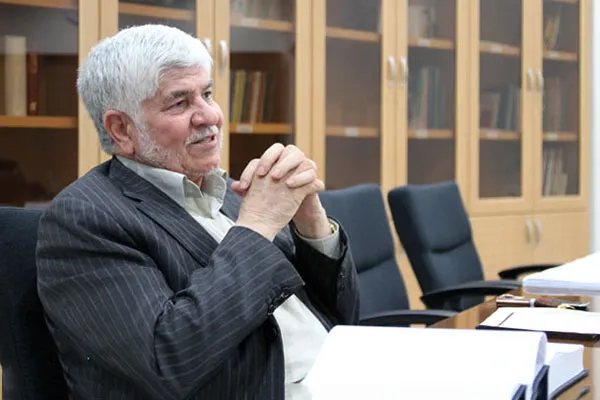
Mohammad Hashemi Bahramani, a veteran Iranian politician and the younger brother of Ayatollah Akbar Hashemi Rafsanjani, is one of the most experienced figures in the executive-political structure of the Islamic Republic over the past half-century. As one of the companions of the historic flight on February 1, 1979, and a founder of the Islamic Association of Iranian Students in America, he has held prominent positions in his career, including approximately 12 years as head of the IRIB (1981-1993), acting Minister of Foreign Affairs, six years as Vice President for Executive Affairs in the Hashemi and Khatami administrations (1995-2001), and 15 years of membership in the Expediency Discernment Council. Hashemi, who registered for the presidency in 2017 but was not approved, is currently the CEO of the Iran Cancer Research, Treatment, and Education Institute and, as one of the prominent figures of the moderate and Executives of Construction current, maintains a sustained analytical presence in Iran's public discourse.
Who is Mohammad Hashemi Bahramani?
Mohammad Hashemi Bahramani (born August 29, 1942) is a veteran Iranian politician, former executive manager, former member of the Expediency Discernment Council, and current CEO of the Iran Cancer Research, Treatment, and Education Institute. He is one of the most experienced figures in the executive-political structure of the Islamic Republic over the past half-century. Hashemi, who is known in Iran's public discourse primarily as the younger brother of Ayatollah Akbar Hashemi Rafsanjani, pursued an independent and rich path in the executive structure of the system—from being Deputy Prime Minister in the government of Mohammad Ali Rajai, to approximately 12 years as head of the IRIB, acting and deputy Minister of Foreign Affairs, six years as Vice President for Executive Affairs in the 6th and 7th governments—concurrent with his brother Rafsanjani's second administration and Khatami's first administration—fifteen years of membership in the Expediency Discernment Council, and finally, the management of one of Iran's largest cancer treatment-research institutes since 2010. Hashemi Bahramani, who also registered for the 12th presidential election in 2017 but was not approved by the Guardian Council, is one of the most prominent figures of the first generation of founders of the Islamic Republic who still maintains a sustained analytical presence in Iran's public discourse.
The importance of Mohammad Hashemi Bahramani in Iran's contemporary political-executive sphere can be examined from several angles. First, his distinguished pre-revolution background—from political activity from the age of 14, to participation in the Islamic movement led by Ayatollah Khomeini in the 1960s, exile and imprisonment, founding the Islamic Association of Iranian Students in America, and finally, returning to Iran on February 1, 1979, with the revolution flight—which places him among the narrowest circle of figures who witnessed the founding moment of the system. Second, his approximately twelve years as head of the IRIB—one of the most sensitive periods of contemporary Iranian history (including the peak years of the Iran-Iraq war, the Reconstruction era, and the beginning of the Reform era)—which places him among the longest-serving managers of this organization. Third, his presence in the foreign policy and executive structure of the system in the most tense post-war periods—as acting Minister of Foreign Affairs and then Vice President for Executive Affairs in two different governments—which made him one of the main bridges between different executive periods of the system. Fourth, his management of the Iran Cancer Research, Treatment, and Education Institute—one of Iran's largest non-profit treatment-research institutions in the field of cancer, which under his management has become a structure with at least ten treatment centers in various cities across Iran and two treatment centers in Iraq. Fifth, his sustained analytical presence in public discourse—particularly after the death of his brother in January 2017—which has made him one of the most cited figures associated with the moderate and Executives of Construction current.
Hashemi Bahramani is also a founding member of the Executives of Construction Party—an organization formed in 1996 by the circle close to Hashemi Rafsanjani and considered one of the most prominent moderate and middle-of-the-road reformist parties in Iran. He resigned from the Central Council of this party in 2015.
Life and Background
Mohammad Hashemi Bahramani was born on August 29, 1942, in the village of Bahraman—in the Rafsanjan district, Kerman province. His birthplace is among the agricultural-garden villages of the Rafsanjan region and is the origin of the Hashemi Bahramani family.
Family
Mohammad Hashemi is one of 8 (and in some sources 9) children of Mirza Ali Hashemi Bahramani and Mahbibi Safarian. His father, Mirza Ali Hashemi Bahramani, was from the city of Rafsanjan and migrated to the village to escape the pressures of Reza Shah Pahlavi's government—a narrative that formed the foundation of his family's political-religious identity.
Mohammad Hashemi's notable brothers include:
Akbar Hashemi Rafsanjani—the 5th and 6th President of Iran, the late head of the Expediency Discernment Council, and one of the most prominent figures of the Islamic Republic, who died in January 2017.
Mahmoud Hashemi and Ahmad Hashemi—both of whom were also in Qom during Mohammad Hashemi's adolescence.
This family context, which is among the most prominent political-clerical families of the Islamic Republic, formed the foundation of Mohammad Hashemi's political path.
Education
Mohammad Hashemi's educational path was a combination of traditional seminary education and modern academic education in America.
Maktab and Elementary School
Mohammad Hashemi went to maktab at the age of seven and spent three years there learning the Quran and the works of Saadi. At the age of ten, with the establishment of a school in the village, he began his modern education.
Qom Period (1957-1961)
After completing elementary school in his village, Mohammad Hashemi moved to Qom and, under the supervision of his older brother Akbar Hashemi Rafsanjani, continued his seminary and modern education from 1957 to 1961. This period, which occurred in the atmosphere of the intellectual-political activities of the young clerical generation in Qom, formed the foundation of his political-intellectual identity.
UC Berkeley
In addition to his seminary education, Mohammad Hashemi holds a Master's degree in Management from the University of California, Berkeley—one of the most prestigious universities in the United States and the world. This education, which took place in America before the 1979 revolution, is one of the distinctive aspects of his educational background among the prominent figures of the founding generation of the Islamic Republic.
Pre-Revolution Political Struggles
According to Mohammad Hashemi's own account, his political activities began at the age of 14—partly due to his older brother Akbar's political struggles. This path ultimately led to his active participation in the Islamic movement led by Ayatollah Khomeini in the 1960s and eventually to his arrest, exile, and imprisonment.
Activity in America
After traveling to America for education, Mohammad Hashemi remained there until the victory of the Islamic Revolution. During this period, one of his most notable activities was his participation in the founding and administration of the Islamic Association of Iranian Students in America—an organization that was among the most important aspects of the Islamic opposition to the Shah in America.
The Revolution Flight (February 1, 1979)
The most prominent moment of Mohammad Hashemi's revolutionary career was his presence on the historic Paris-Tehran flight on February 1, 1979. During Ayatollah Khomeini's migration to Paris, Mohammad Hashemi traveled from America to France and then returned to the country with Ayatollah Khomeini on the revolution flight on February 1, 1979. This event, which is among the most significant events of contemporary Iranian history, placed Mohammad Hashemi among the narrowest circle of historical witnesses to this moment.
Post-Revolution Executive Activity
After the victory of the Islamic Revolution, Mohammad Hashemi quickly took a position in the executive structure of the new system.
Deputy Minister of Agriculture
Mohammad Hashemi's first executive position was Deputy Minister of Agriculture.
Deputy Prime Minister
In the tense atmosphere of the presidency of Abolhassan Bani Sadr and the premiership of Mohammad Ali Rajai, Mohammad Hashemi was appointed as Deputy Prime Minister. This period, which was marked by severe tensions between the then president and the government, was one of his first experiences at the highest levels of the system's executive structure.
Head of the IRIB (1981-1993)
The central chapter of Mohammad Hashemi's executive career was his approximately twelve years as head of the IRIB.
Tenure
Mohammad Hashemi was the head of the IRIB from 1981 to 1993. This period, which included the peak years of the Iran-Iraq war, the beginning of the Reconstruction era, and the final years of his brother Hashemi Rafsanjani's presidency, covered one of the most sensitive periods of contemporary Iranian history.
Controversies During His Tenure: The "Crocodile Tears" Series
One of the most widely discussed events during Mohammad Hashemi's tenure was the controversy surrounding the series "Crocodile Tears." This television series, directed by Ahmad Najibzadeh, was broadcast on Channel 1 during the Fajr Decade in 1982 and faced widespread opposition from a section of the Islamic-political current.
According to Mohammad Hashemi's own account: "The Islamic Republic Party held a congress against this series, and 15,000 people signed at Friday prayers that this series had brought tears to the faithful, and Kayhan newspaper headlined it the next day and demanded its broadcast be stopped. But Imam Khomeini, rejecting these pressures, said that they had been fooled by the liberals and ordered the broadcast to continue."
This account, in which Mohammad Hashemi, as the head of the IRIB, was at the center of a major intellectual-political conflict, is a sign of the complexity of his role in the cultural-media arena of that era.
Acting and Deputy Minister of Foreign Affairs
After the end of his tenure as head of the IRIB in 1993, Mohammad Hashemi served as acting Minister of Foreign Affairs and Deputy Minister of Foreign Affairs for a period. This period, which occurred in the post-war and Reconstruction atmosphere, was one of the bridging links between his prominent executive positions.
Vice President for Executive Affairs (1995-2001)
Mohammad Hashemi served as Vice President for Executive Affairs from 1995 to 2001. This period occurred in two different phases:
1995-1997: Vice President for Executive Affairs for his brother, Akbar Hashemi Rafsanjani, in the 7th government (Rafsanjani's second presidential term).
1997-2001: Vice President for Executive Affairs for Mohammad Khatami in the 7th government (Khatami's first presidential term).
This continuity, in which Mohammad Hashemi served as Vice President for Executive Affairs in two relatively different governments—from Hashemi's Reconstruction government to Khatami's Reform government—was one of the notable aspects of bridging between different generations of the system's executive structure.
Membership in the Expediency Discernment Council (1996-2011)
Mohammad Hashemi was a member of the Expediency Discernment Council for 15 years, from 1996 to 2011—a prominent institution that his brother, Akbar Hashemi Rafsanjani, chaired for a long period. During this time, Mohammad Hashemi also served as the head of the office of the Chairman of the Expediency Discernment Council.
Founding the Executives of Construction Party
In 1996, Mohammad Hashemi was among the founding members of the Executives of Construction Party of Iran. This party, which was formed by the circle close to Akbar Hashemi Rafsanjani and is considered one of the most prominent moderate and middle-of-the-road reformist parties in Iran, was one of the aspects of Mohammad Hashemi's party activity.
Mohammad Hashemi was a member of the Central Council and the Political Committee of the Executives of Construction Party but resigned from these positions in 2015. This resignation, which occurred in the tense post-2013 election atmosphere and on the eve of the final years of his brother's life, was one of the notable events of his party path.
2017 Presidential Election
On April 15, 2017, Mohammad Hashemi registered for the 12th presidential election at the Ministry of Interior. In explaining his reason for registering, he stated: "It is necessary for more than one person to participate in the electoral competition."
However, his candidacy was not approved by the Guardian Council, and he was consequently barred from participating in the electoral competition—a decision that received widespread coverage in Iranian media, especially given his prominent executive background in the system.
Managing the Iran Cancer Research, Treatment, and Education Institute (since 2010)
The most prominent chapter of Mohammad Hashemi's recent career is his CEO and chairmanship of the Iran Cancer Research, Treatment, and Education Institute.
About the Institute
This institute, which is among the largest non-profit treatment-research institutions in Iran in the field of cancer, was founded by the Hashemi family. Fatemeh Hashemi Rafsanjani has served as the Vice Chair of the Board of Directors of this institute since August 2015.
Scope of Activity
The Iran Cancer Research, Treatment, and Education Institute, according to published reports, has at least ten treatment centers in various cities across Iran and two treatment centers in Iraq—a sign of its extensive activity in the field of cancer treatment.
Mohammad Hashemi has been the CEO and Chairman of the Board of Directors of this institute since 2010.
Views and Analytical Positions
Throughout his intellectual-political career, Mohammad Hashemi has formulated a clear intellectual framework.
Defense of Hashemi Rafsanjani's Legacy
After the death of his brother Akbar Hashemi Rafsanjani in January 2017, Mohammad Hashemi became one of the most prominent defenders of his legacy. In one of his notable positions, criticizing the documentary "Hashemi is Alive" (known in public discourse as an anti-Hashemi documentary), he stated: "A certain current is working hard to destroy Ayatollah Hashemi's image to achieve its goals in the upcoming elections."
Analysis of Tensions with the US and Israel
In one of his recent analytical positions, Mohammad Hashemi stated: "What you see now—Trump and Netanyahu coming and being insolent and insulting and attacking the leadership—its roots are not from today; it comes from Imam's movement and revolution. From the very first day the Shah left and it became clear that the Pahlavi regime had no roots in Iran and could not secure America's interests, they opposed Imam."
Criticism of Pressures on Governments
In one of his recent notable positions, Mohammad Hashemi stated: "For a current to disrupt the government's work to the point of trying to force the president's resignation is almost a rare occurrence. What kind of thinking is this that considers the president separate from the Islamic Republic system and puts him on the line?"
View on the Livelihood Crisis
From a socio-economic perspective, Mohammad Hashemi has identified the people's livelihood as the Achilles' heel of governments and has stated in one of his notable positions that "the future government will face an unemployment crisis" and that "spending money is not the solution to overcome the crisis.
Exclusive conversation between Abdi Media and Mohammad Hashemi Rafsanjani, head of IRIB, Vice President, member of the Expediency Discernment Council.
Connections with Figures and Currents
Mohammad Hashemi Bahramani is situated within a complex network of family-political connections with prominent figures of the Islamic Republic. At the family level, his relationship with Akbar Hashemi Rafsanjani, Fatemeh Hashemi Rafsanjani, Mohsen Hashemi and Yaser Hashemi, and Ali Hashemi Bahramani forms his prominent family-political network.
At the party level, his relationship with the Executives of Construction Party—of which he was a founder—formed his party network.
At the executive level, his sustained relationship with Akbar Hashemi Rafsanjani, Mohammad Ali Rajai, Mohammad Khatami, and Masoud Pezeshkian forms his political communications network.
At the media level, his consistent presence in media outlets close to the Executives of Construction and moderate currents forms his media communications network.
Conclusion
Mohammad Hashemi Bahramani is one of the most experienced figures in the executive-political structure of the Islamic Republic over the past half-century. With a unique combination of a distinguished pre-revolution background, presence on the historic Paris-Tehran flight on February 1, 1979, a combined seminary-academic education, numerous prominent executive positions, founding membership in the Executives of Construction Party, candidacy for the 2017 presidential election, and finally, about a decade and a half of management of one of Iran's largest cancer treatment-research institutes, he occupies a unique position in the political-executive-treatment structure of contemporary Iran.
Hashemi's distinguishing feature, on the first level, is his exceptional ability to bridge different executive periods of the system—an ability in which a figure with a prominent revolutionary background was able to serve in various executive positions in different governments. This continuity is relatively unique among the first-generation figures of the Islamic Republic. On the second level, his distinctive political identity in the shadow of his older brother—in which, despite close family ties with one of Iran's most prominent presidents, he pursued his own independent path—is one of the notable aspects of his character. On the third level, his successful transition from the executive-political arena to the treatment-research arena—reflected in his management of one of Iran's largest cancer institutes—is an example of his evolving role in recent years.
From an analytical perspective, Hashemi's position exemplifies the phenomenon of the "revolutionary-executive manager bridging generations" in contemporary Iran—a phenomenon in which a figure with a pre-revolution background, over decades, plays a sustained role in the most tense executive periods of the system and ultimately continues productive activity in social-treatment arenas. This pattern, which has other examples among the first-generation figures of the Islamic Republic, has found a special reflection in Hashemi through his family ties with the most prominent moderate figure and his exceptional executive-managerial continuity.
What is clear from today's perspective is that the topics Hashemi has addressed in his works and positions—from analysis of the history of the IRIB, Iran-US relations, the role of the leadership in the system's structure, challenges of pressure on governments, the livelihood crisis, criticism of destructive currents, and defense of his late brother's legacy—remain among the most enduring topics in contemporary Iranian political-executive discourse. In a situation where Iran is in one of the most tense periods of its political-economic discourse—particularly after the 12-day Iran-Israel war in June 2025 and increasing internal challenges—Hashemi's analytical voice, with a combination of prominent historical credibility, unique family background, and long executive experience, is one of the widely referenced sources of the moderate current in Iranian media.
Frequently Asked Questions
Who is Mohammad Hashemi Bahramani?
Mohammad Hashemi Bahramani (born August 29, 1942, in the village of Bahraman, Rafsanjan district, Kerman province) is a veteran Iranian politician and the younger brother of Akbar Hashemi Rafsanjani. He has held prominent positions such as head of the IRIB, Vice President for Executive Affairs, and member of the Expediency Discernment Council. He is currently the CEO and Chairman of the Board of Directors of the Iran Cancer Research, Treatment, and Education Institute.
What is Mohammad Hashemi's educational background?
Mohammad Hashemi completed his seminary education in Qom (from 1957 to 1961) under the supervision of his brother Akbar Hashemi Rafsanjani. In addition, he holds a Master's degree in Management from the University of California, Berkeley.
What was Mohammad Hashemi's role in the victory of the revolution?
Mohammad Hashemi began his political activity at the age of 14 and was arrested, exiled, and imprisoned for his participation in the Islamic movement led by Ayatollah Khomeini in the 1960s. During his studies in America, he was a founder of the Islamic Association of Iranian Students in America. He traveled from America to France during Ayatollah Khomeini's migration to Paris and then returned to Iran with the revolution flight on February 1, 1979.
When was Mohammad Hashemi head of the IRIB?
Mohammad Hashemi was the head of the IRIB from 1981 to 1993—approximately twelve years—one of the longest management periods of this organization.
What was the "Crocodile Tears" series controversy?
One of the most widely discussed events during Mohammad Hashemi's tenure as head of the IRIB was the controversy surrounding the series "Crocodile Tears," directed by Ahmad Najibzadeh, broadcast during the Fajr Decade in 1982. The Islamic Republic Party held a congress against this series, and 15,000 people signed at Friday prayers, but Ayatollah Khomeini rejected the pressures and ordered the broadcast to continue.
What are Mohammad Hashemi's prominent executive positions?
Among Mohammad Hashemi's most important executive positions are: Deputy Minister of Agriculture, Deputy Prime Minister, head of the IRIB, acting and deputy Minister of Foreign Affairs, Vice President for Executive Affairs (1995-2001) in the 6th and 7th governments, and member of the Expediency Discernment Council (1996-2011).
Why was Mohammad Hashemi's candidacy for the 2017 presidency rejected?
On April 15, 2017, Mohammad Hashemi registered for the 12th presidential election. In explaining his reason for registering, he stated: "It is necessary for more than one person to participate in the electoral competition." However, his candidacy was not approved by the Guardian Council. The exact reasons for this decision were not officially published in Iranian media.
What is the Cancer Research Institute?
Mohammad Hashemi has been the CEO and Chairman of the Board of Directors of the Iran Cancer Research, Treatment, and Education Institute since 2010—one of Iran's largest non-profit treatment-research institutions in the field of cancer, with at least ten treatment centers in various cities across Iran and two treatment centers in Iraq. Fatemeh Hashemi Rafsanjani has served as the Vice Chair of the Board of Directors of this institute since August 2015.
What is Mohammad Hashemi's relationship with the Executives of Construction Party?
Mohammad Hashemi was among the founding members of the Executives of Construction Party of Iran and was a member of its Central Council and Political Committee. However, he resigned from these positions in 2015.
Is Mohammad Hashemi still active?
Yes, Mohammad Hashemi Bahramani, as the CEO and Chairman of the Board of Directors of the Iran Cancer Research, Treatment, and Education Institute, and as one of the most prominent analytical figures associated with the moderate and Executives of Construction current, remains active in Iran's political-social arena. His consistent presence in prominent media outlets is a sign of his enduring role. His analytical positions on recent developments, Iran-US relations, the challenges of Pezeshkian's government, and his late brother's legacy have received widespread coverage in Persian-language media.
Take less than a minute, register and share your opinion under this post.
Insulting or inciting messages will be deleted.
Sign Up