
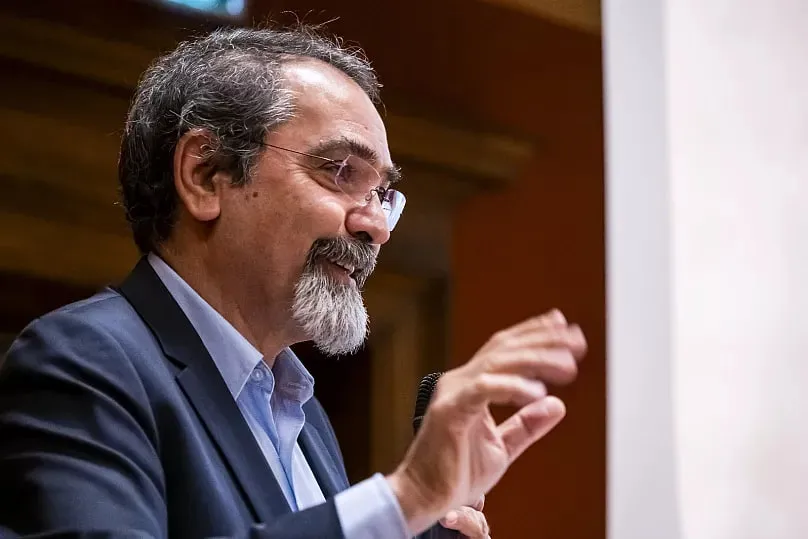
An analysis of Iran's nuclear dossier from a technical and structural perspective has been the primary focus of Mehran Mostafavi's commentaries and interviews over the past two decades. As a professor of physical chemistry at Paris-Saclay University and a scientific deputy within his department at the CNRS (French National Centre for Scientific Research), he leverages his expertise in radiation chemistry to offer distinct, critical perspectives on Iran’s uranium enrichment and heavy water reactors. Read on to explore this researcher's academic record, political stances, and media controversies.
Who is Mehran Mostafavi?
Dr. Mehran Mostafavi—a physical chemist, professor at Paris-Saclay University, scientific deputy at the French National Centre for Scientific Research (CNRS), Iranian nuclear policy researcher, and political activist—was born in 1962 in Hamadan. He is one of the most widely recognized Iranian-born academics in France and a prominent critic of the Islamic Republic of Iran's nuclear program. Over the past two decades, leveraging his scientific expertise in physical chemistry and his command of the technical aspects of nuclear technology, Mostafavi has established himself as a major analytical and technical reference in the critique of Iran's nuclear policy.
The significance of Mehran Mostafavi can be understood through several key dimensions:
Technical and Scientific Expertise: He is one of the few Iranian-born experts who critiques the technical facets of Iran's nuclear program—particularly uranium enrichment and the heavy water reactor—from a position of rigorous scientific authority, backed by approximately 200 scientific papers published in international journals.
Political and Familial Affiliations: Mostafavi is the son-in-law of Abolhassan Banisadr, post-revolutionary Iran’s first president. He is an active figure within the political-intellectual current close to Banisadr and a key contributor to the Enghelab-e Eslami dar Hejrat ("Islamic Revolution in Exile") website. This connection solidifies his political stance as a long-standing regime critic embedded within the Nationalist-Religious Republican tradition.
Media Presence: His extensive appearances across diaspora Persian-language media—ranging from Euronews and BBC Persian to Radio Farda, Radio Zamaneh, and Andisheh TV—have made him one of the most frequently cited analysts on Iranian nuclear affairs.
Mostafavi’s central thesis is that Iran's nuclear program has lacked economic and scientific justification from its very inception and has been driven from the start by the objective of acquiring nuclear weapons—a position he has repeatedly documented and argued in lectures, articles, and interviews.Life and Background
Mehran Mostafavi was born in 1962 in the city of Hamadan. He spent his childhood and adolescence in Iran, pursuing his education until the second year of secondary school. In 1978—on the eve of the 1979 Revolution—he immigrated to France to continue his studies, a move that marked the beginning of a long scientific and political trajectory in the country.
Upon arriving in France, Mostafavi pursued his university education in physical chemistry. He successfully obtained his PhD in Physical Chemistry from the University of Paris (known today as Paris-Saclay University). This institution stands as one of the most prestigious universities in France and Europe in the fields of basic sciences and technology.
A year after earning his doctorate, Mostafavi was recruited as a researcher at the French National Centre for Scientific Research (CNRS)—the most important research institution in France and one of the largest scientific research centers globally. This launched an extended research and academic career in France, establishing him as a well-known scientist of Iranian descent in the country.
Academic and Research Trajectory
Following years of activity as a researcher at the CNRS, Mostafavi achieved the rank of full university professor in Physical Chemistry in 1998. This promotion integrated him into the permanent faculty of the French university system, adding lecturing and the supervision of student theses to his research responsibilities.
A major milestone in his academic career occurred in 2006, when he was appointed director of the Institute of Physical Chemistry (Laboratoire de Chimie Physique), one of France’s most prestigious physical chemistry laboratories. Mostafavi held this responsibility for nine years, a prolonged tenure that reflected the French scientific community's confidence in his managerial and scientific capabilities.
Following this period, Mostafavi advanced to a higher position within the French scientific infrastructure. He currently serves as a scientific deputy at the CNRS, a role in which he is responsible for overseeing and managing French research centers within his area of expertise. This position constitutes one of the most vital scientific-administrative responsibilities within the framework of French scientific research.
Additionally, Mostafavi is an honorary professor at the University of Tokyo in Japan, an indication of his international standing in scientific circles.
Area of Research Specialization
Mostafavi’s specific area of scientific research focuses on ultra-fast chemical reactions induced in matter by nuclear radiation. This field—situated at the intersection of physical chemistry, nuclear physics, and materials science—studies phenomena where nuclear radiation triggers extremely rapid chemical reactions in materials. This specialization has thoroughly familiarized Mostafavi with the technical dimensions of nuclear technology, serving as a primary foundation for his expert authority in analyzing Iran's nuclear program.
To date, Mostafavi has published nearly 200 scientific articles in international journals and has presented his research at dozens of international conferences. This extensive research record makes him one of the most prolific Iranian-born researchers in the basic sciences in Europe.
Familial-Political Link to Abolhassan Banisadr
One of the most significant aspects of Mostafavi’s political persona is his familial relationship with Abolhassan Banisadr (1933–2021), post-revolutionary Iran’s first president. Mostafavi is Banisadr's son-in-law, a connection that over the past decades positioned him as one of the closest figures within Banisadr’s intellectual and political circle in exile.
In practice, this familial tie has had important intellectual and political implications for Mostafavi. Over the past decades, he has served as a primary narrator of Banisadr’s views, stances, and memoirs. In numerous articles, interviews, and lectures, he has analyzed and articulated Banisadr's thought—particularly concerning the necessity of popular sovereignty, the authenticity of the 1979 Revolution's original ideals, and the critique of religious despotism. In one of his analyses, Mostafavi traces the roots of the "incompatibility" between Banisadr and Mehdi Bazargan to the formation of institutions such as the Islamic Revolutionary Guard Corps (IRGC) and the Revolutionary Courts—institutions that, in his view, became the "main pillars of despotism."
Following Banisadr’s passing in October 2021, Mostafavi has continued to play an active role in preserving and disseminating his intellectual legacy.
Political Activity and Critique of Iran’s Nuclear Policy
Parallel to his scientific-academic career, Mostafavi has maintained a consistent political presence throughout his nearly four decades in France. Over the last 20 years, the primary focus of his political activity has centered on Iran’s nuclear policy dossier, a domain in which his scientific-technical expertise has allowed him to become a prominent and well-reasoned critic.
Technical-Political Views on the Nuclear Program
Mostafavi’s core perspectives on Iran's nuclear program can be summarized across several key axes:
Military Intentions: He maintains that Iran's nuclear program was pursued from its very inception with a military objective aimed at acquiring nuclear weapons. In one of his analyses, he emphasized that Iran has never been willing to admit that its initial intent in developing the nuclear program was weaponization.
Lack of Economic Justification: He argues that uranium enrichment lacks economic and scientific justification for Iran. In his commentaries, he has asserted that enriched uranium serves only two practical purposes: "either as fuel for reactors and very large vessels, or for manufacturing a bomb." Given that Iran possesses neither a substantial nuclear reactor fleet requiring enriched fuel nor a nuclear-powered submarine fleet, he views the insistence on enrichment as a clear indicator of the program's military objectives.
The Arak Heavy Water Reactor: Mostafavi contends that the Arak heavy water reactor was unnecessary for Iran, arguing that this project was also pursued in line with acquiring military capabilities (specifically, plutonium production).
Public Exclusion: He believes that under the Islamic Republic, the public has been kept in the dark regarding the realities of nuclear policy, and that no serious scientific or public debate regarding the necessity of nuclear energy, its hazards, and alternative options has taken place within Iranian media or universities. Consequently, he has characterized this approach as treating the public as "outsiders" to the nuclear dossier.
Critique of the JCPOA: In his analysis of nuclear negotiations, Mostafavi has maintained a critical stance toward the Joint Comprehensive Plan of Action (JCPOA) and related nuclear agreements. In 2016, he declared that "Khamenei knew from the beginning that the nuclear negotiations meant accepting defeat." His fundamental position is that Iran must completely abandon its uranium enrichment program, a stance he justifies on both technical and legal grounds.
Broader Political Perspectives
Beyond the nuclear dossier, and in alignment with Banisadr’s intellectual tradition, Mostafavi champions popular sovereignty, national independence, and an approach defined within Banisadr's framework as "democratic Islam." He is a severe critic of Velayat-e Faqih, the power structure of the Islamic Republic, and the securitization of the political and social spheres. In his view, the 1979 Revolution possessed authentic ideals (popular sovereignty, independence, and liberty) that were derailed in practice, particularly after June 1981 following the dismissal of Banisadr and the onset of widespread repression.
Furthermore, across various platforms, Mostafavi has advocated for a method of political engagement centered on "purity of conduct and purity of speech"—conceived as an inheritance of Banisadr's intellectual framework—in opposition to what he describes as forces representing "darkness and falsehood."Here is the professional and fluent English translation of the remaining sections of the text, keeping the high-quality academic and analytical register established previously:
Media Activity
Mostafavi is one of the most visible Iranian-born analysts across diaspora Persian-language media. He makes regular appearances on numerous networks, including BBC Persian (on programs such as HardTalk / Be Ebarat-e Digar), Euronews Persian, Radio Farda, Radio Zamaneh, Andisheh TV, and various other independent media outlets.
In addition to broadcast media, Mostafavi has published dozens of articles and analytical essays on websites associated with Banisadr's school of thought, most notably Enghelab-e Eslami dar Hejrat ("Islamic Revolution in Exile") and Majame-e Eslami-ye Iranian ("The Iranian Islamic Assemblies"). These sites, whose intellectual management took shape during Banisadr's life in France, have served as the primary hubs for publishing the stances and statements of the political current close to Banisadr and his inner circle.
Affiliations with Figures and Currents
Throughout his years of political involvement, Mehran Mostafavi's name has been tied to a distinct network of figures and political-intellectual movements. At the center of this network sits Abolhassan Banisadr (his father-in-law), and extending from it are figures close to Banisadr's movement in exile—including former associates from his presidential office and his intellectual inner circle from recent decades.
Discursively, Mostafavi belongs to the Nationalist-Religious Republican current aligned with Banisadr's intellectual tradition. Within the wider Iranian opposition spectrum, this current distances itself from monarchist, leftist, and Mojahedin-e Khalq (MEK) factions, choosing instead to emphasize the original ideals of the 1979 Revolution, namely popular sovereignty and national independence.
At the scientific level, Mostafavi maintains institutional ties with French research bodies (CNRS, Paris-Saclay University) and international entities (The University of Tokyo). Within the realm of nuclear analysis, he has participated in panel discussions and analytical debates involving a wide spectrum of commentators and experts on Iranian affairs.
Conclusion
Dr. Mehran Mostafavi represents a rare synthesis of international academic-scientific prestige and persistent political activism dedicated to critiquing the Islamic Republic of Iran. His trajectory—from immigrating to France on the eve of the revolution and earning a PhD in Physical Chemistry, to forging a prolific scientific career at the CNRS and Paris-Saclay University, alongside two decades of systematic critique of Iran's nuclear policy—presents the portrait of a "scientist-political activist." Leveraging his scientific credentials, he has provided a rigorous technical-political critique of a dossier that remains central to the destiny of contemporary Iran.
Mostafavi's defining attribute, on the first level, is his ability to bridge technical expertise (physical chemistry and an understanding of the technical dimensions of nuclear technology) with political analysis (critiquing Iran's nuclear choices and the power structure of the Islamic Republic). This combination sets his commentaries apart from purely political analysis, lending a distinct technical-scientific weight to his stances. On the second level, his familial and intellectual relationship with Abolhassan Banisadr establishes him as a primary narrator and custodian of the intellectual legacy of post-revolutionary Iran's first president.
Analytically, Mostafavi exemplifies the phenomenon of the diaspora Iranian "academic opposition" in the West—a dynamic wherein individuals with high scientific standing within Western academic institutions engage in a systematic critique of the Islamic Republic's policies, particularly within their own fields of expertise. Within the domain of the nuclear dossier—where complex technical dimensions deter most political analysts from deep engagement—the role of figures like Mostafavi becomes exceptionally vital in providing well-reasoned analyses from a technical standpoint.
What remains clear from today's perspective is that the questions and analyses Mostafavi has raised over the past two decades regarding the technical, economic, and political dimensions of Iran's nuclear program—ranging from the necessity of uranium enrichment to the program's actual goals and potential negotiation pathways—remain critical, living topics of debate within both Iranian political-intellectual discourse and the international community. As Iran's nuclear file and its associated frictions continue to be a cornerstone of Middle Eastern geopolitics, Mostafavi's expert, critical voice will maintain an enduring position in the discourse surrounding this issue.
Frequently Asked Questions (FAQs)
Who is Mehran Mostafavi and what is his specialization? Mehran Mostafavi (born 1962 in Hamadan) is an Iranian-French physical chemist, a full professor at Paris-Saclay University, and a scientific deputy at the French National Centre for Scientific Research (CNRS). His scientific specialization lies in physical chemistry, focusing heavily on ultra-fast chemical reactions induced in matter by nuclear radiation. He is also widely recognized as a researcher and analyst of Iranian nuclear policy.
What is Mehran Mostafavi’s educational background? Mostafavi pursued his education in Iran until his second year of secondary school before immigrating to France in 1978. He earned his PhD in Physical Chemistry from the University of Paris (known today as Paris-Saclay University). A year after receiving his doctorate, he was recruited as a researcher by the CNRS, advancing to the rank of full professor in 1998.
What scientific positions does Mehran Mostafavi hold? Mostafavi is a professor at Paris-Saclay University, a scientific deputy at the CNRS with managerial responsibilities over research centers, and an honorary professor at the University of Tokyo in Japan. He also served as the director of the Institute of Physical Chemistry (Laboratoire de Chimie Physique) for nine years starting in 2006. To date, he has published nearly 200 scientific papers in international journals.
What is Mehran Mostafavi’s relationship with Abolhassan Banisadr? Mehran Mostafavi is the son-in-law of Abolhassan Banisadr, post-revolutionary Iran's first president. This familial connection establishes him as a primary narrator of Banisadr’s views and intellectual legacy. In the political sphere, he is known as an active face within the intellectual current close to Banisadr and a staff writer for the Enghelab-e Eslami dar Hejrat website.
What is Mehran Mostafavi’s view on Iran’s nuclear program? Mostafavi maintains that Iran's nuclear program was designed from the beginning with the objective of acquiring nuclear weapons and lacks any economic or scientific justification. He argues that enriched uranium is only practically useful for reactor fuel, large nuclear-powered vessels, or manufacturing a bomb; given that Iran has no objective domestic need for the first two, he views the insistence on enrichment as clear evidence of military goals. His fundamental position is that Iran must completely abandon its enrichment program.
Why does Mehran Mostafavi characterize Iran’s nuclear dossier as an approach of treating the public as "outsiders"? Mostafavi believes that no serious scientific or open public debate regarding the necessity of nuclear energy, its structural hazards, and potential alternative options has been permitted within Iranian media or universities. Because the public has been excluded from the technical and economic realities of the program, he describes this systemic opacity as treating the people as "outsiders" (Namahram) to their own national dossier.
To which political-intellectual current does Mehran Mostafavi belong? Mostafavi belongs to the Nationalist-Religious Republican current close to the intellectual school of Abolhassan Banisadr. This movement emphasizes the original aspirations of the 1979 Revolution (popular sovereignty, independence, and liberty) and maintains a deliberate distance from monarchist, leftist, and Mojahedin-e Khalq (MEK) factions within the Iranian opposition spectrum.
Is Mehran Mostafavi still active? Yes, Mehran Mostafavi remains active in both scientific and analytical-political spheres. Regionally and internationally, he continues his scientific work as a deputy at the CNRS and a professor at Paris-Saclay University. In the analytical-media arena, he routinely shares his assessments regarding Iran's nuclear file and political developments through diaspora Persian media (BBC Persian, Euronews, Radio Farda, Radio Zamaneh, Andisheh TV) and websites associated with Banisadr's school of thought.
Take less than a minute, register and share your opinion under this post.
Insulting or inciting messages will be deleted.
Sign Up