
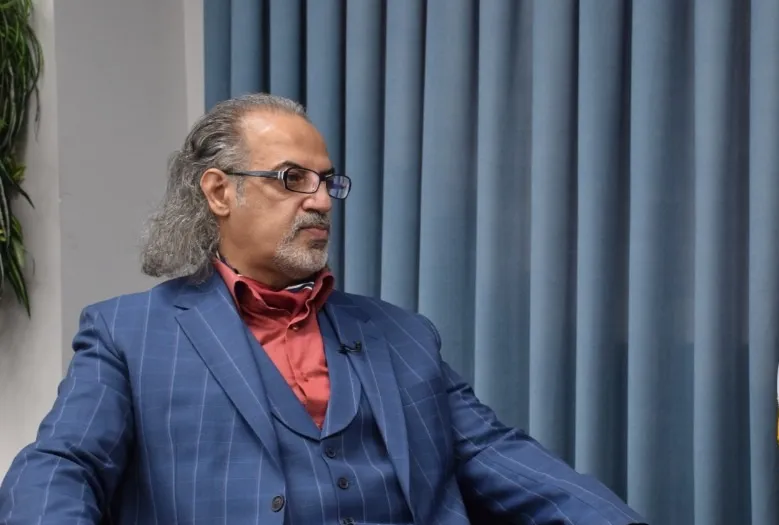
Mehdi Motaharnia, born on 12 February 1966 in Kashan, is an Iranian political analyst, futurologist, university professor, and theorist specializing in domestic and foreign policy. He is one of the most frequently appearing and widely recognized political commentators in Iranian media over the past two decades.
Motaharnia, who describes himself as a “pro-change” (transformist) thinker, has become a distinctive—and at times controversial—figure in the field of political analysis and futurology in Iran. He is known for combining academic activity, frequent media appearances, and the introduction of his own conceptual frameworks and theories, which have contributed to his visibility in public discourse.
Who is Mehdi Motaharnia?
Mehdi Motaharnia is an Iranian political analyst, futurologist, university professor, and theorist in the fields of domestic and foreign policy. Born on 23 February 1966 in Kashan, he is one of the most frequently visible and well-known political commentators in Iranian media over the past two decades. Motaharnia, who describes himself as a “transformist” (pro-change advocate), has become a distinctive—and at the same time controversial—figure in the field of political analysis and futurology in Iran, combining academic activity, frequent media appearances, and the presentation of his own conceptual and theoretical frameworks.
The importance of Motaharnia in Iran’s media and analytical sphere can be examined from several angles. First, he is one of the most active political analysts in both domestic and international Persian-language media, and his continuous presence in interviews and discussions on Iranian and regional developments has made him a familiar face to political audiences. Second, as the founder and head of the “Simorgh Futurology Think Tank,” he has attempted to institutionalize futurology as an interdisciplinary field within Iranian intellectual circles. Third, he has introduced a set of original concepts and theories—such as “Greater Heartland,” “Glass Room,” “Crystal Ball,” “Parsonman,” and “Barikh-Shenasi”—as part of his effort to build a personal analytical framework for understanding power, politics, and the future.
At the same time, Motaharnia’s career has been accompanied by controversies, particularly ambiguities surrounding parts of his academic credentials. This profile aims to present a balanced and accurate overview of his career, ideas, and controversies.
Life and Background
Mehdi Motaharnia was born on 23 February 1966 in Kashan. He grew up in a Kashani family and completed his early education at Maarefi School in Kashan. He attended middle school and early high school at Khavari, Molla Fathollah, and Imam Khomeini schools in Kashan.
After his family moved to Tehran, he received his high school diploma from Dr. Shariati High School. He then entered university studies in political science, a path that eventually led him to become a well-known figure in political analysis and futurology in Iran.
Education and Controversy Over Degrees
Motaharnia’s academic path is one of the most debated aspects of his profile, with different sources offering conflicting accounts.
According to published narratives, he completed his master’s degree at Islamic Azad University (Tehran Central Branch), after which he began teaching political science and was later appointed as a faculty member at the same university system.
Regarding his PhD, accounts differ significantly. According to the Persian Wikipedia entry, he holds a doctorate in political science from the “University of Hawaii,” which has been described as an unaccredited institution, and thus his degree was not recognized by Iran’s Ministry of Science. In contrast, some sources close to him claim he holds a PhD in futurology from Imam Khomeini International University in Qazvin, with a dissertation titled “Future Media and Their Role in New Social Movements.”
This ambiguity regarding his academic credentials has been one of the main sources of criticism. Regardless of the dispute, what is clear is that he has worked for years as a lecturer and academic staff member within Iran’s university system.
Academic and Teaching Activities
Motaharnia has taught for many years at various branches of Islamic Azad University, including Qom, Tehran Central, and Tehran North. He has also served as an adjunct professor at several institutions, including the University of Tehran, the Supreme National Defense University, Strategic Studies institutions, and Sayyad Shirazi University, teaching political science, futurology, sociology, cultural management, and related fields.
He also served for several years as head of the Social Sciences and Revolution Research Institute at Islamic Azad University. His academic and research work spans political science, sociology, futurology, communications, media studies, security studies, and psychological operations.
Work in Media and Broadcasting
Motaharnia also has experience in media management. He previously held managerial and editorial roles in the Iranian national broadcasting organization (IRIB). In addition, he served as the political editor of “Rah-e Rashd” magazine.
This media background, combined with his claimed expertise in “security and psychological operations,” has shaped many of his views on the relationship between media, power, and politics. In recent years, he has become one of the most frequently appearing political analysts in both Iranian and international Persian-language media.
Simorgh Futurology Think Tank
One of his major projects is the Simorgh Futurology Think Tank, which he founded and leads. The institute aims to develop futurology studies and train analysts in political forecasting, strategic analysis, and interdisciplinary thinking.
Simorgh seeks to move from traditional forecasting toward scenario-based strategic design and has expanded its work into emerging fields such as the impact of artificial intelligence on the future of power and politics.
Original Concepts and Theories
A distinctive feature of Motaharnia’s work is his attempt to introduce original theoretical concepts in political analysis and futurology. These include:
- “Greater Heartland”: A reinterpretation of Halford Mackinder’s classical Heartland theory in geopolitics.
- “Glass Room”: The idea that modern information society makes political power increasingly transparent.
- “Crystal Ball”: A metaphor for forecasting and shaping the future.
- “Crystal/Fluid Sky Framework”: A set of metaphoric constructs used to explain power dynamics.
- “Parsonman” and “Barikh-Shenasi”: Methodological concepts introduced in his analytical approach.
While these concepts reflect his effort to create a unique analytical framework, critics have sometimes described them as overly metaphorical or lacking a solid theoretical foundation.
Views and Positions
Motaharnia describes himself as a “transformist” and is generally associated with reformist-leaning intellectual currents in Iran, although he prefers the term “transformism” over “reformism.”
His analytical approach emphasizes several key themes:
- The importance of futurology and strategic thinking in policymaking
- The relationship between power, media, and psychological security
- The need for structural reform and responsiveness to social demands
- The impact of emerging technologies—especially artificial intelligence—on politics and global power
In foreign policy analysis, he frequently discusses Iran’s relations with global powers, Middle Eastern geopolitics, and Iran’s position in the international system.
Controversies and Criticism
Two main areas of controversy surround Motaharnia:
- Academic credentials: Questions about the validity and recognition of his PhD have been widely discussed. Critics challenge the legitimacy of his “doctor” title, while supporters reject these claims as politically motivated.
- Nature of his analyses: Some critics argue that his predictions are overly broad or inconsistent, and that his theoretical concepts are too abstract or metaphorical. Others see his frequent media presence as a strength, while critics interpret it as a lack of deep specialization.
Supporters, however, praise his ability to present accessible analyses, his futurological perspective, and his effort to introduce new conceptual tools.
Books and Publications
Motaharnia has authored numerous books and articles in political science, sociology, futurology, communication studies, and security/psychological operations. Much of his output also appears in interviews, media appearances, and content published through the Simorgh Institute and his social media platforms (Telegram, Instagram, and X).
Institutional and Intellectual Connections
He has worked closely with Islamic Azad University, where he served as head of a research institute, and he founded the Simorgh Futurology Think Tank.
He has also been involved with academic and advisory bodies such as the Iranian Sociological Association’s futurology group and the Academy of Sciences’ think tank on future studies. Ideologically, he is linked to reformist-leaning “transformist” currents but works across a wide range of media and intellectual platforms.
Conclusion
Mehdi Motaharnia is one of the most visible and controversial political analysts and futurologists in contemporary Iran. His career—spanning university teaching, media management, institutional leadership, and extensive media commentary—reflects an effort to establish himself as a hybrid figure of analyst and theorist.
His most distinctive feature is his attempt to institutionalize futurology in Iranian intellectual discourse and to develop original conceptual frameworks for understanding politics and power. At the same time, his wide media presence has made him a familiar public figure, while also raising questions about academic depth and analytical precision.
Regardless of agreement or disagreement with his views, he remains a well-known figure in Iranian political analysis, and his emphasis on futures thinking and the impact of emerging technologies continues to contribute to broader debates about Iran’s and the world’s political future.
Frequently Asked Questions
Who is Mehdi Motaharnia and what is his field of expertise?
He is an Iranian political analyst, futurologist, and university professor specializing in political science, futurology, media studies, and security analysis. He is the founder of the Simorgh Futurology Think Tank.
What is the Simorgh Institute?
It is a futurology think tank founded by Motaharnia that focuses on strategic scenario design, futures studies, and training analysts in interdisciplinary political forecasting.
What are his main theories?
His key concepts include the “Greater Heartland,” “Glass Room,” “Crystal Ball,” and other metaphorical frameworks related to power, media transparency, and future studies.
What controversies surround him?
The main controversies involve questions about the validity of his PhD degree and criticism of his abstract or inconsistent analytical frameworks.
Take less than a minute, register and share your opinion under this post.
Insulting or inciting messages will be deleted.
Sign Up