
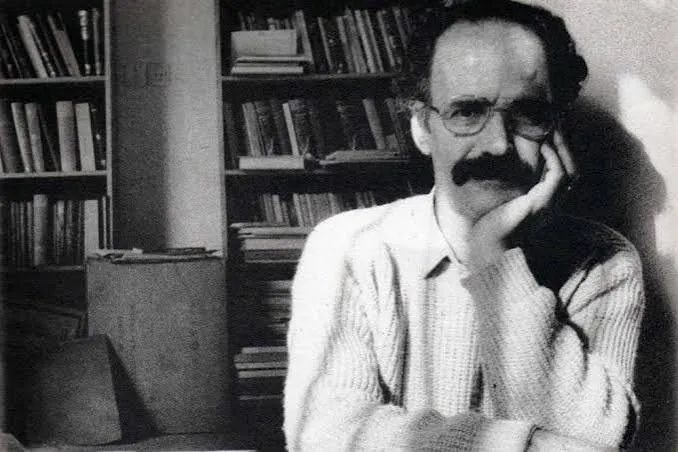
Houshang Golshiri, writer, literary critic, editor, professor of literature, and editor-in-chief of the magazine Kārnāmeh, is regarded as one of the most influential contemporary Persian-language fiction writers and one of the most frequently cited architects of the modern Iranian novel. With his novella Shazdeh Ehtejab (1969), which, according to Manouchehr Atashi, marked “the brilliant starting point of the new Iranian novel,” his career included founding the prominent literary circle Isfahan’s Jung, teaching at the Faculty of Fine Arts of the University of Tehran at the invitation of Bahram Beyzai, holding weekly fiction-reading sessions from 1983 until the end of his life, where a generation of prominent writers of the 1990s was nurtured, serving as editor-in-chief of the magazine Kārnāmeh, and receiving notable international awards such as the Erich Maria Remarque Peace Prize (2000). Golshiri died on June 5, 2000, and his legacy continued through the Houshang Golshiri Cultural and Research Foundation, established through the efforts of his wife, Farzaneh Taheri, and figures such as Mahmoud Dowlatabadi and Bahman Farmanara, as well as the Golshiri Literary Award, which was presented until 2014 as the most prestigious independent literary award in the Persian-speaking world.
Who Is Houshang Golshiri?
Houshang Golshiri (born on 15 Esfand 1316 [March 6, 1938] in Isfahan; died on 16 Khordad 1379 [June 5, 2000] in Tehran) was a writer, literary critic, editor, literature professor, and editor-in-chief of the influential magazine Kārnāmeh. He is regarded as one of the most influential contemporary Persian-language fiction writers and one of the most frequently cited architects of the modern Iranian novel.
Golshiri followed a unique path: he began his career as a teacher in rural areas and later in Isfahan; joined the Saeb Literary Association of Isfahan in 1339 [1960–61], an association that led to his arrest in 1340 [1961–62] because of his acquaintance with several political activists; helped establish the influential literary circle known as the Isfahan Literary Anthology—one of the most prominent literary circles before the Revolution; and published the highly acclaimed novella Shazdeh Ehtejab in 1348 [1969–70], which made him one of the best-known contemporary Iranian writers and came to be regarded as one of “the strongest Iranian stories.”
His career also included teaching at the Faculty of Fine Arts of the University of Tehran from 1353 to 1357 [1974–79], at the invitation of Bahram Beyzai; spending several months in the International Writing Program in the United States in 1357 [1978–79]; active membership in the Iranian Writers’ Association; holding weekly story-reading and fiction-criticism sessions from 1362 [1983–84] until the end of his life, through which he influenced a generation of prominent writers of the 1990s; and serving as editor-in-chief of the influential magazine Kārnāmeh. He died on 16 Khordad 1379 [June 5, 2000] at Iranmehr Hospital in Tehran after an illness.
Golshiri produced a significant body of work, including the novels Shazdeh Ehtejab (1348/1969–70), Christin and Kid (1350/1971–72), The Lost Lamb of the Shepherd (1356/1977–78), The Fifth Innocent (1358/1979–80), Dar Velayat-e Hava [In the Province of Air] (1370/1991–92, published in Sweden), The Black-Clad King, and The Book of Jinns, as well as important short-story collections such as As Always (1347/1968–69), My Little Chapel (1354/1975–76), The Robe House (1362/1983–84), The Five Treasures (1368/1989–90), and The Dark Hand, the Light Hand (1374/1995–96).
He was among the few contemporary Persian-language writers to receive several major international awards during three continuous decades of literary activity. These included the Forugh Literary Award, shared with Bahram Sadeghi, in 1365 [1986–87]; the Lillian Hellman/Dashiell Hammett Grant in 1376 [1997–98]; and the Erich Maria Remarque Peace Prize in 1378 [1999–2000]. After his death, the Houshang Golshiri Cultural and Research Foundation was established through the efforts of his wife, Farzaneh Taheri, a prominent translator, and figures such as Ali-Ashraf Darvishian, Mahmoud Dowlatabadi, and Bahman Farmanara. The Houshang Golshiri Literary Award, one of the most respected independent literary awards in the Persian-speaking world, was presented regularly until Ordibehesht 1393 [May 2014].
The Importance of Houshang Golshiri
Houshang Golshiri’s importance in contemporary Persian literature can be examined from several perspectives.
First is his pioneering role in the development of the modern Iranian novel, reflected most clearly in Shazdeh Ehtejab. According to the prominent poet Manouchehr Atashi, the novel was “the brilliant starting point of the new Iranian novel.”
Second is his pioneering role in establishing the Isfahan Literary Anthology, which became one of the most influential literary and intellectual circles in Iran before the Revolution and played a central role in shaping several generations of Persian writers.
Third is his exceptional contribution to educating a new generation of contemporary Persian writers, particularly through the weekly story-reading and fiction-criticism sessions he conducted from 1362 [1983–84] until the end of his life. These sessions helped nurture a generation of prominent writers of the 1990s. Abbas Maroufi, one of the best-known writers of the following generation, said that he considered himself indebted to Golshiri.
Fourth is his enduring position as a founding member of the Iranian Writers’ Association, the most prominent professional organization of contemporary Persian-language writers.
Fifth is his lasting legacy through the Houshang Golshiri Foundation and its literary award, which became one of the most respected independent literary awards in the Persian-speaking world and played a central role in shaping literary criticism among writers and critics of the 2000s and 2010s.
Life and Background
Houshang Golshiri was born on 25 Esfand 1316 [March 16, 1938] in Isfahan, one of Iran’s major historical and cultural centers. Isfahan, a city with a distinguished literary and cultural heritage, played an important role in the formation of several major Iranian literary and intellectual figures.
Born in the late 1930s by the Gregorian calendar, Golshiri belonged to a generation that came of age amid the 1953 coup d’état, the formation of Iran’s intellectual discourse during the 1950s and 1960s, and later the events of the Islamic Revolution.
The Beginning of His Literary Career and the Saeb Association
One of the most important stages in the beginning of Golshiri’s literary career was his membership in the Saeb Literary Association of Isfahan from 1339 [1960–61]. The association, one of the most prominent literary circles in Isfahan, provided the foundation for his acquaintance with local literary and political figures. According to Golshiri himself, his participation in literary associations continued during 1342 and 1343 [1963–65].
His Arrest in 1340 [1961–62]
In 1340 [1961–62], Golshiri was arrested because of his acquaintance with several political activists in the milieu of the Saeb Association. This was his first legal and judicial experience and reflected his early connection with Iran’s critical intellectual environment.
Collecting Folklore
According to published accounts, Golshiri “began his literary work in 1339 [1960–61] by collecting the folklore of the Isfahan region. He then wrote poetry for a while. He soon realized that he did not have a talent for poetry, so he abandoned it and began writing fiction.”
This distinctive path—from folklore to poetry and then to fiction—formed part of the foundation of his unique narrative language.
Teaching in Rural Areas and Isfahan
Golshiri began his working life as a teacher in rural areas and later in Isfahan. This experience, through which a young literary intellectual encountered both rural and urban Iranian society as a teacher, strengthened his connection with ordinary people and contributed to the development of his distinctive fictional language.
The Founding of the Isfahan Literary Anthology
The founding of the influential literary circle known as the Isfahan Literary Anthology was one of the most important aspects of Golshiri’s cultural and literary career before the Revolution.
About the Isfahan Literary Anthology
The Isfahan Literary Anthology, one of the most influential literary and intellectual circles in Iran during the 1960s and 1970s, was a major center in the development of modern Persian literature before the Revolution. Writers, poets, critics, and other cultural figures from Isfahan gathered in this circle, which helped shape the discourse of modern Persian literature.
The Important Novel Shazdeh Ehtejab (1348/1969–70)
The best-known work in Golshiri’s literary career is the novella Shazdeh Ehtejab, published in 1348 [1969–70]. Regarded as one of “the strongest Iranian stories,” the novel quickly established Golshiri’s reputation in contemporary Persian literature.
Film Adaptation
In 1974 [1353], Bahman Farmanara directed the film Shazdeh Ehtejab, based on Golshiri’s novella. The film is considered one of the most important literary adaptations associated with Iran’s New Wave cinema and received considerable international attention.
International Translations
Shazdeh Ehtejab was translated into several languages, including English by the Scottish writer Jimmy Buchan, as well as French. These translations contributed to Golshiri’s international recognition as one of the most important contemporary Iranian writers.
Critical Assessment
According to the prominent Iranian poet Manouchehr Atashi, “Shazdeh Ehtejab is the brilliant starting point of the new Iranian novel.” This assessment emphasized Golshiri’s pioneering role in the development of the modern Iranian novel and became one of the most important critical statements affirming the significance of the work.
Teaching at the University of Tehran (1353–1357 / 1974–79)
From 1353 to 1357 [1974–79], Golshiri taught at the Faculty of Fine Arts of the University of Tehran at the invitation of Bahram Beyzai. Beyzai, one of the most important figures in contemporary Iranian literature and theater, played a central role in Golshiri’s academic career.
Participation in the International Writing Program in the United States (1357/1978–79)
According to published accounts, Golshiri spent several months in the United States in 1357 [1978–79], invited by the International Writing Program. This experience reflected his early international literary reputation and strengthened his connection with the global literary community.
Activities in the Iranian Writers’ Association
Golshiri was a member of the Iranian Writers’ Association, the most prominent professional organization of contemporary Persian-language writers. In the decades following the Revolution, he became one of the association’s most prominent figures and played an important role in defending freedom of expression and the professional rights of writers.
Weekly Story-Reading Sessions (1362/1983–84 Until His Death)
One of the most important aspects of Golshiri’s educational work after the Revolution was the weekly story-reading and fiction-criticism sessions he held from 1362 [1983–84] until the end of his life. These sessions helped nurture a generation of prominent writers of the 1990s who played a central role in the formation of modern Persian fiction.
Held regularly for nearly two decades, these sessions are regarded as among the most important contemporary Persian-language fiction workshops. Abbas Maroufi, one of the leading writers of the following generation, said that he considered himself indebted to Golshiri.
Editorship of Kārnāmeh
Serving as editor-in-chief of the influential magazine Kārnāmeh was one of the most important aspects of Golshiri’s editorial and media career. The magazine became a lasting platform for literary discourse associated with his work. Regular poetry and fiction-criticism sessions were also held at the magazine’s office.
Major Works
Among Houshang Golshiri’s most important works are the following:
Short-Story Collections
As Always (1347/1968–69)—his first short-story collection
My Little Chapel (1354/1975–76)
The Robe House (1362/1983–84)
The Five Treasures (1368/1989–90)
The Dark Hand, the Light Hand (1374/1995–96)
The Dark Half of the Moon (a selected collection, published posthumously in 1380/2001–02)
Novels and Novellas
Shazdeh Ehtejab (1348/1969–70)—his acclaimed masterpiece
Christin and Kid (1350/1971–72)
The Lost Lamb of the Shepherd (1356/1977–78)
The Fifth Innocent, or The Account of Hanging the Dead Man Who Will Come (1358/1979–80)
The Fisherman and the Demon (1363/1984–85)
In the Province of Air: A Diversion in Satire (1370/1991–92, published in Sweden)
The Black-Clad King
The Book of Jinns
Books on Literary Theory and Criticism
In addition to his fiction, Golshiri published two books on literary theory and criticism, as well as two volumes of collected essays and articles.
According to published accounts, his complete body of work consists of eight novels, five short-story collections, two books on literary theory and criticism, and two volumes of collected essays.
Awards and Honors
Throughout his intellectual and literary career, Golshiri received several significant international awards.
The Forugh Literary Award (1365/1986–87)
In 1365 [1986–87], Golshiri received the Forugh Literary Award jointly with Bahram Sadeghi, one of Iran’s most important contemporary writers.
The Lillian Hellman/Dashiell Hammett Grant (1376/1997–98)
In 1376 [1997–98], Golshiri received the Lillian Hellman/Dashiell Hammett Grant from a human-rights organization. The grant is awarded to writers who have played a sustained role in defending freedom of expression.
The Erich Maria Remarque Peace Prize (1378/1999–2000)
In 1378 [1999–2000], Golshiri received the Erich Maria Remarque Peace Prize, one of the most respected international peace awards. The award recognized his role in defending freedom of expression and writers’ rights and represented one of the most important international achievements of his career.
Death (16 Khordad 1379 / June 5, 2000)
Houshang Golshiri died on 16 Khordad 1379 [June 5, 2000] at Iranmehr Hospital in Tehran following an illness. He was buried at Imamzadeh Taher Cemetery near Karaj.
Reactions to His Death
Golshiri’s death was widely reported and deeply felt throughout the Persian-speaking literary world. According to accounts by people close to him, “On the seventh day after his death, it was announced at his graveside at Imamzadeh Taher that a foundation bearing his name would be established, so that the writer’s final dream might become a reality.”
The Houshang Golshiri Foundation
The most prominent posthumous legacy of Golshiri is the Houshang Golshiri Cultural and Research Foundation.
Establishment and Founders
The foundation was established after his death in Khordad 1379 [June 2000] through the efforts of his wife, Farzaneh Taheri, a prominent translator, and several of Golshiri’s close friends and admirers. Its founders were Ali-Ashraf Darvishian, Mahmoud Dowlatabadi, Farzaneh Taheri, and Bahman Farmanara.
Board of Trustees
In addition to the four principal founders, other well-known figures served on the foundation’s board of trustees, including Simin Daneshvar and Simin Behbahani, among other leading figures in Persian literature.
Structure of the Foundation
The Golshiri Foundation was an independent cultural foundation and nongovernmental organization. Its principal activities included organizing the Houshang Golshiri Literary Award and holding fiction-writing classes for young writers.
The Houshang Golshiri Literary Award
The foundation’s central activity was the Houshang Golshiri Literary Award, one of the most respected independent literary awards in the Persian-speaking world.
The Award’s Framework
The Golshiri Award was given to works of fiction written in Persian and published within Iran. The awards ceremony was held annually in the autumn, and works were judged in four principal categories:
Best Novel
Best Short-Story Collection
Best First Novel
Best First Short-Story Collection
Prestige
According to critical assessments, “The Houshang Golshiri Foundation was a nongovernmental organization, and its award was one of the most respected independent literary prizes. Winning it brought recognized prestige and credibility to both the writer and the book.”
Discontinuation of the Award
The final Golshiri Award ceremony was held in Ordibehesht 1393 [May 2014] at Farzaneh Taheri’s home. Following increasing restrictions, the award was officially discontinued. The Golshiri Foundation’s website was blocked in Iran on 27 Aban 1389 [November 18, 2010].
At the final ceremony, Farzaneh Taheri said: “After receiving negative responses from various places about holding a public ceremony for the award, we decided to hold the ceremony in this form and on a more private basis.”
Golshiri’s Literary and Intellectual Framework
Throughout his literary and intellectual career, Houshang Golshiri developed a distinctive literary framework.
A Pioneer of the Modern Iranian Novel
The most important element of Golshiri’s literary approach was his development of a modern style of Persian fiction, characterized by multilayered narratives, rich language, interior monologue, and stream-of-consciousness techniques. As Manouchehr Atashi put it, “Shazdeh Ehtejab is the brilliant starting point of the new Iranian novel.”
Connection with the Persian Literary Heritage
A distinctive feature of Golshiri’s work was his combination of Iran’s classical literary heritage with modern techniques of global fiction. In works such as The Fifth Innocent, The Book of Jinns, and The Black-Clad King, classical Persian themes, characters, and settings are combined with innovative narrative techniques.
Teacher of the Next Generation
Another distinctive feature of Golshiri was his exceptional ability to educate and influence younger writers. Through nearly two decades of weekly fiction-reading sessions, he helped nurture a generation of prominent writers of the 1990s. This role made him one of the most important literary teachers in contemporary Persian literature.
Defending Freedom of Expression
A defining aspect of Golshiri’s post-Revolutionary career was his consistent defense of freedom of expression for Persian-language writers. This position was reflected in his active membership in the Iranian Writers’ Association, his continued professional activities, and his receipt of international honors such as the Lillian Hellman/Dashiell Hammett Grant and the Erich Maria Remarque Peace Prize.
Connections with Literary Figures and Movements
Houshang Golshiri was part of an extensive network of literary and cultural relationships with prominent Persian-language figures.
His Closest Circle: His Wife and His Legacy
The most important personal and professional relationship in Golshiri’s life was with his wife, Farzaneh Taheri, a prominent translator who later directed the Golshiri Foundation. Taheri played a central role in preserving and continuing Golshiri’s legacy after his death.
The Isfahan Literary Circle
At the literary and cultural level, Golshiri’s relationship with the Isfahan Literary Anthology and the city’s prominent writers formed the central network of his early literary career.
Other Important Literary Figures
Golshiri’s literary and intellectual network included figures such as Bahram Beyzai, who invited him to teach at the University of Tehran; Bahram Sadeghi, with whom he shared the Forugh Literary Award; Simin Daneshvar and Simin Behbahani, who served on the foundation’s board of trustees; Mahmoud Dowlatabadi and Ali-Ashraf Darvishian, who were among the foundation’s founders; and Bahman Farmanara, the director of Shazdeh Ehtejab and one of the foundation’s founders.
The Generation of the 1990s
Among the younger generation, Golshiri’s relationship with Abbas Maroufi—one of the best-known writers of the following generation, who considered himself indebted to Golshiri—and with the writers who developed through his fiction sessions formed an important part of his literary legacy.
The Iranian Writers’ Association
At the professional and civic level, Golshiri’s membership in the Iranian Writers’ Association and his sustained defense of writers’ freedom of expression formed a central part of his public and professional identity.
Conclusion
Houshang Golshiri was one of the most prominent and influential figures in contemporary Persian fiction. His distinctive position was shaped by his Isfahani background; his early work as a teacher in rural areas and later in Isfahan; his membership in the Saeb Literary Association from 1339 [1960–61] and his arrest in 1340 [1961–62]; his role in founding the Isfahan Literary Anthology; the publication of Shazdeh Ehtejab in 1348 [1969–70], which became one of the strongest Iranian stories and was described as the brilliant starting point of the new Iranian novel; his teaching at the Faculty of Fine Arts of the University of Tehran from 1353 to 1357 [1974–79] at the invitation of Bahram Beyzai; his participation in the International Writing Program in the United States in 1357 [1978–79]; his active membership in the Iranian Writers’ Association; his weekly fiction-reading and criticism sessions from 1362 [1983–84] until his death; his influence on a generation of writers of the 1990s; his editorship of Kārnāmeh; his substantial body of fiction; his receipt of major international awards; and, finally, the preservation of his legacy through the Houshang Golshiri Foundation and the Golshiri Literary Award, which was presented until Ordibehesht 1393 [May 2014] as one of the most respected independent literary awards in the Persian-speaking world.
Golshiri’s most distinctive contribution was his pioneering role in the development of the modern Iranian novel, a role reflected in Shazdeh Ehtejab, which Manouchehr Atashi called “the brilliant starting point of the new Iranian novel.” His contribution to educating the next generation of Persian writers through nearly two decades of weekly fiction sessions is another important aspect of his legacy. A third aspect is his posthumous institutional legacy through the Golshiri Foundation and its literary award, which played an important role in shaping literary criticism during the 2000s and 2010s.
From an analytical perspective, Golshiri represents the figure of the “writer-teacher-critic-founder of a literary tradition” in contemporary Persian literature. He was a writer who, over several decades, played a sustained role in fiction, education, criticism, and the establishment of literary institutions. This pattern, which has other examples among Persian-language writers, took a particularly distinctive form in Golshiri through his role in founding the Isfahan Literary Anthology and through the lasting legacy preserved by the Golshiri Foundation.
From today’s perspective, it is clear that Golshiri’s legacy—including his fiction, the Isfahan Literary Anthology, the generation of writers nurtured through his story sessions, the magazine Kārnāmeh, the Houshang Golshiri Cultural and Research Foundation, and the Golshiri Literary Award—is among the most enduring legacies of contemporary Persian literature. At a time when Persian fiction is experiencing one of the most turbulent periods in its cultural and identity-related history—particularly after the 2022 protests, the twelve-day Iran–Israel war in Khordad 1404 [June 2025], and growing challenges to freedom of expression—Golshiri’s legacy, combining international literary recognition, a pioneering contribution to the modern Iranian novel, and a sustained defense of writers’ freedom of expression, remains one of the principal reference points in contemporary Persian literary discourse.
Frequently Asked Questions
Who was Houshang Golshiri?
Houshang Golshiri (born on 25 Esfand 1316 [March 16, 1938] in Isfahan; died on 16 Khordad 1379 [June 5, 2000] in Tehran) was a writer, literary critic, editor, literature professor, and editor-in-chief of the influential magazine Kārnāmeh. Literary historians regard him as one of the most influential contemporary Persian-language fiction writers.
What Was Golshiri’s Most Important Novel?
Golshiri’s best-known work is the novella Shazdeh Ehtejab, published in 1348 [1969–70]. Regarded as one of “the strongest Iranian stories,” it was described by Manouchehr Atashi as “the brilliant starting point of the new Iranian novel.” Bahman Farmanara directed a film adaptation of the novella in 1353 [1974].
What Were Golshiri’s Other Important Works?
His other important novels and novellas include Christin and Kid (1350/1971–72), The Lost Lamb of the Shepherd (1356/1977–78), The Fifth Innocent (1358/1979–80), In the Province of Air (1370/1991–92, published in Sweden), The Black-Clad King, The Fisherman and the Demon (1363/1984–85), and The Book of Jinns. His major short-story collections include As Always (1347/1968–69), My Little Chapel (1354/1975–76), The Robe House (1362/1983–84), The Five Treasures (1368/1989–90), and The Dark Hand, the Light Hand (1374/1995–96).
What Was the Isfahan Literary Anthology?
The Isfahan Literary Anthology, of which Golshiri was one of the founders, was one of Iran’s most influential literary and intellectual circles during the 1960s and 1970s and one of the major centers in the development of modern Persian literature before the Revolution.
What Were Golshiri’s Major Awards?
During his literary career, Golshiri received several important awards, including the Forugh Literary Award, shared with Bahram Sadeghi, in 1365 [1986–87]; the Lillian Hellman/Dashiell Hammett Grant in 1376 [1997–98]; and the Erich Maria Remarque Peace Prize in 1378 [1999–2000].
What Were Golshiri’s Fiction Sessions?
From 1362 [1983–84] until the end of his life, Golshiri held weekly fiction-reading and story-criticism sessions. These meetings helped nurture a generation of prominent writers of the 1990s. Abbas Maroufi, one of the leading writers of the next generation, said that he considered himself indebted to Golshiri.
What Was Golshiri’s Role in the Iranian Writers’ Association?
Golshiri was a member of the Iranian Writers’ Association and became one of its prominent figures in defending freedom of expression and the professional rights of writers during the decades following the Revolution.
When and Where Did He Die?
Houshang Golshiri died on 16 Khordad 1379 [June 5, 2000] at Iranmehr Hospital in Tehran after an illness. He was buried at Imamzadeh Taher Cemetery near Karaj.
What Is the Houshang Golshiri Foundation?
The Houshang Golshiri Cultural and Research Foundation was established after his death in 1379 [2000] through the efforts of his wife, Farzaneh Taheri, and figures such as Ali-Ashraf Darvishian, Mahmoud Dowlatabadi, and Bahman Farmanara. The foundation’s board of trustees included prominent figures such as Simin Daneshvar and Simin Behbahani. Its main activities included organizing the Houshang Golshiri Literary Award and holding fiction-writing classes for young writers.
What Was the Golshiri Literary Award?
The Houshang Golshiri Literary Award was one of the most respected independent literary awards in the Persian-speaking world. Presented annually in the autumn, it judged works in four main categories: Best Novel, Best Short-Story Collection, Best First Novel, and Best First Short-Story Collection. Its final ceremony was held in Ordibehesht 1393 [May 2014], after which the award was discontinued. The Golshiri Foundation’s website was blocked in Iran on 27 Aban 1389 [November 18, 2010].
What Is Golshiri’s Lasting Legacy?
Houshang Golshiri’s lasting legacy includes his major works of fiction—especially Shazdeh Ehtejab—the Isfahan Literary Anthology, the generation of writers of the 1990s who developed through his story sessions, particularly Abbas Maroufi, the magazine Kārnāmeh, the Houshang Golshiri Cultural and Research Foundation, and the Golshiri Literary Award. As one of the most influential contemporary Persian-language writers, Golshiri continues to have a strong presence in Persian literary culture and has played a central role in shaping the discourse of modern Persian fiction.
Take less than a minute, register and share your opinion under this post.
Insulting or inciting messages will be deleted.
Sign Up