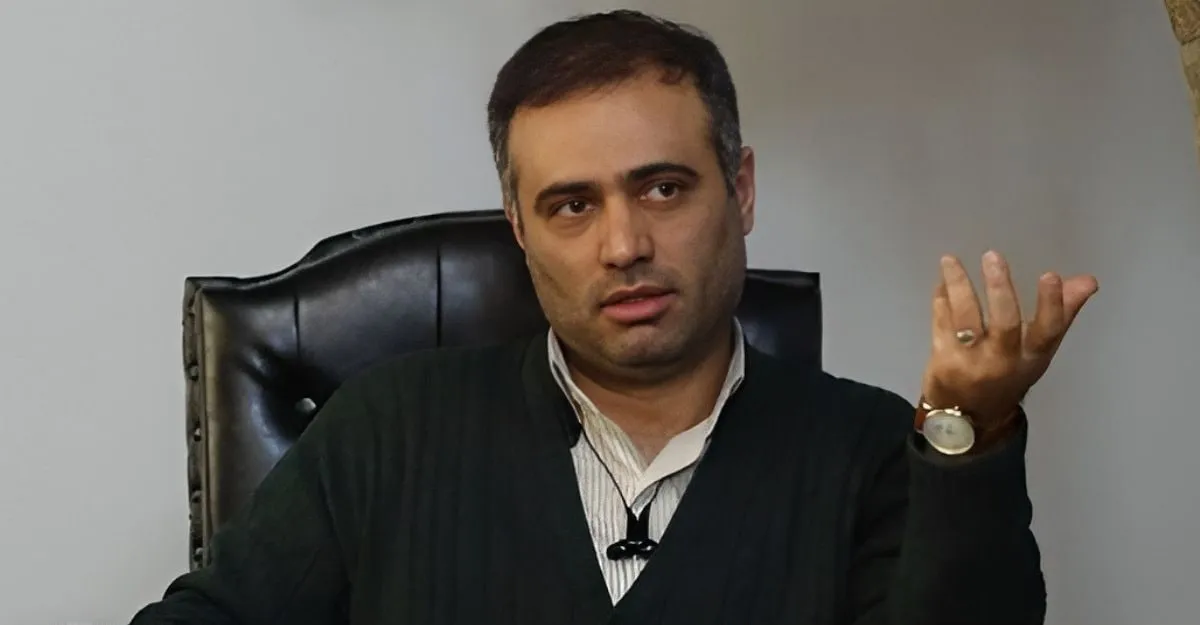
Amir Dabiri-Mehr—a political science researcher, author, and media analyst—is one of the prominent figures of the new generation of political thinkers in contemporary Iran, who advances the link between academic theory and applied analysis through the "Kherad Think Tank." His intellectual project is built upon three pillars: democracy, wise governance, and security. In this piece, our media platform, alongside a comprehensive anatomy of his career, written works, and critical stances regarding the state broadcaster (IRIB), republishes and analyzes for the first time the exclusive podcast interview with Dr. Dabiri-Mehr titled "Iranian Elections from Crisis to Ideal: The Battle of Security, Participation, and Competition." This dialogue moves precisely on the boundary between his theoretical concerns regarding the role of public votes and the current political realities of Iran.
Who is Amir Dabiri-Mehr?
Dr. Amir Dabiri-Mehr—born in 1977 in Tehran—is an Iranian political science researcher, author, media and political analyst, academic faculty member, and the CEO of the Andisheh va Qalam Research Institute (Kherad Think Tank). He stands as one of the prominent figures of the new generation of political science thinkers and cultural-media experts in contemporary Iran. Over nearly three decades of cultural, social, political, and media activity beginning in 1995, Dabiri-Mehr has leveraged a solid academic foundation in political science, an extensive output of intellectual content (including hundreds of articles and several research books), and a consistent presence in public analysis to become an intellectual reference point in the fields of religion and democracy, governance, media, and security.
The significance of Amir Dabiri-Mehr in Iran's intellectual and media landscape can be examined through several lenses:
The Islam and Democracy Research Project: His research on the relationship between Islam and democracy in Iran—epitomized in his landmark book, Islam and Democracy in Iran: A Study on the History of Disputes Between Jurists and Intellectuals Regarding the Role of Public Votes in Governance—serves as a serious intervention in one of the most enduring and controversial debates in contemporary Iranian political thought. In this work, Dabiri-Mehr synthesizes and analyzes the views of thinkers from vastly opposing spectrums within a single analytical framework.
A Multi-Faceted Intellectual Synthesis: His broader intellectual project spanning religion, politics, media, and security is structurally formulated across his four core books: Islam and Democracy in Iran, Molk-e Soltani va Negin-e Soleymani, Kheradmandi va Parsayi, and Farzangi va Jahandari. Together, they present a multi-dimensional conceptual project tailored to contemporary Iran.
A Reference Point for Analytical Media: His consistent, analytical media presence—especially during pivotal regional conflicts, economic sanctions, and structural challenges facing the state broadcaster—has established him as a prominent reference analyst for moderate and reformist media outlets, including Ensaf News and its affiliates.
Currently, alongside leading the Kherad Think Tank (operating via dabirimehr.ir), Dabiri-Mehr serves as a university lecturer and faculty member. His career across academia, book authorship, and media analysis offers a portrait of a multi-dimensional political scientist focused on bridging the gap between political theory and practical analysis.
Early Life and Background
Amir Dabiri-Mehr was born in 1977 in the city of Tehran. He belongs to the specific generation raised in the immediate aftermath of the 1979 Islamic Revolution, spending his childhood and adolescence during the intense years of the Iran-Iraq War, the subsequent era of national reconstruction, and the eventual Reform Era of the late 1990s.
Being born in Tehran just a year prior to the revolution allowed Dabiri-Mehr’s personal development to parallel the evolution of the first post-revolutionary generation—a demographic that found itself at the epicenter of the cultural-political shifts following the late 1990s intellectual and social movements.
In describing his own professional trajectory, Dabiri-Mehr notes that he initiated his activities in cultural, social, political, and media domains in 1995 at the age of 18. This early entry into public and intellectual engagement expanded in the following years into formal academic specialization and extensive text publication.
Academic Education
Dabiri-Mehr pursued his higher education in the discipline of political science, ultimately obtaining a PhD. As an academic field situated at the crossroads of political theory, political philosophy, international relations, and political sociology, this discipline equipped him with a structured framework for analyzing the complex links between power, state, society, and culture.
This academic background heavily informed his written works, particularly his extensive analysis of Iranian political thought. His methodology is characterized by an ability to dissect the views of diametrically opposed thinkers—ranging from traditional clergy to secular intellectuals, and from jurists supporting absolute governance to their critics—without relying on factional bias.
Andisheh va Qalam Institute (Kherad Think Tank)
A central institutional pillar of Dabiri-Mehr's career is his founding and management of the Andisheh va Qalam Research Institute, widely recognized in public and media circles as the Kherad Think Tank. Operating in the fields of culture, society, and politics, the institute utilizes its official platform at dabirimehr.ir—subtitled Kherad Think Tank; Andisheh va Qalam Research Group—to publish the analytical papers, essays, and research projects generated by Dabiri-Mehr and his colleagues.
Under the guiding theme of "The Writings and Reflections of Amir Dabiri-Mehr (On Culture, Society, and Politics)," the Kherad Think Tank serves as an intellectual hub where strategic analyses, critical commentaries, and academic inquiries are systematically archived. Over the past two decades, this platform has become a primary repository of his work for Iran's intellectual community. Within the institute, Dabiri-Mehr occupies multiple strategic roles, being variously credited as the Head of the Research Group, the CEO of the Institute, and the Editor-in-Chief of the Kherad Think Tank website.
Written Works and Books
Throughout his research career, Amir Dabiri-Mehr has authored four primary volumes, each exploring a distinct dimension of his overarching intellectual project:
1. Islam and Democracy in Iran
Subtitled A Study on the History of Disputes Between Jurists and Intellectuals Regarding the Role of Public Votes in Governance, this stands as Dabiri-Mehr's most prominent work. The book is structurally organized into an introduction and three separate volumes:
Volume I: Examines the historical friction and practical confrontation between Islam and democracy in Iran, offering a theoretical overview of basic concepts and the two diverging approaches to Islamic political thought. Within this volume, he analyzes the views of a wide array of figures, including Sheikh Fazlollah Nouri, Seyyed Hossein Nasr, Mohammad-Taqi Mesbah-Yazdi, Hatam Qaderi, Javad Tabatabai, Mirza Mohammad-Hossein Naini, Morteza Motahhari, Ali Shariati, Abdolkarim Soroush, and Mohsen Kadivar.
Volume III: Focuses on the variables influencing the compatibility or incompatibility of Islam and democracy in Iran, mapping out the spectrum of supporting and opposing thinkers, and offering conceptual recommendations to resolve the theoretical crises undergirding this relationship in practice.
The text is regarded as one of the more comprehensive and balanced contemporary Persian-language studies on the subject, largely due to its method of examining a full spectrum of opposing and supporting ideologies within a singular, non-partisan analytical framework.
2. Molk-e Soltani va Negin-e Soleymani: Essays on Media, Politics, and Security
Using a symbolic title referencing the two dimensions of power in Eastern tradition—Molk-e Soltani (temporal/political power) and Negin-e Soleymani (spiritual wisdom and authority)—this book explores the structural intersections of media, politics, and state security. Written in the context of rapid technological evolution and the expanding influence of media over political systems, it offers a theoretical look at modern media and security dynamics.
3. Kheradmandi va Parsayi: Reflections on the Links Between Religion, Politics, and Society
Focusing on two classical virtues—Kheradmandi (Wisdom in the socio-political sphere) and Parsayi (Piety in the moral-religious sphere)—this volume investigates the structural ties binding faith, governance, and public life. The terminology, drawn from traditional Persian-Islamic thought, reflects Dabiri-Mehr's approach of addressing modern socio-political questions within a classic intellectual framework.
4. Farzangi va Jahandari
This volume is dedicated to the study of governance, statecraft, and wisdom in politics. Continuing the trajectory of his previous two books, it explores political philosophy and political ethics. The title, Farzangi va Jahandari (Wisdom and World Governance), invokes the classical Persian ideal of the "philosopher-king" and the concept of the wise ruler found throughout classical literature.
Hundreds of Research Articles
Beyond his four foundational books, Dabiri-Mehr has penned hundreds of analytical essays, articles, and commentaries addressing politics, culture, and society. Frequently published on the Kherad Think Tank platform and various national media outlets, this large volume of writing makes him one of the highly active political science commentators of his generation in Iran.
Academic Activity and Faculty Role
Within the university sphere, Dabiri-Mehr operates as a faculty member and political science lecturer. This academic position allows him to complement his private research and writing with direct teaching and interaction with the new generation of political science students.
His lectures and academic notes often address broader comparative concepts—ranging from studying the developmental models of Malaysia as a successful example of progress in the Islamic world, to analyzing Karl Popper's critiques of democracy, alongside other foundational topics in classical political science.
Media and Analytical Stances
In recent years, Dabiri-Mehr has maintained a frequent presence across major Iranian analytical platforms, with his commentaries appearing regularly in outlets such as Ensaf News and Chand Saniyeh.
Critique of State Broadcasting (IRIB)
In a widely noted media intervention—published by Ensaf News following a regional "40-day war"—Dabiri-Mehr offered a sharp critique of the Islamic Republic of Iran Broadcasting’s (IRIB) wartime media strategy. During the interview, he stated:
"The senior managers of the state broadcaster suffer from a profound misunderstanding of the actual concept of the 'war of narratives'."
Dabiri-Mehr compared the IRIB’s media techniques to "announcing artificial prices to change the reality of the market," asserting that this strategic error led the broadcaster to abandon realistic, objective reporting rooted in audience trust and analytical intelligence. From his perspective, professional media standards dictate providing accurate narratives using effective tools while simultaneously reflecting diverse public viewpoints. His analysis argued that the gap between state media coverage and ground realities stems more from poor creative production choices rather than purely structural or technical limitations.
Emphasis on "Iran-Inclusiveness" (Iran-Shomouli)
In the same critique, Dabiri-Mehr called for fundamental adjustments at the managerial level of the state broadcaster, arguing:
"This organization must move toward 'Iran-inclusiveness,' reflecting all domestic viewpoints and securing the broader national interest. The national media must represent all social preferences within society rather than a singular, insulated viewpoint, because Iranian society is inherently pluralistic, and diverse perspectives exist even on critical issues like war."
This stance, framed around the concepts of media pluralism and broad inclusivity, highlights his reformist approach to media policy and public communication.
Frequently Asked Questions (FAQs)
Who is Amir Dabiri-Mehr? Dr. Amir Dabiri-Mehr (born 1977 in Tehran) is an Iranian political science researcher, author, faculty member, and media analyst. He serves as the CEO of the Andisheh va Qalam Research Institute, commonly known as the Kherad Think Tank. Active in public intellectual circles since 1995, he has produced hundreds of articles and four major books focusing on political philosophy, media policy, and governance.
What are his most prominent books? Dabiri-Mehr has authored four primary volumes: Islam and Democracy in Iran: A Study on the History of Disputes Between Jurists and Intellectuals Regarding the Role of Public Votes in Governance (his flagship research work); Molk-e Soltani va Negin-e Soleymani (essays exploring media, politics, and security); Kheradmandi va Parsayi (reflections on religion, politics, and society); and Farzangi va Jahandari (focusing on wise statecraft).
What is the Kherad Think Tank? The Kherad Think Tank (Andisheh va Qalam Research Group) is an independent analytical institute focusing on culture, society, and politics. Directed by Dabiri-Mehr, the institute uses its official platform, dabirimehr.ir, to regularly publish strategic insights, public notes, and academic papers generated by its research staff.
What is the core argument of his book Islam and Democracy in Iran? The book tracks a century of intense intellectual debates between traditional Islamic jurists and modern intellectuals regarding the legitimacy of public votes and popular sovereignty in governance. It systematically analyzes opposing viewpoints—from Sheikh Fazlollah Nouri and Mesbah-Yazdi to Abdolkarim Soroush and Mohsen Kadivar—within a single framework to evaluate the variables affecting the compatibility of faith and democracy.
What is his critique regarding the IRIB (State Broadcasting)? Dabiri-Mehr is a vocal critic of the IRIB's communication strategies during major national and regional crises. He argues that its leadership misunderstands the nature of modern media narratives, often discarding objective reporting at the expense of audience trust. He advocates for structural reforms to make the broadcaster "Iran-inclusive," meaning it should represent the diverse spectrum of the entire population rather than a singular faction.
How is his professional work structurally organized? He operates simultaneously across three distinct spheres: institutionally as the head of the Kherad Think Tank; academically as a university faculty member and political science lecturer; and publicly as a regular analytical contributor to prominent independent media outlets like Ensaf News and Chand Saniyeh.
Take less than a minute, register and share your opinion under this post.
Insulting or inciting messages will be deleted.
Sign Up