
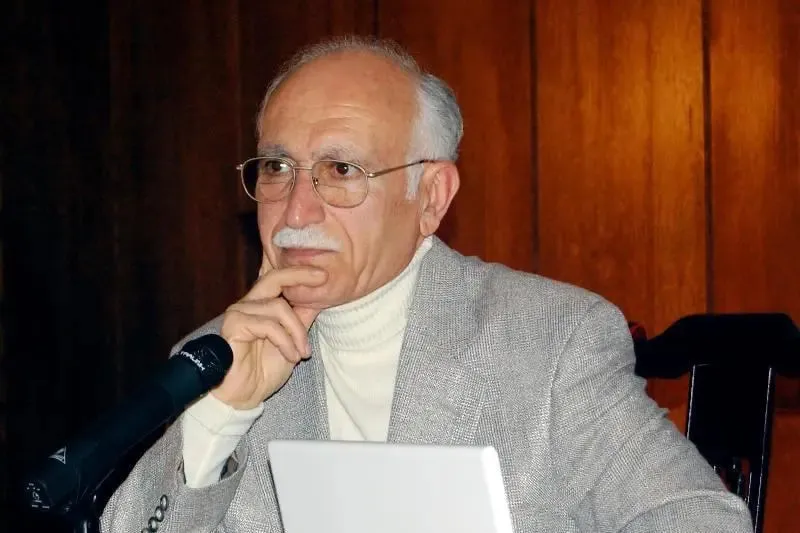
Abdolali Bazargan is a journalist, writer, Quran researcher, architect, and Iranian political activist residing in the United States. He is one of the most widely discussed and multifaceted figures of the religious intellectual current and the Freedom Movement of Iran over the past six decades. As the second son of Mehdi Bazargan, he has pursued a unique path throughout his career: from membership in the Central Council of the Freedom Movement of Iran and editorship of the newspaper Mizan in 1979, to several imprisonments during the Pahlavi era and the Islamic Republic, to his emigration to the United States in the early 2000s, and finally, to the production of the notable series Nazm-e Quran. A member of the Board of Directors of the Mehdi Bazargan Cultural Foundation since 1996, Bazargan has become one of the main references of modernist Quranic studies in the Persian-speaking diaspora through his approach of reconciling religion and modernity and emphasizing a "return to the Quran."
Who is Abdolali Bazargan?
Abdolali Bazargan (born August 13, 1943, in Tehran) is a journalist, writer, Quran researcher, architect, and Iranian political activist residing in the United States. He is one of the most widely discussed and, at the same time, multifaceted figures of the religious intellectual current and the Freedom Movement of Iran over the past six decades. Bazargan, with a unique path—from a prominent family background as the second of five children of Mehdi Bazargan, to his architectural engineering education, to membership in the Central Council and Political Bureau of the Freedom Movement of Iran from 1976, to editorship of the newspaper Mizan in 1979, to several imprisonments during the Pahlavi era and the Islamic Republic, to his emigration to the United States in the early 2000s, and finally, to his establishment as one of the most prominent contemporary Persian-language Quran researchers—has become one of the most cited figures in the discourse of religious intellectualism and the reconciliation of religion and modernity. Bazargan, through his notable series Nazm-e Quran and other works, has become a main reference in this field, and in recent years has been among the most prominent critical figures of the Islamic Republic's structure.
The importance of Abdolali Bazargan in Iran's contemporary intellectual-political sphere can be examined from several angles. First, his unique family background—as the son of Mehdi Bazargan, a figure who is among the founders of the Freedom Movement of Iran, the first Prime Minister of the provisional government after the Islamic Revolution, and one of the most prominent figures of religious-political intellectualism in 20th-century Iran—which forms the foundation of his political-intellectual identity. Second, his exceptional ability to combine different fields—including architectural engineering, journalism, Quran research, political activism, and cultural activity—which makes him one of the few multifaceted figures active in the Persian-speaking religious intellectual sphere. Third, his pioneering contribution to modernist Quranic studies—reflected in his notable works such as the Nazm-e Quran series, in which an analytical, simple, and contemporary approach to understanding Quranic verses is presented. Fourth, his notable persistence in activism despite several imprisonments—which, during the Pahlavi era and the Islamic Republic, have been accompanied by multiple judicial convictions. Fifth, his prominent position in the Persian-speaking religious intellectual discourse of the diaspora—through years of activity in America, the production of Quranic research content for interested Iranians, and the legacy of his father's tradition—which places him among the most central figures in this field.
However, there are different views of Abdolali Bazargan. Media close to the principlist movement have criticized him for "presenting interpretations aligned with Western cultural teachings of Islamic and Shia concepts." In contrast, media close to the religious intellectual current have praised him as the "heir to the return to the Quran."
Important Note: This profile reports the narratives published in media and official sources. The differing views surrounding Bazargan's intellectual framework—from various intellectual currents—are one of the debated aspects of contemporary Persian-speaking religious intellectual discourse.
Life and Background
Abdolali Bazargan was born on August 13, 1943, in Tehran. Born in the mid-1940s, Bazargan belongs to a generation that came of age during the events of the 1953 coup and began his political-intellectual activities in his youth in the tense pre-revolution atmosphere.
Family
Abdolali Bazargan is the second of five children of Mehdi Bazargan—an engineer, religious intellectual, political activist, professor at the University of Tehran, and the first Prime Minister of the provisional government after the victory of the 1979 Islamic Revolution. Mehdi Bazargan, who is among the prominent founders of the Freedom Movement of Iran and one of the most cited figures of 20th-century Iranian religious-political intellectualism, formed the foundation of Abdolali's later political-intellectual identity.
Abdolali Bazargan is married and has three children.
Education
Bazargan holds a Master's degree in Architecture from the National University of Iran (now Shahid Beheshti University). This technical-engineering background formed the foundation of his early professional activities in the field of architectural engineering.
Student Activity
During his studies at the National University of Iran, Bazargan was among the founding members of the Islamic Students' Association of the National University of Iran from 1962 to 1969—an experience that formed the foundation of his early entry into political-student activism.
Professional Activity in Architectural Engineering
After completing his education, Bazargan began his professional career as an architect. Over the decades, he has participated in the design, supervision, and execution of numerous construction projects and has been active in various prominent institutions:
The Industrial Foundation of Iran.
Engineering consulting firms such as Barmak, Razi, Yad, Tareh, and Kavosh.
This prominent professional experience, which stands in contrast to many Persian-speaking religious intellectual figures, is one of the notable aspects of his multifaceted identity.
Pre-Revolution Political Activity
The central chapter of the beginning of Bazargan's political activism was his joining the Freedom Movement of Iran.
The Freedom Movement of Iran
From 1976, Bazargan became a member of the Central Council and Political Bureau of the Freedom Movement of Iran—a position that is among his most prominent institutional roles in one of Iran's oldest national-religious parties.
The Movement of Militant Muslims
Between 1977 and 1978, Bazargan was also a member of the Central Council of the Movement of Militant Muslims and was involved in the group producing its publications—an organization that was considered among the prominent Islamic-revolutionary currents before the revolution.
1973 Arrest
In 1973, Bazargan was imprisoned for four months due to a conviction by the Army Prosecutor's Office—his first judicial experience.
After the 1979 Revolution
Editorship of the Newspaper "Mizan" (1979)
After the victory of the Islamic Revolution, Bazargan served as the editor-in-chief of the newspaper Mizan, the organ of the Freedom Movement of Iran, in 1979. This newspaper, which was considered one of the most prominent media outlets of the Freedom Movement after the revolution, was one of the main platforms of post-revolutionary national-religious discourse.
Tension with the New Structure
After the revolution, the Freedom Movement—which had played a central role in the provisional government led by Mehdi Bazargan—gradually came into tension with the official structure of the Islamic Republic. Abdolali Bazargan, as one of the most prominent figures of this movement, faced the judicial consequences of this tension several times over the following decades.
Post-Revolution Arrests
Arrest 1986-1989
From 1986 to 1989, Bazargan was arrested for his membership in the Society for the Defense of Freedom and the Sovereignty of the Iranian Nation—a tense period that occurred in the atmosphere of the end of the Iran-Iraq war.
Arrest 1990-1991
Following this period, Bazargan experienced a two-year prison sentence in the Revolutionary Court.
Arrest 2009
After the 2009 presidential election and following the consequences of the election results and the Green Movement protests, Bazargan once again faced judicial restrictions.
Emigration to the United States
In the early 2000s, Bazargan emigrated to the United States. According to published accounts, the reason for this emigration was "not for leisure or escape from Iran, but to achieve a freer environment in which he could expand his cultural and religious activities and convey his message to interested Iranians." According to sources close to him, "Bazargan was forced to emigrate due to the constriction of his freedoms in Iran."
Since his emigration, Bazargan has continued his sustained intellectual-interpretive activity as one of the most prominent figures of Persian-speaking religious intellectualism in the diaspora.
The Quarterly "Fara Rah"
In 2001, Bazargan served as the owner and managing director of the quarterly Fara Rah—a publication that was considered among the prominent media outlets of the Persian-speaking religious intellectual current.
Activity in the Mehdi Bazargan Cultural Foundation
Since 1996, Bazargan has been a member of the Board of Directors of the Mehdi Bazargan Cultural Foundation—an institution established to preserve and expand his father's intellectual legacy and one of the prominent centers of Persian-speaking religious intellectual discourse.
Prominent Quranic Research Works
The central chapter of Bazargan's intellectual-publishing career is his Quranic research works.
"Nazm-e Quran"
Bazargan's most widely discussed work is the multi-volume series Nazm-e Quran (Qalam Publishing). This work, in which "an innovative and contemporary interpretation of the Holy Quran with an analytical and simple language" is presented, is considered one of the most prominent contemporary Persian interpretations of the Quran. According to the publisher's description, "Bazargan has attempted to express the meanings and deep concepts of the Quran in a way that is understandable and relevant to modern life, using traditional interpretations and new studies. This work, emphasizing the educational, social, and moral aspects of the verses, helps readers find a stronger connection with Quranic teachings."
Video Quranic Interpretation on YouTube
In addition to Nazm-e Quran, Bazargan has published a complete interpretation of the Quran in video format on his YouTube channel—a collection that is considered among the most prominent Persian-language digital Quranic research works.
Other Quranic Research Works
Among Bazargan's other important Quranic research works are:
An Introduction to Freedom in the Quran.
Memories of Pioneers.
Intellectual Framework
Throughout his intellectual-political career, Abdolali Bazargan has formulated a clear intellectual framework.
Listen | The Truth of Religion and Faith - Program "Parto-ye Noor" 220 with Engineer Abdolali Bazargan.
Listen without filter on the Abdi Media Castbox.
Religious Intellectualism
Bazargan's most central intellectual framework is religious intellectualism as a way of life. In the view of those close to him, "his striking resemblance to his father reveals the multidimensionality of his character." This framework, in which economic activity as an architect, political activity as a member of the Freedom Movement, and intellectual activity as a Quran researcher are connected, is one of the notable aspects of his identity.
Reconciliation of Religion and Modernity
Bazargan is among the most prominent figures of the current of reconciliation of religion and modernity in Persian. This framework, rooted in the tradition of his father Mehdi Bazargan, is widely reflected in his Quranic research works.
Return to the Quran
According to Hassan Yousefi Eshkevari, "Bazargan is the heir to the return to the Quran." This framework, in which the Quran is introduced as the primary source of understanding Islam, is one of the notable aspects of his intellectual approach.
Defense of the National-Religious Tradition
Throughout his intellectual-political career, Bazargan has consistently defended the national-religious tradition—represented in figures such as his father Mehdi Bazargan, Yadollah Sahabi, Ayatollah Taleghani, and Sadr Hajj Seyyed Javadi.
Advocacy for a Peaceful Approach
In one of his notable positions, Bazargan stated that "the Freedom Movement was not at all a revolutionary organization"—a position in which the Freedom Movement's sustained commitment to a reformist and peaceful approach is highlighted. In this framework, Bazargan refers to the role of his father Mehdi Bazargan and Ebrahim Yazdi in preventing early post-revolutionary executions.
Brain Condition in 2020
On July 25, 2020, Bazargan suffered a brain condition after a lengthy speech on the occasion of the "Hajj days" and underwent successful surgery that same day. Following this event, according to a statement by the Freedom Movement of Iran, Bazargan was placed under medical care in the intensive care unit of a hospital in his place of residence and later recovered.
Connections with Figures and Currents
Abdolali Bazargan is situated within a network of intellectual-political connections with prominent figures of the national-religious and religious intellectual current in Persian.
Intellectual Family
Bazargan's most central intellectual connection is with Mehdi Bazargan, which formed the foundation of his intellectual-political identity.
National-Religious Network
At the national-religious level, Bazargan's relationship with prominent figures such as Yadollah Sahabi, Ayatollah Taleghani, Sadr Hajj Seyyed Javadi, Ezzatollah Sahabi, Ebrahim Yazdi, and other prominent figures of this current formed his close intellectual-political network.
The Freedom Movement
At the party level, Bazargan's sustained relationship with the Freedom Movement of Iran and its current prominent figures forms his institutional network.
Religious Intellectualism
At the religious intellectual level, Bazargan's relationship with Hassan Yousefi Eshkevari, Nader Marzban, Seyyed Ali Asghar Gharavi, Mehdi Nourbakhsh, and other prominent figures of this current forms his close intellectual network.
Diaspora
At the diaspora level, Bazargan's relationship with the extensive network of Iranians residing in America and Persian-language media abroad forms his international communications network.
Conclusion
Abdolali Bazargan is one of the most widely discussed and multifaceted figures of the religious intellectual current and the Freedom Movement of Iran over the past six decades. With a unique combination of a prominent family background as the second of five children of Mehdi Bazargan, an architectural engineering education, prominent professional activity in the field of architectural engineering, membership in the Central Council and Political Bureau of the Freedom Movement of Iran from 1976, editorship of the newspaper Mizan in 1979, several imprisonments during the Pahlavi era and the Islamic Republic, emigration to the United States in the early 2000s, the production of prominent Quranic research works, the publication of other notable works, ownership and management of the quarterly Fara Rah, and sustained membership on the Board of Directors of the Mehdi Bazargan Cultural Foundation since 1996, he occupies a unique position in the intellectual-political structure of Persian-speaking religious intellectualism.
Bazargan's distinguishing feature, on the first level, is his exceptional ability to combine different fields—an ability in which a thinker consistently works in the fields of architectural engineering, journalism, Quran research, political activism, and cultural activity. This multidimensionality, which has other examples among Persian-speaking religious intellectuals, has found a special reflection in Bazargan through his unique family background. On the second level, his pioneering contribution to modernist Quranic studies—reflected in the notable series Nazm-e Quran—is one of his most widely discussed legacies. On the third level, his notable persistence in activism despite numerous prison experiences—reflected during the Pahlavi era and the Islamic Republic—is one of the notable aspects of his character.
From an analytical perspective, Bazargan's position exemplifies the phenomenon of the "religious intellectual-engineer-Quran researcher-political activist" in contemporary Iran—a phenomenon in which a thinker with a distinguished academic background, over decades, plays a sustained role in various intellectual, professional, media, and political arenas. This pattern, which has other examples among Persian-speaking religious intellectuals, has found a special reflection in Abdolali Bazargan through his direct legacy from one of the most prominent figures of 20th-century Iranian religious intellectualism and his pioneering contribution to modernist Quranic studies.
What is clear from today's perspective is that the topics Bazargan has addressed in his works and positions—from modernist and contemporary interpretation of the Quran, freedom in the Quran, reconciliation of religion and modernity, religious intellectualism as a way of life, critique of the Islamic Republic's structure, defense of the national-religious tradition, a peaceful reformist approach, and the legacy of his father Mehdi Bazargan's tradition—remain among the most debated topics in contemporary Persian-speaking religious-political intellectual discourse. In a situation where Iran is in one of its most tense periods of religious-philosophical discourse—particularly after the 2022 uprising, the 12-day Iran-Israel war in June 2025, and increasing identity-religious challenges—Bazargan's analytical-interpretive voice, with a combination of prominent historical family credibility, distinctive Quranic research background, and courageous persistence in expressing his positions, is one of the main references for this discourse in Persian-language diaspora media.
Frequently Asked Questions
Who is Abdolali Bazargan?
Abdolali Bazargan (born August 13, 1943, in Tehran) is a journalist, writer, Quran researcher, architect, and Iranian political activist residing in the United States. He is the second of five children of Mehdi Bazargan and a prominent member of the Freedom Movement of Iran.
What is Abdolali Bazargan's educational background?
Bazargan holds a Master's degree in Architecture from the National University of Iran (now Shahid Beheshti University).
What is his relationship to Mehdi Bazargan?
Abdolali Bazargan is the second of five children of Mehdi Bazargan.
What are Bazargan's political backgrounds?
Among Bazargan's most important political backgrounds are: founding member of the Islamic Students' Association of the National University of Iran, membership in the Central Council and Political Bureau of the Freedom Movement of Iran from 1976, membership in the Central Council of the Movement of Militant Muslims, membership in the Society for the Defense of Freedom and the Sovereignty of the Iranian Nation, and membership on the Board of Directors of the Mehdi Bazargan Cultural Foundation since 1996.
What are Bazargan's media backgrounds?
Bazargan served as the editor-in-chief of the newspaper Mizan in 1979 and as the owner and managing director of the quarterly Fara Rah in 2001.
What were Bazargan's arrests?
Bazargan had several prison experiences: 4 months in prison in 1973, arrest from 1986 to 1989, and a 2-year prison sentence from 1990 to 1991. In 2009, he also faced judicial restrictions.
Why did Bazargan emigrate to the United States?
In the early 2000s, Bazargan emigrated to the United States. According to sources close to him, the reason for his emigration was "not for leisure or escape from Iran, but to achieve a freer environment for the expansion of cultural and religious activities" and due to "the constriction of his freedoms in Iran."
What are Bazargan's most important works?
Bazargan's most widely discussed work is the multi-volume series Nazm-e Quran. Among his other notable works are An Introduction to Freedom in the Quran and Memories of Pioneers. He has also published a complete interpretation of the Quran in video format on his YouTube channel.
What is Bazargan's intellectual framework?
Bazargan's most central intellectual framework is religious intellectualism, the reconciliation of religion and modernity, and the return to the Quran. According to Hassan Yousefi Eshkevari, "Bazargan is the heir to the return to the Quran."
What is Bazargan's view on the Freedom Movement?
Bazargan has stated that "the Freedom Movement was not at all a revolutionary organization"—a position in which the Freedom Movement's sustained commitment to a reformist and peaceful approach is highlighted.
Is Abdolali Bazargan still active?
Yes, Abdolali Bazargan, as one of the most prominent Persian-speaking religious intellectual figures residing in America, remains active in the intellectual-interpretive arena. His consistent presence on his YouTube channel with a complete interpretation of the Quran, the publication of new volumes of the Nazm-e Quran series, and his activity in intellectual circles of Iranians residing in America are signs of his sustained activity. Despite his brain condition in 2020, Bazargan remains one of the most widely discussed figures of Persian-speaking religious-political intellectualism in the diaspora. His analytical positions on contemporary Quranic interpretation, the reconciliation of religion and modernity, critique of the Islamic Republic's structure, and the legacy of the national-religious tradition continue to receive widespread coverage in Persian-language media.
Take less than a minute, register and share your opinion under this post.
Insulting or inciting messages will be deleted.
Sign Up